Get in Touch with GUANGQI



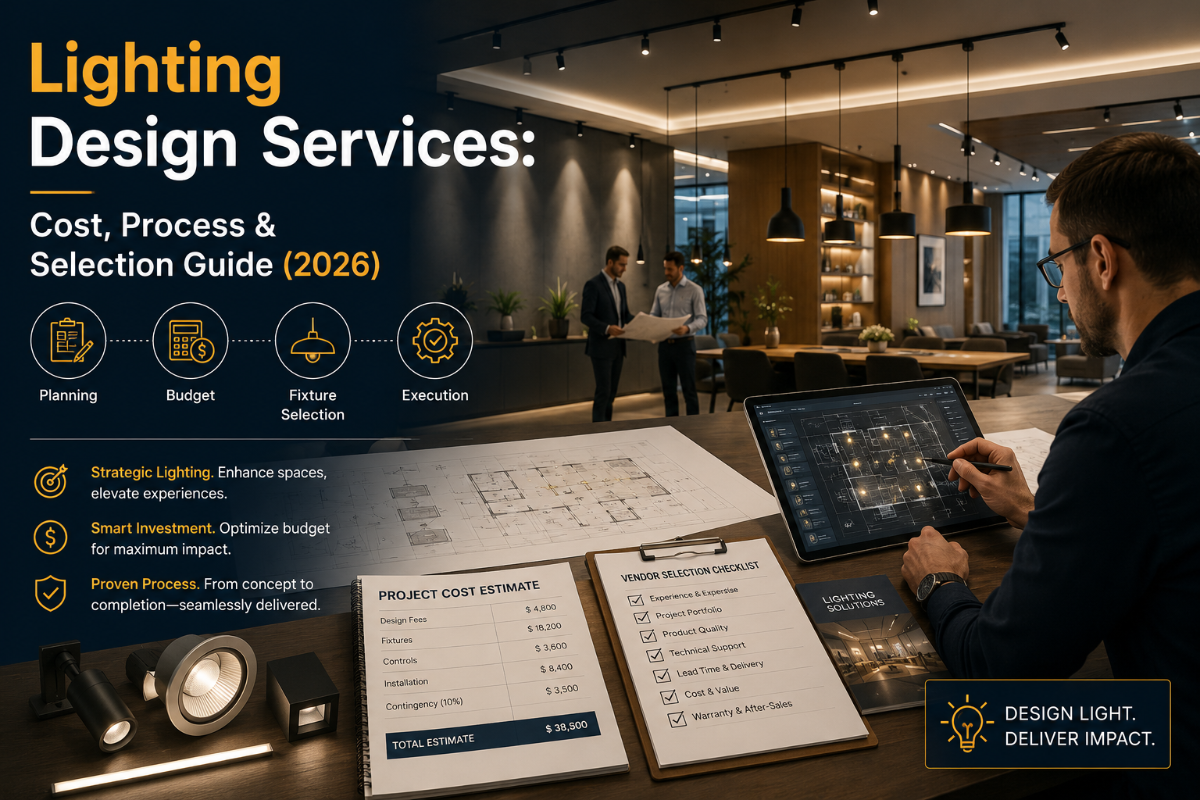
Lighting Design Services: The Complete 2026 Guide to Cost, Process & Choosing a DesignerProfessional lighting design services turn rough architectural intent into a defensible photometric plan, a fixture bill of materials, and a control system that survives building inspection. This guide explains what a lighting design service actually delivers, how the 5-phase process unfolds, what designers cost in 2026 (with concrete hourly and per-project ranges from ProMatcher and CADCrowd), the four canonical lighting layers, the certifications that matter (IALD, NCQLP-LC, ALA), and a decision framework for hire-versus-DIY. If your scope is specifically commercial outdoor work, our sibling page on commercial landscape lighting design services goes deeper on the procurement side.
What Are Lighting Design Services? (Definition & Scope)

A lighting design service is the engineering and creative practice of specifying how artificial light interacts with a built environment — interior, exterior, architectural, or landscape — to meet performance, safety, and aesthetic targets. Unlike fixture sales, a lighting design service produces deliverables that an electrician can bid and an inspector can sign off on. Unlike interior decoration, the work is grounded in measurable photometric values (footcandles, lumens, color rendering index) and in industry standards published by the Illuminating Engineering Society and equivalent bodies abroad.
A complete service project, regardless of provider, usually entails a consistent set of artifacts that supply a project from intent through to installed performance.
Quick Specs: What a Lighting Design Service Delivers
| Concept package | Mood board, sample illumination references, scope brief |
| Photometric plan | Scaled CAD or Revit layout with calculated illuminance per zone |
| Fixture BOM | Bill of materials with model numbers, quantities, finishes, optics |
| Test & spec files | IES photometric files (.ies), LM-79 test reports, LM-80 LED data |
| Electrical engineering | Voltage drop calculation, transformer sizing, circuit grouping |
| Control diagram | Driver topology (0-10V / DALI / TRIAC), scene programming logic |
| Construction docs | Mounting details, shielding specs, commissioning checklist |
Six Categories of Lighting Design Services
Most buyers arrive looking for “a lighting design service” without a clear sense of which sub-discipline applies to their project. A single job title spans six recognizably different practices, each with its own deliverable depth and certification expectations.
- Interior lighting design services cover residential homes and commercial interiors (offices, retail, restaurants). Emphasis falls on layered illumination, color temperature scheduling, and integration with interior design intent. These services are often delivered through showroom-affiliated designers or independent firms.
- Architectural lighting design services address building facades, lobbies, structural illumination, and integrated luminous architecture. Designers in this discipline work tightly with architects and MEP engineers, and deliverables include Revit families integrated into the architectural model.
- Commercial landscape lighting design services serve outdoor environments for hospitality resorts, municipal plazas, developer mixed-use, and architectural grounds. This is where Guangqi Lighting concentrates its design and manufacturing work; for project scope and tier-based engagement detail see our dedicated commercial landscape lighting design services page.
- Hospitality lighting design services target hotels, resorts, bars, restaurants, and F&B venues. Strong emphasis sits on guest-experience scene programming, dimming schedules tied to time-of-day, and warm color temperatures (typically 2700K-3000K).
- Retail and signage lighting design services drive merchandise highlighting, brand identity through facade lighting, and point-of-sale focal accent. Color rendering index targets are aggressive (CRI ≥ 90 for apparel, R9 > 50 for skin tones in cosmetic retail).
- Broadcast and theatrical lighting design services apply to broadcast studios, sports arenas, theatrical productions, and live events. This is a specialized track tied to entertainment industry standards rather than architectural codes.
How the Lighting Design Process Works (5-Phase Workflow)
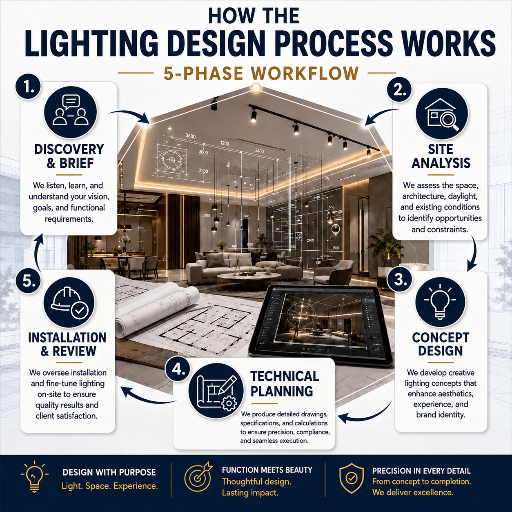
A professional lighting design service is a defined phased sequence of work steps adapted from architectural project lighting delivery, scaled to lighting-specific deliverables. There is a sign-off artifact at the end of each phase, and a client review opportunity at the end of each gate to reset scope before downstream cost accumulation.
What Is the Typical Process for Working With a Lighting Designer?
This five phased process is typical for most commercial lighting design engagements, although tier-based services (concept / standard / turnkey) variations during each phase can compress or further delineate the buy.
- Discovery and brief (1-2 weeks)- Kick-off, site walk-through, programmatic interviews with primary stakeholders. Deliverable: write-up of design brief including circulation schedules, daylight conditions, energy budget, control system concepts, and aesthetic direction.
- Concept design (2-3 weeks) – Mood board, photometric sketches for 2-4 focal zones, fixture-family recommendations, indicative beam spreads and color temperatures. Deliverable: mixed-media presentation deck for stakeholder approval prior to engineering effort commencing.
- Schematic design and photometric calculation (2-3 weeks) – Scaled CAD or Revit lighting plan with calculated illuminance per zone, modeled in Dialux Evo or AGi32 to IES recommendations. Deliverable: photometric plan with target illuminance overlays.
- design development (3-4 weeks) – Final fixture specification including model numbers, finishes, optics, drivers; integration with architectural and MEP coordination; low-voltage voltage drop calculation. Deliverable: fixture BOM with IES files, LM-79 reports, voltage drop spreadsheet, and control diagram.
- Construction documentation and commissioning support (2-4 weeks) – Mounting details, shielding specs, wire-routing diagrams, scene programming worksheets, on-site commissioning checklist. Deliverable: bid-ready documentation set plus designer site-visit at installation handover.
A typical mid-size commercial project comprises 10-16 weeks from kick-off to commissioning support, not including time to produce the specified fixtures. Custom-molded fixtures involves an additional 5-10 weeks for tooling.
How Much Do Lighting Design Services Cost in 2026?
Pricing for a lighting design service is one of the industry’s least transparent practices. Predominantly quotations are obtained for per project buy, while little industry transparency exists for published flat fee pricing. Statistically, the spread between the cheapest showroom consultation and the most experienced independently-certified designer is genuinely wide. However, below the chart are averaged third-party industry estimates plus practitioner self-disclosure on forums.
How Much Does a Lighting Designer Cost?
Hourly billing is the dominant model for consultations and small-scope work. Per-project flat fees apply once scope and deliverable depth are pinned down. Both numbers shift with experience tier, geographic market, and whether the designer carries a recognized certification.
| Engagement Tier | Hourly Range | Per-Project Range | Source |
|---|---|---|---|
| Showroom-affiliated consultation | Often free with fixture purchase | $0-$500 (rebated against orders) | Lightology, Visual Comfort, Lamps Plus model |
| Standard professional consultation | $50-$85/hr | $150-$500 basic plan | Dominion Lighting, Coohom benchmarks |
| Mid-tier residential / small commercial | $80-$100/hr | $1,000-$5,000 full-room or single-floor | ProMatcher avg ($89.23/hr interior) |
| Experienced independent designer | $125-$250/hr | $5,000-$15,000 multi-zone | Dominion Lighting senior tier |
| Architectural lighting plan (CDs & spec) | N/A (project-priced) | $4,300-$7,100 ($5,050-$6,120 avg) | CADCrowd architectural lighting plan benchmark |
| Production / broadcast LD day-rate | N/A | $1,200/day typical | Practitioner self-disclosure on r/lightingdesign |
Five factors actually drive the spread within these ranges. Project scope (room count and zone count) sits at the top. Fixture count follows — more fixtures means more individual specification work, more BOM line items, and more photometric modeling effort. Custom fixture engineering (your aesthetic on the designer’s molds) adds tooling cost amortized into per-unit pricing. Certification scope matters: a project that needs UL/ETL/DLC for North America or a DarkSky Approved submission requires extra paperwork and review cycles. Logistics scope (FOB factory versus full DDP delivery) accounts for the rest.
⚠ Watch out:
A “free” design service from a showroom is rarely free in the strict sense — the cost is built into fixture markup. For multi-room residential or any commercial scope, an independent designer billing transparently at $80-$150/hr typically delivers a tighter BOM and saves 15-25% on fixture spend versus a showroom-bundled package, even after the fee.
For commercial outdoor projects with combined design plus fixture supply needs, a single-source manufacturer-direct engagement removes the design-versus-supply markup entirely. Get a quote for our commercial landscape lighting design services with combined fixture supply.
The Four Layers of Lighting (Foundation Concept)
Every defensible lighting plan layers four functionally distinct kinds of light in a single space. The four-layer model is the framework most professional designers use to brief clients and to audit their own work.
- Ambient lighting provides the general fill that defines overall illuminance level for a space. Sources include recessed downlights, surface-mounted ceiling fixtures, cove lighting, and pendant arrays. This layer sets the baseline footcandle target on which every other lighting solution depends.
- Task lighting delivers focused illumination on a specific work surface or activity zone. Kitchen counter under-cabinet, desk lamps, vanity sconces, and reading sconces all serve this layer. Typical task-plane illuminance runs 3-5x ambient.
- Accent lighting uses directional light to highlight a specific architectural element, artwork, sculpture, or material texture. Track heads, recessed adjustable, picture lights, and gallery uplighters are all common accent fixture types.
- Decorative lighting treats the light as a design object, where the fixture itself is intended to be seen and admired. Statement chandeliers, architectural sconces, and sculptural pendants live here. This layer adds character without necessarily adding measurable illuminance.
Three layers (ambient + task + accent) is the older taught model from Illuminating Engineering Society educational materials; adding decorative as a discrete fourth layer is now standard practice in residential and hospitality work where the fixture aesthetic is itself a design statement.
What Is the 5/7 Light Rule?
⚠ Common myth:
There is no documented “5/7 light rule” in IES, IALD, ASHRAE, or any other recognized lighting standards body. The phrase circulates in Reddit threads and YouTube design-tips videos but has no canonical source. It is sometimes a colloquial reference to a 5-7 footcandle target for entry zones, but that is a single illuminance value, not a “rule” of design.
Real industry references are illuminance targets published by IES and adopted by ANSI/IES RP-33 and similar standards. Useful values for commercial pedestrian environments include 1-3 footcandles for walkways, 0.5-2 footcandles for parking areas, 5-10 footcandles for entry transitions, 30-50 footcandles for kitchen task zones, and 50-100 footcandles for office work surfaces. Color temperature guidance follows: 2700K for hospitality warmth, 3000K for residential warm, 3500-4000K for office and retail, 5000K and above for task-critical environments where color discrimination matters most.
Tools & Deliverables in a Professional Lighting Design Service

A lighting designer’s toolchain reveals their level of rigor. Showroom-tier services run on PDFs and photo overlays; specifier-grade services run on integrated photometric software with file deliverables an architect can drop into a Revit model.
Common professional software includes Autodesk Revit (with MEP integration for architectural coordination), Dialux Evo (the dominant photometric calculation tool in Europe and Asia), AGi32 (the dominant North American photometric tool), IES Visual, and Relux for European projects. Increasingly, AI-assisted placement plugins are being added to Dialux Evo and similar tools to suggest fixture positions based on input target illuminance.
A specifier-grade service should produce each of the following deliverables, and a buyer should specifically request the file extension where applicable.
- ✓Photometric calculation file — Dialux .DLX or AGi32 .AGI source file (not just the PDF report)
- ✓IES files — Individual .ies photometric file for every specified luminaire
- ✓Revit families — .rfa files for each fixture, dropped into the project Revit model
- ✓DWG layouts — Scaled CAD plans with fixture symbols and circuit grouping
- ✓Fixture BOM — Spreadsheet with model numbers, quantities, finishes, optics, drivers
- ✓LM-79 / LM-80 reports — Independent test lab data for selected luminaires
- ✓Voltage drop calculation — Spreadsheet for low-voltage landscape circuits
- ✓Control diagram — Driver topology (0-10V / DALI / TRIAC) and scene programming
- ✓Installation details — Mounting, shielding, wire-routing details for the electrician
- ✓Commissioning checklist — Aiming, focus, and scene-programming verification steps
Lighting Designer Qualifications & Certifications
Lighting design is not a licensed profession in the way that architecture or professional engineering is. No jurisdictional bar exam exists for lighting expert credentialing. Instead the field has built voluntary certifications that act as technical quality signals, and a buyer should know which credential maps to which scope of work.
| Credential | Issuing Body | Requirements | Best Signal For |
|---|---|---|---|
| IALD Professional | International Association of Lighting Designers | Minimum 5 years architectural lighting design experience plus peer-reviewed application | Architectural / commercial / hospitality scope |
| NCQLP-LC | National Council on Qualifications for the Lighting Professions | Exam-based, eligibility prerequisites in lighting practice | Specifier-grade, broad lighting practice |
| ALA Certified | American Lighting Association | Showroom and trade-channel program | Residential consultations through showroom partners |
| IES Member | Illuminating Engineering Society | Membership, continuing education through chapter programs | Practitioner staying current with IES standards |
| Architecture / interior design degree | University programs (NAAB / CIDA accreditation) | Bachelor or master degree, sometimes with lighting concentration | Designers entering lighting from a related practice |
Six criteria separate a credible designer from one who will burn your budget on a plan that does not survive engineering review.
- ✓Verified certification plus minimum 5 years experience. IALD Professional, NCQLP-LC, or equivalent, with a confirmable membership lookup.
- ✓Portfolio in your project type. A retail lighting designer is not interchangeable with a hospitality landscape designer; verify case studies in the actual project class.
- ✓IES files and Revit family deliverables confirmed in writing. If the contract does not name file formats explicitly, you may receive PDF screenshots only.
- ✓Independent versus manufacturer-affiliated disclosure. Either model is fine, but the buyer should know which one applies before sign-off.
- ✓Site visit plus post-installation support included. Installation aiming and scene-programming require designer presence; written remote-only support is a red flag for any project above showroom-tier.
- ✓Insurance and liability coverage. Professional liability insurance is standard for IALD members; ask to see the certificate before contracting.
For procurement teams focused on commercial outdoor projects, our commercial landscape lighting design services include all six criteria as standard, with in-house manufacturing of the specified fixtures so the BOM and the installed product match exactly.
When to Hire a Lighting Designer (vs DIY or Showroom-Free Service)

Not every project needs a paid lighting design service. Three decision tiers map cleanly to project scope, occupancy class, and code-compliance triggers.
- DIY is fine for a single residential room, fixture budget under $10,000, ambient-only need, no commercial occupancy, and no DarkSky-jurisdictional concern. Big-box retail kits and online configurators handle this scope.
- Showroom-free service is enough for multi-room residential, $10,000-$30,000 fixture budget, layered lighting needed, no commercial occupancy, and no specifier requirement. Lightology, Visual Comfort, and Lamps Plus all run capable showroom design desks.
- Hire a paid designer for any commercial occupancy classification, hospitality program, DarkSky-jurisdictional site, municipal or developer project, specifier-required scope, luxury residential above $50,000 fixture budget, multi-story building, custom-molded fixtures, or any project where photometric defensibility under code review is non-negotiable.
Industry Trends in Lighting Design Services for 2026
Five demand-side and supply-side shifts are reshaping how lighting design services are scoped and delivered through 2026 and 2027.
Across 14+ years of designing and manufacturing LED outdoor and architectural luminaires for projects in 50+ countries, Guangqi sees the following five trends actively shifting client briefs and procurement decisions.
- Smart and connected fixtures are reshaping briefs as DALI-2, Casambi, and Bluetooth Mesh adoption rise rapidly in both commercial and high-end residential work. Designers now routinely include scene programming and over-the-air firmware update planning in standard scope.
- Human-centric and circadian lighting is moving from novelty to default expectation. Tunable-CCT luminaires that shift color temperature through the day are entering mainstream hospitality and office briefs. Owners now expect designers to explain CCT scheduling logic rather than treating it as an extra feature.
- DarkSky regulation is expanding fast. Version 3.1 of the DarkSky Approved Commercial Luminaire Program (October 2025) tightened uplight caps to 0.5% of total output and codified full-cutoff shielding requirements. Municipal ordinances are increasingly enforcing these criteria.
- Energy-efficiency mandates continue tightening. EU EcoDesign updates, California Title 24 cycles, and ASHRAE 90.1 revisions are continuously reducing allowable lighting power density. Designers now routinely include energy-modeling deliverables alongside photometric plans.
- AI-assisted photometric tooling is being integrated into Dialux Evo and competitors. These placement assistants suggest fixture positions based on target illuminance input, accelerating concept-phase iteration but not replacing designer judgment on aesthetic intent or beam-spread selection.
Frequently Asked Questions

Q: How long does a lighting design project typically take?
View Answer
A standard mid-size commercial lighting design service runs 10-16 weeks from kickoff to commissioning support. Concept phase takes 2-3 weeks, schematic and photometric calculation 2-3 weeks, design development 3-4 weeks, and construction documents 2-4 weeks. Custom-molded fixtures add another 5-10 weeks of tooling time. Showroom-tier residential consultations can finish in 1-2 weeks for a single room.
Q: Do I need a lighting designer or just an electrician?
View Answer
An electrician installs and connects what a lighting designer specifies. These two roles do not overlap. For any project beyond replacing existing fixtures with like-for-like equivalents, the lighting designer produces the photometric plan, fixture BOM, and control diagram; the electrician then bids and installs against those documents. For single-fixture residential swaps an electrician alone is typically sufficient.
Q: Will the lighting designer source and supply the fixtures?
View Answer
It depends on the engagement model. Independent design firms typically only specify and leave procurement to the client or contractor. Showroom-affiliated designers source through their parent showroom inventory. Manufacturer-direct services like Guangqi’s in-house design team specify and supply from the same factory, removing the design-versus-supply markup that adds 15-25% on a typical commercial project.
Q: How much does a lighting designer get paid as a salary?
View Answer
Salary differs from project fee. Entry-level lighting designers in the United States earn roughly $50,000-$70,000, mid-career designers $80,000-$120,000, and IALD-certified senior designers at established firms can exceed $150,000 plus bonus and project share. Numbers in the cost section above describe what you pay an independent designer per hour or per project, which is a different question from a designer’s salary.
Q: How is residential lighting design different from commercial?
View Answer
Residential lighting design prioritizes aesthetic warmth, decorative fixture choice, and scene programming for daily living patterns; common deliverables stop at fixture schedule and circuit grouping. Commercial lighting design adds compliance-driven photometric defensibility (IES illuminance targets, energy code adherence, DarkSky for outdoor work), specifier-grade file deliverables (IES files, Revit families, LM-79 reports), and coordination with MEP engineers. Commercial scope typically requires 3-5x the engineering effort per square foot.
Need a lighting design service for your next project?
Get a Guangqi engineering review of your scope, photometric requirements, and fixture supply path.
About This Lighting Design Services Guide
Compiled by the Guangqi Lighting design and engineering team based on 14+ years of designing and manufacturing LED outdoor, architectural, and landscape luminaires for projects in 50+ countries. Cost ranges are referenced to ProMatcher Cost Report, Dominion Lighting, CADCrowd, and Coohom industry benchmarks dated 2025; ranges may shift as labor and component costs move. IALD, NCQLP-LC, and IES references draw on each body’s public membership and certification documentation. Lighting illuminance values are referenced to ANSI/IES RP-33 and the IES Lighting Handbook.
References & Sources
- Join the IALD — International Association of Lighting Designers (Professional membership requirements)
- Choosing a Lighting Designer — Architect Magazine (selection criteria)
- Lighting Design Costs & Prices — ProMatcher Cost Report (interior and outdoor hourly benchmarks)
- Architectural Lighting Plan Budgets — CADCrowd (project total benchmarks)
- Professional Lighting Design Services — Dominion Lighting (hourly rate tiers)
- Illuminating Engineering Society — IES (RP-33 illuminance standards and Lighting Handbook)
Related Articles
- Commercial Landscape Lighting Design Services — Tier-based engagement for hospitality, municipal, developer projects
- Complete Guide to Swimming Pool Lights — Types, selection, and installation
- Solar Flood Lights Guide — Specs, types, and installation explained
- LED Pool Light Replacement Guide — Cost, compatibility, and step-by-step DIY