Get in Touch with GUANGQI


Battery-Powered Generator Explained: Capacity, Output, Charging, and Correct Terminology

GQLAMP Guide | Author: DD
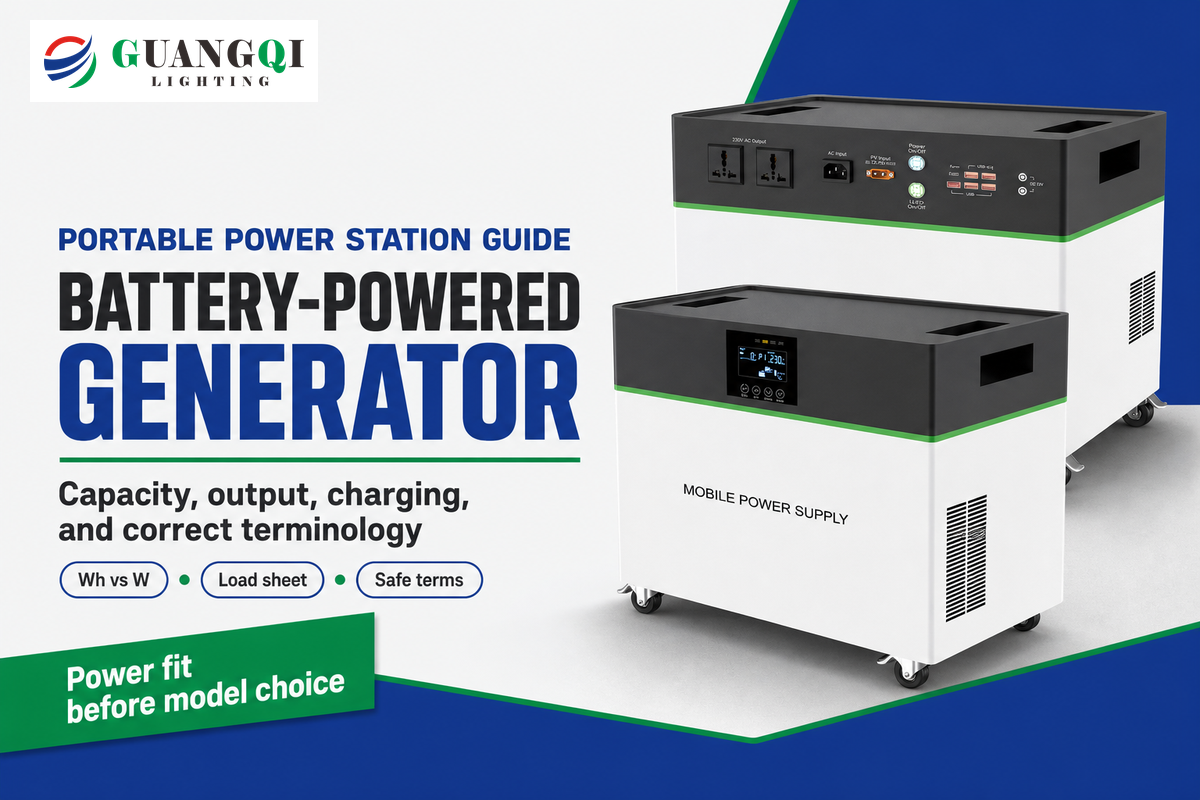
A battery powered generator is usually a rechargeable power station that stores electricity in an electric battery, then sends AC power or DC power through an inverter, USB-C port, or other outlet. The name is common in search and retail pages, but the specs tell you what the unit can actually run.
Buyers should ask a more useful question than whether the label says generator, solar generator, portable generator, or portable power station. Better question: what does the equipment do? Gas generators and inverter generators create electricity from fuel. Battery power products store electricity first, then convert direct current into alternating current when you need an AC outlet. Some official safety notices still use the phrase portable generators for battery power stations, so the wording isn’t perfectly clean. Quote sheets have to be cleaner than the label.
4-Part Power Fit Matrix
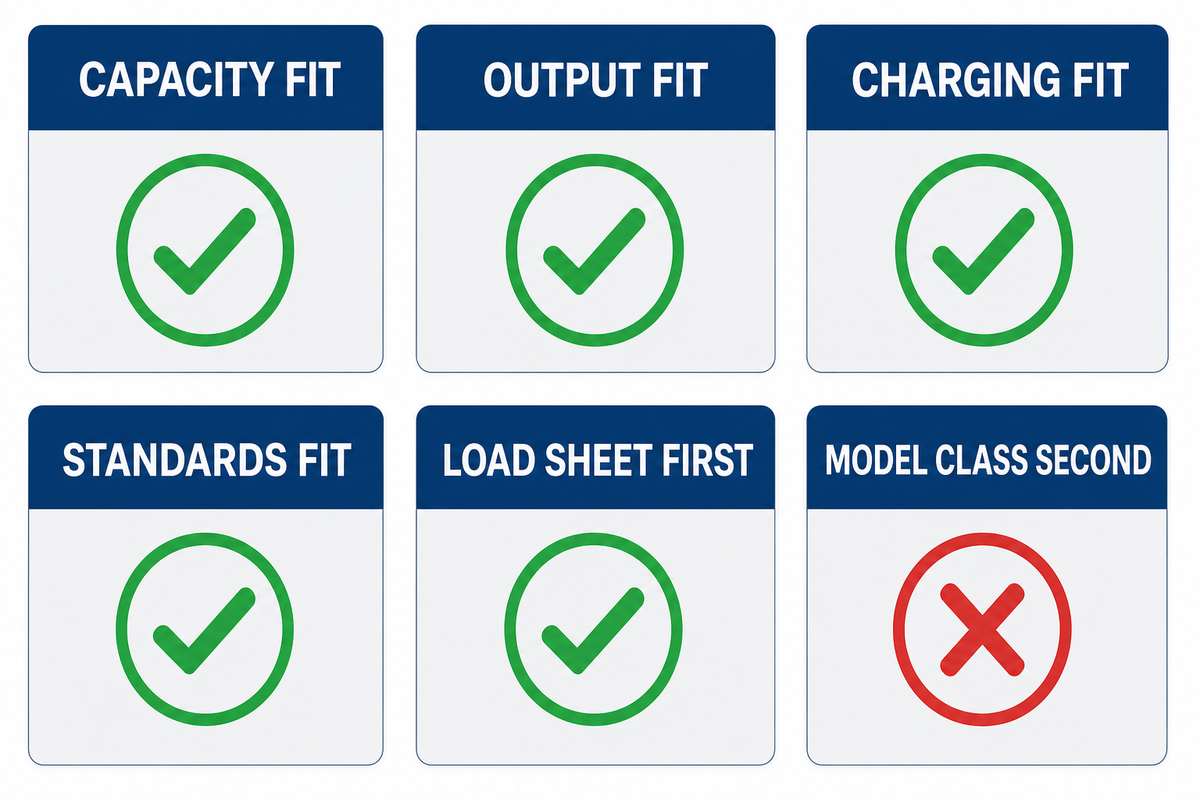
Here, the matrix serves as a buyer quick reference; use it to simplify language, avoid ordering incompatible items, and not overpromise product utility during quotes. It also separates GQLAMP company history, including more than 14 years of service and customers in more than 50 countries, from the device-specific certificate files that must be checked for a particular model. The same power-versus-energy split appears in NREL storage capacity framing.
Product purchasers should select capacity based upon run time, power output to accommodate hardware, charge cycle to shorten turnaround time, and standards to suit use.
What A Battery-Powered Generator Really Is
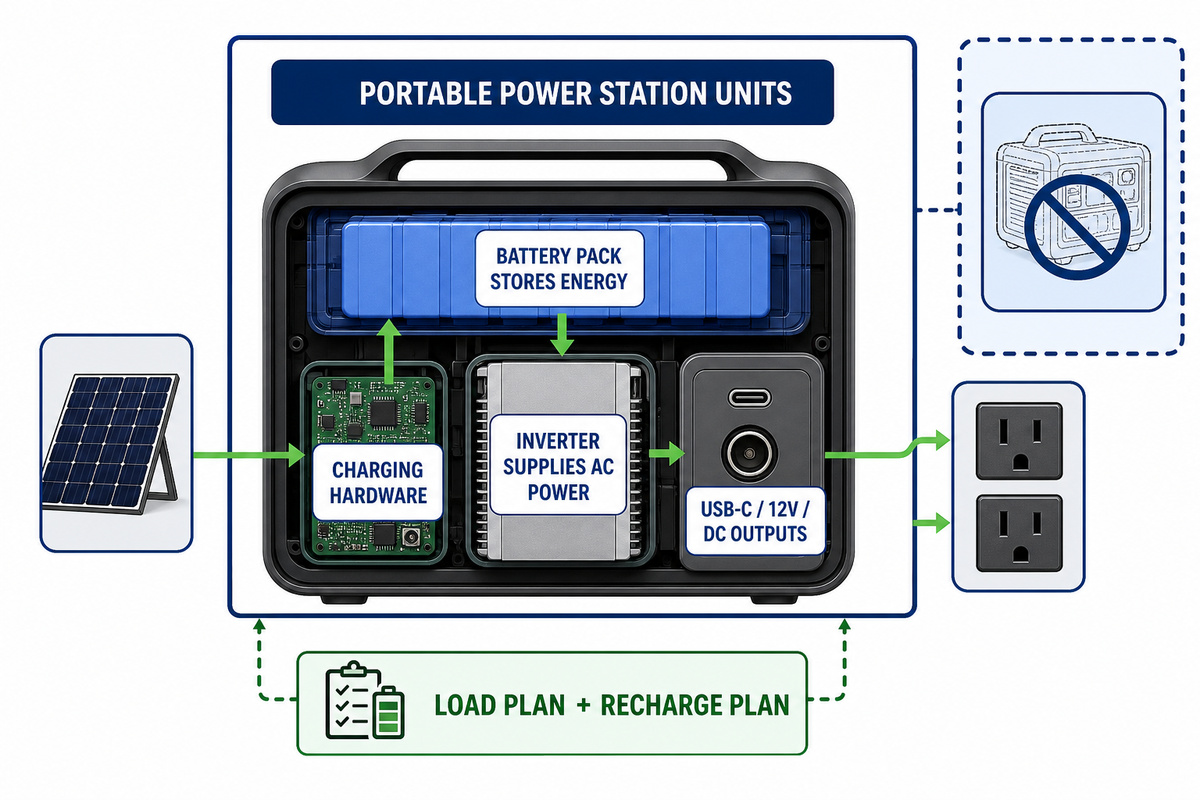
Most products sold under this search phrase are portable power station units. Inside the enclosure, a rechargeable battery pack stores energy. Inside, a power inverter supplies AC power. Charging hardware manages input from wall AC, a vehicle socket, solar panel input, or another allowed source. Some models also supply DC portable power station outputs for USB-C, 12V, or other power devices.
Simplified, the unit combines battery storage, inverter output, charging electronics, and port protection in one enclosure. The battery type may be lithium iron phosphate or another chemistry, but the key point is the same: the battery stores electricity, while the inverter converts it into usable AC or DC output.
This ambiguity matters: an electric generator creates electricity from another energy source, while an electric battery stores it. Because CPSC recall language can still call some rechargeable power stations portable generators, the resolution isn’t to ban the word. Better resolution: ask what the GQLAMP model stores, converts, outputs, and certifies for the buyer’s market.
In home use, shoppers may type battery powered generator because they need power during outages or an essential home backup power solution. That wording is useful for search, but it is not the same as running a generator with fuel, exhaust, oil, and engine noise. A battery-driven power station needs a load plan, a recharge plan, and a clear limit on how much output the selected model can supply.
GQLAMP buyers can keep the wording practical: define the required power station function, then choose the model class. GQLAMP’s portable power station range is the natural place to move after you know your loads, runtime, port needs, plug standard, waveform, and certificate file needs: battery-based portable power stations.
Capacity: Wh And kWh Estimate Runtime
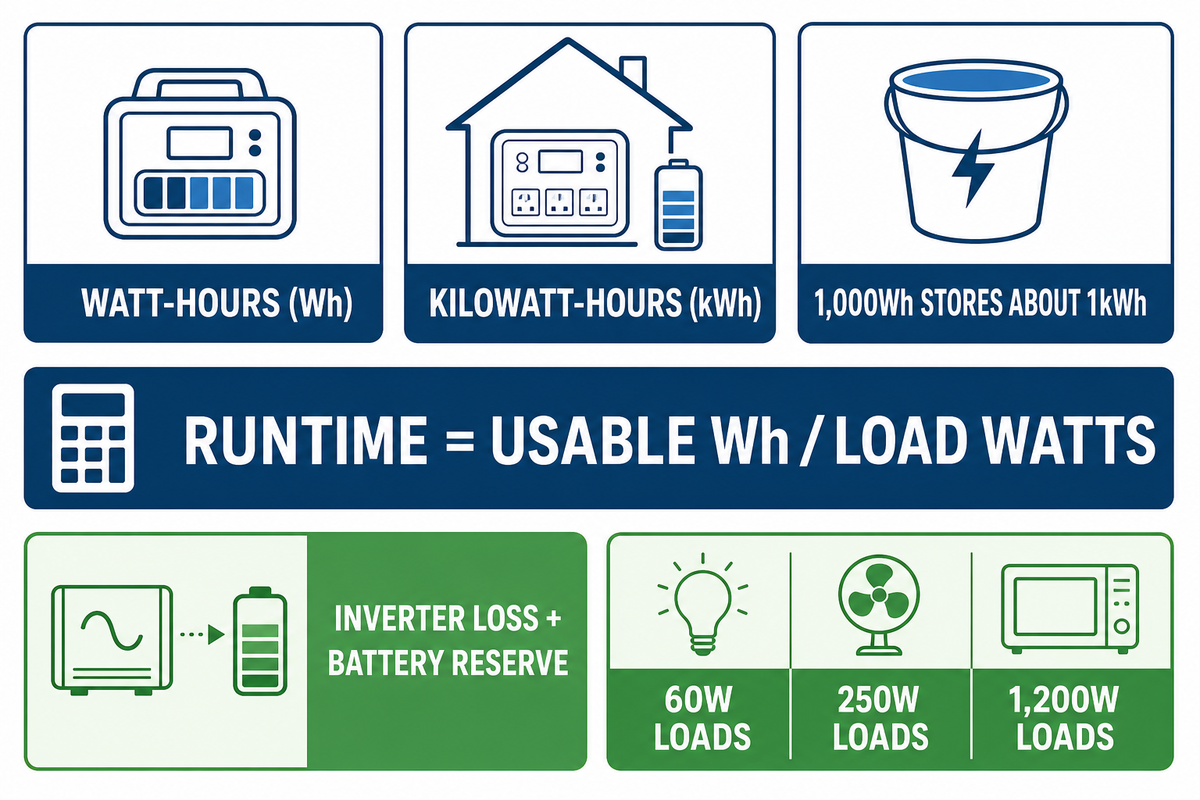
After that terminology boundary, capacity is the energy bucket. It is usually shown as watt-hours (Wh) or kilowatt-hours (kWh). For example, a 1,000Wh rating means the electric battery stores about 1kWh before real-world losses and product reserves. NREL storage material uses the same separation at a larger scale: power capacity and energy capacity are different measurements.
In the worst-case scenario, a buyer compares a 576Wh battery with a 1280Wh battery while omitting real loads such as 60W, 250W, or 1,200W. The chosen GQLAMP model might still be wrong if the rating is not high enough to sustain the load and maintain the desired runtime. A load-based sheet and desired runtime are the right starting point for any GQLAMP representative.
Simple runtime estimate
Estimated runtime = usable Wh x efficiency factor / load watts. Plan conservatively because inverter loss, battery reserve, temperature, age, and load behavior reduce usable power below the label rating.
That formula is a planning tool, not a guarantee. With a 60W router and light load, runtime may be far longer than with a refrigerator, pump, or space heater. Refrigerators may draw modest running watts but need higher starting watts. Pumps may start hard. Workstations may change load during use. Small appliances may look harmless until heat or motor startup raises the demand.
Output: Watts, Surge Watts, AC Outlets, And Waveform
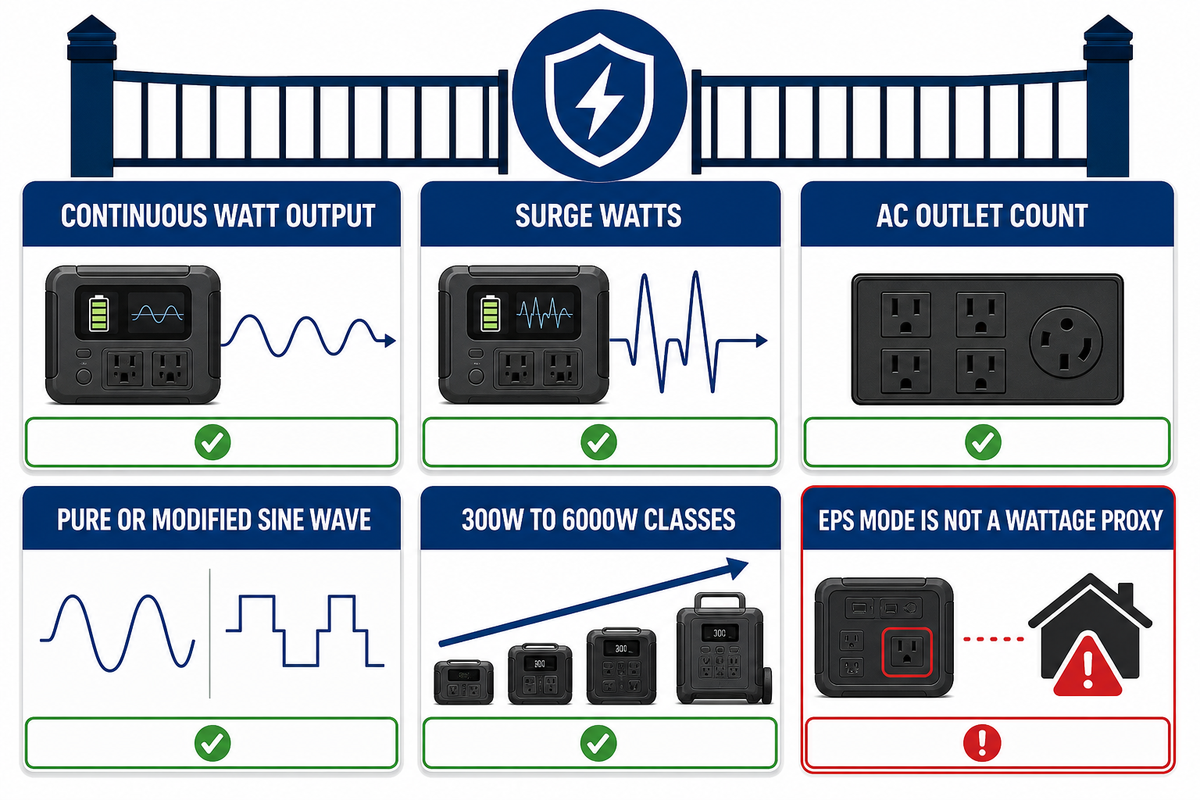
Output is the gatekeeper. Continuous watt output tells you the steady load a power station can supply. Surge watts, sometimes called peak power, tell you what it may tolerate for a short startup event. AC outlet count tells you how many devices can connect, but the total output rating still applies. Pure sine wave or modified sine wave output matters for compressors, tools, some chargers, and sensitive electronics.
Buyer trap: the weak point isn’t always capacity; it’s often output mismatch. Because a 0.6kW, 1kW, or 1.5kW class can behave differently at startup, GQLAMP needs running watts, peak watts, waveform needs, and AC outlet layout before model selection.
GQLAMP’s product examples show why a single battery powered generator label isn’t enough. Representative portable power station classes range from about 300W for light portable use to larger 1000W, 1500W, 3500W, and 6000W classes for heavier backup or jobsite use. Capacity examples also vary widely, from compact Wh ratings to kWh-scale portable and mobile storage examples. Right match starts with the load list, not with the largest number in the catalog.
This discussion does not treat EPS, pass-through behavior, receptacle configuration, grounding, and transfer equipment as generic add-ons. A 2025 CPSC recall involving a 2,000W lithium iron phosphate power station operating in EPS mode shows why this matters: watts and kWh alone are not a proxy for internal wiring, outlet behavior, or safe configuration.
Charging: AC, Solar PV, Vehicle/DC, And Hybrid Recharge
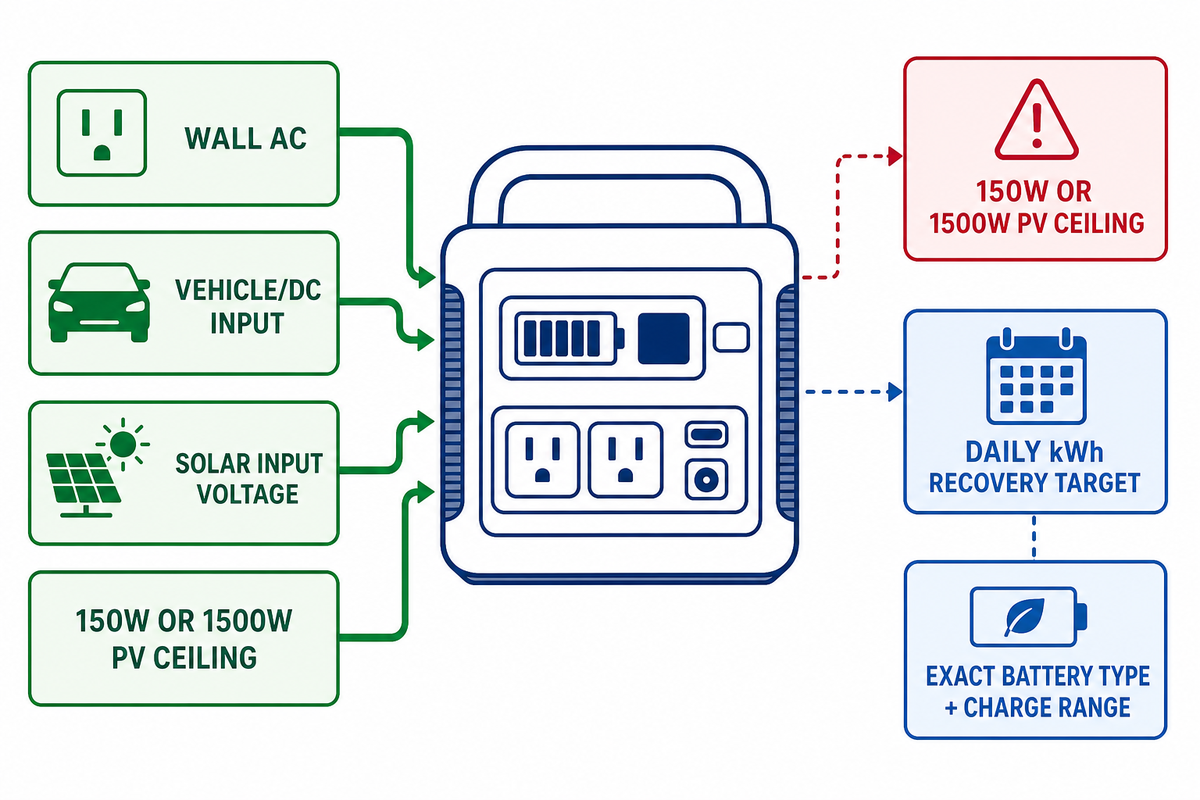
Charging specs tell you which inputs can be connected and how the unit can recharge while serving a load: wall AC, vehicle/DC input, solar input voltage and watt rating, or combined charging. If buyers expect solar panels to power daily operation, they should plan panel angle, season, weather, temperature, cable losses, and the available charging window.
Common risk: assuming the label input equals field energy. Because a 150W or 1500W PV input rating is a ceiling, not the day’s yield, a buyer should state location, season, panel plan, and daily kWh recovery target. GQLAMP can then check whether the requested charger, adapter, and PV range belong to that model class.
Maximum PV input is a connector limit. It is not a guarantee that the solar panel will provide that watt number all day. Solar power is unpredictable. Foul weather can extend recharge time. Hot weather can reduce panel output. Off-grid shoppers should also include daily consumption, battery capacity, solar window, and the harvest goal after a power outage in the charge plan.
Comparison pages and citation pages often group fast charge, LiFePO4 battery chemistry, expansion batteries, app control, and portable solar kits. Those factors have their place, but they are model-specific. Ask about the exact battery type, charge range, adapter needs, charging temperature thresholds, and market files before ordering a batch. GQLAMP’s runtime model calculator is a practical follow-up once the load list is known. Portable power station design references also separate stored battery energy, DC source design, and charging interfaces, as shown in this portable power station charging design context.
What It Can Run: Camping Loads, Refrigerators, Tools, And Selected Home Backup
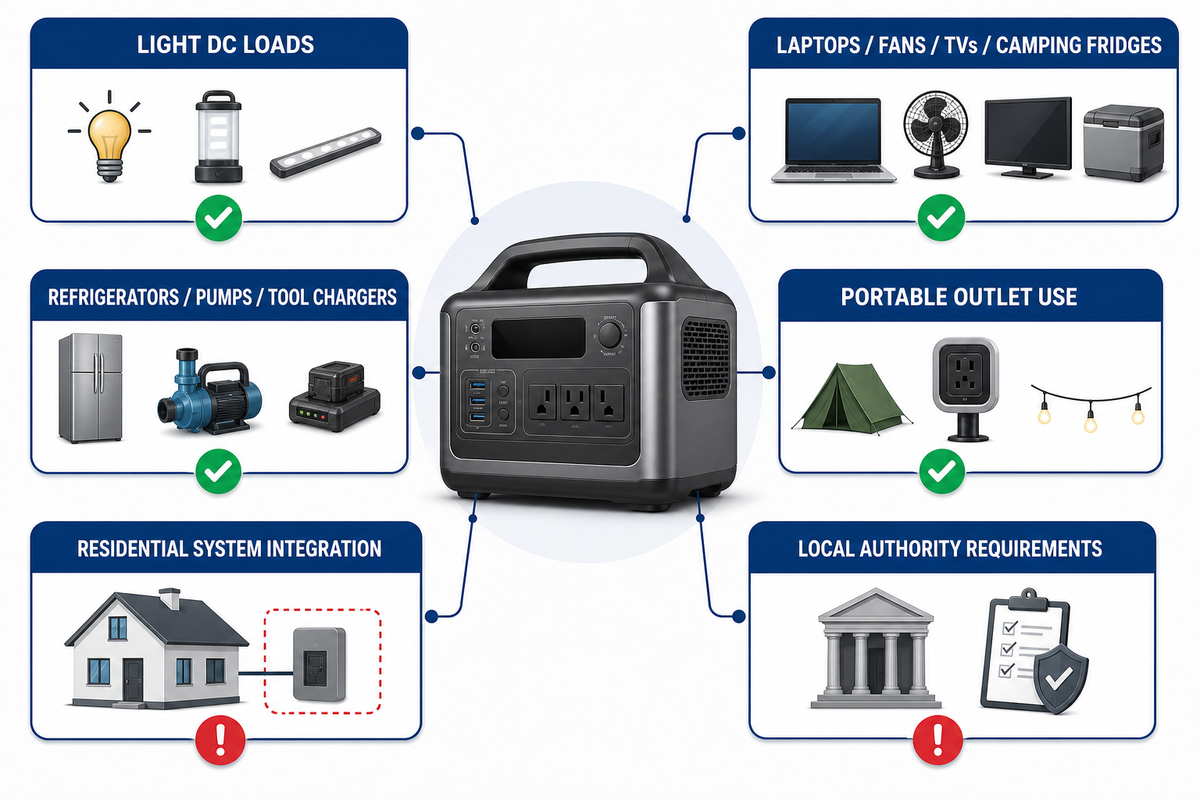
After the charging and battery type checks, begin with a load table. Phones, routers, LED fixtures, and small DC loads may fit a lightweight package. Laptops, fans, TVs, and camping fridges require heavier battery capacity and steady output. Refrigerators, pumps, tool chargers, and workstations require closer inspection for surge watts and waveform. Bigger units can support appropriate home backup loads, but that phrase needs to remain specific.
Home power mismatch is a liability risk because a portable power supply used through its own outlets is different from an uninterruptible power supply or a permanent home system. For emergency power, source, transfer path, marking, and local authority requirements are just as important as the watt label.
Draw a clear distinction between using a portable unit through its outlets and integrating a home backup system into wired home power. UL instructions treat home energy storage systems differently from portable power units, and NFPA 855 may apply if stationary or portable ESS equipment is used in a stationary installation.
First, list what you plan to operate at home: refrigerator, phone charger, internet equipment, lights, CPAP or other medical device with permission from the maker and power-station supplier, and a few critical small loads. Then separate the project into two scenarios: portable outlet use and residential system integration. The second scenario requires more engineering review.
Safety And Certification Terms Buyers Should Not Mix Up
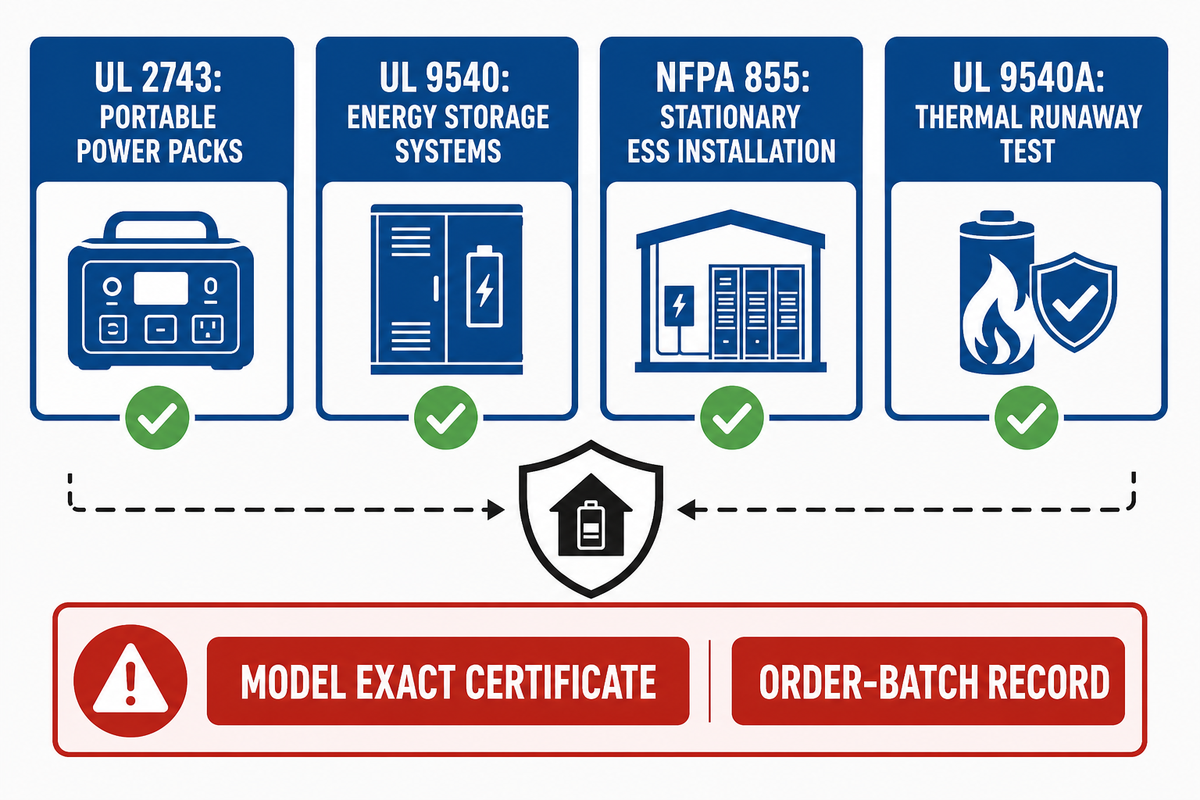
Stationary ESS equipment, portable power packs, home solar generator kits, and battery packs may appear in the same promotional copy, but their standards language is not interchangeable. UL 2743 applies to portable power packs. UL 9540 relates to energy storage systems. NFPA 855 relates to stationary ESS installation. UL 9540A is a thermal runaway propagation test method; it is not a general product acceptance.
Vague certificate requests are red flags. Because GQLAMP inspects files by model, plug standard, market, battery transport need, and order batch, a buyer should never assume one phrase of certification applies to class 300W through class 6000W.
Never request “battery certification” as one phrase. Always request a model exact certificate, plug standard, battery transport document, target market file, and order-batch record.
Quote-Ready Checklist Before Choosing A Model
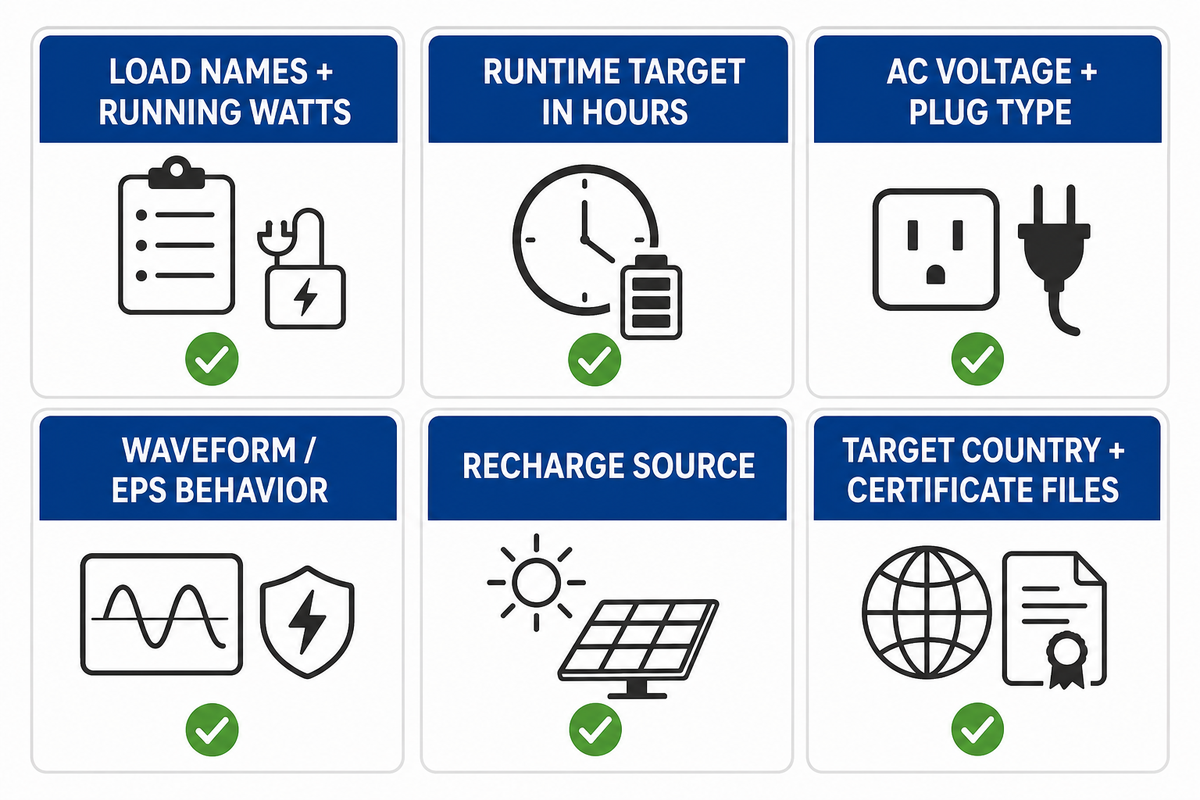
After those certificate boundaries, GQLAMP’s proud history is in high-performance LED products, and its portable power station page presents model-class examples and quote fields for power buyers. The model comparison table helps separate output class, capacity class, and use case before a quote moves forward. Keep the quote request factual. A distributor, installer, rental buyer, or project purchaser may send a list like this:
Most RFQ problems are avoidable when the buyer turns every mismatch risk into one document: application, test report need, power requirement, backup power function, and market certificate files. This prevents model selection from being driven by a generator label alone. For the portable-pack standard boundary, keep the current UL 2743 scope separate from any stationary ESS file request.
- Load names, running watts, startup watts, and whether each load has a motor, compressor, heater, or sensitive charger.
- Runtime target in hours and use case: camping trip, mobile work, outage support, emergency power, or essential home power.
- Required AC voltage, plug type, AC outlet count, DC port count, USB-C needs, and adapter limits.
- Waveform requirement, pure sine wave request, and whether uninterrupted power or EPS behavior is desired.
- Recharge source: wall AC, vehicle/DC, solar panel, portable solar kit, or mixed charging.
- Target country, certificate files, battery transport files, label language, and batch quantity.
This list protects both sides. It minimizes the risk of getting a power source that has sufficient stored energy but improper output, ample AC power but insufficient outlet count, or a good solar generator label but the wrong certification context.
FAQ
Are battery-powered generators worth it?
Battery-powered generators are justified when quiet stored power, indoor-friendly portable outlet use, low maintenance, and rapid setup matter more than fuel runtime. They are not a perfect substitute for every gas-powered portable generator. Good buyer suitability depends on battery capacity, continuous output, surge watts, recharge plan, power needs, and whether the application is camping power, backup power, off-grid work, or selected home backup.
Can a battery-powered generator run a house?
A battery-powered generator can support selected loads, but “run a house” is too generic. Using its own outlets, a portable power station could support a refrigerator, router, lights, fan, or charger provided the output and capacity match. Residential wiring considerations vary. Home backup power configuration may require transfer equipment, listing, grounding, neutral bonding, local code adherence, and qualified installation inspection. Never assume a portable outlet scenario equates to a whole-house configuration plan. Ask separately about fixed wiring before ordering equipment.
How long will a battery operated generator run?
Runtime depends on usable Wh divided by load watts, then adjusted for inverter loss, reserve, temperature, age, startup loads, and device cutoff. For quoting, use a load sheet, not a label, because small electronics and compressor loads behave very differently.
What is the best battery-powered generator?
The best battery-powered generator is the unit that fits the load sheet: continuous watts, surge watts, usable Wh, waveform, ports, recharge method, market files, battery transport documents, and batch size. For a GQLAMP quote, fit the project first; a consumer-table winner is not automatically the right distributor or jobsite choice.
Review sites may list best portable power stations, portable power stations of 2026, best power stations of 2026, or consumer models such as EcoFlow Delta, EcoFlow Delta Pro, EcoFlow Delta Pro 3, EcoFlow Delta 3, EcoFlow River 3, Delta 3 Plus, and EcoFlow Delta 3 Max, but that does not create a project quote. Testing data can still be useful when it reports usable Wh, port layout, recharge time, and AC output. A rental buyer, distributor, or site purchaser will usually care more about plug standard, certificate files, replacement stock, and support schedule than a consumer-table winner.
Is a solar generator the same as a portable power station?
Often, yes in buyer language. A solar generator for home is usually a portable power station paired with solar panels, but the panels do not turn stored energy into engine generation. They provide a recharge source. For an LFP solar generator, check the LiFePO4 cell type, PV input rating, controller behavior, ambient conditions, and operating-temperature range before assuming it will recover enough energy each day. Daily recovery still depends on sunlight, cable losses, battery reserve, and the permitted charging window.
References & Sources
- NREL Storage Futures Study input data report
- DOE OSTI record for the NREL report
- UL Q&A on portable power packs and stationary ESS boundaries
- UL portable power pack testing service page
- Current UL 2743 listing
- ANSI Webstore historical listing for UL 2743 Ed. 2
- American Clean Power storage terminology page
- CPSC 2025 power station recall notice
- GQLAMP About Us, the GQLAMP portable power station page linked above with the required anchor, and GQLAMP’s portable power station manufacturer checklist.
Related Posts
Trending now