Get in Touch with GUANGQI



![Solar Flood Light vs Wired Complete Comparison [2026]](https://gqlamp.com/wp-content/uploads/2026/04/Solar-Flood-Light-vs-Wired-Complete-Comparison-2026.png)
Choosing between a solar flood light vs wired setup feels simple on the shelf at Home Depot — until you start adding up the real numbers. A $50 solar fixture and a $300 hardwired floodlight may end up costing the same over five years, or differ by $2,000, depending on your climate, security needs, and tolerance for replacing batteries. This guide compares both options across nine specific dimensions — brightness, installation, cost, reliability, security, environment, and a 4-Factor Decision Matrix — using verified data from NREL, SEIA, and field-tested industry benchmarks.
Quick Specs: Solar vs Wired at a Glance
| Power source | Solar panel + battery vs. 120V grid (hardwired) |
| Typical brightness | Solar 200–6,000 lm vs. Wired 2,000–20,000+ lm |
| Installation | Solar DIY 15–30 min vs. Wired licensed electrician 2–6 hr |
| Upfront cost (per fixture) | Solar $50–$200 vs. Wired $40–$300 + $150–$600 install |
| Service life | Battery 2–5 yr / LED 50,000 hr vs. 50,000–100,000 hr (10+ yr) |
| Best for | Remote / low-traffic areas vs. Security / high-reliability zones |
Solar vs Wired Flood Lights: At a Glance
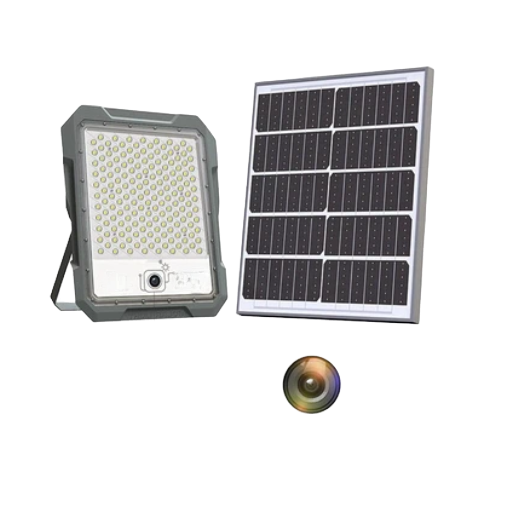
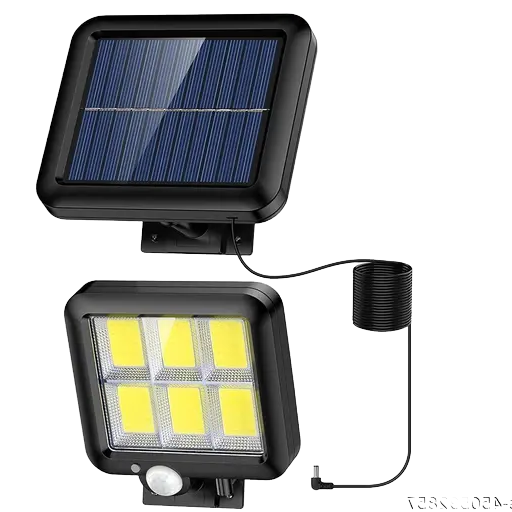
Solar flood lights harvest sunlight through a photovoltaic panel, store it in a rechargeable battery, and power an LED bulb after dusk — fully off-grid. Wired flood lights draw AC power from your home’s electrical system, delivering consistent illumination on demand through a switch, timer, or motion sensor. Both serve the same job — outdoor lighting and landscape lighting — but trade off in opposite directions across five key dimensions.
| Dimension | Solar Flood Light | Wired Flood Light |
|---|---|---|
| Power dependency | Sunlight + battery | Grid (fails in outage unless on UPS) |
| Brightness ceiling | Plateaus around 6,000 lm | No practical ceiling |
| Installation | Mount with screws — no electrician | Licensed electrician + permit (varies by city) |
| Maintenance | Battery swap every 2–5 yr; clean panel | Inspect wiring; replace bulb at end-of-life |
| 5-yr cost trajectory | Low upfront, rises with battery swaps | High upfront, near-zero recurring |
If you want one sentence to remember: solar wins on installation simplicity and remote-area access in any outdoor space; wired wins on raw brightness, predictability, and long-term cost when an electrician is already on-site. Everything else in this article expands on that tradeoff. For a primer on solar-specific specs and product types before comparing, see our complete solar flood light guide.
Brightness & Lumen Output — Can Solar Match Wired?
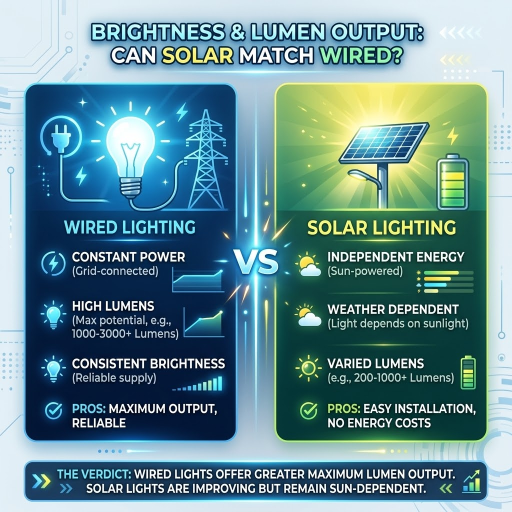
Lumen output is the single biggest performance gap between the two. A typical budget solar flood light delivers 200–800 lm — usable for ambiance or path edges, but well below the threshold where it works as a real security deterrent. Premium solar floods with larger panels and lithium batteries reach 1,500–6,000 lm. Wired LED floodlights start where premium solar tops out and scale almost without limit — a single 200W wired fixture can produce 20,000 lm, enough to wash an entire commercial yard.
| Tier | Solar lumen range | Wired lumen range |
|---|---|---|
| Budget / DIY | 200–800 lm | 2,000–4,000 lm |
| Mid-range security | 1,000–3,000 lm | 5,000–10,000 lm |
| High-output | 3,500–6,000 lm | 10,000–20,000+ lm |
Solar brightness also varies through the night — most fixtures dim by 30–50% after the first 4–6 hours to preserve battery life on cloudy days. By contrast, wired floodlights hold their full output until you flip the switch. If you require consistent illumination for a driveway or storefront, that flatness matters more than peak brightness.
📐 Engineering Note — Lumen Requirements by Application
Walkways and ambiance: 700 lm minimum. Garage and driveway security: 1,200–2,000 lm. True commercial flood: 3,000–5,000 lm. A 300-lm solar light marketed for “security” simply will not trigger the deterrence response you need.
What Are the Disadvantages of Solar Flood Lights?
Honest answer: brightness ceilings, weather dependence, and a battery clock. Field-tested products marketed at “10,000 lumens” frequently deliver under 1,500 lm in real-world six-month testing — the gap between marketing copy and measured output is the single biggest disappointment buyers report. Solar fixtures also dim on consecutive cloudy days, even with quality panels, and the rechargeable cells inside need replacement every 2–5 years. Solar panels mounted in shade — under tree canopies, on north-facing walls — never charge fully and cause premature failure. None of those are deal breakers, but they explain why top-rated solar flood lights for 2026 all use larger panels, lithium batteries, and adjustable solar arrays rather than fixed all-in-one fixtures.
Installation — DIY Solar vs Hiring an Electrician
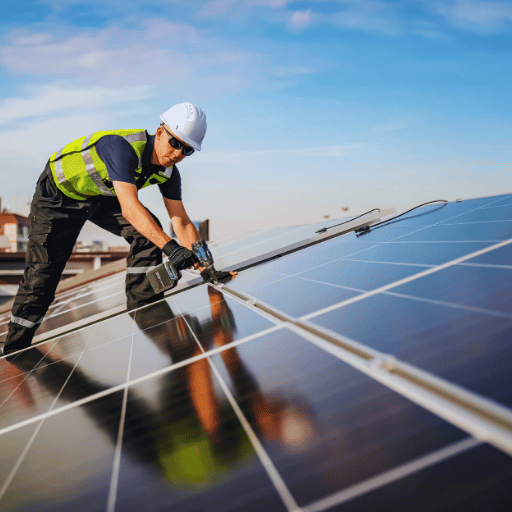
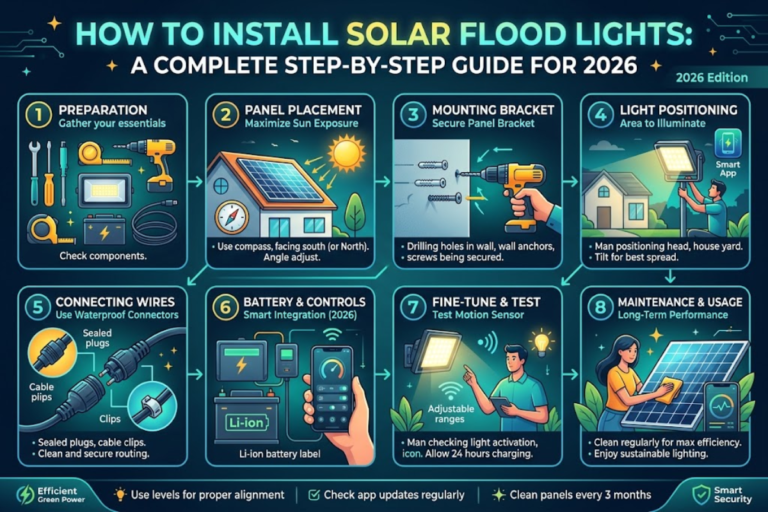
Installation is where most homeowners feel the price difference instantly. With a solar flood light, the install is plug-and-play: pick a sunny mounting spot, drive in four screws, peel the protective film off the panel, flip the on switch, and walk away. Because the fixture is self-contained, no wire runs through the wall and no permit gets pulled. Average install time: 15 to 30 minutes per fixture.
Hardwired flood lights are a different project entirely. The fixture must be connected to your home’s electrical system, which usually means routing wire through a wall, junction box, or conduit. Most jurisdictions require a licensed electrician for any new outdoor circuit, and many cities require a permit before the work starts. According to Angi’s 2025 outdoor lighting installation data, contractors charge anywhere from $150 to $600 for replacing an existing fixture, and between $2,000 and $6,000 for installing new wiring with multiple light fixtures. Forum reports from r/AskElectricians describe two-fixture installs landing between $600 and $1,800 once drywall repair is factored in.
💡 Pro Tip — When Wired Install Is Cheap
If your eaves already have an outdoor outlet or junction box within 6 feet of where you want the light, replacement install drops to $150–$300 — close to the price of a premium solar flood light fixture. Cost only blows up when new circuits or trenching are required.
Cost Comparison — Upfront, Running, and 5-Year Total
Sticker price favors solar; total cost of ownership is closer than people think. Five-year math depends on three line items: hardware, install, and replacement parts (batteries on solar; almost nothing on a properly installed wired fixture).
| Cost item | Solar (per fixture, 5 yr) | Wired (per fixture, 5 yr) |
|---|---|---|
| Fixture purchase | $50–$200 | $40–$300 |
| Installation | $0 (DIY) | $150–$600 (replacement) / $2,000+ (new circuit) |
| Annual electricity | $0 | $3–$15 (50W LED, 6 hr/night, $0.16/kWh) |
| Battery replacement | $15–$40 × 1–2 swaps | N/A |
| 5-year total estimate | $80–$280 | $215–$975 (replacement) / $2,055+ (new) |
Two patterns emerge. First, solar wins by a wide margin when you would otherwise need new wiring — the $2,000+ install gap is hard to make up. Second, when you replace an existing wired fixture in place, the gap shrinks to a couple hundred dollars over five years, and wired tends to win on a 10-year horizon because solar batteries need a second swap. The common mistake is ignoring the second battery replacement; buyers who plan only the first cycle end up paying more than the wired option they originally rejected.
Reliability & Durability — Battery, Weather, and Cloudy Days
Reliability splits along two axes: what fails and how often. Wired fixtures fail at the bulb (LED end-of-life around 50,000–100,000 hours) and very occasionally at the wiring (corroded connections, surge damage, rodent chew). Solar fixtures fail at the battery first, every 2–5 years, then at the panel (UV degradation), then at the housing seal. Both target IP65 outdoor ratings or higher, aligned with DOE-aligned outdoor lighting standards, but seal quality varies widely between budget and premium models.
Battery chemistry is the hidden variable here. Older solar floodlights still ship with NiMH or generic Li-ion cells rated at 300–500 charge cycles — about one usable year before noticeable dimming. Premium fixtures now use LiFePO4 (lithium iron phosphate), rated at 2,000–3,000 cycles, which translates to 5–8 years of nightly runtime before performance drops below useful levels. That is a 5- to 6-fold lifespan improvement and the single biggest factor narrowing the durability gap with wired LED lighting.
✔ Wired Reliability Strengths
- No degradation over time – same brightness year 1 and year 10
- Performs identically in winter, summer, rain, snow
- 50,000–100,000 hr LED lifespan
- Compatible with smart-home, motion, timer, schedules
⚠ Wired Reliability Limitations
- Goes dark during power outages (unless on UPS)
- Surge events can burn out drivers
- Outdoor wiring corrodes if seals fail
- Roughly 10% of installs develop wiring issues over a decade
Why Do Solar Lights Fail So Quickly?
Three causes account for nearly all early failures. First, battery wear-out — rechargeable cells lose capacity each cycle, and cheap NiMH batteries are functionally dead in 12–18 months. Second, solar panel placement: a fixture mounted under a tree, on a shaded wall, or behind a downspout never gets a full charge cycle, so the battery enters a chronic deep-discharge state that destroys it within months. Third, ingress — water seeping past degraded gaskets shorts out the controller. Fixing all three is straightforward: buy fixtures with LiFePO4 batteries and IP65 minimum sealing, mount the panel where it gets at least 6 hours of direct sun, and replace cells before they hit zero capacity.
Security Lighting — Solar or Wired for Your Property?
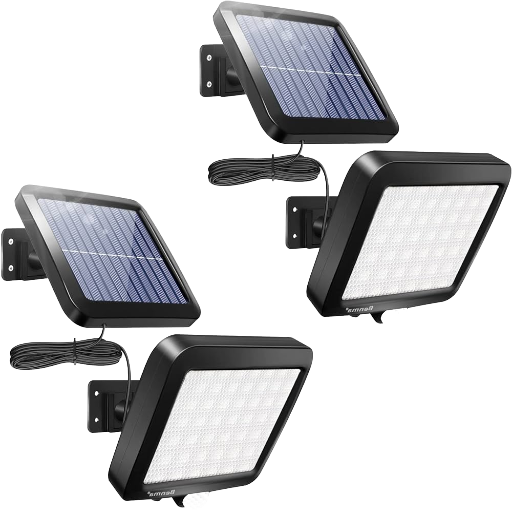
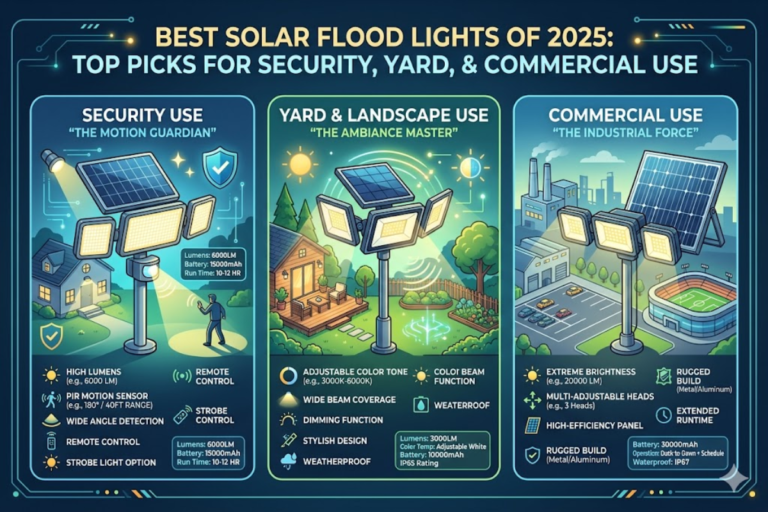
Security lighting is the use case where the wrong choice gets noticed fastest. Industry consensus from outdoor lighting electrical engineers places the minimum useful security flood at 1,200–2,000 lm, with 3,000–5,000 lm preferred for driveways and large yards. That immediately rules out the $25 dollar-store solar fixtures rated at 200–400 lm, regardless of how aggressive the marketing copy is.
Where solar competes for security duty: low- to medium-traffic perimeter zones, garden paths, and remote sheds where the alternative is no light at all. A premium solar fixture with motion sensors and 1,500–3,000 lumens gives roughly 80% of the deterrence value of a wired flood at a fraction of the install cost. Where wired wins outright: any zone tied to a security camera, any point of forced entry (front door, side gate), and any outdoor space where the lights need to come on instantly during a power outage tied to an attempted break-in.
⚠️ Common Security Mistake
Buying a 300–500 lm solar flood light because it is sold as a “security floodlight.” The illumination is roughly the same as a porch sconce — useful, but not a deterrent. Pair real high-lumen solar flood lights with motion sensors, or run a wired fixture, but do not expect a 400 lm bulb to scare anyone off.
Environmental Impact — Solar’s Green Advantage (And Its Hidden Costs)
Solar flood lights cut grid electricity to zero, eliminating roughly 25–60 kg of CO₂ per fixture per year compared to an equivalent wired LED running 6 hours nightly. A property with 10–20 floodlights — a common landscape lighting solution on larger acreage — sees a real reduction in greenhouse gas emissions over a decade. Renewable energy from the sun is a genuine argument here, not a marketing line.
Battery waste is the hidden cost. NiMH and Li-ion cells are not currently recycled at scale in residential channels, and a fixture replaced every 2–3 years generates more battery waste over 10 years than a wired LED, which contains no battery at all. LiFePO4 batteries narrow this gap considerably — fewer replacements, less hazardous chemistry, easier recycling — but the consumer recycling infrastructure for small lithium cells remains thin in most regions. If you are buying solar specifically for environmental reasons, prioritize LiFePO4 fixtures and check whether your municipal e-waste program accepts the cells before the first one fails.
Which Should You Choose? The 4-Factor Decision Matrix
Most “solar vs wired” comparisons conclude with a little bulleted list of “recommend solar if…” Our team prefers a structured matrix that weighs four aspects of the installation — sun exposure, installation burden, brightness requirement, and maintenance tolerance — to clarify your decision. This matrix has held up well across gray-area exceptions that simple linear comparisons miss.
| Factor | Score 1 (Solar wins) | Score 3 (Wired wins) |
|---|---|---|
| Sun exposure | 6+ hours direct sun on the panel daily | North-facing, shaded, or <3 hr / cloudy region |
| Install difficulty | No nearby outlet; new wiring required | Existing junction box within 6 ft |
| Brightness need | Ambiance / path / accent (under 1,500 lm) | Security / driveway (3,000+ lm constant) |
| Maintenance tolerance | OK swapping batteries every 2–5 yr | Set-and-forget for a decade |
How to use it: Score each factor 1, 2, or 3 based on your situation. Totals of 4–6 strongly favor solar; 7–9 is mixed (consider a hybrid approach with wired at security zones and solar on perimeter); 10–12 strongly favors wired. Weight each factor equally — none should dominate the others in your decision.
Need a fixture that scores well on all four factors?
Are Solar Flood Lights Getting Better? Industry Outlook 2025–2026
Honest answer: yes, faster than wired LED is improving, but not yet fast enough to make wired obsolete. Two streams of data back this up: World PV capacity increased in 2024 by approximately 460 GW direct current, a 14% year-over-year jump, according to the NREL Winter 2025 Solar Industry Update. State-of-the-art solar cells now reach 25.9% efficiency in record-setting N-type TOPCon designs, and 18–22% efficient panels have begun arriving in residential outdoor lighting fixtures. On the battery side, LiFePO4 has displaced older Li-ion in mid-tier applications, lifting service life from 1–2 years to 5–8.
If you are planning a 2026 outdoor project, this matters: a premium solar floodlight installed today should last 7–10 years before its first major component swap — competitive with a wired LED, without the install cost. The SEIA Q2 2025 Solar Market Insight Report indicates US residential solar deployment is slowing 7% YoY due to headwinds from policy uncertainty, while global manufacturing capacity continues to expand, sustaining downward pricing pressure on solar components.
MPPT vs PWM Controllers — Which Is Better for Solar Lighting?
Charge controllers inside a solar flood light decide how efficiently sunlight reaches the battery. PWM (pulse-width modulation) is the older, cheaper design — simple on/off switching at roughly 70–75% conversion efficiency. MPPT (maximum power point tracking) actively tunes the panel’s voltage and current operating point and reaches 92–98% efficiency, especially in low-light conditions. For a flood light fixture under 50W, PWM is acceptable and keeps the price down. For larger fixtures (60W+) or any deployment in cloudy regions, MPPT extracts noticeably more illumination per square inch of panel and pays back its cost differential within the first season.
FAQ — Solar vs Wired Flood Lights
Q: Are solar-powered flood lights worth it?
View Answer
For ambiance, path, and remote-area lighting where running new wire would cost $1,500+, solar is almost always worth it. For security zones, primary entrances, and any spot needing 3,000+ lumens consistently, wired typically delivers better long-term value. Premium models with LiFePO4 batteries close the durability gap considerably.
Q: What’s better, solar powered flood lights or direct connection?
View Answer
It depends on three things: how much sunlight your mounting location gets, whether you need brightness above 3,000 lumens, and whether running new wire is realistic for your property. Use the 4-Factor Decision Matrix in this article to walk through each axis.
Q: Solar vs wired flood lights — which requires less maintenance?
View Answer
Hardwired fixtures need less maintenance over a 10-year window — typically only an LED bulb swap at end-of-life. Solar requires panel cleaning twice a year and battery replacement every 2–5 years, which is more frequent but easier (no electrician needed).
Q: How many years do solar flood lights last compared to wired?
View Answer
Quality solar fixtures last 5–8 years before needing major service (battery, sometimes panel). LED bulbs in the same fixture last 50,000 hours regardless of power source. Wired LED flood lights routinely run 10+ years with no servicing if installed correctly.
Q: Wired vs solar — which handles extreme temperatures better?
View Answer
Wired wins in extreme cold (below -10°C / 14°F), where solar batteries lose capacity and may fail to charge fully. Both perform similarly in heat up to 50°C / 122°F if properly rated. In tropical or persistently cloudy regions, wired is generally more predictable; in sunny temperate climates, solar is competitive.
About This Comparison
Guangqi Lighting manufactures solar flood lights and wired LED outdoor fixtures, so we have a stake in this comparison. We chose to publish the cost, brightness, and reliability data points that recommend wired over solar in specific cases — including security zones and shaded mounting positions — because pretending solar wins everywhere damages buyer trust and the broader category. Data points come from NREL, SEIA, Angi, and field-tested industry benchmarks; the 4-Factor Decision Matrix is our framework, refined across export projects to 50+ countries since 2010.
References & Sources
- Spring 2025 Solar Industry Update — National Renewable Energy Laboratory (NREL), U.S. Department of Energy
- Winter 2025 Solar Industry Update — National Renewable Energy Laboratory (NREL)
- Solar Photovoltaic Technology Basics — U.S. Department of Energy
- Solar Market Insight Report Q2 2025 — Solar Energy Industries Association (SEIA)
- Electrician Cost To Install Outdoor Light + How To Budget — Angi (2025 cost data)
Related Articles
- Solar Flood Lights: Specs, Types & Installation Explained — Complete primer on solar flood light fixtures and IP ratings
- Best Solar Flood Lights of 2026 — Top picks for security, yard, and commercial use
- Guangqi Solar Flood Lights — Product Range — High-lumen solar flood light fixtures with LiFePO4 batteries
![Solar Flood Lights Specs, Types, and Installation Explained [2026]](https://gqlamp.com/wp-content/uploads/2026/04/Solar-Flood-Lights-Specs-Types-and-Installation-Explained-2026-768x512.png)