Get in Touch with GUANGQI


Solar Street Lights with Pole — Sizing, Engineering, and Buyer’s Guide

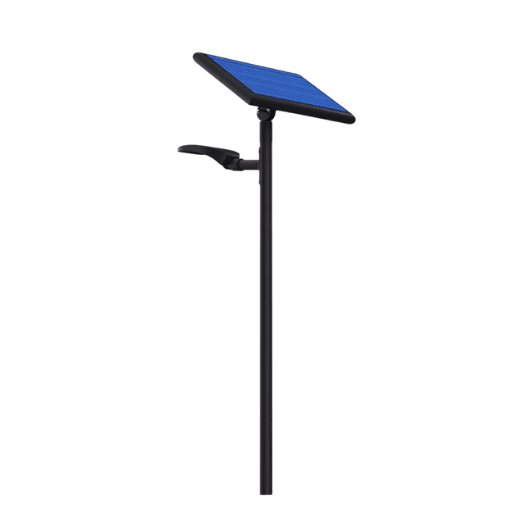
Choosing the wrong solar street lighting design has impacts that are greater than the cost differential between cheap and quality light fittings and include labour, procurement time, and credibility when fittings go within 18 months. This guide covers the technical factors distinguishing a reliable commercial lighting solution from a repeat-replacement cycle: how system components interact, how to specify correctly for road class and climate, what to demand from steel poles, why battery chemistry trumps investment, and what the supplier should be showing you that most spec sheets omit.
Quick Specs: Solar Street Light System at a Glance
| Parameter | Typical Range (Commercial Grade) |
|---|---|
| Fixture Power | 20–500 W |
| System Efficacy | 150–190 lm/W (LED fixture) |
| Battery Chemistry | LiFePO4 (2,000+ cycles) or Sealed Lead-Acid (300–500 cycles) |
| Pole Height | 3–10 m (pathway to arterial road) |
| Autonomy Reserve | 2–5 overcast days (climate-dependent sizing) |
| Solar Panel Type | Monocrystalline, 18–23% efficiency |
| IP Rating | IP65 minimum (IP67 recommended for flood-prone areas) |
| Certifications | CE, RoHS, IES LM-80, ANSI/IES RP-8-22 compliant photometrics |
| Commercial Warranty | 2–5 years (parts and labor vary by supplier) |
How a Solar-Powered Street Light System Works

A solar street lighting system works by capturing sunlight through a monocrystalline solar panel during the day, storing converted electricity in a rechargeable battery via an MPPT charge controller, and automatically powering an LED fixture from dusk to dawn using stored energy.
Each solar street light with pole comprises four elements: the photovoltaic panel, the Maximum Power Point Tracking charge controller (MPPT), the battery pack, and the LED lamp. In the day time, the panel feeds the battery through the controller, which maximises energy transfer at 93–98% efficiency regardless of cloud cover. When the night dark falls, the photocell or natural light sensor switches on the LED and it uses the battery energy until morning.
All-in-one and split-array systems also differ in flexibility of installation: an integrated package mounts the panel, battery and fixture together on the pole top as a unit (quick to fit, minimizes space); with split-array designs, a large panel is fastened separately from the pole-top fixture in order that the panel’s tilt can be optimised separately from pole alignment. Split arrays are most common in locations north of 45N, where winter sun angles demand a steeper panel pitch.
Dusk-to-dawn control, the baseline. More sophisticated methods of automation incorporate PIR or radar motion sensing that cut the output to between 30 and 60 per cent during quiet hours (from around 11pm until 5am) thereby extending a 2-day battery reserve to between 4 and 5 days in moderate conditions.
Advantages
- No grid connection or trenching required
- Operating cost near zero after installation
- Deployable in 1–3 days (no civil electrical work)
- Qualifies for 30% federal ITC (US commercial)
- Zero emissions; environmentally friendly design with 95–99% recyclable components
Limitations
- Higher upfront CAPEX than grid-tied lighting
- Solar lighting performance degrades in dense shade or on north-facing slopes
- High-latitude sites (above 50°N) need custom sizing
- Battery replacement every 5–7 years (LiFePO4)
- Vandalism exposure for remote-mounted panels
Real-World Deployment: Remote Access Road, Arizona
A highway maintenance department has tested 60 lighting poles for a desert access road in Arizona no grid connection for 400 metres. One of the lowest costing trenching and grid-extension bids came in at $127,000 before hardware. A 80 W per pole solar powered street lighting system with 4 day autonomy battery pack (well within Arizona 6 plus peak sun hour average) was installed and commissioned on trial over three weeks for 40% of grid-extension cost and survived four years.
Battery health tests show 94% original capacity on the LiFePO4 packs.
For engineered product options and complete solar lighting solutions, the solar street lights with pole from Guangqi Lighting cover wattage from 40 W to 300 W with factory-tested LiFePO4 battery packs and full CE certification documentation.
Sizing Your Solar Street Light: Wattage, Lumens, Pole Height, and Spacing

How Do I Choose the Right Wattage for My Road or Parking Lot?
Match the wattage to provide the needed light level standard for your application and road class, then check the lumen output at the pole height and pole spacing suggested. For a two lane collector road, set to AASHTO RP-8-22, standard would be 0.6-0.9 avg. maintained fc at a uniformity ratio of 3:1. A 100 W LED light fixture (150 lm/W = 15,000 lumens) on a 7 m pole spaced 25 m apart will generally meet this standard on roads 7–9 m wide.
Solar parking lot illumination consists of two lighting design guidelines: IES RP-20 parking guidelines: 0.5-1.0 fc avg. with 0.25 fc min. and wide parking lots with additional maintenance lighting illumination standards. A 60 W LED street light on a 5 m pole at 20 m spacing meets IES RP-20 requirements for standard commercial parking areas.
The fact that the sizing decision can be reduced to four typical applications is presented in the table on the slide below, for example from solar parking lot lights through to high-mast arterial road applications. Wattages assume 150–165 lm/W commercial-grade solar LED efficacy and an average-climate installation (4.5 peak sun hours/day, 12-hour dusk-to-dawn operation).
| Application | Fixture Wattage | Pole Height | Pole Spacing | Illuminance Target |
|---|---|---|---|---|
| Pedestrian pathway / park | 20–35 W | 3–4 m | 15–20 m | 0.5–1.0 fc (IES RP-20) |
| Commercial parking lot | 60–100 W | 5–6 m | 20–25 m | 0.5–1.0 fc (IES RP-20) |
| Local / collector road | 100–300 W | 6–8 m | 25–30 m | 0.6–0.9 fc, 3:1 uniformity (AASHTO RP-8-22) |
| Arterial / highway access road | 300–500 W | 8–10 m | 30–40 m | 0.9–1.4 fc, 3:1 uniformity (AASHTO RP-8-22) |
The following figures are based on Type III (T3) lens optics which offer a rectangular distribution (ideal for roadway and parking lot lighting) with those mounted at the edge of the traveled way. Type II optics are used for median mounted and Type IV for corner mounted poles.
Sizing for Your Climate: Peak Sun Hours and Panel Wattage
Pole height & wattage of fixture are used to tell if you reach illuminance criteria at night. Solar panel wattage is used to tell if the battery will recharge fast enough during the day. These are two different calculations, and often the most common sizing mistake in a supplier’s quote.
For solar street lighting projects, the key variable is Peak Sun Hours (PSH)which is the number of hours per day your location receives an average of 1,000 W/m solar irradiance. US regional averages Southwest 6.0-7.5 PSH/day, Southeast 4.5-5.5, NE 3.5-4.5, PNW 3.0-4.0. Calculation of local readings from the NREL PVWatts Calculator before placing an order.
A simplified panel sizing formula:
Required Panel Wattage = (Fixture W × Operating Hours) ÷ (PSH × Charge Efficiency)
For a 100 W fixture on 12 hours in Phoenix (6.0 PSH, 95% MPPT efficiency): 100 × 12 ÷ (6.0 × 0.95) = 211 W panel. In Seattle (3.5 PSH): 100 × 12 ÷ (3.5 × 0.95) = 361 W panel. That 71% difference in panel size is why one-size-fits-all solar lights from an online catalog will consistently underperform in the Pacific Northwest.
Solar lights designed for southern climes fail predictably high latitudes.
Want to confirm the sizing for an exact location?
The Lumen Sizing Calculator can show diagram of the fixture-level lux calculations doing in parallel with the capacity calculations of panel.
Pole Engineering: Steel, Galvanization, and Foundation Specifications

Since the solar panel assembly –8-25kg, depending on wattage– is gravitationally 8-25kg heavier than a standard grid-tied fixture, it doubles the structural load on the pole top. This alters the wind-load engineering calculation and raises the importance of pole quality from a mere product listing to something much more influential.
The structural engineering variable controlling pole foundation design is the Effective Projected Area (EPA). It is computed as the wind load cross-section of the fixture times an aerodynamic drag coefficient (typically 1.0-1.2 for flat panels). AASHTO requires structural engineers sign off on EPA calculations prior to pole installation, especially for commercial solar street lighting infrastructure in ASCE 7-22 wind speed zones >90 mph. Typical pole diameters are 60-114 mm for 3-6 m heights; 76-140 mm for 8-10 m.
Grade is more important than diameter. Q235 steel (235 MPa yield, Chinese standard) and ASTM-GR65 (448 MPa, American) are the two steel grades most commonly specified for solar street light poles. ASTM-GR65 yields nearly double the strength for the same wall thickness, which enables more aggressive designs (light and thin) without compromising stiffness.
| Parameter | Hot-Dip Galvanized Steel | Aluminum | Cold-Dip Steel |
|---|---|---|---|
| Aeolian vibration resistance | High — second-mode resistant | Low — susceptible to fatigue cracks under sustained vibration | Medium |
| Expected pole lifespan | 25–50 years outdoor | 15–25 years (lower near coastlines) | 5–15 years |
| Zinc coating thickness | 65–120 μm (chemical bond, ISO 1461) | N/A (anodized or powder-coated) | 5–15 μm (mechanical bond only) |
| Steel standard | Q235 (China) / ASTM-GR65 (US) | AA6063-T5 | Q235 |
| 25-year TCO vs. painted steel | ~30% lower (fewer replacements) | Comparable (coastal sites higher) | ~30–40% higher |
Hot-dip galvanization is achieved by totally immersing this fabricated steel structure into a bath of molten zinc 450 Celsius / 842 Fahrenheit. On cooling, a permanant zinc-iron alloy forms a chemical bond with the steel substrate, unlike surface zinc films that can flake off. When the outer zinc layer reacts with oxygen, it forms a self-healing mix of zinc oxide and carbonate with limits future corrosion.
Cold-galvanizing (zinc rich paint) provides only a mechanical barrier coating. Once physically compromised, the steel rusts immediately. “In commercial solar lighting deployments, hot-dip galvanized steel poles consistently outlast cold-galvanized alternatives by 15-25 years. Corrosion protection differs fundamentally — one is a chemical bond, the other is paint. For municipal-grade infrastructure, that distinction should drive the specification.” – Greenshine New Energy engineering documentation
Foundation depth is a function of local geotechnical conditions, and based on EPA calculations. Standard practice: 1/6 of pole height plus 600 mm minimum in firm soil. Sandy or fill soils necessitate a poured concrete anchor base. Always request foundation drawings with pole order; vendors unable to produce them are proposing hardware without engineering support.
For the solar category overview including pole configuration options, see the solar street lights category page.
Battery Technology for Solar Street Lights: LiFePO4 vs. Lead-Acid

LiFePO4 or Lead-Acid: Which Battery Works Better for Commercial Street Lights?
LiFePO4 technology surpasses sealed lead-acid in all respects that design engineers expect for commercial solar streetlight projects: cycle life, useable capacity, operation in cold weather, and 10-year total cost. Only scenario where lead-acid still makes sense: a price-sensitive job with plans for 3-4 year battery changes, zero cold weather exposure. Any deployment expected to run 5+ years with minimal maintenance should specify LiFePO4.
| Parameter | LiFePO4 | Sealed Lead-Acid |
|---|---|---|
| Cycle life (to 80% capacity) | 2,000–3,000+ | 300–500 |
| Safe depth of discharge | 80% DoD | 50% DoD (deeper discharge accelerates degradation) |
| Operating temperature (discharge) | −20°C to +60°C (70–80% capacity at −20°C) | 0°C to +40°C (capacity halves at −20°C) |
| Self-discharge per month | 2–3% | 5–15% |
| Energy density (Wh/kg) | 90–120 | 30–50 |
| Typical replacement interval | 5–7 years | 3–5 years (gel/AGM) |
| 10-year battery cost per pole | $200–400 | $600–900 |
Cold weather note: LiFePO4 has about 70-80% of its rated capacity at 20 C. That is roughly twice what a lead acid would deliver under identical conditions. Standard LiFePO4 cells cannot be charged below 0 C (32 F) without damage to the cell due to lithium deposition on the anode unless thermal management is incorporated into the design. Commercially available precision systems often include a Battery Management System (BMS) that limits charge current in cold weather, or activates some form of low wattage cell heater. Installations in extreme cold weather climates—Northern latitudes, Alaska, high mountain regions—should specify either a heated battery box housing a LiFePO4 bank, or a low temperature variant of LiFePO4 designed for cold weather charging.
⚡ The 2-Day Autonomy Rule
A 100 W LED fixture with 12 hours of nightly runtime, located in a mild climate, would require a fully sized commercial solar street light system capable of operating at full-rated output through 2 days of continuous cloud cover without retuning to the solar array. Systems falling significantly short of 2 days of autonomy are considered residential grade—regardless of wattage or fixture manufacturer. Industry standard for commercial deployments in temperate climates is 3–5 days of autonomy. Few commercial street lights fail because of existing battery technology if a 2-day reserve is met. Early failures usually stem from under-deployed autonomy.
Case: Distribution Center Perimeter Lighting, Atlanta, Georgia
A 100 W LED fixture with 12 hours of nightly runtime, mounted on a security friendly obscuration tower at the distribution yard, was contracted in three separate bids—one using installed costs for a sealed leadacid system with about 1.5 days of autonomy. This puts the instalation below the desired 2 day performance minimum. 18 months later, 11 of 24 fixtures went offline for lack of emergency replacement following a 3 day overcast event in central Massachusetts in February. The second bid used a properly sized LiFePO4 bank rated for a 3 day autonomy. Four years later, all 24 system are still online, battery health calculations show 91% of initial capacity and maintenance labour to date has been 2 onsite visits. Cost savings averaged $95 per pole initially. Year one replacement cost averaged $340 per pole.
Site Assessment: Autonomy Calculations and Control Options

Before placing a purchase order for any solar street lighting system, three location-specific numbers determine whether a catalogued product will actually perform at your site: peak sun hours, daily load, and required autonomy reserve. This list of three numbers should be studied until fully understood. Any failure here will result in a system that either is non-functional in winter or is massively oversized.
Step 1 – Look up your Peak Sun Hours (PSH). Run the NREL PVWatts calculator (pvwatts.nrel.gov) with your project address as input, and determine the lowest monthly average PSH value; not the annual average. Design for the worst month of the year, not the average year. A system sized for July peak sun will not function in December in most northern states.
Step 2 — Calculate your daily load.
Daily Load (Wh) = Fixture Wattage × Operating Hours per Night
For a 100 W fixture running 12 hours: 100 × 12 = 1,200 Wh per pole per night.
Step 3 – Size the bank for your autonony requirement.
Battery Capacity (Wh) = Daily Load × Reserve Days ÷ Depth of Discharge
For 3-day autonomy with LiFePO4 (80% DoD): 1,200 × 3 ÷ 0.80 = 4,500 Wh battery.
Pro Tip: Use Adaptive Dimming to Extend Autonomy
Dimming the LEDs from 100% strength to 50% strength during low traffic hours (11PM-5AM) cuts nightly power consumption almost in half. A system sized for 2 day power autonomy at 100%, can in practice, operate with a 4-5 day reserve if an adaptive dimming schedule is used. Most commercial MPPT controllers support configurable dimming schedules without additional hardware.
Lighting control options for commercial solar street light deployments:
- Photocell (dusk-to-dawn): baseline control, no moving parts, most reliable
- Photocell + PIR motion sensor: dims to 30-60% in a pre-selected interval if no motion detected (ordinarily 3-5 min)
- Radar (microwave) sensing: longer detection range (to about 12 m), functional even in ambient rain and fog conditions PIR degrades
- Adaptive schedule dimming: time-based profile, reliable predictible energy budget best used in parking lot with known traffic dynamics
Run the Climate Autonomy Checker to estimate battery reserve requirements by city, by fixture wattage, and by number of operating nights.
ROI Analysis and Limitations: Where Solar Street Lights Win — and Where They Don’t

Total world solar street lighting market sat at about USD 5.4 billion in 2025 and is forecasted to reach USD 11.0 billion by 2035 (FutureMarketInsights, 2025). That’s increased demand driven by three factors coming together: grid-extension costs increasing in real dollars as inflation and materials prices grow, LED and battery technology prices falling for the foreseeable future, and more affordable capital from solar third-party owners and financial institutions.
The key information for the ROI question is whether your site already has grid access. In off-grid or remote locations, solar will be less expensive for first cost as well as lifecycle: trenching, conduit, and electrical connections can add $1,200-3,500 per pole to a grid-tied install before utility hook-up costs. Complete solar street lights with poles installed typically range from $800-2,000 each depending on wattage and battery size-below the grid-extension cost on any remote site. Solar street lighting installations over 50 poles can command volume pricing from manufacturers.
For locations already served by the grid, you need to factor utility rate schedules and the 30% federal ITC into your calculations. Under IRC Section 48 (business Investment Tax Credit), solar energy property (including the batteries, photovoltaics, and charge controls in a solar street lighting system) can claim a 30% credit on the installed cost of the project. Projects under 1 MW automatically qualify at a flat 30% rate and don’t have to pass prevailing-wage or apprenticeship conditions. Touch base with the qualified tax professional because the IRS has confusing information on what is “qualified energy property” and it may not define poles and fixtures as “solar project property” as the statute uses.
Run a detailed lifecycle cost comparison by inputting your local utility rates, your grid extension costs and number of luminaires into the Solar vs Grid TCO Calculator.
What Are the Disadvantages of Solar Street Lighting?
The five real world limitations to solar street lighting that should be considered when specifying:
- Higher initial capital costs. Without using the ITC and not subtracting the savings on trenching and conduit, solar is more expensive per pole.
- Long-term performance limitations at high latitude. Beyond 50N, installation with high snow loads lead to a need for 40-60% oversized systems, yet most product literature doesn’t give information on the winter sub-zero efficiencies of PV modules.
- Solar street lights do not work well when the effective PSH drops below 3 hours/day that makes either the mounting location and pole placement impractical in dense urban, or the annual cost effective replacement of sub-optimal PV modules a challenge.
- Theft risk and vandalism. Widely spaced, elevated mounting locations on tall poles, though effective in reducing vandalism, also make theft more attractive. Strategies include vandal and tamper resistant mounting hardware and remote communications with free monitoring enabled.
- Battery maintenance cycle. Even LiFePO4 batteries need to be replaced every 5 to 7 years. This is a planned need which grid-tied systems don’t have.
Case: Remote Mining Access Road, Northern Montana
A mining operation required 32 access road lights across a 1.4 km stretch with no existing grid within feasible extension range. Grid-extension quote: $340,000 including trenching and transformer installation. The solar street light system was installed at $68,000 total (32 poles × $2,125 average, including 5-day autonomy LiFePO4 packs required for Montana’s sub-freezing winters). Ten-year net savings before maintenance: $272,000. The high-altitude, high-latitude location required custom extended-autonomy battery sizing and low-temperature LiFePO4 units — 35% more expensive per pole than the standard specification, but still 80% below the grid-extension alternative.
Specification Checklist: 12 Items to Verify Before Purchasing Commercial Solar Street Lighting
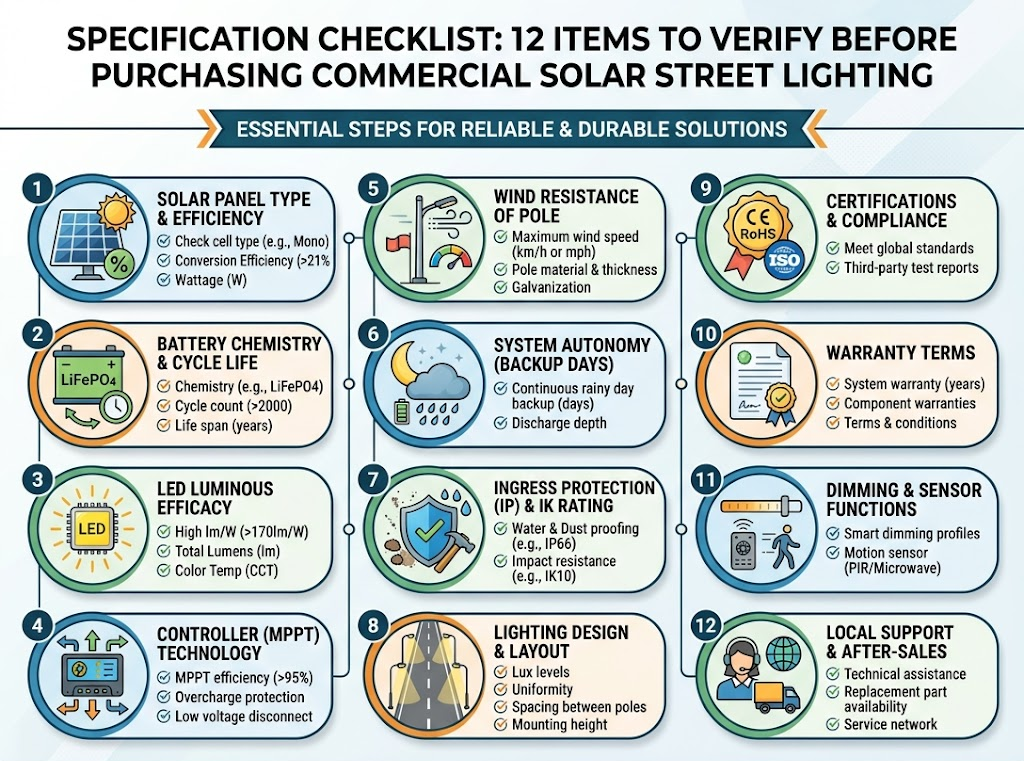
Most of the failures with solar street lights are specification failures rather than manufacturing failures. Whether you are selecting LED luminaires for use in a parking installation or selecting a complete solar street lighting system for use in a highway project, this checklist of 12 items covers the technical and contractual issues which distinguish a valid commercial-grade purchase from a repeat-order cycle.
- System efficacy in lm/W – not just wattage. 100 W fitting at 150 lm/W gives you 15,000 lm. At 80 lm/W this would be only 8,000 lm. Same power, half the light.
- Battery Chemistry provided – LiFePO4 or lead acid power pack with cycle life to 80% stated in the datasheet.
- Autonomy rating recorded – your worst uninterrupted string of overcast days running at full rated capacity at your project latitude
- Steel standard of pole: Q235 or ASTM-GR65; nature of galvanisaion: HDG (hot-dip, ISO 1461) or CDG (cold-dip).
- All outdoor parts should be IP rated min. of IP65 and battery enclosures rated to IP67 in flood risk zones.
- LED test standard—ANSI/IES LM-80-20 for package lumen maintenance. Reject datasheets claiming “25,000h lifespan” without an accompanying LM-80 test data.
- Life rating method—ANSI/IES TM-21 projection to L70 (70% lumen maintenance).Marketing-stated “50,000h”without TM-21 is not verifiable.
- Photometric IES file is available-for RP-8-22 / IES RP-20 compliant modeling in AGi32 or Visual photometric software.
- MPPT controller- specs- maximum power point tracking efficiency (93 %), over charge and over-discharge voltage levels, BMS specs for LiFePO4.
- CE declaration of Conformity – with specified test-house reference number. Self-declarations without third-party tests are aweak contract.
- ✔ Foundation drawings and EPA calculation — on request. Suppliers without engineering documentation create liability for the buyer.
- ✔ Warranty terms in writing — parts vs. labour vs. replacement unit, response time SLA, and which party bears shipping costs for warranty claims.
Frequently Asked Questions
What are the disadvantages of a solar street lighting system?
The main disadvantages are higher upfront cost compared to grid-tied lighting (before ITC and without accounting for trenching savings), reduced performance at high latitudes above 50°N, sensitivity to shading from trees or buildings, vandalism risk for panel hardware in remote locations, and a planned battery replacement every 5–7 years (LiFePO4). Sites with existing low-cost grid access and heavy tree canopy typically see payback periods of 8–12 years.
Why do solar lights fail so quickly?
Failures in commercial solar lights always come down to one of four issues: Under-sized batteries to meet (autonomy < 2 days), a chemistry mismatch (LiFePO4 inside a load and climate profile demanding lead-acid), a non-existing or defective BMS permitting overdischarge, or cheap LED chips (50-80 lm/W versus 150+ lm/W commercial grade) which drain the battery faster than the panel can replace it. At the bottom of the it all, the worst fixtures hit all four from day one.
Are solar-powered street lights any good?
Yes, for properly engineered commercial applications. Smarter solar street lights can achieve 150-190 lm/W efficacy, 50,000+ hours LED ratings (per ANSI/IES LM-80 testing), 2,000+ battery cycles in LiFePO4 chemistry, and 20+ years poles service life without maintenance when properly specified. This is knowable from real installations from DOT contractors, municipalities, and industrial operators. It just takes proper specification: “solar street light” covers a spectrum from $80 residential garden fixtures to $2,000 commercial grade systems designed for AASHTO RP-8-22 standards.
How much does a streetlight pole cost?
A standalone hot-dip galvanized steel light pole (without fixture) runs approximately $300–800 for 4–8 m heights, depending on wall thickness and steel grade. As a complete solar street light system — including fixture, LiFePO4 battery pack, MPPT controller, pole, and anchor bolts — installed cost ranges from $800 to $2,000 per unit at commercial scale (50+ poles), before any federal ITC credit.
Are solar street lights worth the money?
For grid-remote locations, yes – frequently by a large margin. Avoiding trenching and grid extension $1,200-3,500 per pole makes solar the lowest total cost option even before considering the 30% federal ITC available through 2032 under IRC Section 48. For locations with grid access and low utility costs, payback can extend to 8-12 years. As utility prices increase, or project scale is raised, this calculation gets better.
How long do solar street lights last?
Commercial solar street lighting has three distinct service horizons: LED array lifespan calculated at 50,000+ hours (roughly 11 years at 12 hours per night, validated to ANSI/IES LM-80), LiFePO4 batteries providing 2,000+ cycles before reducing to 80% charge capacity – roughly 6-8 years of daily cycling, and monocrystalline solar panels rated for 20-25 years at 80-85% of original power output. Hotdip galvanized poles surpass the other components at 25-50 years.
What are the hidden costs of cheap solar street lights?
The largest unseen cost is early battery replacement – as soon as 18 months for undersized lead-acid batteries in a commercial application and load profile at the cost of $80-120 per pole plus labour time. 50-80 lm/W LED chips empty batteries faster robbing the array of autonomy, necessitating a 2-day minimum. Missing EPA calculations on poles increases structure liability when the pole receives a guarantee violation. And sources that lack LM-80 test data have no way of supporting that any component lasts for the claimed lifespan.
About This Buyer’s Guide
This guide was written and reviewed by the Guangqi Lighting engineering team – specialists in LED outdoor lighting based in Zhongshan, China, who have been manufacturing solar and grid-tied street light systems since 2010. All products are CE, RoHS, and IP65/IP66 certified. For engineering quotes, photometric layouts, or project sizing specific information, visit the solar street lights with pole product page or use the calculators throughout this guide.
Note on tax credit info that may be presented in this guide: this should not be taken as tax advice. For information specific to your project, please consult a tax professional.
Related Articles
Trending now