Get in Touch with GUANGQI



Updated October 2026
LED light bulb flickering is a repeated change in a lamp’s brightness. Common causes of flickering may include an incompatible dimmer, a lamp or driver problem, and an unstable electrical connection or supply. First identify which lights flicker and when. Burning smells, damaged fittings, shocks or flickering that keeps happening without any explanation call for an electrician, not more bulb replacements.
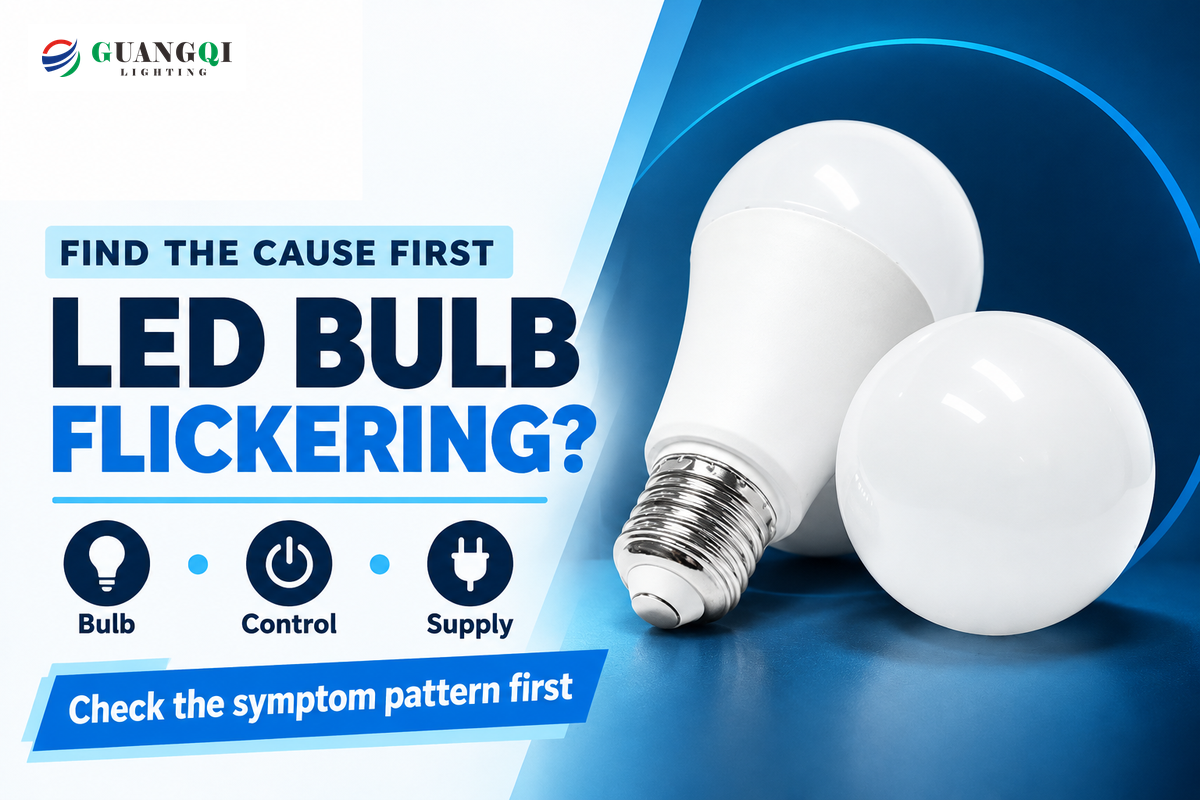
LED light bulb flickering can come from the bulb, its controls or the electrical supply. Check the symptom pattern and exact bulb/control match first. Stop using damaged equipment and have electrical warning signs investigated.
Before you buy another bulb
- A dimmable label doesn’t make every bulb and dimmer a compatible pair.
- A bulb that works elsewhere can still behave differently on the original control.
- Faint light after switch-off can involve an electronic control’s standby current.
- Unexplained flickering across rooms needs electrical investigation.
1. Start with the pattern: one bulb, one group, or the whole home
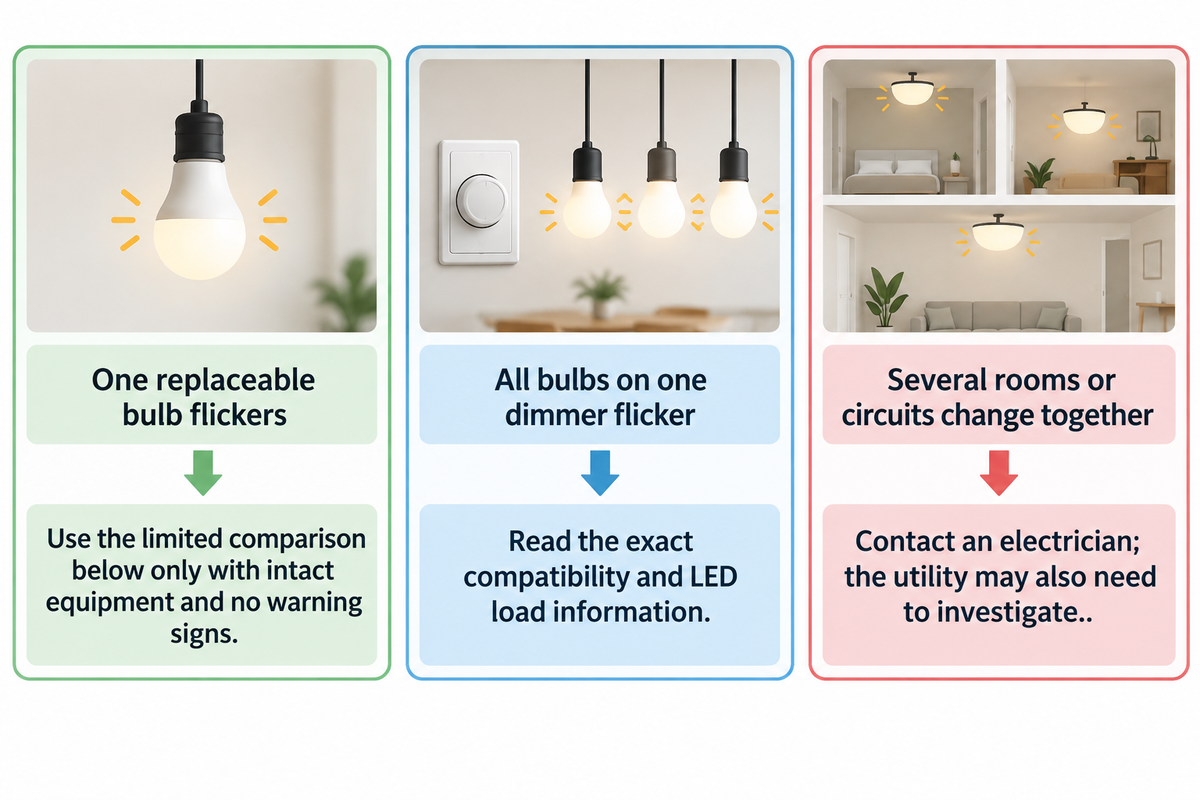
One flickering bulb points toward its lamp, fittings and control. Changes in several lights together may point to a problem with their shared supply. Make a note of the pattern first. Change that’s unexpected and unexplained warrants attention. Circuit faults can’t be ruled out by replacing a bulb.
Dim or flickering lights are also mentioned by the Electrical Safety Foundation among home wiring warning signs. It also has switch safety guidance that mentions lights getting brighter or dimmer when appliances are turned on. Leave an unusual buzz from a switch, discolored wall plate or repeated breaker trip to a licensed electrician.
| What you notice | What to consider | Next action |
|---|---|---|
| One replaceable bulb flickers | Lamp condition, seating or its control pairing | Use the limited comparison below only with intact equipment and no warning signs. |
| All bulbs on one dimmer flicker | Shared dimmer, lamp mix or loading | Read the exact compatibility and LED load information. |
| Shimmer only at low brightness | Minimum usable dimming level | Use documented, externally accessible low-end trim. |
| Glow or periodic flash while off | Electronic control current or another circuit issue | Record how the light was switched off; review the control type. |
| Flicker begins after warming up | Enclosure suitability, lamp or driver condition | Stop the trial; examine the product ratings after isolation and cooling. |
| Brightness changes when an appliance starts | Supply or connection issue needing investigation | Record the timing and arrange an electrician’s inspection. |
| Several rooms or circuits change together | A shared electrical supply issue | Contact an electrician; the utility may also need to investigate. |
| Stripes appear only in video | Light modulation interacting with the camera | Separate recording performance from a visible-light complaint. |
| A smart bulb flashes after a settings change | App state, firmware or control compatibility | Use the model’s support instructions; avoid generic reset sequences. |
A momentary voltage change can coincide with a motor starting, but timing alone cannot identify the fault. Loose connections and voltage fluctuations are the responsibility of an electrician, especially when many light fixtures change brightness together. If your lights are flickering or buzzing, note where the sound comes from without opening anything. Never repeatedly start an appliance in an attempt to reproduce an electrical warning sign.
2. Check the bulb without opening the wiring
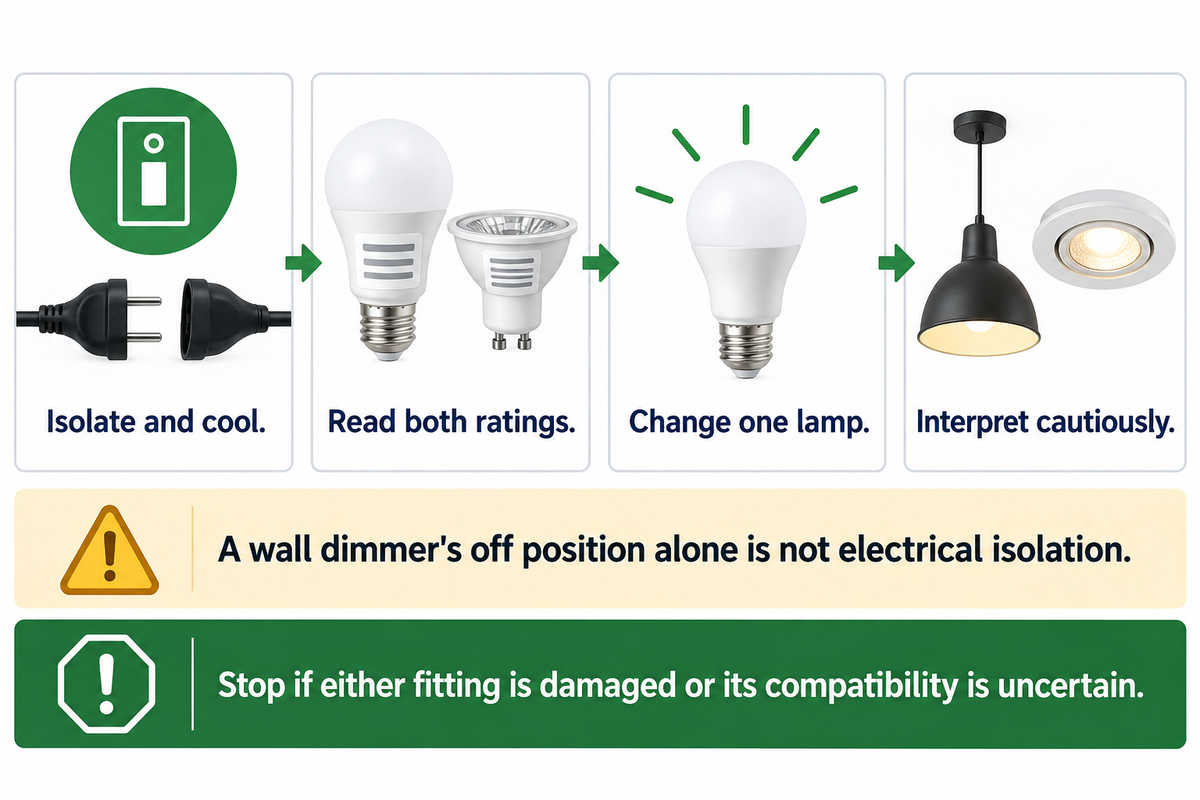
A step-by-step bulb comparison is a troubleshooting aid that assists in isolating a flickering complaint to a specific lamp or an installation condition. It can be performed on an easily accessible, intact, user-replaceable bulb provided it has the correct ratings and a compatible test fitting. Otherwise, damaged sockets, sealed lamps, and anything requiring wiring access should be assessed by a qualified person.
How do you stop LED light bulbs from flickering?
Correct the condition or mismatch by ensuring a compatible lamp/control pair, setting the approved dimming range, or replacing a faulty, properly specified bulb. Electrical warning conditions take precedence. If no explanation for the condition is found, arrange for an inspection rather than move suspect bulbs until the condition or symptom disappears.
Follow-the-Bulb Check
The Follow-the-Bulb Check compares an intact lamp in compatible fittings with power isolated prior to each move. It may assist in narrowing the next step in the investigation.
- Isolate and cool. Turn off the light and disconnect its supply: unplug a portable lamp, or isolate a fixed fitting at its breaker. Let the bulb cool. A wall dimmer’s off position alone is not electrical isolation.
- Read both ratings. Match base, supply voltage, permitted wattage, enclosure use and dimmability. The comparison bulb must also suit the installed control.
- Change one lamp. With the power isolated, fit a known-working, compatible replacement. Restore power only after the lamp is seated normally and your hands are clear. Observe using the normal controls.
- Interpret cautiously. If needed, compare the original intact bulb in another suitable fitting. Isolate and cool both fittings before moving it. Stop if either fitting is damaged or its compatibility is uncertain.
If flickering follows the originally suspected lamp into a suitable comparison fitting, that lamp becomes a stronger candidate for replacement. If several other compatible bulbs in the same fitting flicker, the control or supply system requires further assessment. Neither of the previous two conditions identifies a loose terminal, and neither justifies opening the fitting.
The conditions cited in the flicker research of the DOE matter because driver loading, dimming level and the dimmer’s waveform may affect output. Different fittings may also affect conditions beyond the bulb’s location.
Example: one new lamp shimmers in a kitchen pendant, while the others remain steady. A maintenance person first records the new lamp’s model and the existing dimmer. A replacement from the tested compatibility list may solve the lamp’s behavior without replacing every bulb. Moving the suspect lamp to a plain table lamp offers another observation, but removes the original dimmer from the comparison. If the suspect lamp now looks steady, a sensible next step is to check the original pairing. Calling old bulbs “definitely good” ignores changes in conditions. Abnormal switch noise, a hot fitting or a damaged lamp base ends the comparison.
3. Fix flickering LED bulbs on a dimmer
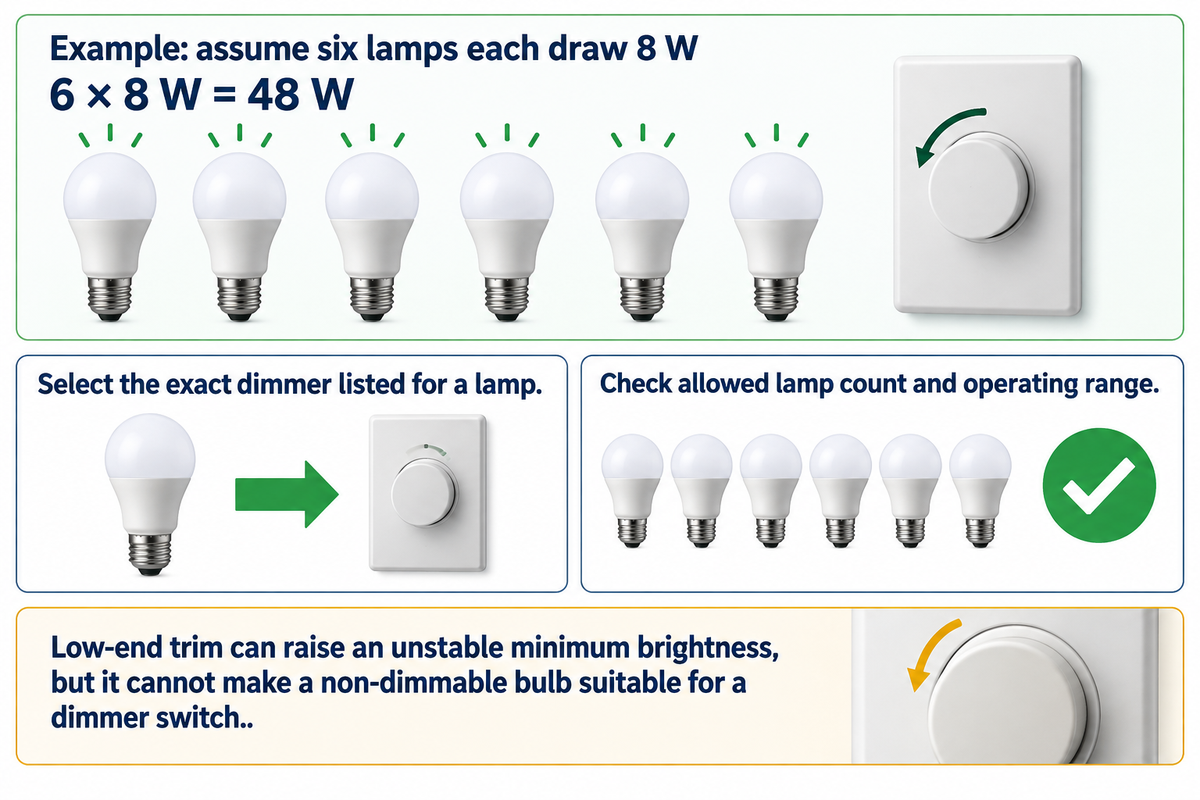
Flickering LED lights on a dimmed circuit require a matching dimmable lamp and control, not simply a dimmer labeled for LEDs. Check allowed lamp count and operating range. Low-end trim can raise an unstable minimum brightness, but it cannot make a non-dimmable bulb suitable for a dimmer switch.
How do I choose a compatible LED bulb and dimmer when the lights flicker at low brightness?
Select the exact dimmer listed for a lamp. Then check the tested quantity of lamps and the dimming range. Some LED dimmers provide external low-end trim. Start at a stable higher setting. Follow the model’s instructions to raise the minimum level, if necessary; stop if adjusting level would require access to the wiring.
An incompatible dimmer can cause LED lights to flicker, drop out or turn on abruptly. ELECTRICAL CONTRACTOR’s 2024 dimming guide explains why Lutron and Leviton test specific lamp and dimmer combinations. “LED compatible” and “designed for LEDs” are product categories. The pairing list explains installed combinations.
Read the LED rating of a control, and don’t reuse the incandescent rating for dimming. Minimum load can be specified with a tested number of lamps. Maximum loading also includes the current drawn at switch-on; therefore, dividing an old incandescent wattage by a new bulb’s wattage can yield an incorrect answer.
Example: assume six lamps each draw 8 W and are labeled “60 W equivalent.” Their operating power draw is 6 × 8 W = 48 W, not 360 W. The equivalent figure describes brightness compared with incandescent bulbs. A buyer could therefore misread both the lamp label and the control rating while assembling the same order. The useful purchase decision is whether those six exact lamps appear within that dimmer’s tested LED limits. Even a control with a higher nominal LED watt rating still needs the correct load type and any installation derating. Have the installer handle those requirements rather than adding lamps merely to satisfy an assumed threshold.
Some controls operate on the leading edge of the supply waveform and some operate on the trailing edge. Some combinations of LEDs work with either phase; others require a particular phase. Electronic and magnetic low-voltage systems introduce additional requirements. Blindly replacing all the old controls with a reverse-phase dimmer is an expensive gamble, especially if there’s no compatible lamp and transformer support.
Many smart bulbs expect a steady supply and adjust their own brightness. A non-dimmable smart bulb shouldn’t be placed on a wall dimmer on the assumption that the highest brightness setting makes it acceptable. Also keep commercial driver protocols separate. A commercial lighting control system using 0–10V or PWM control is a different control arrangement from a household screw-in bulb.
4. Understand flashing or glowing after switch-off
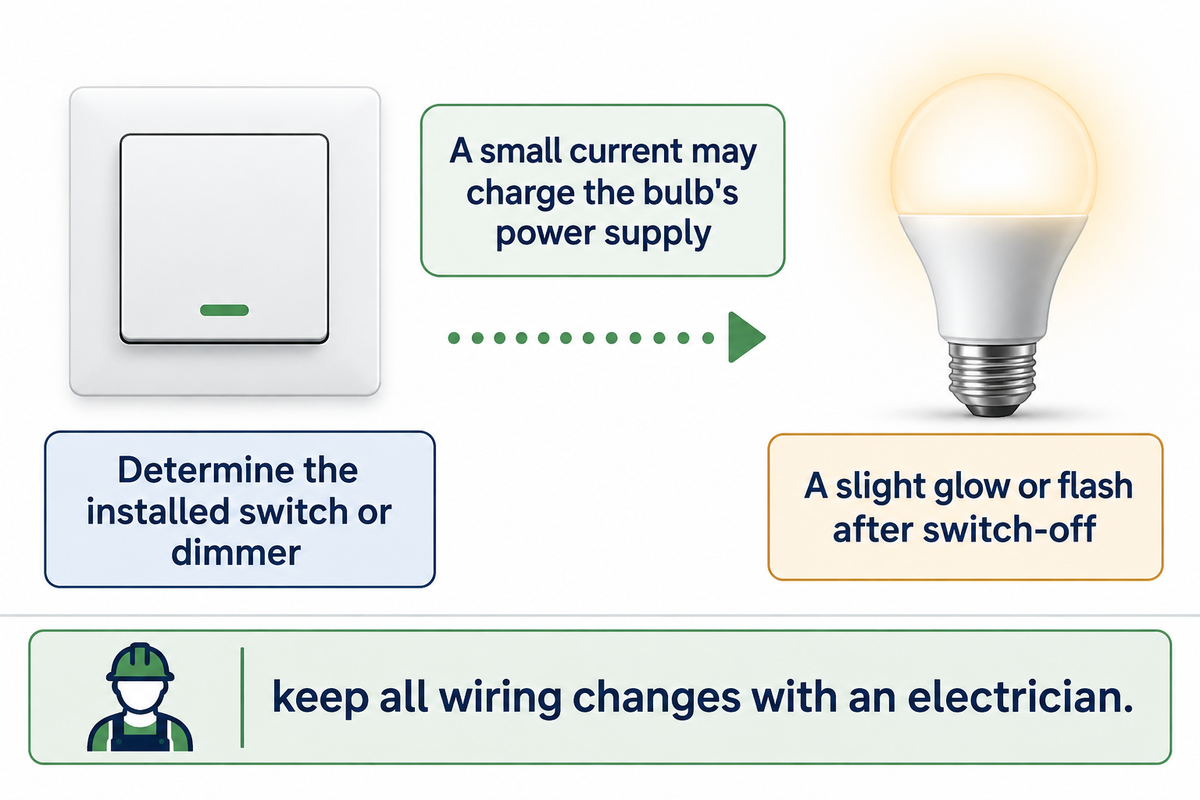
A slight glow or flash after switch-off may occur when an electronic control passes a small current through a sensitive LED lamp. The control may need that current to power its own electronics. Determine the installed switch or dimmer before selecting a remedy, and keep all wiring changes with an electrician.
In some non-neutral smart controls, the load is part of the electronics’ standby power path. A small current may charge the bulb’s power supply, and briefly produce light. This is different from rapid flickering while the lamp is on, and different from a smart bulb that’s turned off via an app while its wall supply is still on.
Record the precise off state of the load. Record the off state precisely: Was it switched off by the wall switch, dimmer button, a command in the app, or a timer? Records of these states are often confused in forums. The record can help the installer distinguish between controls and other electrical causes. The record may also prevent the installer from treating every off-state pulse as a dying lamp.
Do
- Identify the exact lamp and control models.
- Use a tested replacement lamp when appropriate.
- Have an electrician handle control replacement.
Don’t
- Assume off means electrically isolated.
- Add a generic resistor or capacitor across the lamp.
- Use a switch-only accessory on a dimmer.
A specific example of that last restriction is the Lutron LUT-MLC: it’s intended for specified digital switches and not for dimming devices. That’s a product-specific boundary, not a universal “anti-flicker capacitor” solution. A neutral-required control may be an option for the installer where the circuit and lamp requirements support it.
5. Check heat, the driver, and 12V transformers
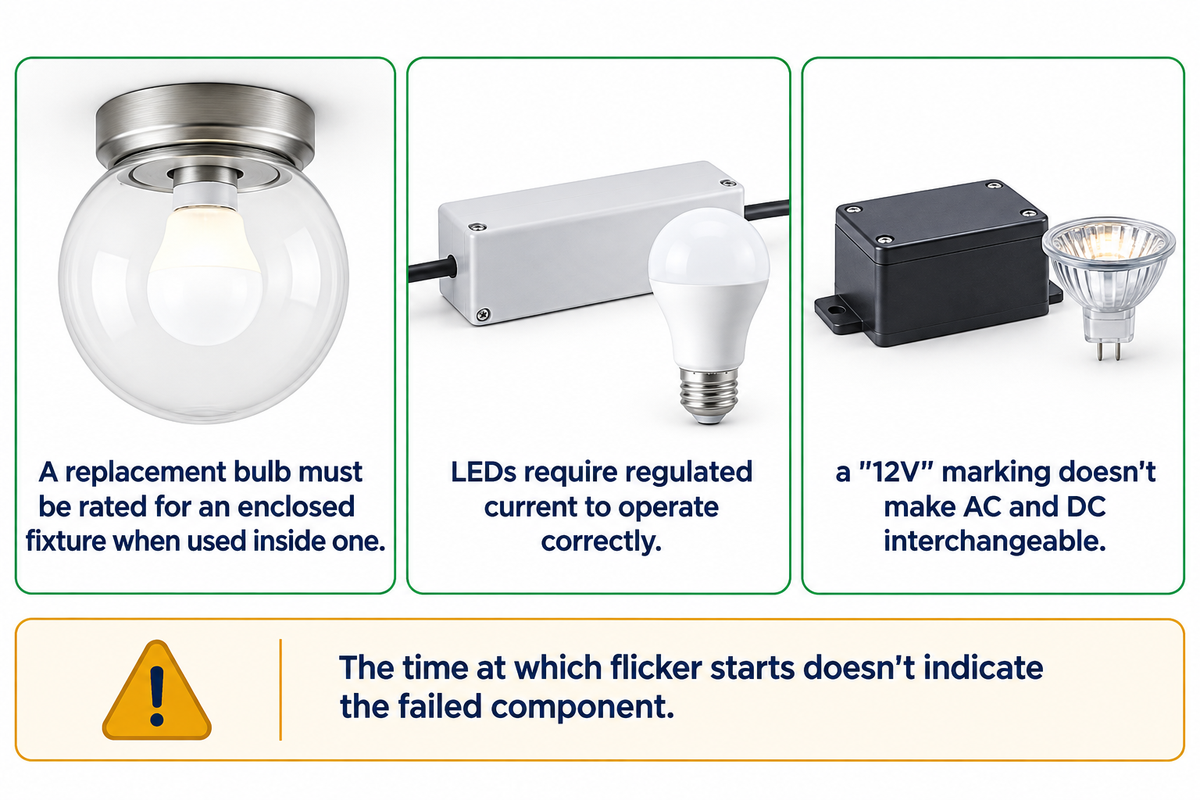
A flickering light after warm-up calls for a check of lamp suitability, as well as the entire power configuration. A replacement bulb must be rated for an enclosed fixture when used inside one. Low-voltage lamps require the specified AC or DC supply and a compatible transformer. The time at which flicker starts doesn’t indicate the failed component.
LEDs require regulated current to operate correctly. The LED driver performs this function, either in a bulb, or in a separate component in a fixture. In the case of a driver failure, light can be interrupted, even if the diode is still functioning. Replacing or opening an internal driver is beyond the scope of a normal bulb replacement.
The DOE/PNNL lighting specification guide, page 26, notes that many retrofit LED lamps aren’t rated for enclosed luminaires. Thus, a lamp used in a closed globe or lensed downlight needs to be a lamp specifically rated for that function. Don’t remove the lens or alter the housing of an unsuitable lamp to run it cooler.
Does a flickering light bulb mean it’s about to go out?
Yes, a failing bulb can flicker; new LED bulbs can flicker because of an incompatible control too. Heat-related faults can involve the fitting and/or driver. Check the pattern and product before replacing a batch; don’t use damaged equipment.
With 12V lamps, the voltage number alone is incomplete. Where LEDs draw less power than the old halogen lamps, an electronic transformer may struggle to operate with the lighter load. Its startup behavior matters alongside its nominal wattage. Use the lamp maker’s tested transformer pairing, supply type and dimming requirements; a “12V” marking doesn’t make AC and DC interchangeable.
Long outdoor cable runs can also present a problem. A damaged connector or excessive landscape lighting voltage drop can affect the light at the end of the run. Have loaded voltage and connection checks performed by someone qualified. Buying a larger transformer without finding the loss can leave the same problem in place.
When ordering, remember that an LED driver and its output ratings are not the same as a fluorescent ballast. If a discharge lamp or tube retrofit is used in the original fitting, follow the correct ballast and replacement-lamp arrangement and not screw-in bulb advice.
6. Separate camera banding from visible flicker
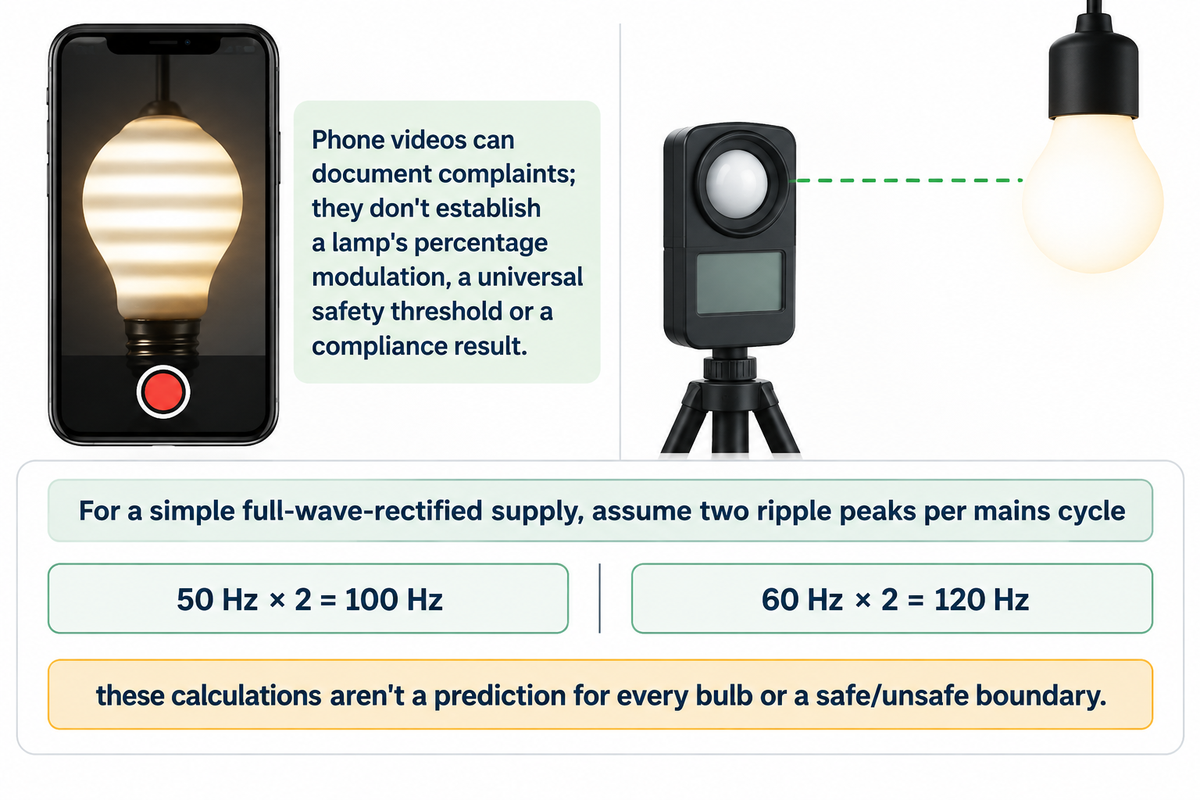
Camera stripes and visible flicker describe different observations of changing light output. Phone videos can document complaints; they don’t establish a lamp’s percentage modulation, a universal safety threshold or a compliance result. Separate the camera conditions from what people see in the room.
“Flicker is a catch-all phrase that we use for changes in light output over time.”
An incandescent tungsten filament maintains its temperature between changes in the supply current. An LED responds much faster, so its driver must smooth or otherwise control the delivered current. Different driver designs can produce very different waveforms. PWM (pulse width modulation) is one way to change the intensity of light. PWM frequency, however, isn’t an indication of the whole result.
For a simple full-wave-rectified supply, assume two ripple peaks per mains cycle: 50 Hz × 2 = 100 Hz, or 60 Hz × 2 = 120 Hz. That explains one possible modulation frequency. An LED driver can change the amplitude and waveform substantially, so these calculations aren’t a prediction for every bulb or a safe/unsafe boundary.
Miller and colleagues’ 2022 review separates the stimulus from the responses (i.e. flicker, phantom array, stroboscopic effect, etc.). Strobing can also create a discontinuous visual image of a moving object. People vary in sensitivity to slight flickers; an observer not seeing a slight flicker doesn’t invalidate a complaint. Movement of the eye can also change the appearance.
Compare lighting in a workspace used for recording with the intended camera before a large purchase. Keep the test camera and its settings consistent. Where a specification calls for measured flicker performance, use an appropriate measurement report covering the intended operating conditions, not a phone clip.
7. Choose the right replacement and know when to call an electrician
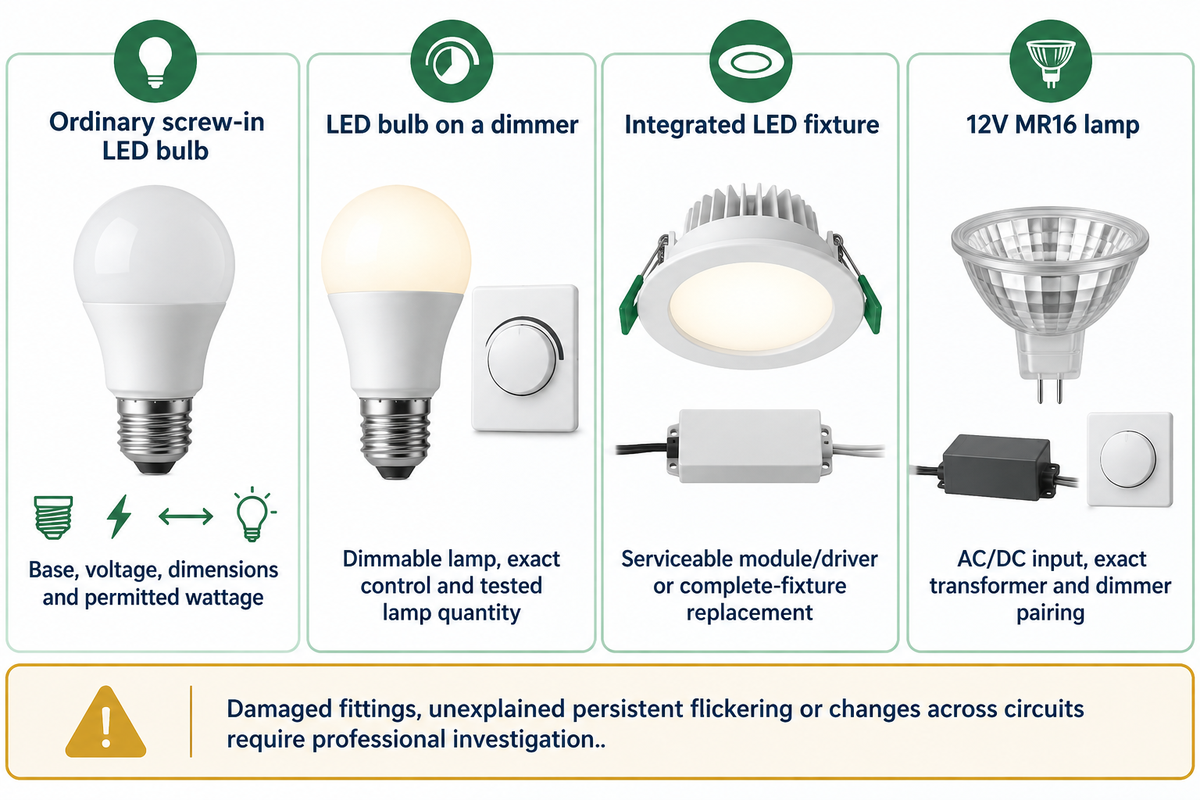
Replace the component indicated by the symptom and compatibility checks, giving priority to electrical warning signs. One correctly specified bulb may be sufficient for a lamp problem. A whole dimmer group may need a matched lamp/control solution. Damaged fittings, unexplained persistent flickering or changes across circuits require professional investigation.
| Replacement situation | Match before ordering | What changes the decision |
|---|---|---|
| Ordinary screw-in LED bulb | Base, voltage, dimensions and permitted wattage | A physical fit alone does not establish electrical suitability. |
| LED bulb on a dimmer | Dimmable lamp, exact control and tested lamp quantity | An unstable dimming range may need a different pairing. |
| Smart LED bulb | Supply and control method allowed by its instructions | A conventional dimmer may be unsuitable. |
| Enclosed globe | Lamp explicitly rated for enclosed use | An open-fixture-only bulb is the wrong replacement. |
| Recessed downlight lamp | Existing housing, lens, base and thermal suitability | An integral module may require a different replacement route. |
| 12V MR16 lamp | AC/DC input, exact transformer and dimmer pairing | An old halogen transformer’s behavior may prevent reliable operation. |
| Integrated LED fixture | Serviceable module/driver or complete-fixture replacement | A sealed light source is not a user-replaceable bulb. |
| Outdoor replacement bulb | Location rating, fitting and supply arrangement | Moisture damage ends a consumer comparison. |
| Fluorescent or CFL fitting | Lamp type and any required ballast/retrofit path | Never infer compatibility from shape or brightness equivalence. |
Is replacing the bulb or the dimmer the cheaper way to fix flickering LED lights?
A compatible lamp replacement bulb is usually the smaller purchase when the lamp is the problem. A control replacement adds the device, installation and setup. When several lamps share the symptom, compare the whole repair scope before buying a batch; the cheapest part cannot correct a fault elsewhere.
Example: the property manager has a collection of downlights that match and shimmer around minimum brightness. It would eat up the maintenance budget to replace all of the downlights before checking whether the existing dimmer’s low-end range can be adjusted. The installer checks the documented range and the exact lamp models. If an approved adjustment provides stable operation, a purchase may not be necessary. If the pairing is unsuitable, compare a tested lamp set against an installed control change, including labor and any required wiring work. For procurement, the useful unit of comparison is the complete working group. For maintenance, it’s reliable operation across the range people actually use.
Which LED bulb brands should I buy to avoid flicker with my existing dimmer switch?
Buy an exact bulb model tested with your existing dimmer rather than choosing by brand alone. Use the control maker’s compatibility tool along with the lamp’s instructions. A familiar brand may sell products with different drivers and dimming ranges; keep the model number on the order and test the intended group before buying in quantity.
Keep the product spec and one replacement record for the owner, installer, and purchasing team: lamp model and batch, control model, the number of lamps, enclosure type, input supply and the brightness setting where the problem occurs. Record any inconsistency between the lamp models in the group. Include the status of the recall. CPSC recall records can distinguish models and batches, so a matching brand name is insufficient.
For a reflector lamp, use the separate Guangqi flood-bulb replacement guide to match shape and application after resolving the flickering complaint. For a commercial fixture project, send the details of the lamp, driver and control models to Guangqi prior to placing an order for replacement parts.
Frequently asked questions
What is the average lifespan of an LED bulb?
Use the rated hours on the particular bulb, rather than a universal average.
Rated life is a product specification under stated operating conditions, not a countdown to a flickering failure. An enclosed fitting, unsuitable control or another component problem can affect performance before that rating is reached. Keep the packaging or model record so the manufacturer can identify the applicable rating and warranty. A flickering bulb still needs the same symptom and compatibility checks as a newer lamp.
When should you not use LED bulbs?
Do not install an LED bulb where its ratings or instructions do not permit the application.
Examples include a non-dimmable bulb on a dimmer, an open-fixture-only bulb inside a closed globe, or a low-voltage lamp connected to the wrong supply type. The lamp must also match the base, permitted wattage and environmental conditions of the fitting. A damaged socket needs attention before a replacement is installed. Choosing LED technology doesn’t override the requirements of the complete fixture.
Do I need to upgrade my recessed fixtures to LED?
A suitable replaceable LED lamp may work in an intact housing; an entire fixture upgrade is not always necessary.
First identify whether the downlight contains a replaceable lamp, a retrofit module or an integrated light source. A replacement lamp must suit the lens, enclosure, base and control. A retrofit kit follows its own installation instructions, while a new hardwired fixture requires appropriate installation work. The DOE/PNNL guide distinguishes these routes because they change both the components purchased and who can install them.
Why does a new LED bulb flicker on a normal switch?
A dimmer is not required for a bulb, fitting or supply problem to cause flickering.
Check the product ratings and whether the symptom affects other lights. An unexplained fluctuation, damaged fitting or persistent problem needs professional investigation. Don’t assume the new bulb is good simply because it’s new.
Can flickering LED lights damage other electronics?
The visible flicker alone does not show that other electronics are being damaged.
A supply disturbance can affect more than the lighting, but a lamp/control mismatch can produce a local light-output problem. Distinguish those possibilities before drawing a conclusion about other equipment. Record simultaneous resets, unusual brightness changes or other symptoms for an electrician. A bulb change isn’t a remedy for an electrical supply fault.
Can I use an incandescent bulb to stop LED flickering?
Sometimes a different load changes the behavior of a control; use only an arrangement permitted by its instructions.
Use only lamp types and loading arrangements permitted for the fixture and control. A tested, compatible LED pairing is a better permanent purchasing target than mixing loads to hide an unexplained symptom.
Why do LED lights flicker in slow motion?
Slow-motion recording can reveal changing light output that appears steady during ordinary viewing.
The recording pattern also depends on the camera’s capture conditions. Rapid flickering in a clip doesn’t provide a calibrated modulation depth or identify a failing driver. For video work, test the intended lighting and camera together at the brightness levels you’ll use. For a product performance requirement, obtain measurements under the specified conditions.
The comparison method covers intact, user-replaceable lamps. Electrical installations, diagnosing issues inside fittings and driver repairs should be done by qualified personnel.
References & Sources
- Home Wiring Safety Tips Electrical Safety Foundation.
- Switch to Safety Electrical Safety Foundation.
- Flicker Research U.S. Department of Energy.
- LED Lamp Dimming: Some care is needed to ensure good performance ELECTRICAL CONTRACTOR, February 2024.
- Lighting Specification Guidance for Schools U.S. Department of Energy / Pacific Northwest National Laboratory, November 2024, pages 26–27.
- Flicker Basics U.S. Department of Energy, 2018.
- Flicker: A Review of Temporal Light Modulation Stimulus, Responses, and Measures Miller and colleagues, Lighting Research & Technology, 2022.
- SATCO Products Recalls KolourOne LED Light Bulbs U.S. Consumer Product Safety Commission, March 2014; model/batch identification example.