Get in Touch with GUANGQI



Updated November 2026
e26 vs e27 refers to a lamp base comparison where circuit voltage and base certification separate the two assemblies cleanly. Both screw caps share an overlapping outer major diameter (26.05–26.41 mm for E26 and 26.05–26.45 mm for E27) and a 3.629 mm thread pitch. E26 serves 120V North American circuits with a shorter bottom insulator, while E27 commonly pairs with 220–240V IEC markets and a taller insulator barrier.
An E26 bulb fits mechanically inside an E27 socket and will screw in the socket cleanly. That physical fit hides real electrical and code risks. Answering this US bulb question starts with voltage: single-voltage 230V E27 lamps can’t run properly on US 120V fixtures, and putting a 120V E26 lamp into a 230V E27 fixture causes burnout and fire hazards. When in doubt, check line voltage, fixture listing and barrel fit first.
E26 vs E27 Meaning: What 26 and 27 Measure and Why Both Exist
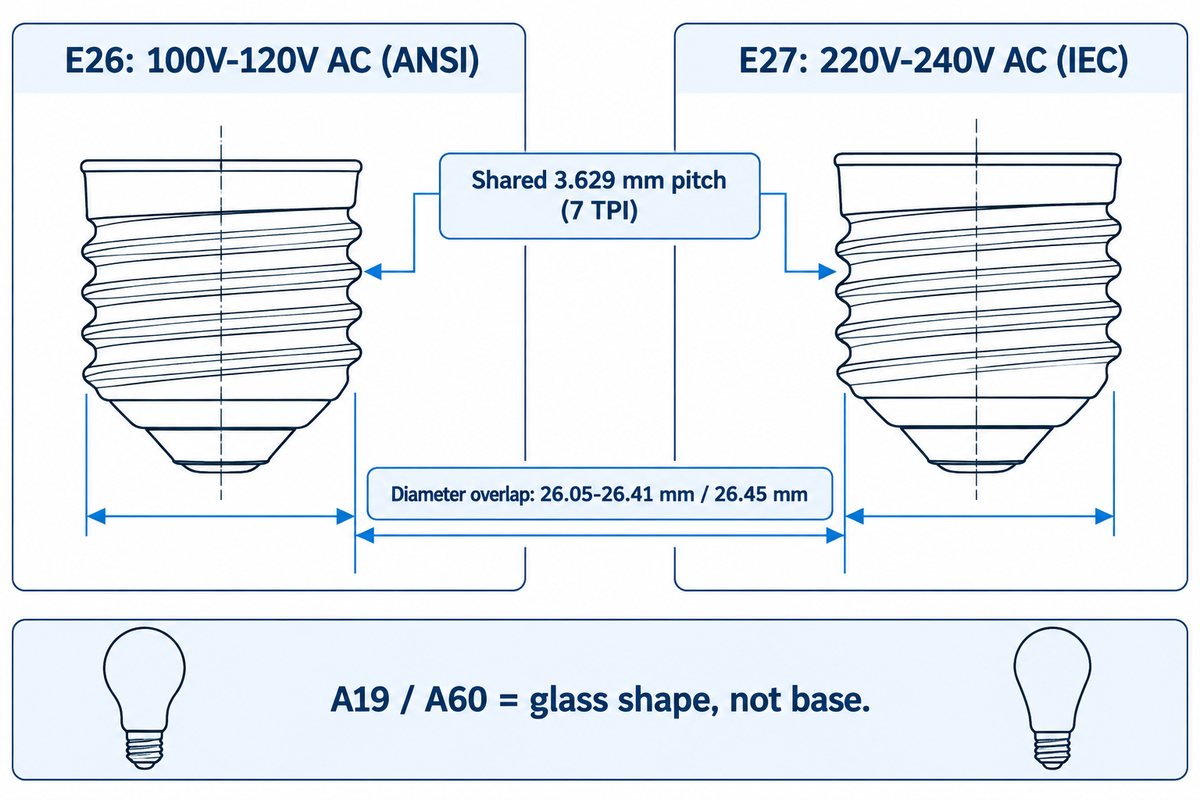
The letter “E” stands for Edison screw, while 26 and 27 denote two distinct medium screw base designations. North America and Japan commonly deploy E26 on 100V to 120V residential power. Europe and most IEC countries commonly build E27 fixtures around 220V to 240V AC grids. Under U.S. DOE FEMP lighting specifications, covered North American grid lamps require ANSI standard bases such as E26 and nominal input-voltage ratings of 120, 240, or 277 VAC (or 12 or 24 VAC or VDC).
Buyers importing lighting fixtures may be wondering if E26 and E27 bulbs are interchangeable. The key difference between E26 and E27 sits in voltage rating and insulator height, not outer thread width. Many engineers assume that E26 and E27 screws differ by a full millimeter in diameter. Others claim E27 uses a wider thread spacing of 2.7 mm.
Neither of the above assumptions is valid under real gauge specifications. Although many guides shorthand that E26 is 26mm and E27 is 27mm in label name, E26 and E27 lamp bases actually overlap across the shared 26.05–26.41 mm band (up to 26.45 mm for E27). Both E26 and E27 standards enforce an identical 3.629 mm thread pitch, equal to 7 threads per inch. Instead of increasing thread pitch, supplier-cited IEC sheet 7004-21-9 dimensions show greater creepage insulation distance over the bottom skirt.
The confusion of base type with glass bulb shape results in many buying errors. Codes like A19 and A60 describe the pear-shaped glass globe, not the threaded base underneath. A North American pendant light typically unites an A19 glass shape with a 120V E26 base. A European pendant would normally use an A60 globe with a 230V E27 lamp base.
Wide-voltage switching drivers have homogenized some regional differences in lamps. Certain LED bulbs accept any input from 90V AC to 240V AC regardless of shell stamping. However, incandescent bulbs, halogens, and single-voltage LED lamps remain locked to their line voltage.
E26 vs E27 Bulb Base Dimensions, Screw Thread Pitch, and Base Size
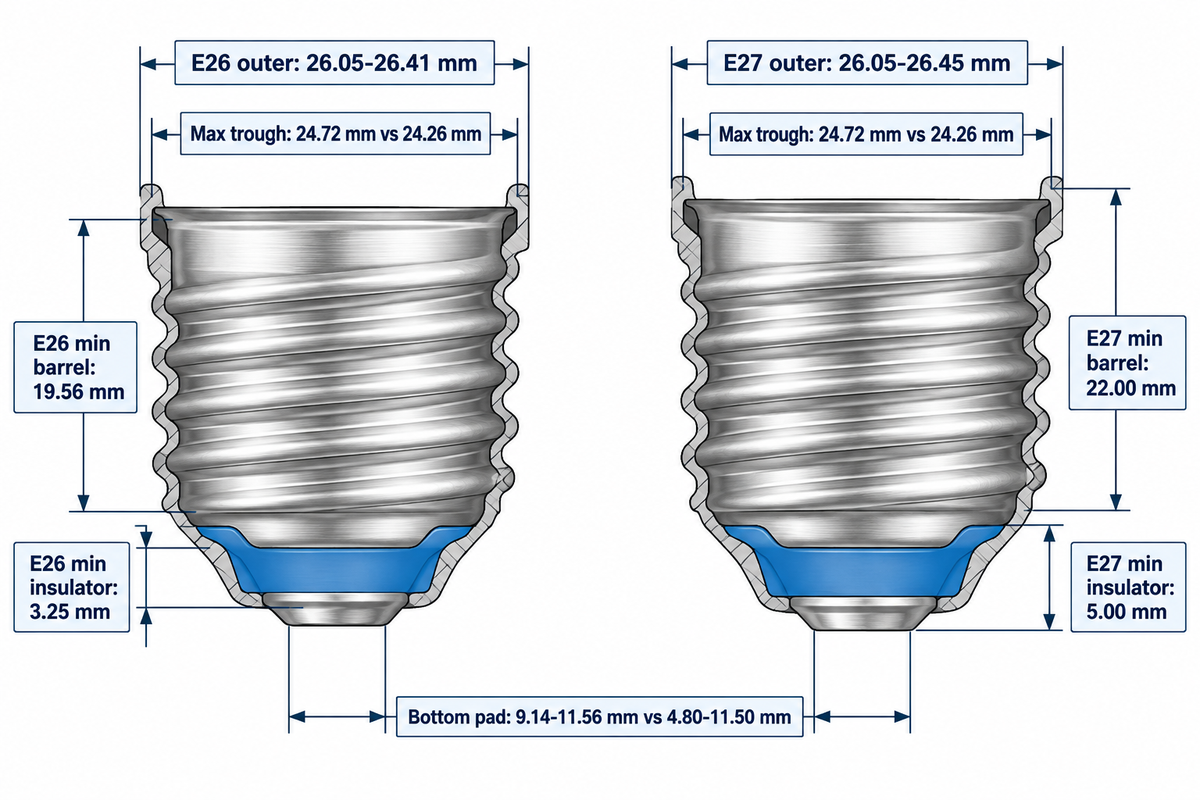
E26 and E27 metal caps overlap from 26.05 mm to 26.41 mm in outer thread diameter, with E27 extending up to 26.45 mm. Their tabulated mechanical differences lie in screw barrel length and insulator skirt height, where vendor-cited sheets list 19.56 mm vs 22.00 mm minimum barrel length and 3.25 mm vs 5.00 mm minimum insulator height.
This is similar to having two house keys with identical tooth spacing, but with one key having a shorter min. sleeve. Both keys will go into the lock, but the key with the shorter sleeve may not engage the back latch in a deep cylinder. This geometry explains how shallow E26 caps behave inside deeper E27 sockets.
North American 120V fixtures use E26 bulbs, whereas European 230V lamps use E27. Both screw bulbs are designed for use in medium screw sockets across different grids. Waveform Lighting’s comparison table lists minimum insulator heights of 5.00 mm for E27 caps and 3.25 mm for E26 caps. That lamp-cap measurement alone does not establish compliance with IEC 60238 lampholder creepage requirements at 250V. EN IEC 60238:2018 applies to E14, E27, and E40 Edison screw lampholders up to 250 V r.m.s. Waveform Lighting lists minimum screw lengths of 19.56 mm for E26 and 22.00 mm for E27; seating depth and center-contact engagement are determined by the actual cap and lampholder geometry. E27 caps also list a 24.26 mm maximum thread trough, while E26 lamp bases list a 24.72 mm maximum trough.
This specification table shows an example comparison of two Medium Edison screw dimensions. The manufacturer-cited IEC 7004-21A-2 and 7004-21-9 comparison lists E26 dimensions of 26.05–26.41 mm for outer thread diameter, 19.56 mm for minimum sleeve length, and 3.25 mm for minimum insulator height.
| Specification Parameter | E26 Base Standard (North America / Japan) | E27 Base Standard (Europe / IEC Export) |
|---|---|---|
| Governing Standard Sheet | IEC 7004-21A-2 / ANSI C81.61 | IEC 7004-21-9 |
| Base Designation Series | E26 (26 mm series designation) | E27 (27 mm series designation) |
| Minimum Major Thread Diameter | 26.05 mm | 26.05 mm |
| Maximum Major Thread Diameter | 26.41 mm | 26.45 mm |
| Maximum Thread Trough (Minor) Diameter | 24.72 mm | 24.26 mm |
| Screw Thread Pitch | 3.629 mm (7 threads per inch) | 3.629 mm (7 threads per inch) |
| Minimum Threaded Barrel Length | 19.56 mm | 22.00 mm |
| Minimum Bottom Insulator Height | 3.25 mm | 5.00 mm |
| Live Bottom Contact Pad Width | 9.14 mm – 11.56 mm | 4.80 mm – 11.50 mm |
What does E27 mean compared to E26 in thread diameter and contact height?
E27 identifies an Edison screw base with a nominal diameter of 27 mm; the bulb’s marked input-voltage range determines whether it can operate on 120V or 220–240V supplies. The outer thread width is in the same overlapping diameter band. Its tabulated minimum sleeve length runs 2.44 mm longer than E26’s, and its minor trough is narrower.
E27 standards are designed for wider creepage separation along base skirt on higher-voltage European circuits. An E26 cap stops at a shorter bottom insulator collar, thus lacking that wider creepage separation.
Can You Put an E26 Bulb in an E27 Socket Safely?
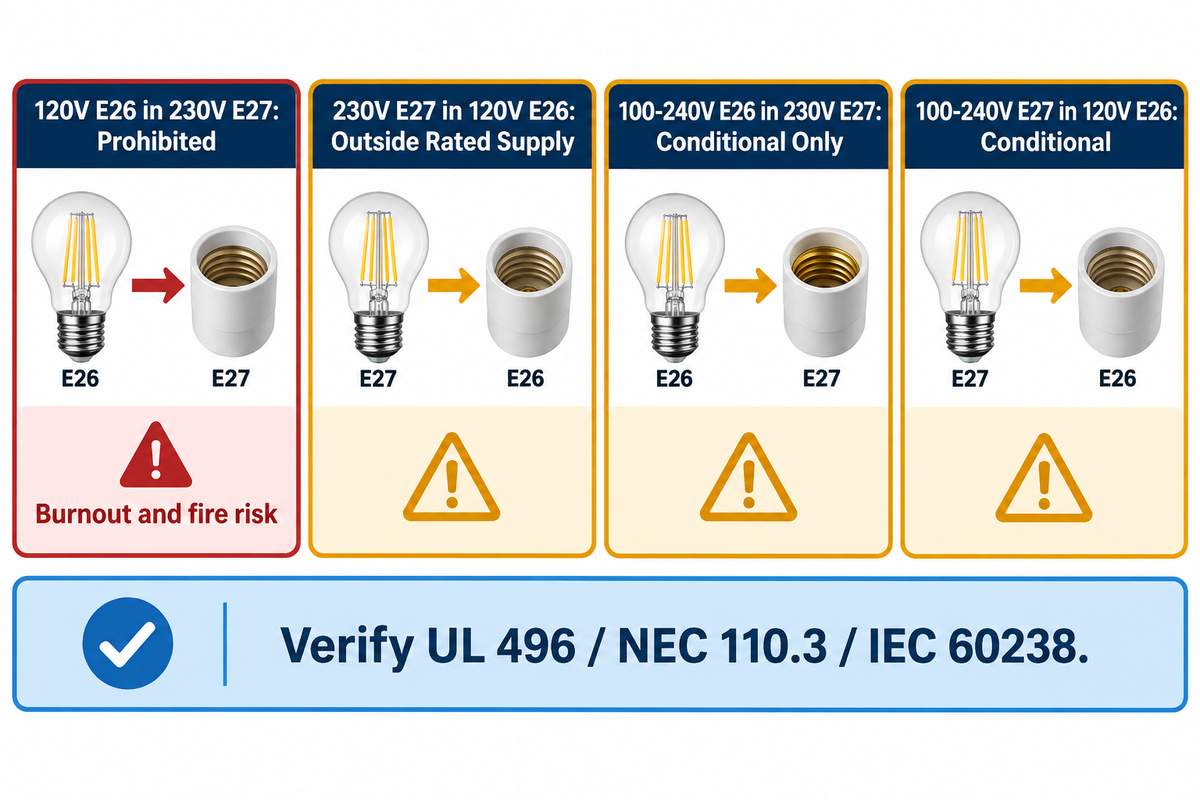
Not as a blanket swap: E26 and E27 bulbs are only conditionally compatible when lamp voltage, permitted base type, center contact, and fixture certification align. Putting a 120V E26 bulb in a 230V E27 socket ruins the lamp and creates a severe fire hazard. UL 496 and IEC 60238 cover lampholder safety. A safe bulb-and-fixture combination requires matching supply voltage, secure bottom contact, adequate insulation, and operation within wattage and environmental limits.
The thread pitch lets you fit an E26 bulb into an E27 socket and vice versa, so they can be screwed together. Still, there are three practical failures that will break compatibility on real sites. Check what each bulb is rated to address before installation, because single voltage bulbs may fail or catch fire across mismatched mains. Never wire 120V E26 lamps on 230V circuits or 230V bulbs with an E27 base on US mains.
Second, physical cap and lampholder tolerances can result in a shorter E26 sleeve not reaching a depressed E27 spring tab, causing intermittent contact or flicker. Third, never force a bulb if a longer E27 barrel or thread tolerance causes binding in a shallow E26 lampholder.
In North America, UL 496 covers lampholders and connectors. NEC section 110.3 requires that listed or labeled equipment be installed and used as indicated in the listings or labelings. In Europe, EN IEC 60238:2018/A1:2018 addresses the safety requirements for E27 Edison screw lampholders and includes creepage, clearance, and resistance to tracking.
| Scenario Pairing | Safety Verdict | Electrical & Mechanical Behavior | Inspection & Code Status |
|---|---|---|---|
| 120V E26 Bulb in 230V E27 Socket | Prohibited | Overvoltage burnout, high surge current, and reduced skirt creepage margin raise fire risk. | Fails IEC 60238 insulation margins. |
| 230V Single-Voltage E27 Bulb in 120V E26 Socket | Outside Rated Supply Voltage | Incandescent filaments glow dimly (27.2% is the constant-resistance approximation, not a measured tungsten result); incompatible 230V LED drivers may fail to start or strobe. | Verify lamp voltage rating and luminaire listing; UL 496 covers lampholders while NEC 110.3 governs listed installation. |
| Wide-Voltage (100–240V) E26 LED in 230V E27 Socket | Conditional Only | Shorter E26 sleeve can miss a depressed E27 center tab; thinner insulator cuts dielectric margin at 240V. | Confirm local project approval where IEC E27 lampholder rules apply. |
| Wide-Voltage (100–240V) E27 LED in 120V E26 Socket | Conditional (120V Within Input Range) | Waveform Lighting lists maximum trough diameters of 24.26 mm for E27 and 24.72 mm for E26; longer E27 barrels may bind in shallow E26 sockets. | Commercial installations require lamp and luminaire certifications accepted under NEC 110.3 and local authority rules. |
Can I put an E26 bulb in an E27 socket or fixture?
No, for single-voltage 120V bulbs; yes only when the lamp voltage, base approval, center contact, and fixture certification all align. Match the bulb’s rated voltage to the 230V supply, make sure it seats smoothly, and use regionally approved hardware. Never install an E26 bulb rated at 120V only into a 220-240V E27 circuit.
Never force or over-tighten any screw in bulb within a lampholder. IEC 60061 Part 2 torque testing specifically evaluates lampholder resistance to tightening and unscrewing forces, not cross-base safety. For US commercial installations, ensure the particular lamp and luminaire combination carries the certification required for its intended use.
Voltage, Frequency, and Wattage Limits: 120V E26 vs 230V E27
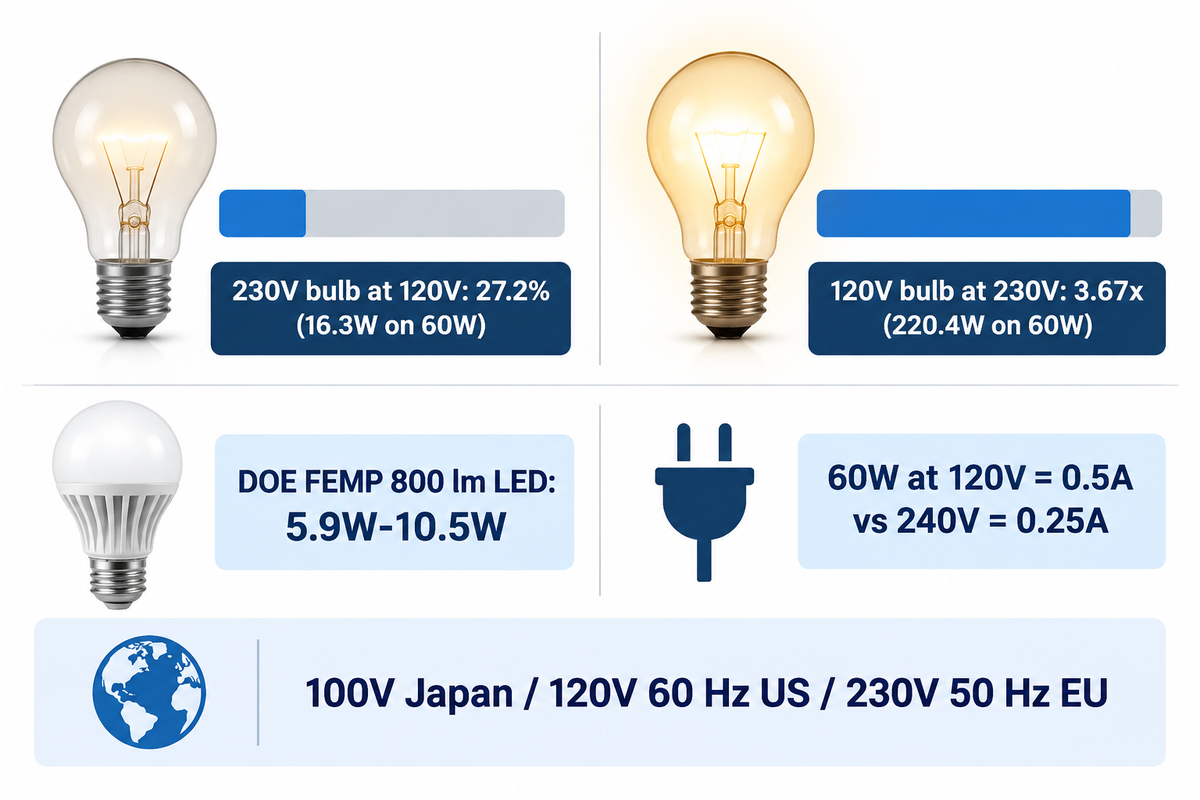
With resistance held constant, a 230V bulb supplied at 120V would consume 27.2% of its rated power. In reality, a tungsten filament cools at lower voltage, decreasing in resistance and diverging from that model. Under the same idealized assumption, powering a 120V bulb at 230V yields 3.67 times rated power and quickly burns out the lamp. Wide-voltage LED drivers (100–240V or 100–277V) bridge these different line voltage levels safely when properly rated.
Voltage should be considered like fixed nozzles attached to a water supply with a variable pressure. Cut pressure almost in half and energy output is severely reduced. Mains frequency also varies globally (60 Hz in North America vs 50 Hz in Europe and parts of Japan), so verify that the LED driver nameplate explicitly states it is designed for 50/60 Hz operation.
A simplified comparison of Joule’s Law illustrates why a mismatch of voltage ruins filaments. Assumed inputs: this worked example assumes constant operating resistance and uses P_actual = P_rated × (V_supply / V_rated)² across 40W, 60W, and 100W bulbs between 120V and 230V. Rose-Hulman Institute of Technology physics lab data confirms that hot tungsten resistivity around 2,700 K rises roughly as T^1.20. The amount of visible light and the actual cold turn-on surge deviate considerably from the fixed resistance theory.
| Rated Bulb Wattage | 230V Constant-R Model at 120V (27.2% Theoretical) | 120V Constant-R Model at 230V (3.67× Theoretical) | DOE FEMP 120/240/277V LED Equivalent |
|---|---|---|---|
| 40W Incandescent | 10.9W (orange dim glow) | 146.9W (instant filament failure) | 4.5–7.0W (450 lumens) |
| 60W Incandescent | 16.3W (underpowered thermal output) | 220.4W (extreme overheating hazard) | 5.9–10.5W (800 lumens; ~9W typical) |
| 100W Incandescent | 27.2W (heavily reduced light) | 367.4W (wire insulation overload) | 10.5–18.0W (1,600 lumens) |
This table shows one example of a fixed filament. Separately, comparing two distinct lamps of that 60W power class shows current doubling at half voltage: the 120V model draws 0.5A whereas the 240V model draws 0.25A, tightening 15-amp lighting circuit load limits. Replacing that legacy incandescent with a 9W LED equivalent cuts fixture wire current sharply.
Under U.S. Department of Energy (DOE) Federal Energy Management Program (FEMP) federal acquisition rules for covered LED light bulbs, eligible agency-purchased lamps must carry rated nominal operating voltage brackets of 120, 240 or 277 VAC, or 12 or 24 VAC or VDC.
The U.S. DOE FEMP procurement specifications state: “They must also have rated nominal operating voltages of 120, 240 or 277 VAC, or 12 or 24 VAC or VDC.”
U.S. Department of Energy (FEMP), Purchasing Energy-Efficient Light Bulbs
Switching LEDs keep visible light steady without excess heat. U.S. DOE FEMP standards benchmark 800-lumen LEDs at 5.9W to 10.5W across 120V, 240V, or 277V AC inputs. Standard UL medium E26 lampholders often list a 660W-250V electrical rating. Always remain below the fixture shade’s lower maximum wattage limit as well.
Different regional grids have subtle differences, too. Japan uses E26 sockets on 100V circuits split between 50 Hz in eastern cities and 60 Hz in western prefectures. Because US E26 LED lamps ship with 120V drivers, some may dim or flicker on 100V Japanese grids. Even a dual-voltage smart light bulb can flicker on leading-edge TRIAC dimmers, one of the common causes of LED bulb flickering.
Will E27 bulbs work in the US on a 120V circuit?
No, single-voltage 220–240V E27 light bulbs won’t run on US 120V circuits. Only an E27 light rated for 120V or 100–240V AC input operates normally, while a UL-listed 120V E26 lamp is the standard US equivalent. Undervolted 220–240V E27 LEDs may stay dark, glow dimly, or flicker on North American wiring.
Always read the voltage printed on the bulb collar before screwing an imported lamp into a domestic fixture. A 100–240V AC rating covers input voltage only, and UL 496 covers lampholders and connectors. Under NEC Section 110.3, US commercial installations require lamps and luminaires to carry the listing required by the project authority.
IEC 60061, ANSI C81.61, and Global Light Bulb Base Type Standards

ANSI/NEMA C81.61-2025 specifies electric lamp bases, including E26. UL 496 Ed. 14-2017 (ANSI revision published March 28, 2022) covers holders and connectors for electric lamps used under CEC Part I C22.1 and NEC ANSI/NFPA 70. Europe governs E27 caps via IEC 60061 (updated through CEI EN IEC 60061-1/A64 in August 2025) and EN IEC 60238:2018 Edison screw lampholders up to 250V r.m.s., excluding E26d.
A European CE marking does not satisfy US electrical inspection rules, where equipment must be installed per its listing or labeling instructions. Per UL Solutions, UL 1598 certifies luminaires up to 600V in North America alongside UL 8750 for LED drivers. North American fixtures use several base types with UL, CSA, or ETL marks, while European E27 holders use porcelain or heat-resistant insulating plastic under IEC 60238.
Efficiency standards are becoming more stringent globally without dropping screw sockets. U.S. DOE rules raise general service lamp efficacy from 45 lm/W to over 120 lm/W on July 25, 2028. EU ecodesign and energy-labelling rules (Regulation (EU) 2019/2020 and Regulation (EU) 2019/2015) project 96 TWh in combined annual lighting savings by 2030. During fixture hookups across regions, match supply conductors using regional AC wire color coding standards.
| Country / Region | Dominant Medium Base | Nominal Voltage & Frequency | Governing Safety Standards |
|---|---|---|---|
| United States & Canada | E26 | 120V AC, 60 Hz (277V commercial) | ANSI C81.61 / UL 496 / UL 1598 / CSA C22.2 No. 43 |
| Japan | E26 | 100V AC, 50 Hz (East) / 60 Hz (West) | JIS C 7709 / PSE electrical safety |
| Taiwan | E26 | 110V AC, 60 Hz | CNS / BSMI electrical approvals |
| European Union | E27 | 230V AC, 50 Hz | IEC 60061 / EN IEC 60238 / CE / ENEC |
| United Kingdom | E27 and B22 bayonet | 230V AC, 50 Hz | BS EN IEC 60238 / UKCA / CE |
| Australia & New Zealand | E27 and B22 bayonet | 230V AC, 50 Hz | AS/NZS 60238 / RCM |
| China | E27 | 220V AC, 50 Hz | GB / CCC (within compulsory scope) / IEC 60238 |
How to Tell E26 vs E27 Apart Before Ordering Replacements
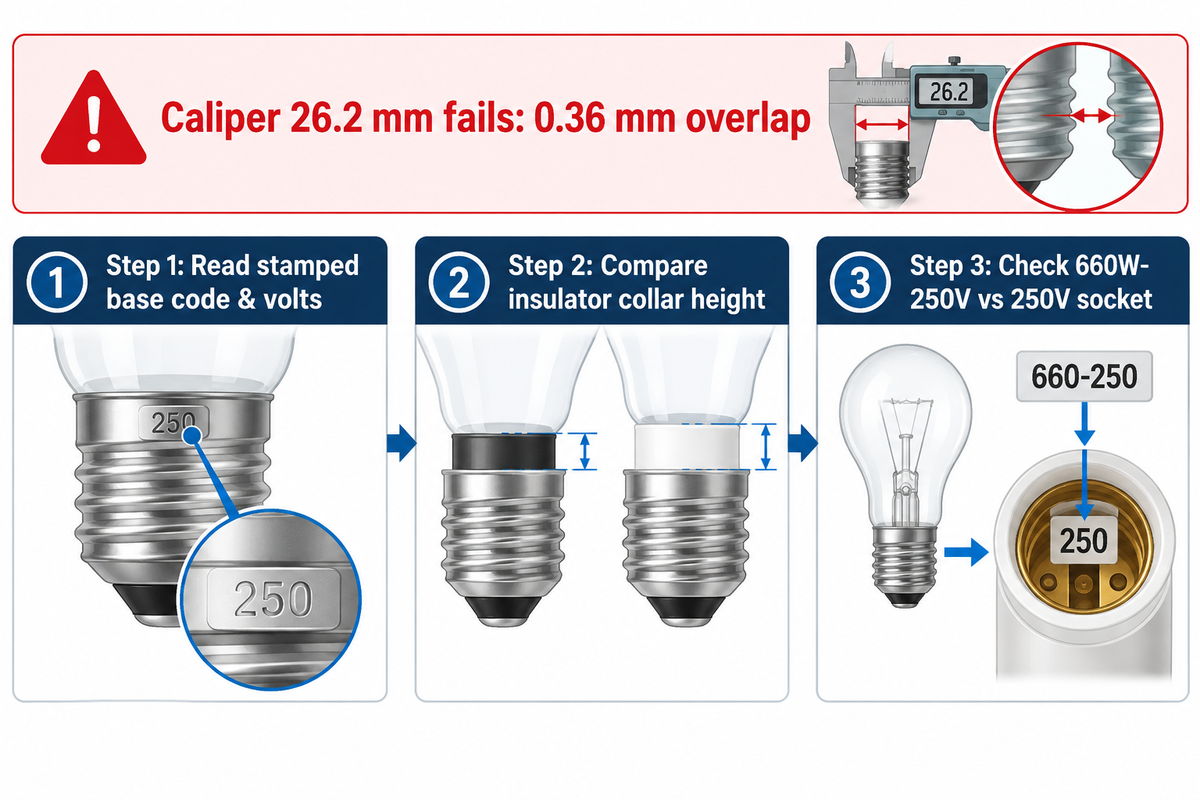
The bulb’s E26 or E27 designation identifies its base type. Voltage ratings, UL or CE marks, and insulator height alone don’t uniquely distinguish the two. Because both caps share a 0.36 mm major-diameter overlap above 26.05 mm, a 26.2 mm caliper measurement identifies neither cap.
Inspect the fixture socket nameplate with your existing bulb to avoid errors with unmarked or wide voltage lamps.
-
✔
Step 1, Read the stamped base code, input-voltage range, and listing mark. E26 caps typically pair with 120V AC (or 100V in Japan) and UL or cUL marks. E27 lamps commonly print 220–240V AC with CE or ENEC marks. Read the stamped cap designation directly when dual-voltage 100–240V E27 or 120V E27 bulbs are present. Federal DOE FEMP procurement guidelines restrict grid lamps to ANSI bases (E26, E26d, E12, E17) and exclude E27. -
✔
Step 2, Compare bottom insulator collar height and sleeve profile: Place the old bulb beside a millimeter scale. In supplier specification tables, E27 caps feature a taller bottom insulator skirt on a longer metal sleeve than E26 caps. -
✔
Step 3, Read the socket rating inside the light fixture: North American medium E26 shells commonly stamp 660W-250V electrical ratings, while European E27 lampholders carry 250V markings under IEC 60238.
How do I know if a lightbulb or socket is E27 or E26?
Check the base code stamped on the lamp collar or socket nameplate first, since voltage labels (such as 100-240V E27) and certification marks overlap in different regions. If markings have worn off, read the fixture’s circuit rating and compare the height of the bottom dielectric collars side by side.
Confirming the exact bulb type prevents restocking fees on service calls. Match each replacement bulb to the building’s mains voltage and check thread size prior to installation.
E26 Socket vs E27 Socket Adapters, Ceramic Lampholders, and Rewiring
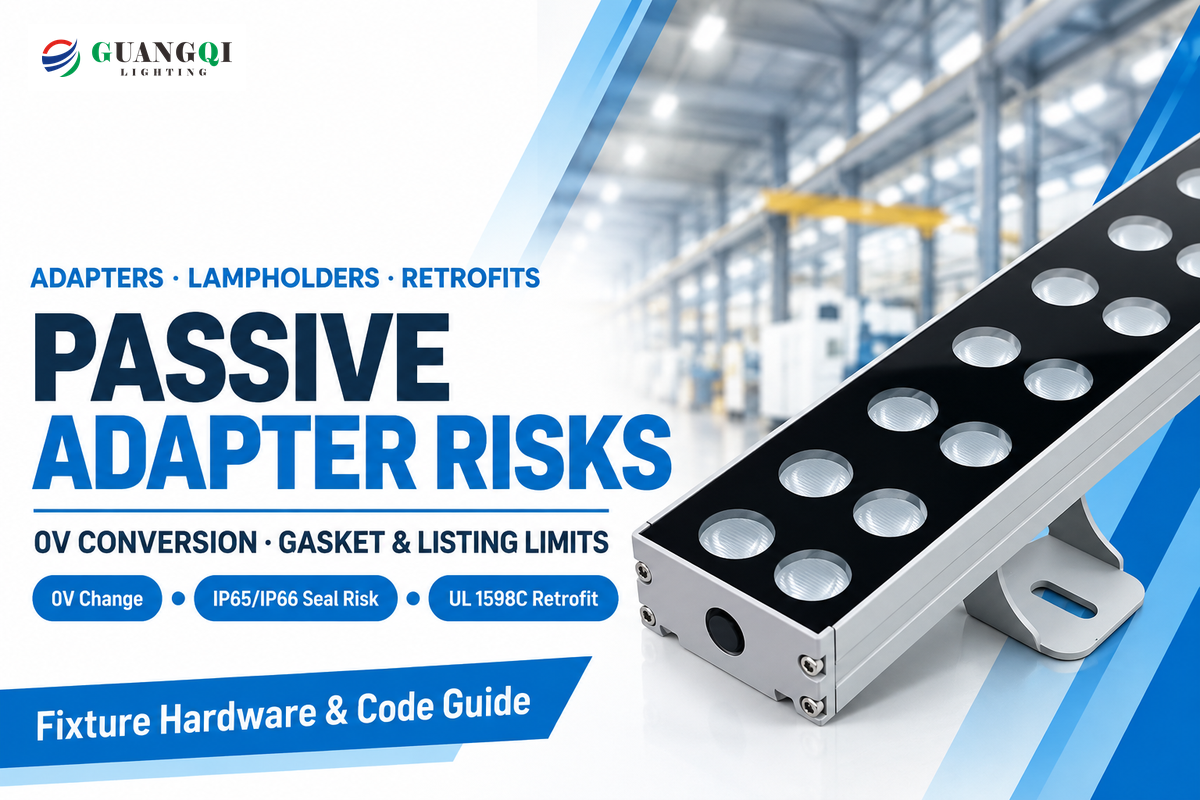
Passive E26-to-E27 screw adapters offer zero voltage conversion and add extra axial length between the socket and lamp. Inside tight enclosed luminaires, added axial extension reduces clearance, traps heat, and interferes with seals. For permanent commercial retrofits, evaluate a voltage-matched luminaire or a UL 1598C retrofit kit installed per its instructions.
There are many importers and online marketplaces that sell low-cost, passive, plastic adapters that mechanically connect E26 and E27 screw threads. Passive adapters don’t transform 120V to 230V, and uncertified builds often expose brass contacts. One UK Office for Product Safety and Standards recall (2106-0125) pulled a DiCUNO B22-to-E27 light bulb adapter from sale because unlocked screws created shock hazards (cited as a cross-base adapter construction risk example).
Thermal confinement and dielectric breakdown present further threats in enclosed canopies and outdoor wall lights. For example, U.S. Patent US9500352B2 (assigned to ETI Solid State Lighting Inc) places LED driver electronics inside an annular housing base recess directly adjacent to the screw base to keep fixture depth compact. Separately, in sealed outdoor luminaires, a bulky adapter can push a lamp against the diffuser or prevent closure of an IP65/IP66 gasket. One electronics manufacturing guide states that Comparative Tracking Index (CTI) is the voltage causing breakdown after 50 drops of 0.1 percent ammonium chloride solution fall on the material.
UL Code Authorities explains the inspection consequence when a fixture is modified without a Listed retrofit kit:
UL regulatory guidance states: “If a luminaire is modified using off-the-shelf parts instead of a UL Certified retrofit kit, the modified luminaire would be no different than any other field-modified electrical equipment, and a UL Field Evaluation would be required to determine its compliance with applicable codes and standards.”
Replacing a lampholder with a manufacturer-approved equivalent is a repair. Converting a socket outside the fixture’s listed configuration under NEC 410.6 and UL 1598C / UL 1993 guidance can affect luminaire certification and may require a field evaluation accepted by the local authority having jurisdiction.
| Conversion Method | Voltage & Mechanical Effect | Thermal & Clearance Limit | When Not to Use |
|---|---|---|---|
| Passive E26-to-E27 Screw Adapter | 0V voltage change; extends overall bulb length. | Reduces bulb-to-lens clearance and may block airflow or interfere with enclosed IP65/IP66 gaskets. | Avoid with single-voltage mismatched bulbs, uncertified wet housings, or where fixture listings disallow adapters. |
| UL Porcelain Socket Swap (660W-250V) | Changes socket physically to ANSI E26; line voltage remains branch voltage. | Ceramic shell handles heat better than phenolic plastic; bracket depth must fit canopy. | Avoid modifying outside manufacturer-approved parts without a field evaluation accepted by the local authority. |
| UL 1598C Certified LED Retrofit Kit | Converts compatible luminaires to LED using the kit’s specified components and rating. | Certification covers the conversion installed per kit instructions and clearance rules. | Do not install in incompatible luminaires outside the kit’s listed instructions. |
| Step-Up / Step-Down Transformer + Correct Bulb | Converts 120V to 230V (or reverse) for single-voltage decorative lamps. | Must be sized for apparent power (VA), inrush current, and frequency, with dry ventilated space. | Costly and bulky for multi-fixture commercial runs; does not solve socket or luminaire listing mismatch. |
Choosing the Correct Bulb: E26 and E27 vs E12, E14, B22, and A19 Shapes
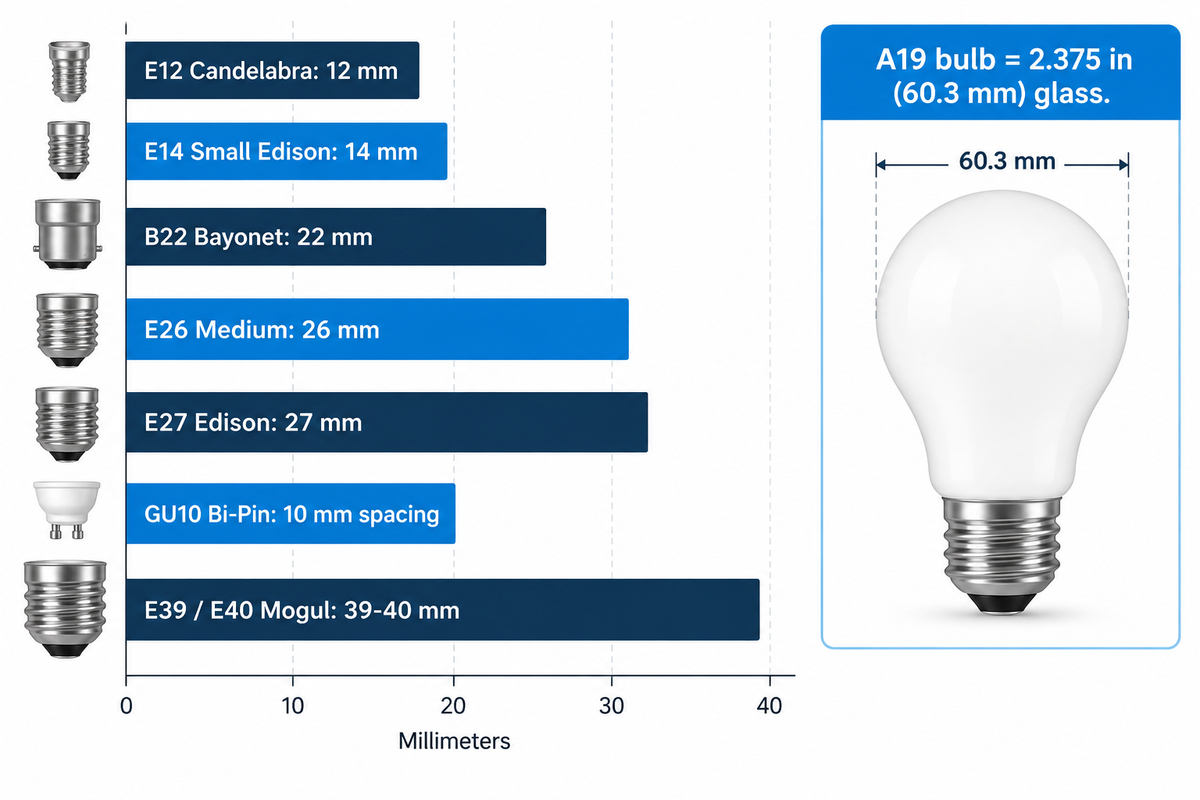
Medium E26 (26 mm) and E27 (27 mm) caps sit between small candelabra bases (12–14 mm) and heavy industrial mogul bases (39–40 mm). Glass shape codes like A19 specify bulb diameter in eighths of an inch (19/8 inches = 2.375 inches, or 60.3 mm). They never tell you the screw base type.
Medium screw base bulbs support many different light bulb shapes, from A19 pear lamps to directional PAR38 floods. Inspect each light bulb socket carefully and keep E27 and other types separated clearly on hardware orders. Twist-and-lock caps (10 mm GU10 and 24 mm GU24) and bi-pin lamps (4–12 mm spacing) can’t fit Edison threads. Likewise, the UK 22 mm B22 bayonet cap locks onto side pins instead of threading in.
Decorative European bulbs are often built with E14 small screw bases rather than US E12 candelabra caps. Check our E12 candelabra screw base guide before ordering chandelier replacements. For linear troffers and shop fixtures, consult the T8 fluorescent and LED tube base standards first.
| Base Code | Base Type & Coupling Category | Nominal Size / Pin Pitch | Primary Regions & Applications |
|---|---|---|---|
| E10 | Miniature Edison Screw | 10 mm outer diameter | Indicator lamps, flashlights, low-voltage displays |
| E11 | Mini-Candelabra Screw | 11 mm outer diameter | North American halogen ceiling fans and track accents |
| E12 | Candelabra Edison Screw | 12 mm outer diameter | North America (120V) chandeliers, wall sconces, nightlights |
| E14 | Small Edison Screw (SES) | 14 mm outer diameter | Europe & UK (230V) decorative pendants, appliances, chandeliers |
| E17 | Intermediate Edison Screw | 17 mm outer diameter | North America (120V) microwave ovens, desk lamps, signage |
| E26 | Medium Edison Screw (MES) | 26 mm nominal outer cap | US, Canada (120V), Japan (100V), Taiwan (110V) general lighting |
| E27 | Edison Screw (ES) | 27 mm nominal outer cap | Europe, UK, Australia, Asia, Latin America (220–240V) fixtures |
| B22 | Bayonet Cap (BC) | 22 mm push-and-twist cap | UK, Ireland, Australia, India (230V) legacy ceiling pendants |
| GU10 | Twist-and-Lock Bi-Pin | 10 mm pin center spacing | Global MR16 directional track heads and recessed downlights |
| GU24 | Twist-and-Lock Self-Ballasted | 24 mm pin center spacing | US high-efficacy code fixtures (California Title 24 / legacy ENERGY STAR, sunset December 31, 2024) |
| E39 / EX39 | ANSI Mogul / Exclusionary Mogul | 39 mm outer diameter | North American warehouse high-bays, HID and corn LED retrofits |
| E40 | Goliath Edison Screw (GES) | 40 mm outer diameter | European and export street lights, flood lights, industrial bays |
Commercial Lighting, Outdoor Fixtures, and Cross-Border Sourcing Checklist
Commercial outdoor buyers standardize cross-border projects by specifying wide-voltage integral LED fixtures or using E27 IEC 60238 and UL 496 E26 lampholder assemblies. Outdoor luminaires that are exposed to the elements need wet-location ratings. Projects requiring IP65/IP66 protection, LM-79 photometry, or LM-80 data add those requirements to the purchase spec. For North American holders, Intertek Inform’s abstract for UL 496:14ED (2017-09-05) notes SA2.4 and SA2.5 rules for integral USB fittings. That abstract also cites Clause 4.8.6.6 wire rules for GU24 holders and Clause 4.9.10 creepage clarifications.
When purchasing LED bulbs for sealed wall packs, remember that LED flood light bulb replacements concentrate heat near the cap. In U.S. DOE FEMP Table 1 for 800-lumen lamps, a 5.5W best-available LED drops annual electricity cost from $6.95 to $2.12 compared with an 18W less-efficient model. That swap delivers $26.35 in lifetime cost savings per socket. Across Europe, European Commission ecodesign and energy-labelling lighting policies saved 81 TWh in 2020 and project €8.8 billion in lower residential electricity bills by 2030.
For US installations, project buyers choose E26 base bulbs or integral wide-voltage luminaires matched to local panel voltage. One lighting supplier guide notes that E27 is governed by IEC 60061-1 with a 5.0 mm insulator cap and recommends E27 for 240V systems. On OEM luminaire orders, project schedules hinge on photometric design sign-off, driver sourcing, and regional UL/ETL or CE safety certification.
At Guangqi Lighting, we manufacture IP65 and IP66 architectural outdoor wall luminaires with CE and RoHS export configurations. Our integral 100–277V drivers support 0–10V, DALI, and TRIAC dimming. Custom fixture BOMs, LM-79 photometry where specified, and written manufacturer warranty schedules are available upon project quotation via our commercial outdoor lighting specification services. Final project sign-off requires site-compliant installation.
Can you get E27 bulbs in the US, and what do dual-voltage options cost?
Yes, US buyers can order dual-voltage 100–240V E27 LED bulbs and screw-base accessories online from specialty lighting distributors, Amazon, and Walmart. Per U.S. Department of Energy pricing data, common LED bulbs cost $3 to $4 for baseline models and $5 to $6 for higher-efficiency versions. Online specialty adapters include a 7-in-1 E26/E27 splitter ($13.99, Amazon) or pin-to-E26/E27 converter ($7.99, Walmart). Home Depot and Lowe’s mainly stock UL-listed 120V E26 lamps.
For US 120V circuits, confirm the bulb’s rated input explicitly includes 120V AC (such as 120V or 100–240V) rather than 220–240V only. Keep uncertified passive adapters out of enclosed or wet outdoor housings. For inspected US projects, confirm that the fixture and any retrofit kit carry certifications accepted by the local inspection authority.
| Qualification Gate | North America (E26 / Integral) | Europe & IEC Export (E27 / Integral) |
|---|---|---|
| Gate 1: Lampholder & Fixture Standards | UL 496 / CSA C22.2 No. 43 lampholder standards; UL 1598 luminaire standard | IEC 60238 lampholder standard; ENEC third-party mark; CE marking with EU declaration |
| Gate 2: Input Voltage & Driver Topology | 120V AC residential or 100–277V AC commercial driver | 220–240V AC 50 Hz or 100–277V wide-voltage driver |
| Gate 3: Creepage & Center Contact Geometry | ANSI C81.61 lamp base dimensions; UL 496 lampholder rules | EN IEC 60238 lampholder creepage & tracking rules; E27 cap geometry defined by the applicable lamp-cap standard sheet |
| Gate 4: Outdoor Enclosure & Sealing | Wet-location rating when rain-exposed (avoid uncertified extension adapters) | IP65/IP66 housing when specified in project requirements |
| Gate 5: Photometric & Warranty Deliverables | LM-79 photometry & LM-80 LED package data where specified; written luminaire and driver warranty terms per project specification | LM-79 data; EU light-source ecodesign rules; written luminaire and driver warranty terms per project specification |
In your quote request to your supplier, copy the procurement items below for E26, E27, or wide-voltage fixtures.
RFQ checklist — copy these into your quote request:
| Parameter | Recommended range | Why it matters | How to verify |
|---|---|---|---|
| Base / Lampholder Standard | ANSI C81.61 E26 cap or IEC 60061 E27 cap matched to regional lampholder | Prevents bottom-tab arcing and regional code failure | Inspect UL 496 or EN IEC 60238 lampholder certificate |
| Input Voltage Window | Region-specific 120V AC or 240V AC, or 100–277V AC integral LED driver | A 100–277V driver covers 120V and 230V supplies; deployment at both requires complete-luminaire ratings and approvals covering each destination’s voltage, frequency, safety, and installation requirements | Driver and complete-luminaire nameplates; applicable UL 8750 certification documentation and CE conformity documentation |
| Socket Wattage & Thermal Ceiling | Up to 660W-250V porcelain shell; 5.9–10.5W LED for 800 lm (DOE FEMP) | Avoids heat buildup inside sealed fixtures and adapters | Verify fixture shade label and thermal safety testing |
| Ingress Protection & Warranty | IP65 / IP66 housing; written manufacturer warranty schedule per project specification | Protects outdoor seals against rain and thermal degradation | Request IP65/IP66 lab report and written warranty schedule |
| Compliance & Lab Sign-Off | UL 1598 / ETL / CSA for North America or CE / ENEC for EU export | Prevents customs holds and municipal field rejection | Confirm sample approval and test files in PO |
| Retrofit & Lifecycle Cost Baseline | Exclude loose adapters outdoors; compare quotes via DOE FEMP 800-lm Table 1 ($26.35 savings) | Separates residential bulb buys from OEM luminaire total cost | Review BOM quote alongside IES photometric layout |
Commercial & Export Project Support
Multi-region outdoor projects require UL 496 E26 sockets, IEC 60238 E27 sockets, or 100–277V integral drivers matched to local codes. Send your destination country and photometric targets for matched fixture drawings and test files.
Frequently Asked Questions About E26 vs E27
Q: What is the equivalent of an E27 bulb in the US?
A UL listed 120V E26 bulb is the standard US equivalent to a European E27 lamp, commonly made in an A19 glass shape.
Although E26 shares nearly identical threads with E27 lamps, North American circuits supply 120V AC. ANSI C81.61 defines E26 lamp cap geometry and UL 496 covers North American lampholders, whereas IEC 60238 covers E27 lampholders.
Q: Is E27 the same as E26 for LED bulbs?
No. E27 and E26 LED bulbs share a 3.629 mm thread pitch, but single-voltage drivers stay locked to 230V or 120V mains.
A wide-voltage 100–240V AC rating covers supply voltage only. Safe cross-region use still requires suitable mechanical fit, clean bottom contact, adequate insulation, luminaire compatibility, and required local certification. Minimum barrel length, insulator skirt thickness, and regional UL or CE approvals remain distinct between both standards.
Q: Are E27 bulbs being phased out?
No. Efficiency laws phase out high-wattage incandescent, halogen, and fluorescent lamps rather than removing the E27 screw socket.
European Ecodesign rules under Regulation (EU) 2019/2020 and the U.S. DOE rules raising efficacy from 45 to over 120 lumens per watt in July 2028 remove inefficient sources while keeping E27 and E26 LED screw lamps active worldwide.
Q: What bulbs are compatible with E26 sockets?
Any 120V or 100–240V E26 LED, CFL, or incandescent bulb within the fixture wattage ceiling fits an E26 socket.
Common UL-listed E26 LED glass shapes include A19 pear lamps, ST19 vintage filaments, BR30 floods, and directional PAR38 bulbs.
Q: Is an A19 light bulb the same as E26 or E27?
No. A19 defines the glass bulb’s 2.375-inch (60.3 mm) pear diameter, whereas E26 and E27 define the metal screw base underneath.
The “A” denotes the standard pear profile, and the “19” denotes the diameter measured in eighths of an inch (19/8 in, or ~2.4 in). North American A19 bulbs normally pair with a 120V AC E26 screw base. In Europe, lamps use the A60 (60 mm) metric shell with either an E27 screw or B22 bayonet cap.
Q: Does an E26-to-E27 adapter convert 120V to 230V?
No. Mechanical screw adapters only join metal threads and pass existing line voltage through unchanged.
Stepping between 120V and 230V circuits takes a dedicated voltage transformer or a dual-voltage 100–240V LED driver.
Q: Why does an E27 LED bulb flicker or glow dimly in a US 120V lamp?
Plugging a single-voltage 220-240V E27 LED bulb into a 120V US socket starves the driver input stage, which can prevent startup, cause dim light output, or produce strobing.
Two secondary factors can cause flicker even on wide-voltage bulbs. First, insufficient clearance around the E27 thread can cause binding in shallow US E26 lampholders before the bulb seats cleanly. Second, leading-edge TRIAC wall dimmers built for resistive 120V loads often destabilize switching LED drivers.
Q: Can I order outdoor commercial light fixtures with UL-listed E26 or CE-certified E27 sockets?
Yes. Commercial manufacturers can configure IP65 or IP66 outdoor luminaire housings with either UL 496 E26 lampholders or IEC 60238 E27 lampholders when specified.
Export buyers also specify integral 100–277V AC LED modules for broad voltage coverage, while pairing each region’s fixtures with the required UL/ETL or CE safety certifications.
Transparency & Engineering Review
Prepared by the Guangqi Lighting engineering team using ANSI/IEC standard specs, U.S. DOE FEMP datasets, UL Code Authorities guidance, and published Guangqi Lighting product specifications. Technical ratings and tables are free from undisclosed sponsor influence.
References & Sources
- EN IEC 60238:2018/A1:2018, Edison screw lampholders (creepage, clearance, and tracking) CENELEC / iTeh Standards
- EN IEC 60238:2018, Scope and E14/E27/E40 lampholder limits up to 250 V r.m.s. CENELEC / iTeh Standards
- Physics Lab Manual: Radiative Power and Tungsten Filament Resistivity (T^1.20) Rose-Hulman Institute of Technology
- Purchasing Energy-Efficient Light Bulbs (ANSI E26/E26d, lumen wattages, and lifecycle cost) U.S. Department of Energy (FEMP)
- ANSI/NEMA C81.61-2025, Specifications for Bases (Caps) Used on Electric Lamps American National Standards Institute / NEMA
- Lighting Testing and Certification (UL 1598 and UL 8750) UL Solutions
- DOE Finalizes Efficiency Standards for Lightbulbs (120 lm/W effective July 25, 2028) U.S. Department of Energy
- Debunking Myths about Phasing Out the Incandescent Lightbulb (DOE retail pricing & EISA overview) U.S. Department of Energy
- Ecodesign and Energy Labelling Requirements for Light Sources, Regulation (EU) 2019/2020 European Commission
- Product Recall: DiCUNO Light Bulb Adapter (2106-0125) UK Office for Product Safety and Standards
- US9500352B2, Integral LED light fixture (assigned to ETI Solid State Lighting Inc) U.S. Patent and Trademark Office (Google Patents)
- LED Retrofit Kits: UL Certified Luminaire Retrofit Kit FAQs (UL 1598C / NEC 410.6) UL Code Authorities