
Get in Touch with GUANGQI



How many watts does a fridge use? In a field study of 86 refrigerators in Maharashtra, India (2018-2020), compressors used 44-156 W while running, with an average of about 100 watts of power. A refrigerator rated at 365 kWh per year averages 41.7 W over a year. A startup event for an appliance like your refrigerator can momentarily draw more power than the refrigerator uses while cooling. If you’re sizing backup power, account for startup separately. If you’re estimating the bill, use the energy label or meter reading (kWh).
A fridge may be plugged in all day, but the load changes as the fridge cools and defrosts. Running wattage describes an operating state. Read a power meter during the relevant operating state to know how many watts your fridge draws at that moment. To calculate refrigerator operating costs or compare a full-size refrigerator with a compact fridge, start with energy use over the same period. In lighting, the same wattage measure describes electrical power, while lumens describe light output.
What Is the Typical Wattage of a Single-Door Refrigerator?
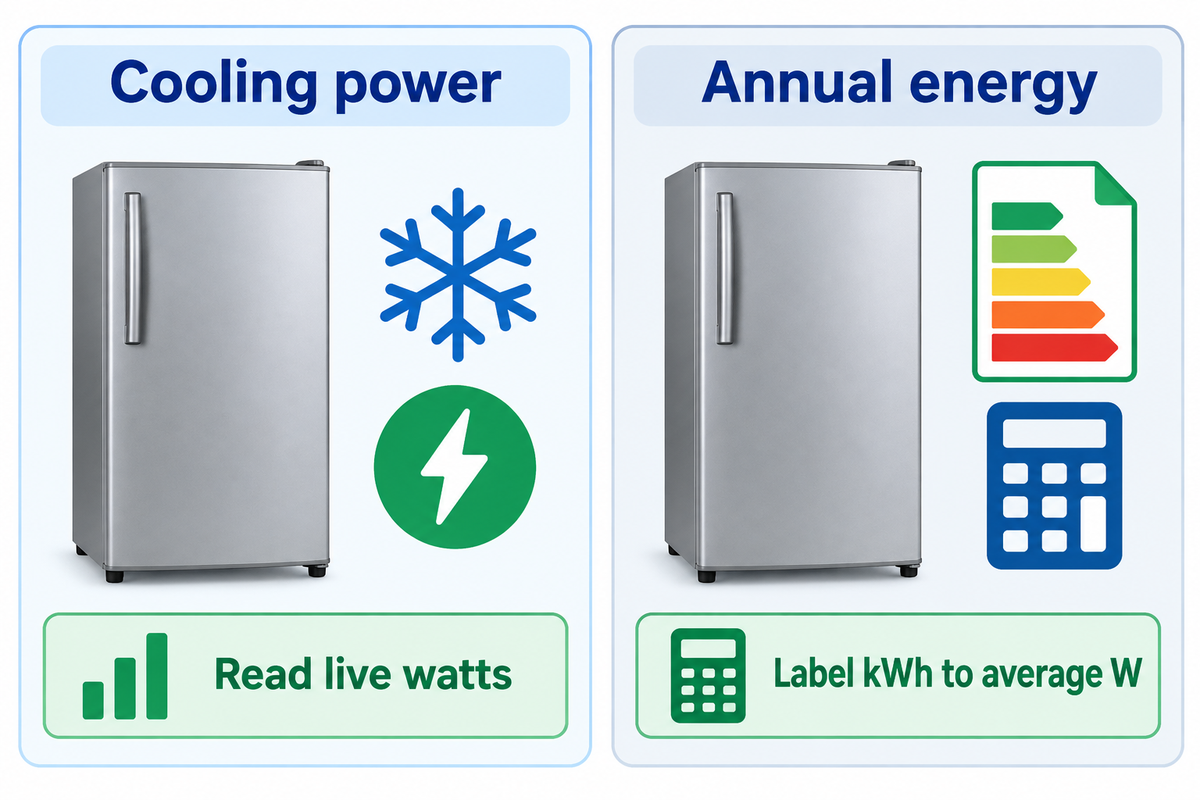
The Danby DAR033A2BDB compact refrigerator averages about 23 W over a year at its rated 201 kWh per year. The 44-156 W measured cooling range comes from a mixed group of refrigerators. Single-door refrigerator running wattage depends on the compressor and cooling demand, so door count alone cannot give you a typical cooling wattage. To get that reading for a fridge, check an outlet power meter while it’s cooling.
How many watts does a refrigerator use on average? A unit rated at 365 kWh per year averages about 42 W over the whole year. This includes how much energy the unit uses when the compressor is changing speeds or isn’t in use. Average wattage, or the average refrigerator wattage for a set period, smooths out changes in the wattage of a refrigerator over time. Divide the watt-hours recorded by the energy meter by the test duration in hours. The running wattage of your refrigerator depends on the cooling needed to run your refrigerator at that moment.
“One Watthour is the energy of one Watt used for one hour.”
U.S. Energy Information Administration, Measuring Electricity
Running Watts, Startup Surge, and Defrost
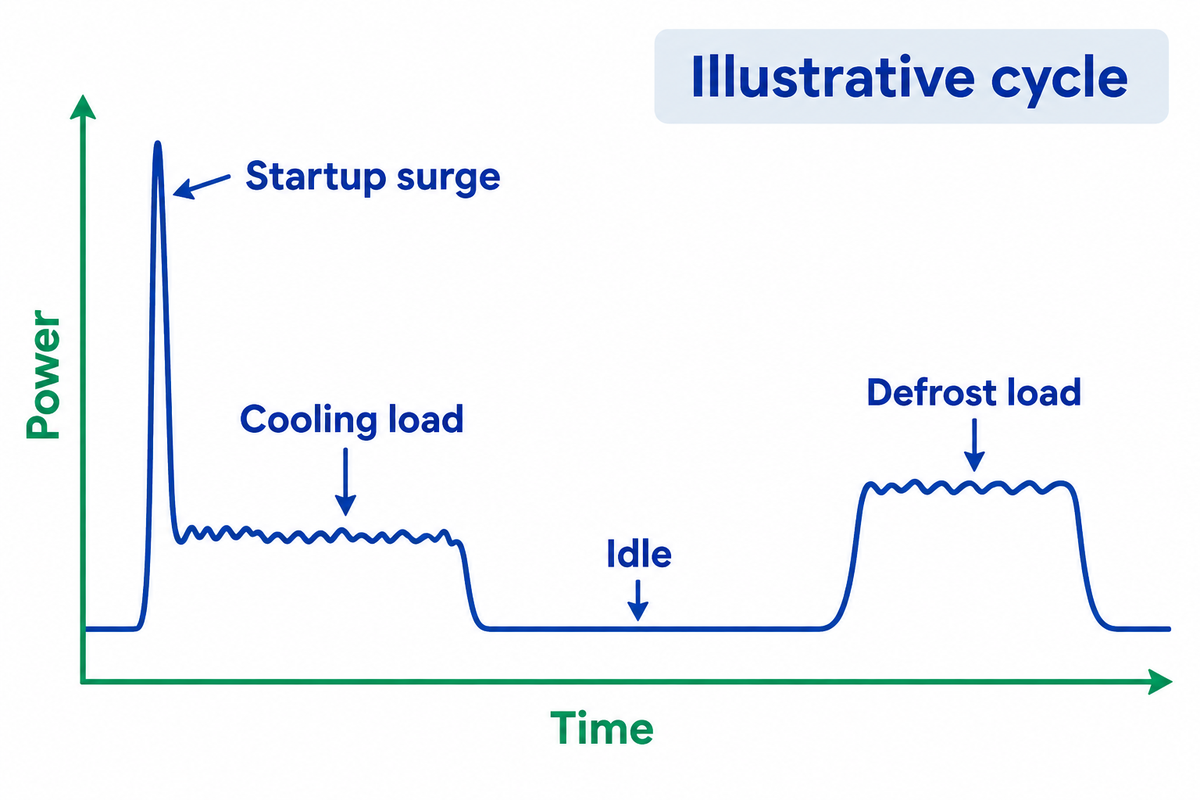
Your meter can show different readings at compressor startup, during cooling, and during automatic defrost. When the refrigerator runs, a fixed-speed compressor cycles on and off to maintain the set temperature. A variable-speed compressor can adjust its speed and power draw during cooling. When the cooling load changes, an energy meter integrates the changes across the full monitoring period.
Defrost can add a separate load. In a study of defrost control in one top-mount refrigerator, two heater designs ran at 160 W in constant-power trials. One ran for 17.0 minutes and the other for 19.3 minutes. Both used the same watts, but the longer trial used more watt-hours. A cooling-only snapshot misses both events. Track the amount of energy your refrigerator uses across all of its usual operating states.
| Reading category | Where to get it | What it tells you |
|---|---|---|
| Cooling power in W | An outlet meter’s real-power reading during ordinary cooling | What the fridge draws at that point in the cycle |
| Highest sustained power in W | Monitor through operating states that include defrost where fitted | What the backup source may need to supply for minutes at a time |
| Startup demand in W or inrush in A | Model documentation or suitable event-capture instrumentation | Whether the source can cover the start event |
| Energy in kWh | Cumulative meter reading over several normal days, or a model’s annual label | What running the fridge costs, or how much energy backup must deliver |
| Daily energy from an annual label | Annual kWh divided by days in the year | Compare two models on the same time basis |
| Average watts over a meter test | Metered kWh, converted to Wh, divided by elapsed hours | Estimate how much load the battery must support over time |
| Apparent power in VA | A power meter with a VA readout, using operating voltage and current | Check a source or meter that lists limits in VA |
| Power factor | A plug-in meter that reports real and apparent power for the same period | Explain why listed amps and measured watts differ |
| Energy cost | Daily or annual kWh and the matching household tariff | Estimate what it costs to run the appliance |
Daily Refrigerator Energy Use by Model
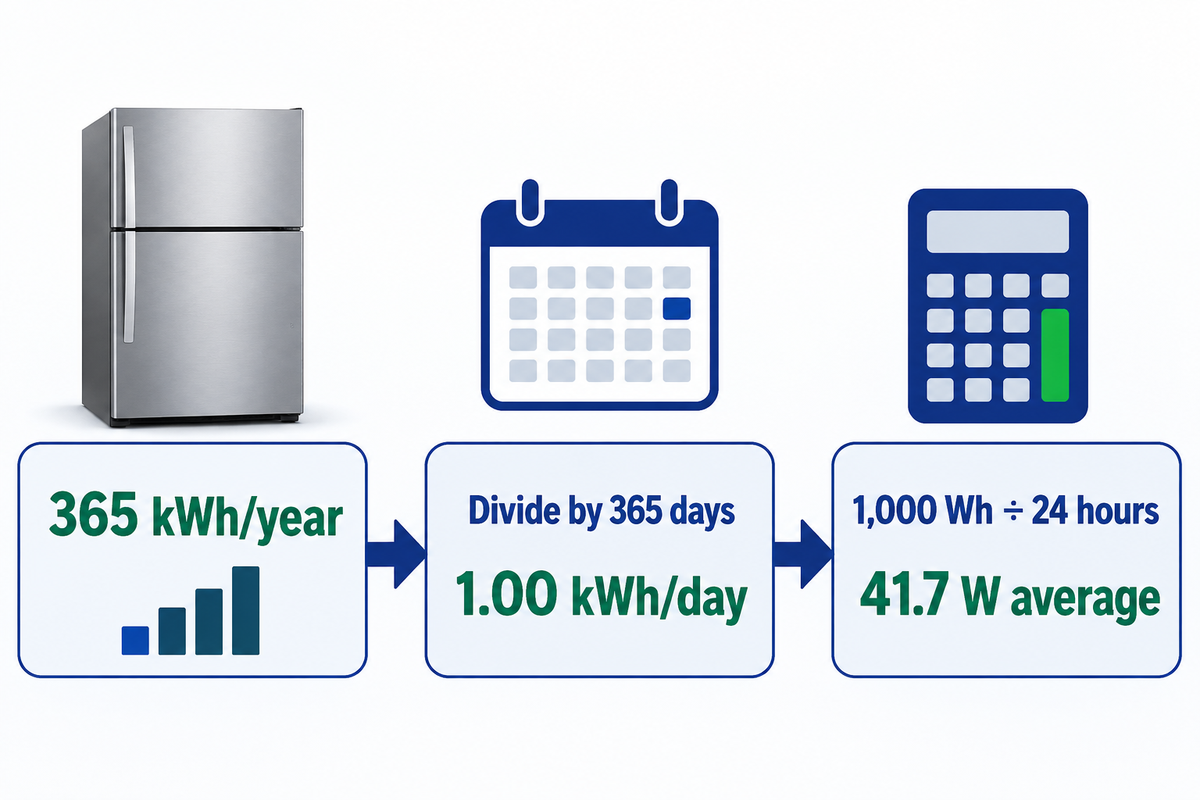
Divide a refrigerator’s annual kWh by 365 for its label-based daily energy use. These certified models use about 0.55-1.73 kWh per day on the label’s test basis. To compare an average home refrigerator with a compact one, work from the labeled kWh for the two models you actually wish to compare.
| Example model and type | Capacity | Label energy | Daily energy | Average power |
|---|---|---|---|---|
| Danby DAR033A2BDB Compact refrigerator |
3.2 ft³ | 201 kWh/yr | 0.55 kWh/day | 22.9 W |
| GE GTE18NSW**** Top freezer |
18.3 ft³ | 365 kWh/yr | 1.00 kWh/day | 41.7 W |
| Whirlpool WRS331SDH*0* Side-by-side |
21.4 ft³ | 602 kWh/yr | 1.65 kWh/day | 68.7 W |
| LG LRFLC2726* French door refrigerator (bottom freezer) |
26.5 ft³ | 632 kWh/yr | 1.73 kWh/day | 72.1 W |
The GE example uses 365 kWh per year. Dividing by 365 days gives 1.00 kWh per day. Multiply by 1,000 to get 1,000 Wh per day, then divide by 24 hours to get 41.7 W. Use the unrounded annual value when calculating each row’s average power. The U.S. Department of Energy test procedure specifies how to determine annual kWh. Kitchen temperature and use can change what the same model consumes in your home. A combined refrigerator and freezer is tested as a single appliance.
How to Read Fridge Nameplate Amps and Watts
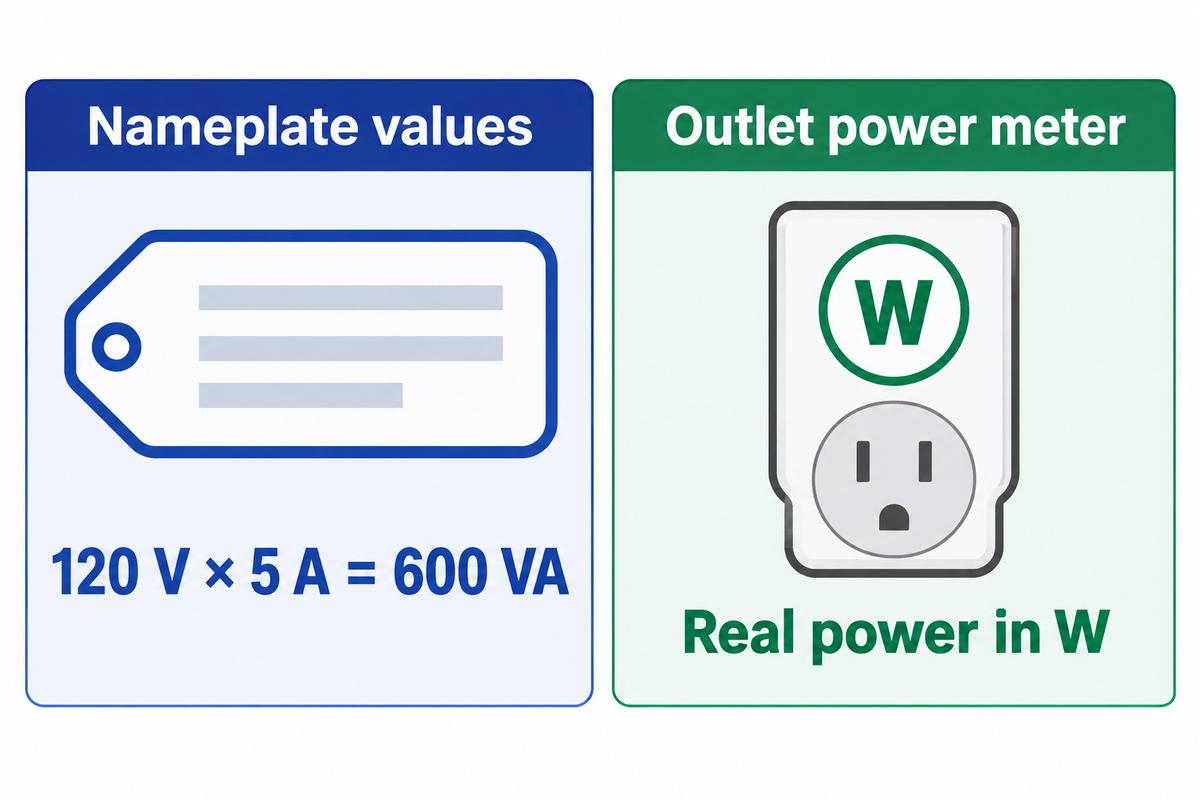
Multiplying the nameplate data on a 120 V, 5 A refrigerator yields 600 volt-amperes (VA). Calling the result 600 watts would assume a power factor of one and an actual operating current equal to the rated current. A wattmeter measures real input power at the outlet. For a single-phase AC load, real power is equal to RMS volts times RMS amps multiplied by the power factor. The Prayas field study’s load and power-factor analysis illustrates readings for refrigerators.
The plate helps identify the refrigerator and its electrical ratings. Take a real power reading after startup to determine the watts a refrigerator uses in normal cooling. Use the model number to find the manual or EnergyGuide. For backup planning, determine the documented start requirement or measure it with equipment that can capture the event, then compare the load and source ratings in the same units.
How to Measure Refrigerator Power Consumption
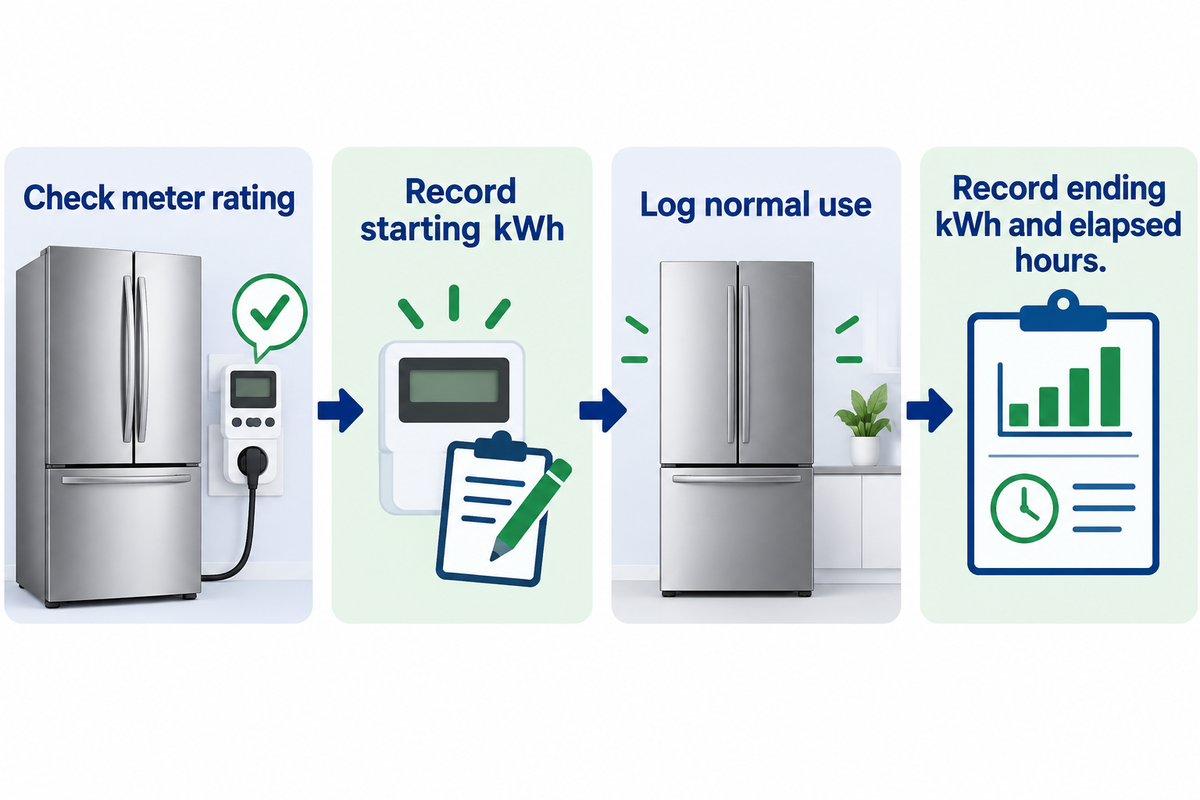
Use a plug-in electricity meter rated for the refrigerator and permitted by its manual. Check that the meter shows cumulative kWh and actual W. Watts indicate the current load, whereas the kWh register shows you the energy your refrigerator uses over the test. Keep your refrigerator at its usual settings and log refrigerator power usage for a few days. A log is helpful in tracking whether a change in surroundings helped reduce energy use. A second fridge in a hot garage can use more energy than a kitchen unit with a similar label. Compare power usage under the conditions in which you’re going to use each appliance.
How do I find my own fridge’s kWh?
Record the meter’s initial reading before you plug the refrigerator into the meter, following the appliance and meter instructions. Write down the kWh total and elapsed hours when you finish. Divide the change in kWh by elapsed hours and multiply by 24 to estimate daily consumption. Keep the test duration and meter reading so you can compare them with those from a later test under similar conditions. To see whether moving the appliance or replacing a worn door seal helps reduce refrigerator power consumption, repeat the same test.
Note a cooling-power reading after startup has settled. If your fridge has automatic defrost, allow enough time for a test to include normal defrost cycles. Use the highest sustained load when you compare continuous power ratings to check the supply of these watts. If your meter only updates the display periodically, it could miss a short startup spike. The PLAID household appliance dataset uses high-frequency voltage and current readings to capture the activation of appliances. A meter for daily energy usage serves a different purpose.
How Much Does a Refrigerator Cost to Run?
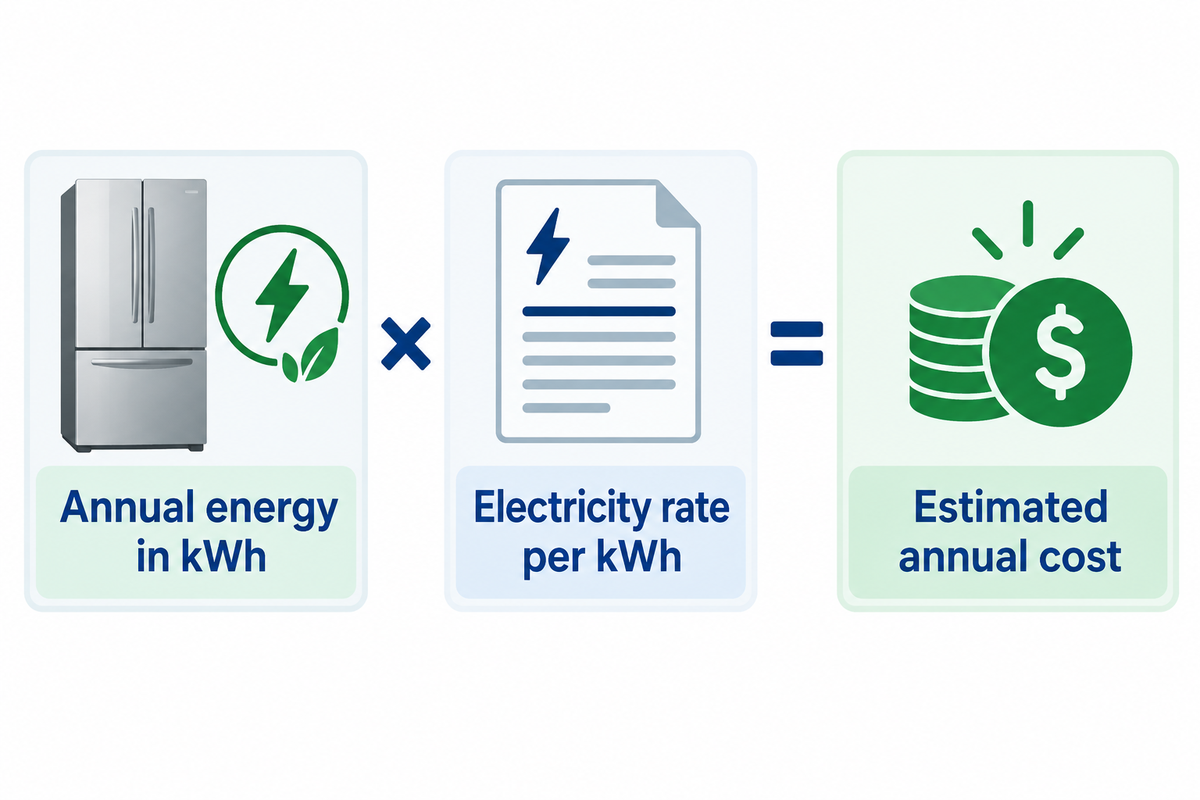
Using the GE model’s 365 kWh annual rating, the estimated cost is $5.24 per month at the U.S. Energy Information Administration’s national residential average of 17.23 cents per kWh, in 2025. For a fridge you already own, multiply your measured annualized kWh by your own rate for electricity.
The GE model’s annual energy label works out to average consumption of 30.4 kWh per month. The FTC’s EnergyGuide guidance explains what costs the label estimates. You may be charged a different rate than what’s used in the estimate. Replacing the fridge leaves a utility’s fixed customer charge in place. When time-varying rates change, use a time-stamped energy log to apply each rate to electricity used during that period.
At a constant electric rate, estimate annual electricity-cost savings by multiplying the difference in annual kWh by that rate. Divide any purchase price premium by the annual savings to estimate simple payback. Keep in mind this calculation considers energy costs only, and doesn’t take financing and maintenance costs into account.
Will a 1500 Watt Generator Run a Refrigerator?
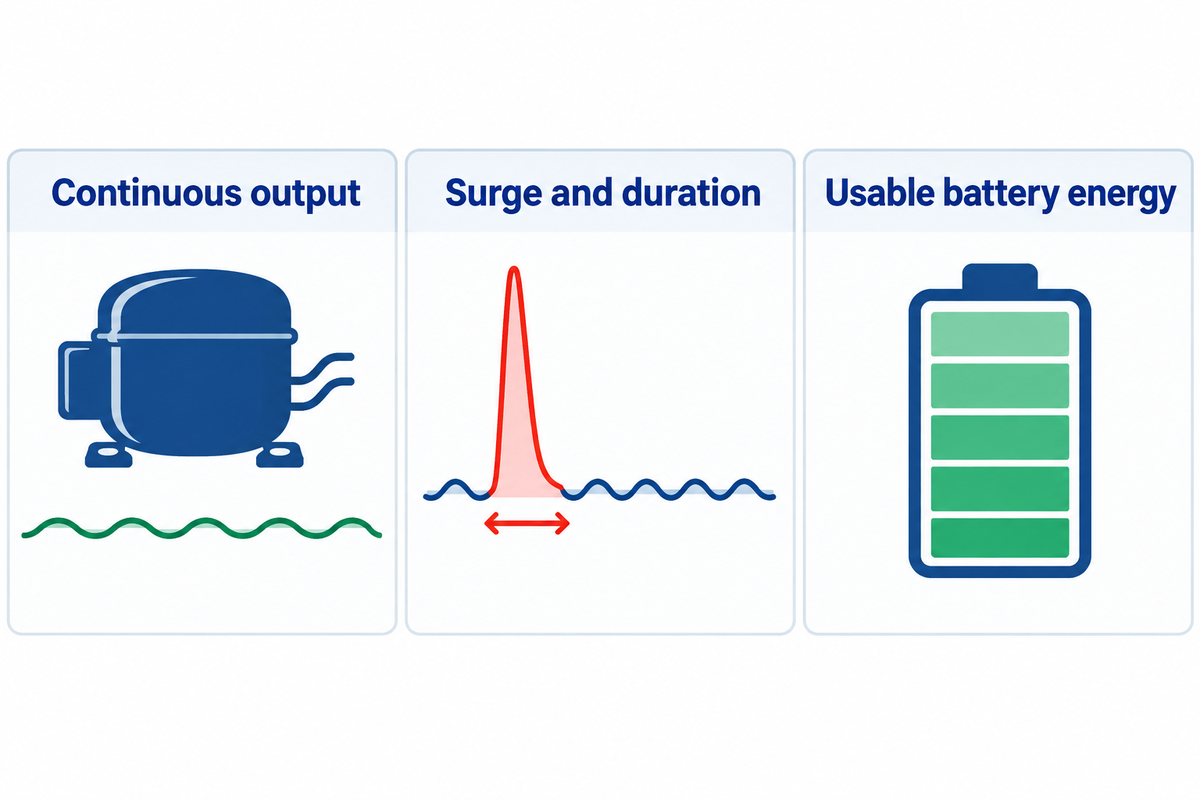
With the correct voltage and frequency, you can power a refrigerator with a 1,500 W generator if its continuous output covers the sustained load and its surge rating supplies the starting watts for long enough. To power your refrigerator during an outage, see if 1,500 W is the continuous rating or the peak output. Add together loads that will run in parallel, including your refrigerator, and anything else that’s drawing power before it starts.
No, if the generator’s max output is 1,500 W, and the refrigerator needs 1,800 W at startup. In the sizing example by the Queensland Electrical Safety Office, they mention approximately 180 W running power and 1,800 W at startup for a refrigerator or freezer. For this example, check whether the generator’s short-duration rating covers the 1,800 W startup demand and for how long.
Here is a different, hypothetical example. With 320 W for defrost and 200 W for other devices, total sustained draw is 520 W. A start event of 900 W alongside those devices brings the watts required during startup to 1,100 W.
How long will a battery run a refrigerator?
A battery system delivering 800 Wh through its AC outlet provides about 16 hours of refrigerator runtime at an average power consumption of 50 W. After checking output capability, divide usable AC watt-hours by the load’s measured average watts to estimate runtime in hours. Other loads and increased fridge consumption shorten the runtime. See how recharging impacts the off-grid runtime in the camping power station sizing guide. Adjust the battery’s nameplate capacity for losses and reserves to estimate whether the battery holds sufficient energy for your refrigerator.
Enter the average power and target runtime in Guangqi’s portable power station runtime calculator to estimate energy, then check the full startup surge and its duration before choosing a model class. Understand battery and fuel options in the battery-powered generator guide. The U.S. Consumer Product Safety Commission says to run a portable fuel generator outdoors at least 20 feet from the home, with the exhaust facing away.
How to Compare Efficiency Labels When Replacing a Fridge
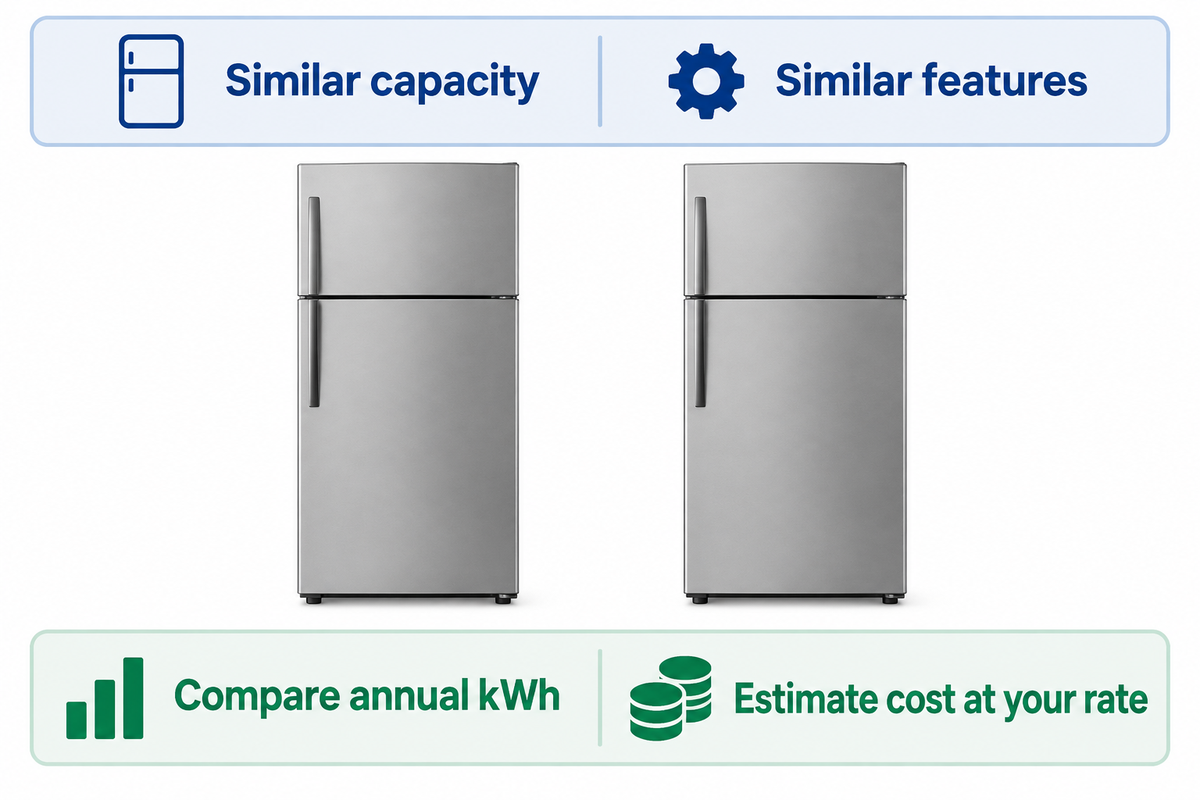
Compare energy labels for fridges of similar capacity and features. Compare refrigerators of the same type with the features you use, such as an integrated ice maker. Look into the type of refrigerator before drawing conclusions based on energy use. The ENERGY STAR refrigerator guide mentions that size, configuration of the cabinets and door seals can also impact energy consumption. Measure a second fridge and compare its running cost to a replacement fridge. For a fridge you want to keep, the ENERGY STAR guide offers tips for reducing refrigerator energy use so you can use less electricity.
A larger fridge can use less energy over time. In one household in the Maharashtra study, replacing a direct-cool refrigerator with a larger and more efficient frost-free model cut refrigerator electricity use by more than half. Across the Maharashtra study sample, replacing an existing refrigerator with an energy-efficient one can save a household about ₹ 2100 per year on average in electricity bills. To estimate how much you would save with a new model, compare your current meter reading and the new model’s energy usage on the same annual basis.
Frequently Asked Questions
How many watts does a fridge use in 24 hours?
A fridge using 1.00 kWh in 24 hours averages 41.7 W across the day.
The meter’s kWh register gives the daily total, while a live W reading shows what the appliance is drawing at that instant. A whole-day average includes the hours the compressor slows down or stops and any defrost events that fall inside that measurement window.
Will 2000 watts run a refrigerator?
Many setups can run a refrigerator from a 2,000 W generator, provided its continuous and surge limits cover the appliance and other connected loads.
Look at which rating the manufacturer calls 2,000 W. Compare continuous output with the highest sustained load you expect. If another appliance could start at the same time, include that possibility when checking the generator’s peak load.
How much electricity does a mini fridge use?
The Danby DAR033A2BDB is listed at 201 kWh per year, about 0.55 kWh per day on the standard test basis.
The air inside the fridge warms when you open the door. How much electricity a mini fridge uses changes with the surrounding temperature, door openings and settings. To estimate the cost for an existing unit, measure its cumulative energy over several normal days and apply your electricity rate.
How many watts does a fridge use per hour?
One hour at a steady 100 watts uses 100 Wh, or 0.10 kWh.
Cycling fridges need an energy measurement over the period. A watt reading tells you what the fridge draws at that instant.
Does a refrigerator use power when the compressor is off?
It can.
Controls and other electronics may still draw power, and automatic defrost can put a separate load on the outlet. A meter that logs kWh captures both.
Planning battery backup?
Bring the measured running load, startup figure, and target runtime when comparing portable power station configurations.
References & Sources
- U.S. Energy Information Administration, Measuring Electricity
- Prayas Energy Group, Refrigerator Electricity Consumption Patterns
- U.S. Environmental Protection Agency, ENERGY STAR Refrigerators
- Federal Trade Commission, How To Use the EnergyGuide Label
- 10 CFR Part 430, Appendix A, Refrigerator Energy Test Procedure
- Purdue University International Refrigeration and Air Conditioning Conference, Defrost Control Study