Get in Touch with GUANGQI



Updated November 2026 · Technical Optical & Luminaire Review
A 395nm uv light is a solid-state long-wave ultraviolet emitter near the top of the 315–400 nanometer UV-A band. Industrial InGaN diodes in this class hold peak output within a ±5 nm center-wavelength bin (390–400 nm). Their 15–20 nm half-power spectral spread spills visible violet energy past 400 nm, and even 410 nm. That tail creates a bright purple beam.
Operating right below visible violet creates two practical trade-offs. First, boundary UV-A diodes cure TPO and BAPO polymers deeply at low chip cost. They also excite uranium glass, scorpions, and HVAC leak dyes vividly. Second, purple glare masks faint biological stains on pale fabrics and defeats ZWB2 Wood’s glass filters built for deeper UV-A lamps.
| Optical / Safety Parameter | Verified Engineering Value | Practical Impact on Selection |
|---|---|---|
| Spectral Band Classification | CDC UV-A (315–400 nm) | True ultraviolet, right below visible violet |
| Industrial Peak Tolerance (CWL) | ±5 nm bin; 15–20 nm FWHM (ASI) | Unbinned budget diodes drift to 410–415 nm |
| Photon Energy (Planck Relation) | 3.14 eV (calculated via 1,239.8 ÷ 395) | Cleaves TPO/BAPO bonds; zero ozone output |
| Industrial Press Cure Benchmark | 200 mW/cm² & 1,100 mJ/cm² (UV+EB Tech) | Curing demands high flux matched to initiator |
| Unprotected Eye UV-A Limit | 1.0 mW/cm² (>1,000 s) (CCOHS) | Mandates ANSI Z87.1 polycarbonate eyewear |
| Safety Standard Scope | 180–400 nm UV (>50% share, IEC 62471-6) | Governs UV LED lamp Risk Group labeling |
What Is a 395nm UV Light? CIE UV-A Boundary Physics and Why It Glows Purple
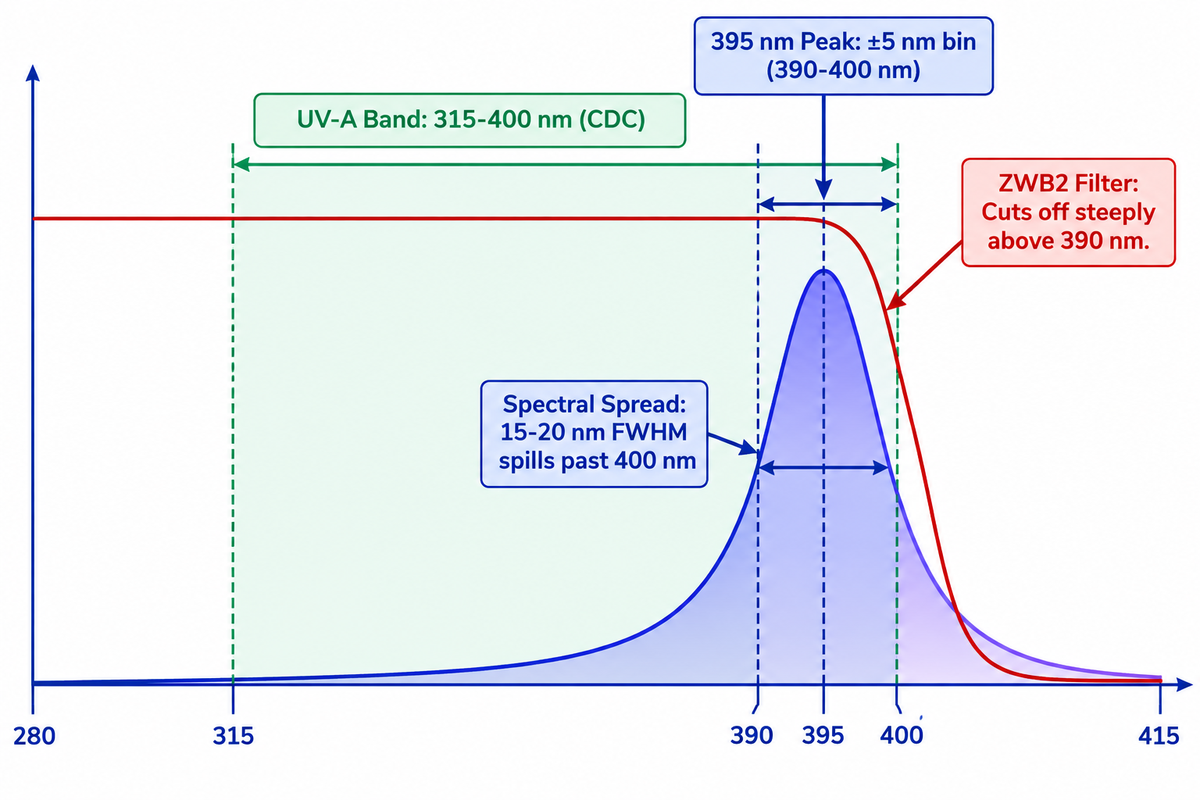
A 395 nm emitter produces non-ionizing longwave uv radiation five nanometers inside the 400 nm ultraviolet ceiling. Both the CDC and Wayne State University OEHS divide ultraviolet light into UV-A (315–400 nm), UV-B (280–315 nm), and UV-C (100–280 nm). Industrial curing inks and general leak dyes target this upper UV-A edge.
Buyers often suspect a bright violet beam means a flashlight is defective. Semiconducting indium gallium nitride (InGaN) chips never emit a single razor-thin laser line. Metrology engineer Jim Raymont documents in Adhesives & Sealants Industry that industrial boundary UV-A diodes carry a ±5 nm tolerance and spread 15–20 nm wide at half power. Significant light emitted from that curve crosses into visible violet light, stimulating human short-wavelength retinal cones.
Overhead commercial and industrial LED lighting fixtures that illuminate plant floors are rated in lumens and Kelvin, whereas monochromatic UV emitters are rated by peak nanometer wavelength and radiometric milliwatts. Trying to strip purple glare from a 395nm wavelength torch with a ZWB2 Wood’s glass lens backfires optically. In 1Lumen’s UV filter test, ZWB2 black glass isolates deep UV-A and cuts off steeply above 390 nm, blocking the emitter’s primary peak.
What is the typical wavelength of light that a black light emits?
Commercial blacklights emit peak UV-A radiation between 365 and 395 nanometers inside the 315–400 nm band. Legacy fluorescent blacklight-blue bulb tubes and glass-filtered inspection torches peak near the deeper end with little visible light. Entry-level T8 LED blacklight bars, party strips, and general household torches center near the upper UV-A edge to maximize radiant output per dollar.
365nm vs 395nm vs 405nm UV LEDs: Contrast, Cost, and Wavelength Selection
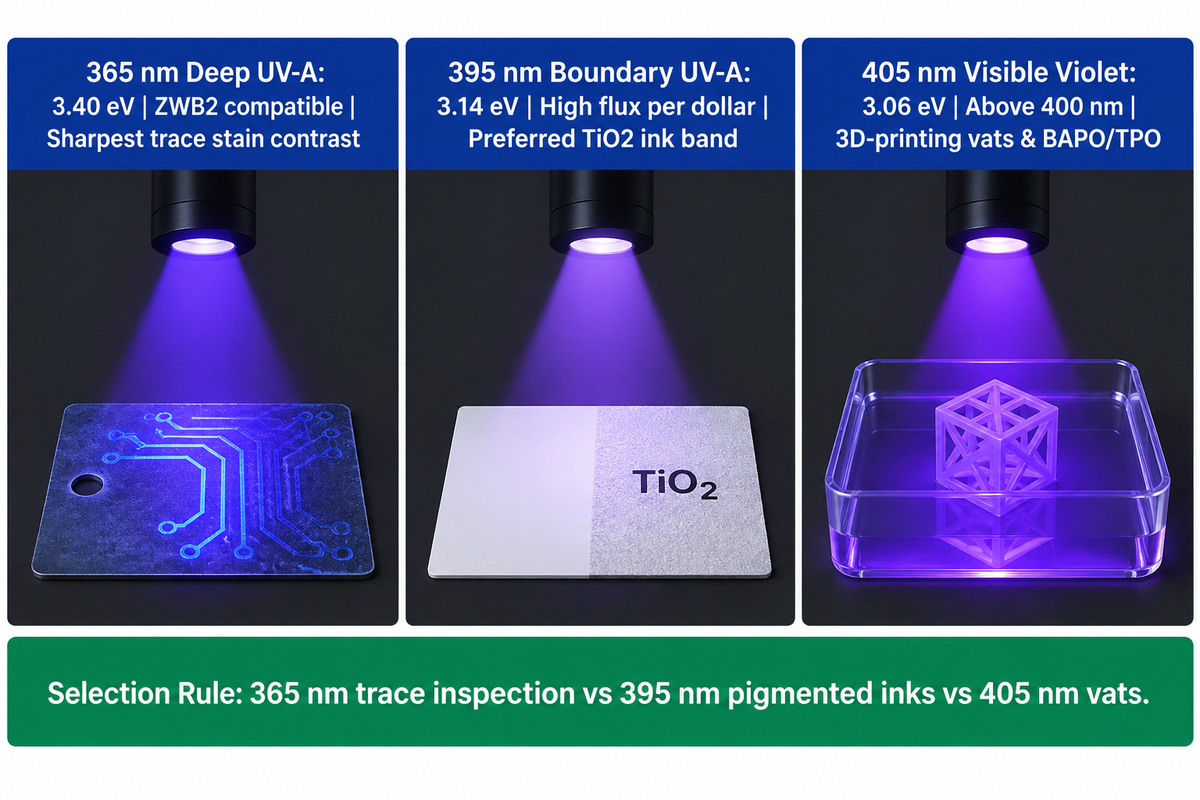
According to UV+EB Technology, commercial solid-state LEDs cluster at four wavelengths, led by a side-by-side 3-wavelength engineering comparison (365 nm vs 395 nm vs 405 nm) with photon energy values of 3.40 / 3.14 / 3.06 eV. Pick 365 nm and 395 nm by contrast versus flux: deep UV-A wins trace inspection, boundary UV-A suits pigmented inks, and violet diodes fit 3D-printing vats.
Evaluating 365nm vs 395nm comes down to semiconductor physics and target absorption. Deeper 365 nm chips require lower indium fractions in the InGaN quantum well. That crystal strain lowers efficiency and raises wafer cost severalfold over longer-wave emitters. A ZWB2-filtered 365 nm light leaks only faint bluish-white light, whereas an unfiltered boundary UV-A diode floods pale surfaces with reflected purple glare.
The 3-Wavelength Near-UV Contrast & Curing Trade-off Table
| Comparison Criterion | 365 nm LED (Deep UV-A) | 395 nm LED (Boundary UV-A) | 405 nm LED (Visible Violet) |
|---|---|---|---|
| Spectral Band | UV-A (CDC 315–400 nm) | UV-A (390–400 nm bin, ASI) | Visible violet (above 400 nm) |
| Photon Energy (hc / λ) | 3.40 eV (1,239.8 ÷ 365) | 3.14 eV (1,239.8 ÷ 395) | 3.06 eV (1,239.8 ÷ 405) |
| Visible Beam Appearance | Dim bluish-white leak (dark with ZWB2) | Moderate-to-bright violet spill | Intense saturated purple glare |
| ZWB2 Filter Compatibility | High transmission; strips visible tail (1Lumen) | Incompatible; blocks primary emitter peak | Incompatible; blocks visible violet beam |
| Relative Cost per Radiant mW | Highest emitter cost tier | Low baseline cost; high flux per dollar | Lowest commodity diode cost |
| Faint Biological Stain Contrast | Sharpest contrast; detects blood serum | Finds dry dark-carpet spots; misses serum | Poor; purple beam masks weak glow |
| Uranium vs. Manganese Glass | Excites both (manganese false positives) | Isolates uranium glass; manganese stays dim | Excites uranyl ions with heavy glare |
| TiO2 White-Pigmented Ink Cure | Scattered within micrometers of surface | Preferred graphic press band (UV+EB Tech) | Deepest penetration with BAPO/TPO |
| Clear Coating Surface Cure | Stronger HMPP/HCPK surface conversion | Needs high irradiance or amine synergist | Prone to surface oxygen tackiness |
| Banknote Security Strip Check | Crisp fluorescence on dark paper (Federal Reserve) | Glows with moderate purple washout | Fails to excite security thread |
Shorter wavelengths aren’t universally superior. When antique collectors inspect Vaseline glassware, a 365nm black light excites manganese-decolorized clear glass into a misleading green glow. Boundary UV-A leaves manganese glass dark while lighting genuine uranium glass vivid green. In graphic printing, UV+EB Technology confirms boundary UV-A is the preferred ink band because titanium dioxide scatters 365 nm uv photons within micrometers. Separate 365nm uv mineral inspection torches and shortwave uv lamps (UV-C) serve specialized prospecting rather than press curing.
Is 405 nm UV light?
No, standard optical conventions end ultraviolet radiation at 400 nm and classify longer wavelengths as visible light, making violet 405-nanometer diodes visible emitters rather than true UV-A. Curing chemists occasionally call that violet edge “UVV” because those diodes harden desktop 3D-printer photopolymers and charge glow in the dark strontium aluminate paint rapidly, unlike dental blue light LEDs.
What Glows Under a 395nm UV Light? Stain, Leak, Pest, and Mineral Performance
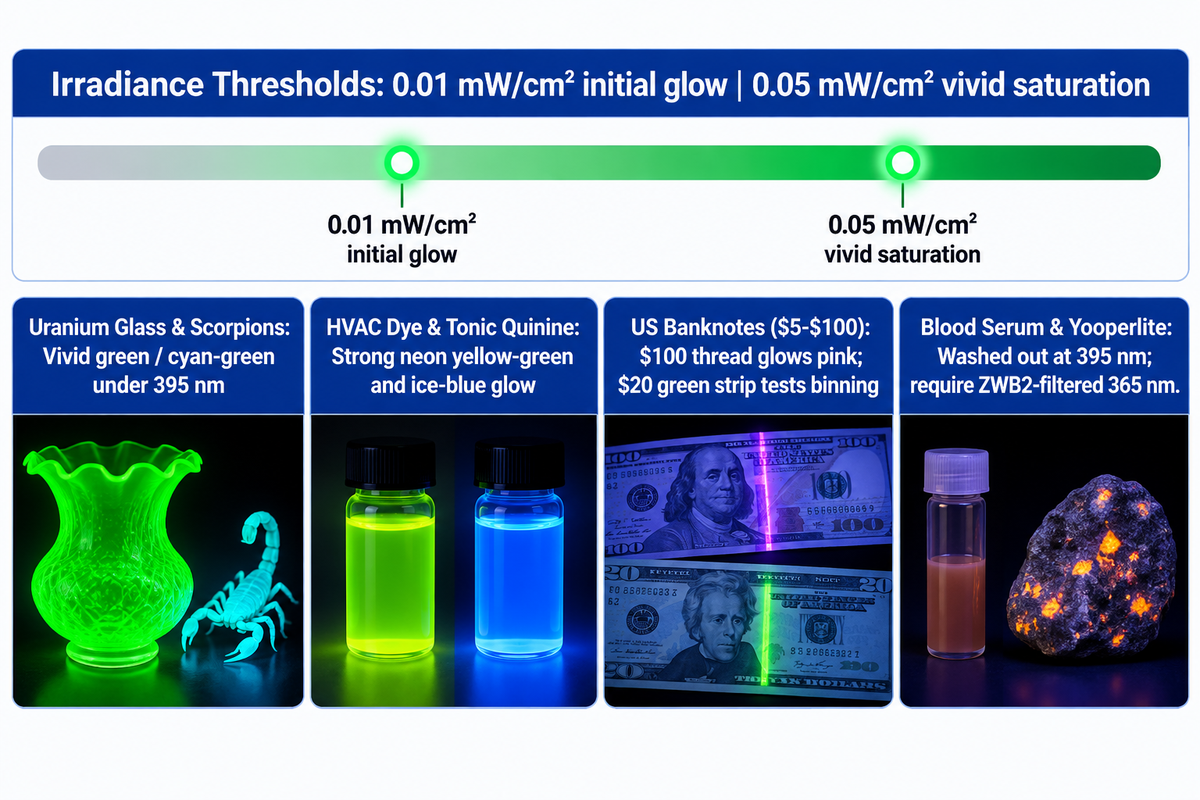
High-yield dyes, bark scorpions, tonic water quinine, and uranyl glass glow intensely under boundary UV-A, starting at 0.01 mW/cm² of irradiance and reaching vivid color saturation at 0.05 mW/cm² in darkened rooms. Sodalite minerals and blood serum traces instead require a filtered 365 nm wavelength source.
Ambient light control governs inspection contrast. Under bright normal light or overhead white light, reflected violet glare from an unfiltered emitter swamps weak Stokes-shift emission. Laundry optical brighteners on white textiles also reflect intense electric-blue light. That background glow masks faint dried urine stains, diluted pet stains, or separated blood plasma on pale carpets.
The 10-Target Fluorescence & Photoinitiator Excitation Lookup
| Target Material | Excitation Band | Boundary UV-A Visibility | Field Inspection Behavior & Caveat |
|---|---|---|---|
| Uranium (Vaseline) Glass | Long-wave uranyl ion | Excellent (vivid green) | Avoids false green glow from manganese clear glass |
| Bark & Desert Scorpions | UV-A beta-carboline | Excellent (cyan-green) | Cuticle glows brightly across dark desert ground |
| HVAC & Coolant Leak Dye | Near-UV naphthalimide | Strong (neon yellow-green) | Pair with yellow contrast glasses in bright engine bays |
| Glow-in-the-Dark Pigments | Near-UV SrAl2O4:Eu,Dy | Excellent (rapid charge) | Saturates phosphorescent lures and stage props rapidly |
| Tonic Water (Quinine) | UV-A alkaloid band | Strong (ice blue) | Reliable dark-room check confirming active UV-A output |
| Dried Pet Urine (Dark Rug) | UV-A oxidized compounds | Moderate (dull yellow) | Fresh wet puddles fluoresce poorly until dry; 365 nm led is sharper |
| Laundry Optical Brighteners | UV-A stilbene dyes | Very strong (electric blue) | Triggers false stain alarms on detergent-washed white sheets |
| US Federal Reserve Strips | Deep UV-A optimal (USCurrency.gov) | Low-to-moderate contrast | Hundred-dollar thread glows pink and twenty-dollar green with glare |
| TPO / BAPO Photoinitiators | 379–380 nm long-wave band | Strong photochemical cleavage | Drives fast through-cure in LED inks, adhesives, and 3D resins |
| Blood Serum & Yooperlite | Narrow deep UV-A band | Fails / washed out | Forensic serum and sodalite require ZWB2-filtered deep UV-A |
Currency verification shows why emitter binning accuracy matters. Documentation from the U.S. Currency Education Program confirms that $5 through $100 Federal Reserve notes contain UV-reactive security threads, with the $100 thread glowing pink. Legitimate upper-band UV-A LEDs excite those strips in darkened rooms. Purple reflections lessen visual contrast, but overall they perform as expected. Complete failure to light a twenty-dollar bill’s green strip exposes a mislabeled violet diode.
What glows under 395 UV light?
Uranium glass, scorpion cuticles, HVAC refrigerant dyes, tonic water quinine, neon pigments, and glow-in-the-dark powders fluoresce vividly under boundary UV-A illumination. At this wavelength, a blacklight for pet urine detection spots dried pet urine stains on dark rugs, and stage light shows use wide washes to pop fluorescent costumes. Switch to a filtered 365nm uv flashlight when checking white hotel linens or sodalite rocks.
Using 395nm UV Light for Resin, Adhesive, Nail Gel, and Ink Curing
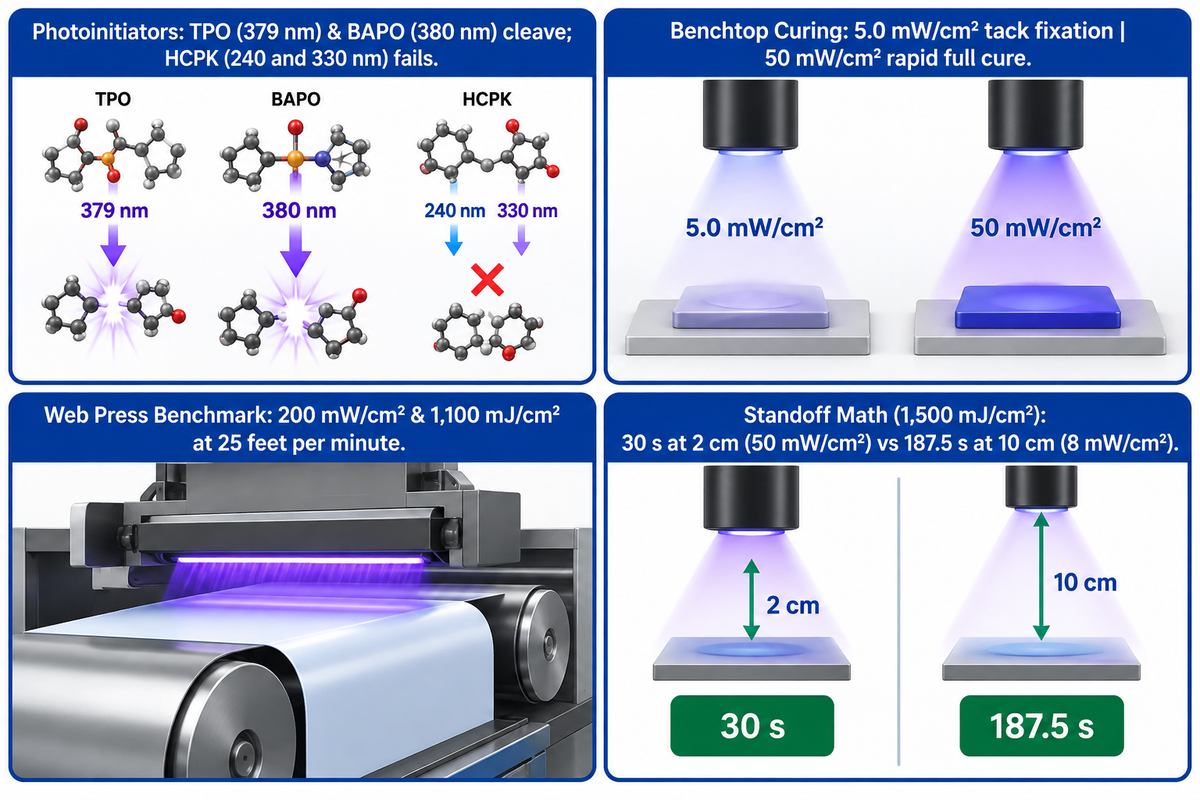
Polymerizing uv resin or acrylate adhesives under boundary UV-A requires 5.0 mW/cm² for initial tack fixation and 50 mW/cm² or higher for rapid full cure, paired with TPO or BAPO photoinitiators. Industrial web presses in UV+EB Technology specify both irradiance and cumulative uv energy, such as 200 mW/cm² and 1,100 mJ/cm² at 25 feet per minute.
5–50+ mW/cm²benchtop resin curing irradiance
1,100 mJ/cm²press cure dose (UV+EB Tech)
379–380 nmTPO & BAPO absorption peaks
Wavelength chemistry governs polymerization before uv power comes into play. Acylphosphine oxides such as TPO (379 nm peak) and BAPO (380 nm peak) cleave efficiently under long-wave LEDs and photobleach to harden thick or white-pigmented layers. Old clear coats built entirely around short-wave HCPK (240 and 330 nm) won’t crosslink under a boundary UV-A uv lamp. Even a 4 W/cm² UV-LED array tested in Coatings left unoptimized high-solids wood coatings tacky from surface oxygen inhibition.
Suppose an optical bonding resin requires a 1,500 mJ/cm² radiant cure dose under a 50 mW/cm² led uv spot lamp. Dividing dose by irradiance (1,500 ÷ 50) delivers that 1,500 mJ/cm² cure dose in 30 s at 2 cm, versus 187.5 s at 10 cm once beam divergence drops surface flux to 8 mW/cm² (1,500 ÷ 8).
Two European regulatory milestones also shape UV formulation choices in 2026. EU Delegated Regulation (EU) 2024/197 prohibited monomeric TPO in cosmetic UV gel nail products starting September 1, 2025, shifting nail gels toward TPO-L and BAPO while industrial inks remain unaffected. Meanwhile, RadTech contributor Jennifer Heathcote confirms EU RoHS Exemption 4(f)-IV for mercury curing lamps runs through February 24, 2027, accelerating upgrades to high power solid-state arrays.
How much irradiance in mW/cm2 does a 395nm UV light need to cure resin?
Craft TPO and BAPO resins require at least 5.0 mW/cm² for initial tack fixation and 50 mW/cm² or higher for rapid through-curing. Conveyorized inks and wood finishes use powerful uv arrays that are far stronger. UV+EB Technology specifies 200 mW/cm² on a web press, while a 40-LED array measured 339 mW/cm² at 100–150 mm standoff and press heads reach multi-watt window peaks.
How Strong Is 395nm UV Light? Radiometric Irradiance (mW/cm2) vs. Wattage Myths
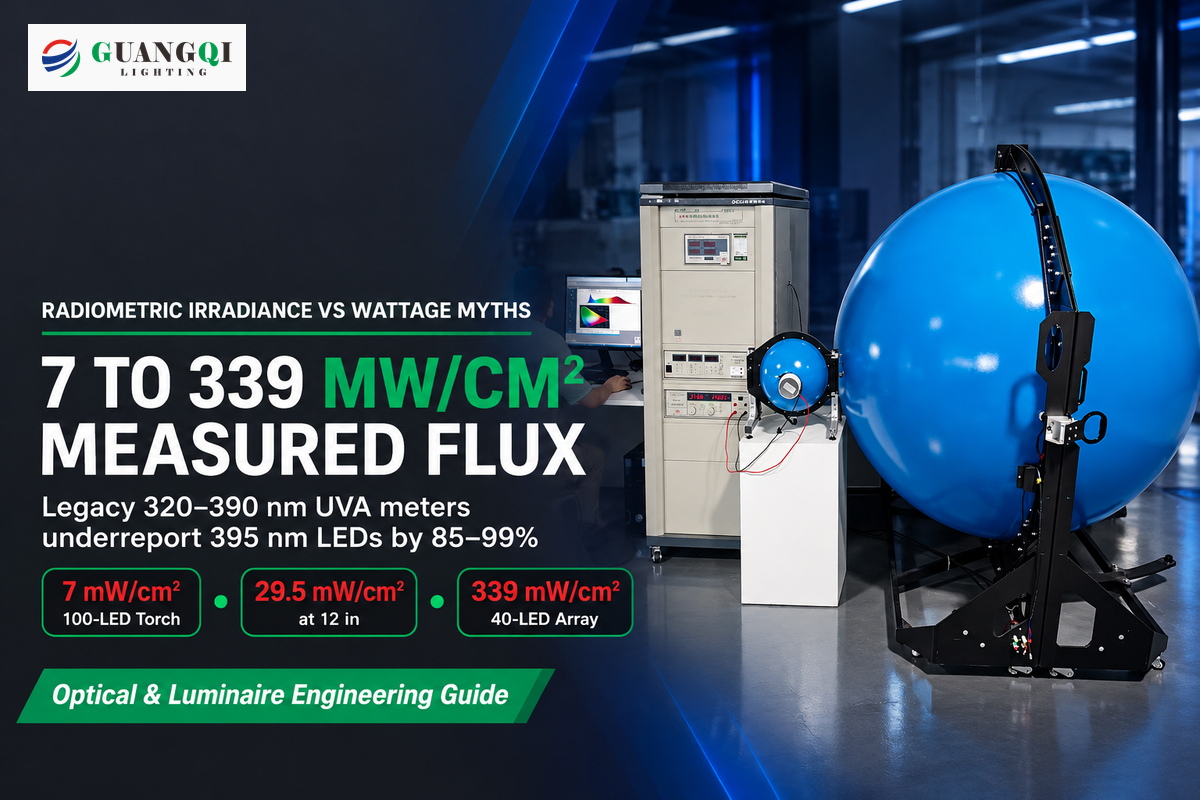
Measured UV-A surface irradiance spans more than two orders of magnitude across hardware tiers, from 7 mW/cm² on budget multi-LED torches to 339 mW/cm² on a 40-LED curing array and multi-watt peaks on press heads. Focused single-emitter flashlights deliver 29.5 mW/cm² at 12 inches, nearly tripling the 10 mW/cm² baseline of noon sunshine. Ignore lumen claims and inflated “100W” titles when sizing uv devices.
Photometric lumens weight light by human green-yellow eye sensitivity peaking at 555 nm, which suits indoor warm light bulbs measured across the visible light spectrum and Kelvin color temperatures yet drops near zero in the UV band. Retail listings also quote “LED-equivalent watts” detached from DC input watts or optical uv output. In a 2026 Linshang LS137 radiometer test on Festool Owners Group, a 100-LED eBay torch and a 144-LED Temu panel both peaked at 7 mW/cm² within 20 mm. A 40-LED curing array in that same test delivered 339 mW/cm² across a 100–150 mm working height.
Radiometer selection creates a second measurement trap. Data in UV+EB Technology shows that legacy 320–390 nm UVA meters underreport a 395 nm LED (390–400 nm peak) by 85–99%. Even on band-matched industrial heads, thin dust or ink mist on the quartz window cuts irradiance noticeably.
Junction-temperature control governs sustained output in every 395nm uv led module and high-wattage outdoor luminaire. At Guangqi Lighting’s Guzhen plant, building visible-spectrum counterparts to uv flood lights starts with finite element analysis (FEA) on CNC die-cast aluminum heat sinks and constant-current driver regulation. Tempered or borosilicate glass optics prevent silicone UV yellowing under IEC 60529 IP65/IP66 sealing, while 48-hour burn-ins and integrating-sphere photometry verify thermal stability.
Is 395 nm UV strong?
Yes at close working range: boundary UV-A output exceeds midday solar UV intensity, hitting 29.5 mW/cm² at 12 inches on a focused torch versus 10 mW/cm² outdoors. Industrial curing arrays reach 200 to 339+ mW/cm². Pull that handheld torch back to 48 inches, however, and beam divergence drops irradiance to 2.1 mW/cm², plenty for poster glow, yet weak for polymer curing.
Is 395nm UV Light Safe for Eyes and Skin? IEC 62471 Limits and the Germicidal Myth
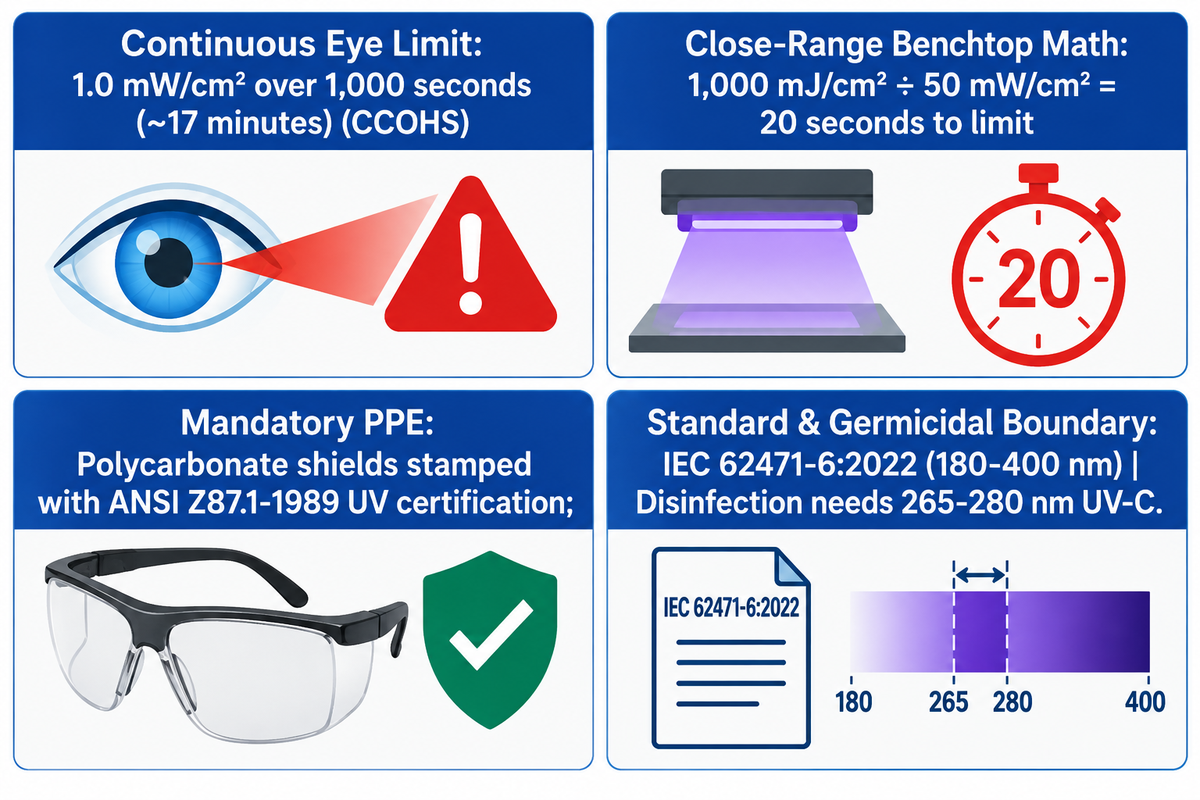
No for unprotected eyes or bare skin at close range: CCOHS caps unprotected eye exposure to 315–400 nm UV-A at 1.0 mW/cm² over 1,000 seconds (~17 minutes) or 1,000 mJ/cm² short-term. Wear ANSI Z87.1 polycarbonate eyewear, long sleeves, or CDC-recommended SPF 15+ skin protection, and never rely on this type of uv for germicidal disinfection.
“For the UV-A (315 to 400 nm), exposure to the eye should not exceed 1 milliwatt per square centimetre (1.0 mW/cm2) for periods greater than 1000 seconds (approximately 17 minutes).”
Close-range benchtop work reaches short-term ocular limits rapidly. Suppose an operator holds that same unshielded 50 mW/cm² 395nm ultraviolet curing lamp over a reflective jig without wrap-around eye protection. Dividing the 1,000 mJ/cm² short-term ceiling cited by CCOHS by 50 mW/cm² yields just 20 seconds to reach the full unprotected eye limit. Dark fashion sunglasses without UV400 blocking worsen lens exposure by dilating the pupil. Wayne State University’s lab protocol mandates polycarbonate shields stamped with ANSI Z87.1-1989 UV certification, which also block glare during forensic uv photography.
Lamp risk-group labeling follows IEC 62471-6:2022, adopted into IECEE CB certification in December 2023. The standard covers lamps where over half of 180–3,000 nm radiant power sits within 180–400 nm. Never substitute a blacklight for pathogen sanitization. Long-wave UV-A diodes cannot dimerize microbial DNA; see our guide on germicidal UV-C wavelength and dose requirements for verified 265–280 nm disinfection specs.
Do
- Wear polycarbonate safety glasses stamped with ANSI Z87.1 UV400 certification around curing beams
- Enclose benchtop UV-A lamps exceeding 1.0 mW/cm² at operator eye height
- Check IEC 62471-6 Risk Group labels (Exempt to RG3) on industrial UV LED modules
- Review photosensitizing medication precautions before long skin exposure to high-output UV-A arrays
Don’t
- Never wear untinted prescription glasses or non-UV400 dark sunglasses that dilate pupils under glare
- Never stare into specular reflections off polished metal molds, glass panes, or wet resin pools
- Never use UV-A blacklights for water, air, or surface disinfection in place of germicidal UV-C
- Never assume dim visual brightness means low radiant flux near the upper UV-A boundary
395nm UV Light Form Factors and Price Tiers: Flashlights, Strips, Floodlights, and Curing Lamps
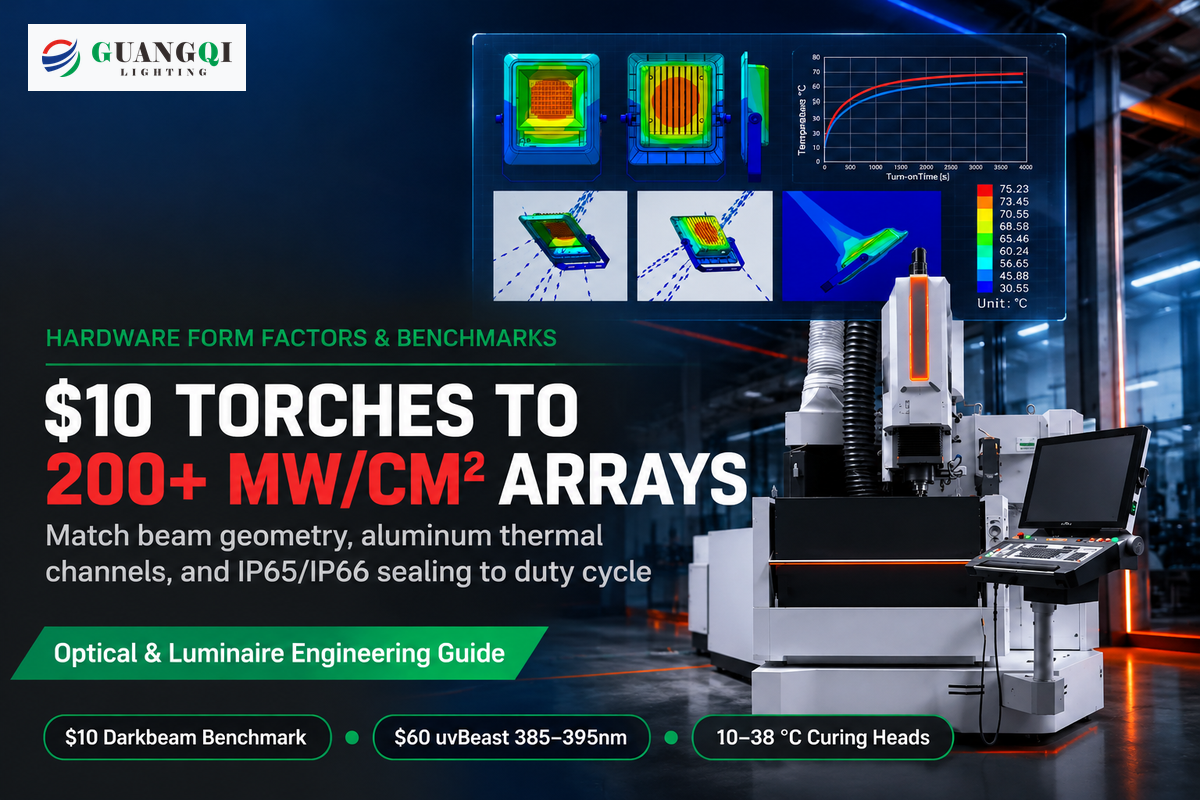
Protective eyewear and enclosure budgets scale directly with optical power across UV-A lamp categories. Verified handheld models in 1Lumen’s 28-flashlight laboratory test include $10 single-cell torches (Darkbeam v5 DB 395nm) and $60 dual-18650 flashlights (uvBeast v3 385–395nm). Custom LED strips, outdoor floodlights, and industrial curing heads are quoted by wattage, cooling, and IP enclosure rating.
| Hardware Form Factor | Verified Price / Quote Basis | Typical Output & Duty | Best-Fit Application & Spec Check |
|---|---|---|---|
| Entry Pocket / Penlight Torch | $10 (1Lumen Darkbeam benchmark) | Low unregulated output; intermittent (100-LED budget torches peaked at 7 mW/cm²) | Casual glow charging, dark-rug pet checks; watch for unpasted MCPCBs |
| Prosumer Handheld / Flat EDC | $60 (1Lumen uvBeast 385–395nm benchmark) | Regulated constant-current beam | HVAC dye tracing, scorpion sweeps; confirm buck/boost driver & IPX6+ |
| 12V / 24V Flexible LED Strip | Varies by emitter density; request quote | 0.02–0.5 mW/cm² wide ambient wash | Display cabinets, theatrical glow; mount on aluminum channel to prevent yellowing |
| Outdoor Blacklight Floodlight | Varies by wattage & seal; request quote | Wide-beam wash; continuous night duty | Stage/event washes; verify real DC watts & IEC 60529 IP65/IP66 housing |
| Industrial Curing Head / Array | Quoted by span & air/water cooling | 200 mW/cm² to multi-watt press heads (UV+EB Tech); 10,000–20,000 hr module life | Adhesives, wood coatings, web presses; keep ambient air within 10–38 °C |
Selecting the best uv gear means matching beam geometry to your work envelope. For quick household sweeps, entry buyers often pick a cheap uv light, usually sold as a 385-395nm black light uv flashlight. Hobbyists also keep a basic uv black light flashlight in a pocket-sized format for glow lures. Service technicians instead carry a regulated handheld light, a slim flat edc flashlight, or a pro uv inspection torch. A typical toolkit holds a dedicated 395nm uv flashlight, a filtered 365 nm unit sold as a flashlight 365nm, or a dual-band uv led flashlight.
Permanent installations demand stricter thermal and environmental protection. Mount every 395nm blacklight led strip inside an extruded aluminum channel so heat doesn’t brown the lens. Check IP65 and IP66 enclosure ingress protection standards before mounting a powerful black light or corded led uv blacklight bar outdoors. Keep room air between 10 °C and 38 °C (50 °F to 100 °F) around air-cooled curing heads. When evaluating a retail “flashlight 395nm” listing, check real DC input watts rather than emitter count.
How to Spot Mislabeled 405nm LEDs, Verify 395nm Suppliers, and Specify Commercial Fixtures
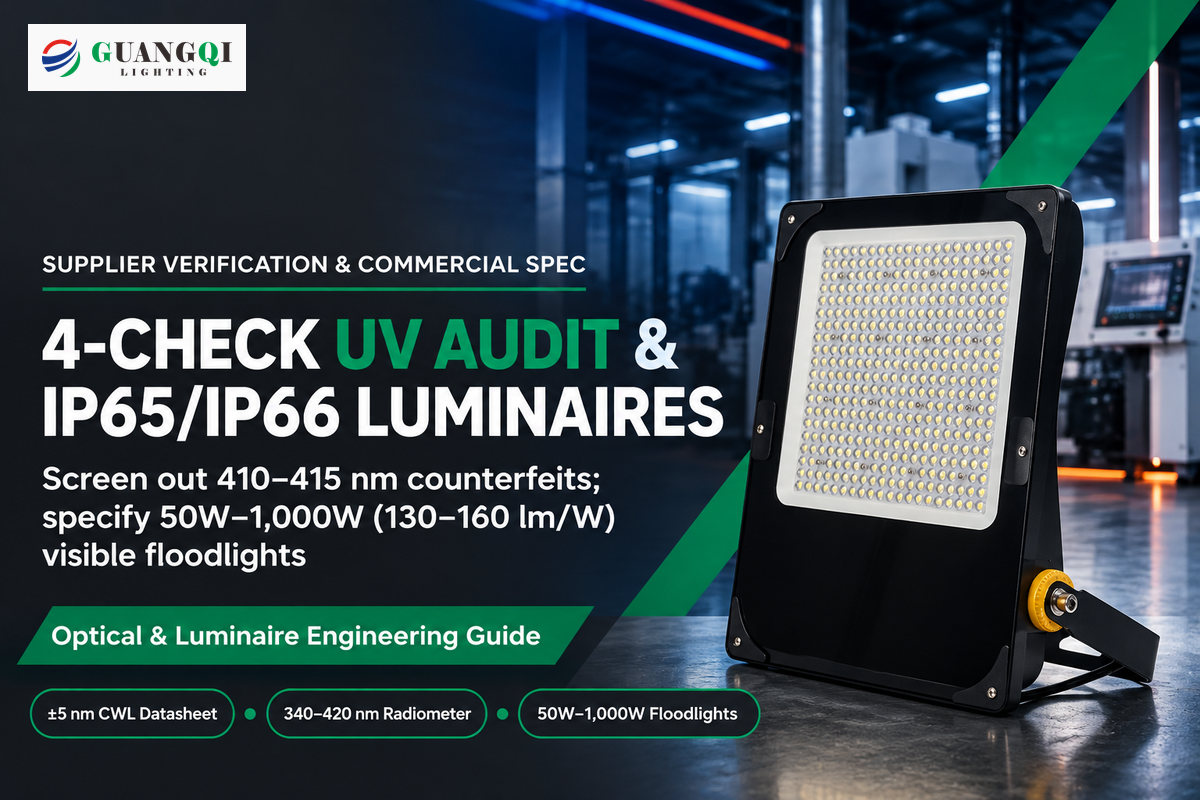
Industrial 395nm uv emitters ship binned to ±5 nm in Adhesives & Sealants Industry testing, whereas low-cost marketplace listings frequently substitute 405–415 nm visible-violet diodes. Budget builds in 1Lumen’s teardowns also pair torches with overrated cells and unpasted circuit boards. Run four incoming checks before deploying any uv blacklight batch on a shop floor.
The 4-Check Irradiance & Wavelength Verification Protocol
- Audit the CWL Binning Datasheet: Request the diode maker’s spectral sheet (such as Nichia, Luminus, or LiteOn emitters documented in 1Lumen) confirming tight UV-A binning. Off-spec batches in ASI metrology reports measured 410–415 nm.
- Run the Two-Target Darkroom Benchmark: Shine the beam on tonic water and a current twenty-dollar Federal Reserve note in a dark room. Authentic upper-band UV-A LEDs turn tonic water blue and light the security thread green, while violet counterfeits show only purple glare.
- Use a Band-Matched Radiometer: Skip 290–390 nm meters like the Lutron UV-340, which 1Lumen’s laboratory review notes cuts off at 390 nm. Measure output at a fixed standoff with a 340–420 nm or LED-calibrated radiometer.
- Check Thermal Paste and Cell Capacity: Inspect the LED star board for thermal compound and discharge-test cells at 1A. 1Lumen’s battery teardown uncovered zero thermal paste under an $11 torch’s MCPCB and measured 1,486–1,512 mAh on cells labeled 2,000 mAh.
Documented UV hardware brands separate cleanly by tier: Nichia, Luminus, and LiteOn for discrete UV LEDs; uvBeast (v3 385–395nm), LUXPRO (LP32UV), and Convoy (S12 UV) for handheld flashlights; and Excelitas (AC7300-395) or GEW (AeroLED2 / LeoLED2) for industrial curing heads. Guangqi Lighting manufactures commercial outdoor, roadway, industrial high-bay, and architectural visible LED luminaires rather than handheld UV blacklights or resin curing lamps. For plant perimeters, loading yards, and inspection bays needing die-cast aluminum outdoor LED flood lights, our Guzhen factory builds 50W–1,000W (130–160 lm/W) fixtures. Every model undergoes 85 °C thermal cycling, salt-spray testing, IEC 60529 IP65/IP66 sealing checks, and 6,000+ hour lumen-maintenance validation.
Key takeaway
Select ±5 nm binned boundary UV-A LEDs for TPO/BAPO curing, uranium glass checks, and dye sweeps. Measure 5–50+ mW/cm² curing flux with a band-matched LED radiometer, and switch to ZWB2-filtered deep UV-A when purple glare hides faint stains.
Specify Commercial Visible-Spectrum Industrial & Outdoor LED Luminaires
Need factory-direct OEM/ODM lighting solutions? Goniophotometer-verified IES files? Outfitting warehouse high-bay zones, IP66 exterior floodlighting, or DMX512 building facades?
Frequently Asked Questions About 395nm UV Lights
Q: Does a 395nm UV light cure UV resin as well as a 365nm light?
Yes, for craft acrylates, 3D-printing photopolymers, and inks formulated with TPO (379 nm) or BAPO (380 nm) photoinitiators, boundary UV-A fixtures cure thick layers rapidly.
Longer near-visible photons penetrate deeper into titanium-dioxide white pigments and thick pours where shorter UV-A energy scatters within micrometers. Thin clear coatings formulated solely with short-wave hydroxyketones, like HCPK (240/330 nm), will not cure at the visible edge. Coatings like these require deeper emitters in the UV-A or acylphosphine blends, to prevent surface tackiness.
Q: Why is the security strip on US dollar bills hard to see with some 395nm flashlights?
Poor banknote visibility comes from one of two causes: Bright purple glare from unfiltered UV-A diodes or counterfeit violet LEDs sold with fraudulent UV labels.
Genuine UV-A emitters excite the security threads on Federal Reserve notes, as documented at USCurrency.gov. Cashiers typically use ZWB2-filters with deep UV-A lights for better contrast when checking identifiability of bills, because unfiltered boundary UV-A reflects off the pale currency paper and thus appears purplish to the cashier.
Q: Can a 395nm UV light pass through regular window glass or polycarbonate shields?
Window glass transmits most long-wave UV-A radiation while UV-filtering safety shields block it almost completely.
Guidance from CCOHS notes that standard window glass blocks UV-B below 315 nm but transmits long-wave UV-A. Therefore, standard untinted spectacles or glass panes will not protect operators near benchtop curing lamps. Always order enclosures and wrap-around eyewear stamped with ANSI Z87.1 UV certification.
Q: Does a 395nm UV light attract flying insects outdoors?
It is true that nocturnal moths and beetles are most visually sensitive across UV-A wavelengths.
Unshielded outdoor blacklights attract insects rapidly. IEC 62471-6:2022 covers UV bug traps separately.
Q: Will a 395nm UV light harden standard two-part epoxy resin?
No, a standard two-part epoxy hardens through an exothermic reaction between epoxide resin and polyamine hardener rather than ultraviolet light.
Shining a UV-A lamp onto mixed two-part casting epoxy never triggers crosslinking because no photoinitiators exist in the mix. Long-term exposure to UV-A light degrades epoxy chains, and eventually, yellowing occurs.
Q: Does a 395nm UV LED generate ozone indoors, or do curing stations still need ventilation?
Sources of solid-state UV-A LEDs generate zero ozone in air, but active exhaust ventilation is still required for indoor resin and ink curing stations.
Splitting atmospheric oxygen molecules into ozone requires vacuum-UV photons shorter than 240 nm, such as the 185 nm line from the clear-quartz mercury arc tubes. A monochromatic boundary UV-A diode emits 3.14 eV photons near the visible edge. These photons eliminate lamp-generated ozone and remove ozone ducting costs on retrofitted printing presses. However, rapid exothermic polymerization of liquid acrylates and cyanoacrylates, 3D photopolymers, and nail gels releases volatile monomer vapors. Benchtop fume extractors and local exhaust hoods are used to control these vapors.
About This Technical Analysis
This analysis cross-checks 395nm UV light binning tolerances, TPO/BAPO photoinitiator curves, broadband UVA radiometer errors, and ACGIH / IEC 62471-6:2022 ocular limits against government, academic, and RadTech metrology sources. Reviewed by the Guangqi Lighting technical team.
References & Sources
- UV Radiation Protection & Spectral Bands U.S. Centers for Disease Control and Prevention (CDC)
- Understanding and Measuring UV LEDs Adhesives & Sealants Industry Magazine
- Proper UV Cure Specifications Are a Piece of Cake UV+EB Technology, RadTech International North America
- Ultraviolet Radiation, OSH Answers Fact Sheets Canadian Centre for Occupational Health and Safety (Government of Canada)
- Ultraviolet Light Laboratory Safety Fact Sheet Wayne State University Office of Environmental Health and Safety
- IEC 62471-6:2022 Photobiological Safety of Ultraviolet Lamp Products IEC System of Conformity Assessment Schemes for Electrotechnical Equipment and Components (IECEE)
- UV Flashlight Laboratory Testing, ZWB2 Filter & Battery Teardown 1Lumen Independent Flashlight Review Lab
- State of UV LED Curing Applications UV+EB Technology, RadTech International North America
- Security and Design Features of Federal Reserve Notes ($5–$100) U.S. Currency Education Program, Federal Reserve Board
- UV-LED Curing Efficiency of Wood Coatings (Coatings 5(4):1019–1033) MDPI Peer-Reviewed Journal
- Clarifications on 2027 Expiration of RoHS UV Mercury Vapor Lamp Exemption 4(f)-IV UV+EB Technology, RadTech International North America
- UV LED Measurement: How Good Is Good Enough? UV+EB Technology, RadTech International North America