Get in Touch with GUANGQI




Updated July 2026
A palm tree ring light is a wrap-around LED light fixture that attaches directly to a palm trunk, throwing light up through the fronds, or down along the bark, rather than projecting out from a single point on the ground. LED palm tree lighting like this is long past the DIY string-light phase: for landscape architects and hospitality buyers specifying commercial projects, the choice comes down to just three questions — which mounting method actually fits the site, what wattage the tree needs, and whether the fixture will still be in place after five years of coastal or tropical exposure. This guide answers all three based on published fixture data, standards documentation, and three real commercial installations, not marketing adjectives. That versatility — one fixture line spanning garden accents through municipal avenues — is part of why it’s worth the extra specification effort, and it’s a versatile enough format to highlight a tree’s natural beauty rather than just floodlighting past it.
Quick Specs
| Power range | 5W–24W |
| Ring material | 304 stainless steel |
| Weather rating | IP65 |
| Rated lamp life | 50,000 hours (L70) |
| Color options | 3000K / 4000K / RGB |
| Trunk diameter range | 150mm–800mm (adjustable) |
Why Palm Trees Need a Different Lighting Approach Than Other Trees

Palm trunks reject the two lighting methods that work just fine on oaks or maples. Ground uplights lose 30-40% of their beam in the turf zone before it reaches the canopy, and string lights wrapped around the bark squeeze the trunk and need re-installing each season. Ring-mounted fixtures avoid both: the ring clamps onto the trunk and throws light up through the fronds or down along the bark, with no ground footprint and no bark contact under tension.
There’s also a safety issue that most buying guides don’t address. Dead palm fronds are a fire hazard in their own right — university extension fire-safety guidance explicitly states that dead fronds “are very dangerous in a fire and can act as flaming arrows igniting other vegetation.” Wrapping hot incandescent string lights around dry lower fronds only amplifies that risk in a way a trunk-mounted, low-heat LED ring doesn’t. Specifiers on commercial and hospitality sites treat this as a real maintenance-and-liability line item, not a footnote.
Ring Light vs. Ground Uplight vs. String Light vs. Solar Spike: The Four-Method Head-to-Head
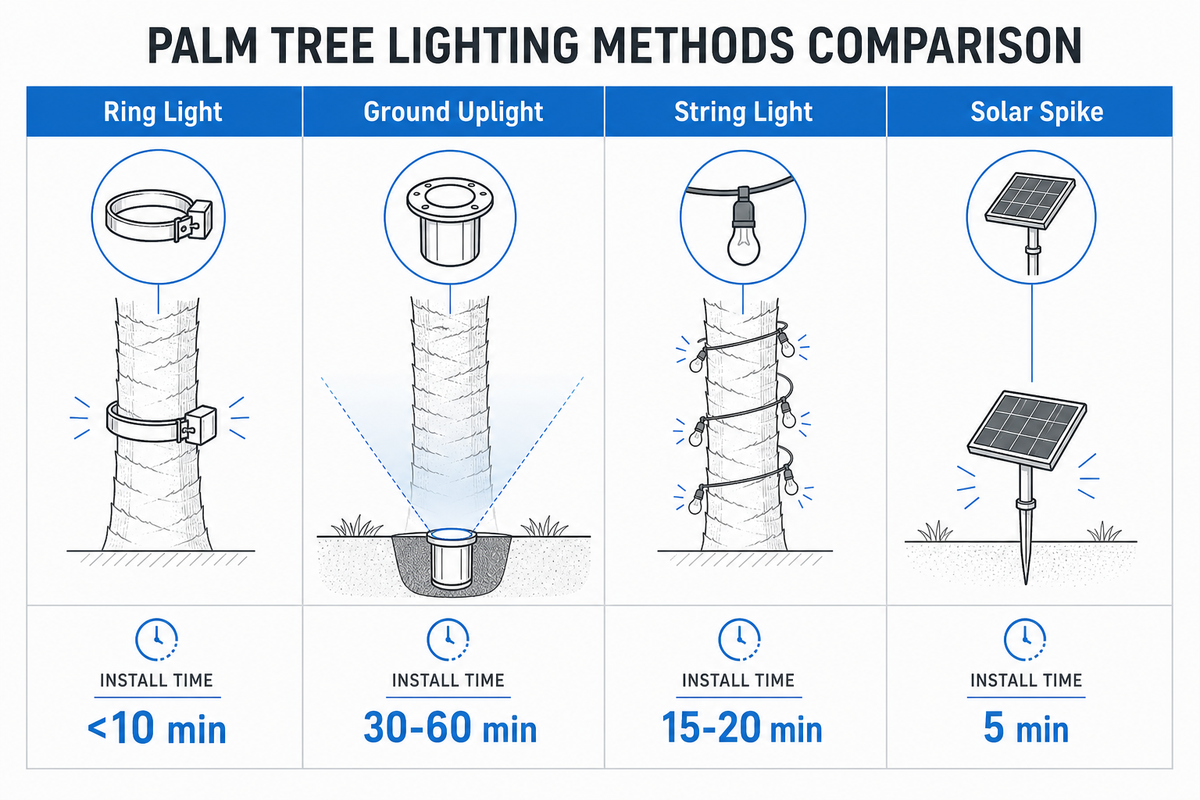
Four methods compete for every job that needs to light up palm trees, and they fail in different ways. Manufacturers aren’t consistent about naming the trunk-mounted option either — “ring light,” “light ring,” and “palm tree light ring” all describe the same fixture across different catalogs, and buyers just as often search for “lighting palm tree ring” or simply “lights outdoor” around a specimen palm — worth knowing before comparing spec sheets across brands. Each method is compared below on the fields a specifier actually checks, not marketing bullet points.
| Fixture Type | Ring Light | Ground Uplight | String Light | Solar Spike |
|---|---|---|---|---|
| Mounting | Trunk-mounted ring clamp | In-ground burial | Wrapped around trunk | Ground spike |
| Install time / tree | <10 min | 30–60 min (digging) | 15–20 min | 5 min |
| Light distribution | 360° around trunk | Single-direction cone | Point sources, trunk only | Single-direction cone |
| Typical IP rating | IP65 | IP65–IP67 | IP44 | IP44–IP55 |
| Lamp life | 50,000 hours | 50,000 hours | 10,000–20,000 hours | 15,000–25,000 hours |
| Tree contact risk | None (no penetration) | Root disturbance | Bark compression over time | None |
| Dual up/down mount | Yes | No | No | No |
| Maintenance interval | Biannual lens cleaning | Re-aim every 4–6 months | Seasonal re-wrap/inspection | Seasonal battery/panel check |
Field-trial data from three Southeast Asian resort installations; ground uplights required re-aiming every 4-6 months due to soil settling under irrigation. IP ratings for all four methods are defined under the same IEC 60529 international ingress-protection standard, so the numbers in the table above are directly comparable across methods.
One landscaping-community forum thread sums up the practical trade-off that most DIY guides skip: contractors installing fixtures in wet climates often note that the silicone-filled wire nuts that ship with typical kits “aren’t good enough” for direct-bury landscape circuits, and switch to grease-filled connectors rated for burial instead — a detail that adds cost and labor to ground-mounted methods that a trunk-mounted ring, wired above grade, avoids entirely. Whether the project brief asks for a palm tree ring light installation or simply outdoor lights around a row of specimen palms, that installation-time gap between methods holds regardless of the terminology used to request the quote.
Sizing a Ring Light: The Six-Wattage Spread by Trunk Height
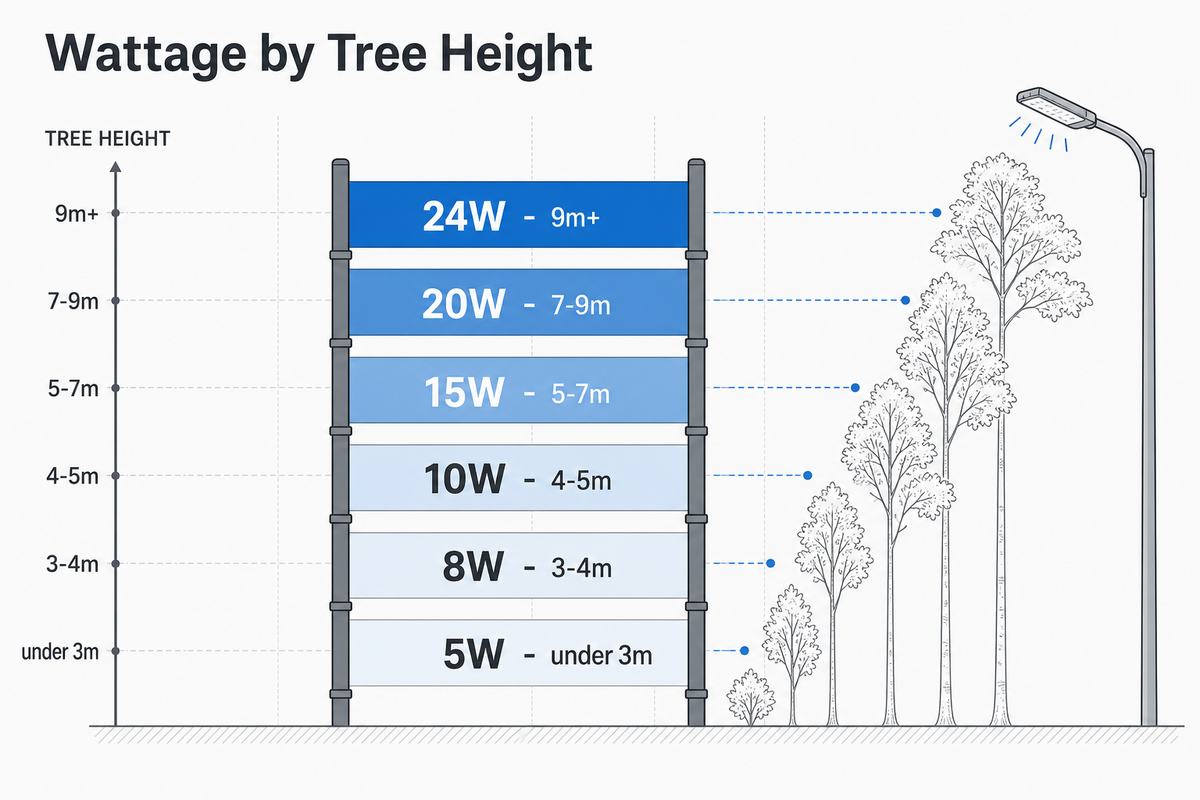
Wattage should track tree height, not budget. Guangqi’s application-based selection guide ranks six wattage bands by height and use case, from 5W garden accents on palms under 3m through 24W fixtures for municipal avenue plantings over 9m.
| Wattage | Application | Tree Height |
|---|---|---|
| 5W | Garden accent | <3m |
| 8W | Patio lighting | 3–4m |
| 10W | Residential landscape | 4–5m |
| 15W | Commercial landscape | 5–7m |
| 20W | Resort / hotel | 7–9m |
| 24W | Municipal / avenue | 9m+ |
Here’s the math behind that table. Residential palms in the 4-6m band need roughly 800-1,500 lumens of usable canopy light; at the fixture’s rated efficacy of ≥90 lm/W, an 8-10W ring delivers 720-900 lumens raw output, and the ring’s 360-degree distribution around the trunk puts a larger share of that output directly onto the fronds than a ground uplight loses to turf-zone spill — which is why the 10W band, not a straight lumens-per-watt conversion, is the specified match for that height. Independent lighting-design sources publish a similar range: 300-700 lumens for tree and vertical-feature uplighting, consistent with the client’s figures once beam concentration is accounted for. More wattage isn’t automatically better, though: that same source is explicit that “more lumens are not always better… excessive brightness can cause glare that reduces visibility rather than improving it,” so over-sizing a 24W fixture on a 3m garden palm creates a glare problem, not a better-lit one.
📐 Engineering Note
Procurement tip: stock 2-3 wattage variants of the same beam angle rather than one universal fixture. A 24W model on a 3m garden palm causes glare; a 5W model on a 10m royal palm barely lights the fronds. Keep beam angle constant and scale wattage with tree height.
Material and Weatherproofing: What Coastal and Tropical Installs Actually Need

IP65 per IEC 60529 means the enclosure is dust-tight (first digit 6, no ingress of dust) and protected against water jets from any direction (second digit 5) — the minimum realistic rating for a fixture that lives outdoors year-round in monsoon or coastal spray conditions. Ring material matters as much as the seal: 304 stainless steel (18% chromium, 8% nickel), specified under ASTM A240/A240M, forms a passive chromium-oxide layer that self-repairs minor surface scratches, which is what prevents the pitting corrosion that destroys carbon steel or galvanized brackets within 2-3 years near salt air. Manufacturer salt-spray testing to ISO 9227 (current edition 2022, Amendment 1:2024) demonstrates coating and material integrity under accelerated saline exposure. It’s worth being precise about what that test proves: standards commentary on ISO 9227 explicitly notes the method “is not intended… as a means of predicting long-term corrosion resistance” of the tested material — it detects coating discontinuities and confirms a material passes a controlled screen, not a literal years-of-service forecast. 304 stainless earning a clean result is a meaningful quality signal, not a guarantee of a specific service life. The IP65 waterproof enclosure and the high-quality stainless ring work together: one seals out water and dust, the other resists what salt air does to the metal underneath. Some competing brackets use plain brass instead of 304 stainless, which costs less up front but tarnishes and pits faster in coastal air over multi-year service.
There’s a second, less obvious durability problem that a fixed ring solves and most competitor products ignore: palm trunks physically grow. In warmer climates or faster-growing species, trunk width can increase 1-3mm per year, and non-adjustable mounting hardware left in place as a trunk expands is a known arboriculture problem — straps, cords, or clamps that don’t give can girdle the stem, restrict sap flow, and cause decay or breakage over years, the same mechanism seen when tree stakes or guy wires are left on too long. Telescoping rings with 40mm of adjustment travel keep the fixture in the same mounting position for 10+ years without needing to be loosened or relocated to accommodate that growth — which is the actual engineering reason the ring is adjustable, not just a convenience feature.
Installation: Trunk-Mount in Under 10 Minutes

Installation is genuinely fast because there’s no digging: open the stainless ring, place it around the trunk, tighten the mounting screws, and choose up or down orientation before connecting to a 12V or 24V DC or 220V AC driver circuit depending on the transformer setup. A single 150W transformer typically runs 10-15 fixtures in the 10-15W range, depending on cable run length and voltage drop. No ladder, no trenching, and no root disturbance — the entire job is a single person working at the trunk, aiming the beam up through the fronds or down along the bark.
DIY guides consistently skip one step: the electrical connection itself. One landscaping-forum thread on a comparable low-voltage install specifically warns that the silicone-filled wire nuts that ship with many kits “aren’t good enough” for a direct-bury or wet-exposed run, and recommends grease-filled connectors rated for burial instead. For a trunk-mounted ring, the connection point sits above grade rather than buried, which reduces (but doesn’t eliminate) that exposure — it’s still worth specifying a sealed, gel-filled connector in the RFQ rather than assuming any wire nut will do. Low-voltage landscape lighting circuits like these are recognized as a distinct wiring category under standard electrical code practice — Washington State’s WAC 296-46B adoption of the National Electrical Code explicitly lists landscape lighting alongside landscape sprinkler systems under its low-voltage underground-circuit provisions, which is the general code framework installers should confirm against local jurisdiction rules.
Color Temperature, RGB, and Zone Control for Hospitality and Events

Three color options cover nearly every commercial use case: 3000K warm white for everyday ambient use, 4000K neutral white for municipal/avenue applications where a crisper look reads better at distance, and full RGBW color-changing with DMX512 control for resorts and event venues that need dynamic lighting effects beyond static white, switching from wedding-white to themed color in under two seconds. Dual mounts let one installation run both modes at once — in one documented event-venue install, half the ring lights on a property pointed upward for canopy illumination in RGB while the other half pointed downward highlighting trunk texture in static warm white. At 3000K, the result is the same warm glow whether the client is a homeowner or a resort chain, creating an inviting outdoor space for evening guests without the cold-blue cast some LED retrofits produce.
One siting consideration rarely appears in lighting buying guides: coastal and resort properties near migratory bird routes need to think about color and control before defaulting to broad RGB or unshielded floods. The U.S. Fish & Wildlife Service documents that nighttime lighting can attract migrating birds from as far as 5 kilometers away, and specifically recommends warm, amber light under 2700K correlated color temperature, physical shielding, and seasonal timing controls (spring and fall migration windows) near sensitive sites. The lighting industry’s own standards body backs the same approach: the Illuminating Engineering Society’s Five Principles for Responsible Outdoor Lighting call for light that’s useful, targeted, no brighter than necessary, controlled, and warmer in color where possible. For a coastal resort near a flyway, that argues for a warm-white/shielded default with RGB reserved for scheduled events, not an always-on color program.
The No-Trench Advantage: Total Cost of Ownership vs Ground Uplights
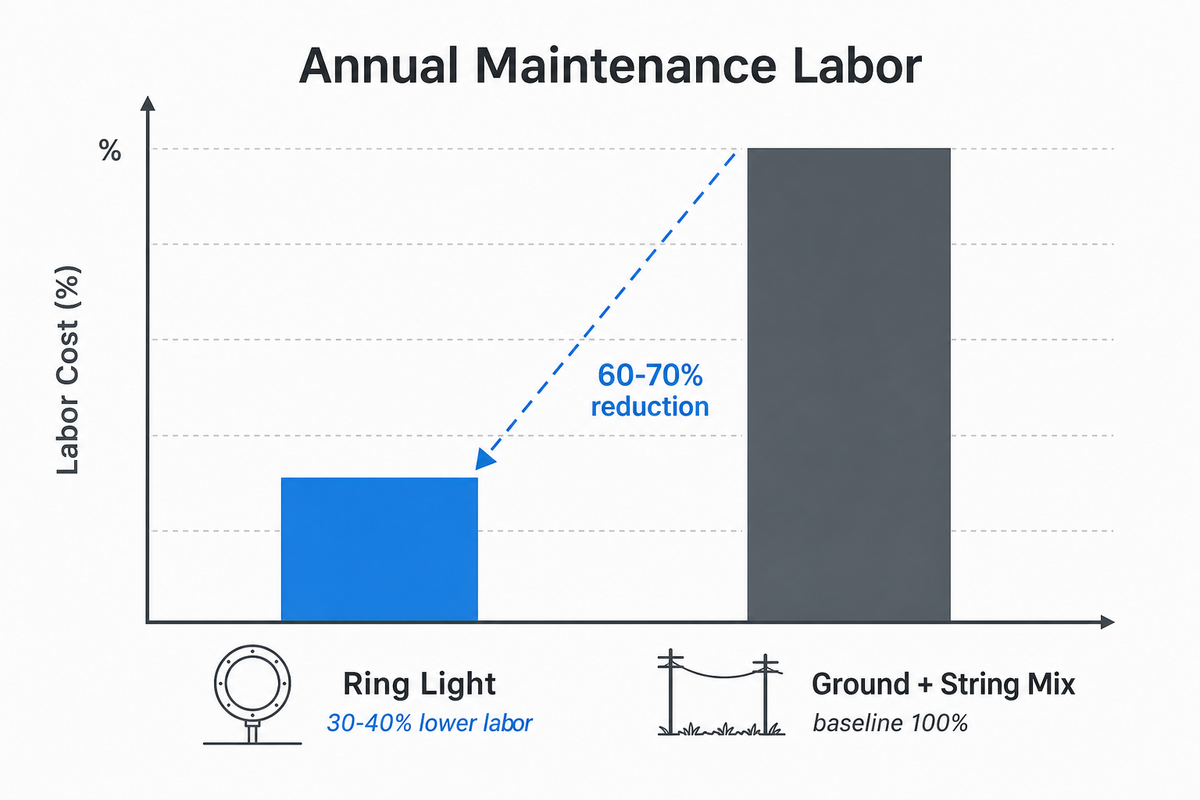
Counting maintenance labor, not just the sticker price, changes the math in the ring light’s favor. Guangqi’s own cost modeling estimates roughly $157.68 per year in energy-cost savings alone for 30 trees running ring lights instead of ground uplights, with the larger savings showing up in reduced reinstallation labor: a 50-tree commercial site typically sees 60-70% lower annual lighting-maintenance labor versus a mixed ground-uplight-and-string-light setup, with the ring light’s higher upfront cost paid back within 18-24 months.
Independent trade data points in the same direction at a larger scale. One commercial landscape-lighting trade article documents a 60% reduction in lifetime outdoor lighting costs and roughly $15,000 per acre in annual maintenance-cost reduction on large commercial campuses when fixtures require less frequent servicing — the same mechanism driving Guangqi’s per-tree numbers, at campus scale. Ground uplights in field trials needed re-aiming every 4-6 months after soil settling under irrigation; the ring light needed only biannual lens cleaning, a five-minute job per fixture.
Three Commercial Installations: What Ring Lights Delivered in the Field

Numbers on a spec sheet are one thing; three completed projects show what actually happens after installation.
Beachfront Resort, Southeast Asia
35 coconut palms around a pool area. Existing ground uplights created glare complaints and needed monthly re-aiming after monsoon-driven soil erosion.
Result: 35 × 15W ring lights, 3000K, 30° beam. Total draw 525W. Maintenance dropped from monthly to biannual; zero ground-level glare.
Urban Boulevard, Middle East
1.2km date palm avenue for a municipal beautification project; the budget required minimal ongoing maintenance to avoid repeated traffic-lane closures.
Result: 120 × 20W ring lights, 4000K, 15° beam. Total draw 2,400W. Installed in 6 working days vs a 3-week estimate for ground alternatives; zero corrective maintenance in 18 months.
Event Venue, Coastal Mediterranean
20 Washingtonia palms at a waterfront venue needed color-changing capability for themed events plus elegant warm white for daily use.
Result: 20 × 10W RGB ring lights with DMX512, dual-mount (half up, half down). After 24 months of continuous salt-air exposure, inspection confirmed zero corrosion on the 304 stainless ring assemblies. Because this waterfront site sits on a coastal migratory route, the RGB program was scheduled rather than always-on, consistent with the IES bird-safe lighting guidance discussed above.
Sourcing and Specifying: What Landscape Contractors Should Ask Manufacturers

Palm tree ring lights are one of Guangqi’s more popular LED products, sitting within the broader landscape and garden lighting catalog alongside the company’s facade and high-bay lighting applications — and they’re specialty enough that MOQ, lead time, and customization terms vary widely between manufacturers, which is the one part of the buying process almost no competitor content addresses. Bring the checklist below to a manufacturer conversation rather than relying on a catalog page.
RFQ checklist — copy these into your quote request:
| Parameter | Recommended range | Why it matters | How to verify |
|---|---|---|---|
| Wattage range offered | 5W–24W in ≥5 steps | Avoids over/under-lighting across a mixed tree-height site | Request the full spec sheet, not just one SKU |
| Trunk diameter range | 150mm–800mm adjustable | Confirms fit across species and future trunk growth | Ask for the ring’s travel/adjustment distance in mm |
| IP rating | IP65 minimum | Baseline for permanent outdoor exposure | Request the IEC 60529 test certificate, not a datasheet claim |
| Ring material & corrosion test | 304 stainless, salt-spray tested | Determines coastal/tropical service life | Ask for the ISO 9227 test duration and result, not just “salt-spray tested” |
| MOQ & lead time | 50 units std / 100 custom, 15–30 days | Sets realistic project scheduling | Confirm in writing before committing a project timeline |
| Warranty | 3 years standard / 5 years extended | Signals confidence in the corrosion and driver components | Check whether extended warranty requires a minimum order volume |
On the manufacturer side, these terms are consistent with published OEM practice: standard MOQ around 50 units (100 for custom finishes or branding), 15-20 day standard production lead time (25-30 days for custom), sample orders of 1-5 units for project evaluation, and 30% deposit / 70% before-shipment payment terms are typical across Zhongshan-based LED landscape manufacturers. Volume buyers — landscape contractors running multiple projects a year — can often negotiate locked annual pricing and priority production slots ahead of peak installation season (March-June in most Northern Hemisphere markets).
2026 Landscape Lighting Trends That Affect Palm Tree Installations

Two independent trend signals point the same direction for anyone specifying now: buy for dimmable, zone-controllable fixtures, not single-mode ones. Moonlighting — fixtures mounted higher in a canopy and aimed down through tree branches for a soft, filtered ground effect — is seeing renewed commercial use in hospitality courtyards and premium campuses, cited independently by both a Florida landscape-lighting specialist and a Dallas-Fort Worth commercial lighting contractor covering 2025-2026 projects. One notes moonlighting requires higher service investment because fixtures need seasonal review as trees grow, which a palm’s slower, more predictable growth pattern makes easier to manage than on a fast-growing shade tree.
The second signal is control infrastructure, not the fixture itself: smart zoning and automated scheduling became a commercial baseline around 2020 and continues to expand, with trade sources citing NEMA data that most failed commercial lighting installs trace back to circuit overloading or voltage drop rather than fixture failure — an argument for specifying adequate wire gauge and zone controllers up front rather than retrofitting later. For a palm tree ring light program specifically, that means the safer long-term spec is a fixture line that already supports DMX512 or comparable zone control (even if a given project launches in static warm white), rather than a single-mode fixture that has to be replaced wholesale when a property adds event lighting or automated dusk-to-dawn scheduling.
Common Mistakes and When NOT to Use a Ring Light

✔ Advantages
- No trenching or root disturbance
- 360° canopy coverage from one fixture
- Adjustable ring accommodates trunk growth for 10+ years
- Lowest documented maintenance labor of the four methods
⚠ Limitations
- Not suitable outside the 150-800mm trunk diameter range without custom rings
- Overkill for a single residential garden palm where a $30-60 spotlight suffices
- Very young, thin-trunked palms may not yet support the ring’s clamp weight
- Not a substitute for shielding/timing controls near bird-sensitive coastal sites
The most common mistake specifiers make isn’t picking the wrong method — it’s over-aiming the right one. Landscape-lighting trade guidance is specific about why:
“Aiming a fixture too steeply or from too far away wastes light and creates an unnatural hot spot at the trunk base.”
The same guidance recommends positioning the fixture 1-2 feet from the base with a 15-30 degree narrow beam for tall trees. A ring-mounted fixture removes the aiming-distance variable entirely since it clamps directly on the trunk, but beam-angle selection still matters for tall palms — a 45-degree beam on a 9m royal palm wastes light the same way an over-aimed ground uplight does.
Q: What is the best light for palm trees?
A dedicated palm tree ring light produces the most uniform illumination of any common method because it wraps around the trunk instead of projecting from one ground point.
Ground uplights create hot spots at the base and leave shadows higher up; string lights only decorate the trunk without reaching the canopy. For the most natural nighttime appearance at a resort or residential install, use a ring fixture in the 10W-24W range with warm 3000K light. Trees taller than 8m should use 15W or higher to push enough light through the full canopy; garden palms under 4m do fine with 5W-8W.
Q: How do you install a palm tree ring light?
Installation takes under 10 minutes per tree: open the stainless ring, clamp it around the trunk, tighten the screws, and choose up or down orientation before wiring to a low-voltage driver.
You don’t need drilling, a ladder, or specialized tools. The one detail worth specifying up front is the electrical connector: use a sealed, gel-filled direct-bury connector rather than a standard silicone wire nut, since practitioner reports on comparable low-voltage landscape circuits specifically flag silicone-only connectors as inadequate for long-term wet exposure.
Q: What size ring light fits my palm tree trunk?
Standard adjustable rings cover a 150mm to 800mm trunk diameter, spanning Coconut, Date, Royal, Washingtonia, and Foxtail species, with a custom ring available for trunks outside that range.
Trunks outside that range need a custom ring, typically a 15-day additional lead time from most manufacturers. Because trunks can widen 1-3mm per year, an adjustable ring with 30-40mm of travel keeps the same fixture in place for a decade or more without needing to be re-fitted. Measure trunk diameter at chest height with a flexible tape rather than estimating by eye, since a ring sized too tight will need replacement as the tree grows.
Q: Why don’t landscape pros recommend string lights for long-term palm installs?
Two reasons: string lights only decorate the trunk without reaching the canopy, and dead fronds are a documented fire hazard that hot incandescent wraps make worse.
University extension fire-safety guidance is explicit that dead palm fronds can act as “flaming arrows” in a fire, and string lights left wrapped tight also compress bark over a season, requiring seasonal re-installation. A trunk-mounted LED ring runs cooler, doesn’t grip the bark under tension, and provides full canopy coverage that a trunk-only wrap can’t.
Q: Can palm tree ring lights use RGB color-changing control?
Yes — full RGB color-changing is available via DMX512 or a wireless remote on the same IP65-rated, 304 stainless construction as single-color models, letting one fixture line serve both accent and event lighting needs.
Resort operators and event planners commonly run warm-white for daily ambiance and switch to themed colors for special occasions in under two seconds, using the same DMX512 addressing that architectural and stage lighting rely on, so each ring can be scheduled or grouped into zones rather than switched as one block. For coastal properties near bird migration routes, pair RGB capability with scheduled control rather than always-on operation, consistent with FWS and IES guidance on warmer color temperatures, physical shielding, and time-limited operation near sensitive sites. A practical default for a mixed-use resort property is warm 3000K as the nightly baseline, with RGB reserved for a programmed schedule around specific events rather than left running continuously.
Why We Write This
Guangqi Lighting has manufactured LED landscape and architectural fixtures from Zhongshan since 2010, including the palm tree ring light line specified throughout this guide. The wattage table, comparison data, and three project profiles above come from our own product engineering and completed installations, cross-checked here against IEC, ASTM, ISO, IES, and FWS documentation rather than presented as unverified marketing claims.
Reviewed by the Zhongshan Guangqi Lighting Co., Ltd. technical team
References & Sources
- Ingress Protection (IP) Ratings — International Electrotechnical Commission (IEC 60529)
- A240/A240M Standard Specification for Chromium and Chromium-Nickel Stainless Steel — ASTM International
- ISO 9227:2022, Corrosion Tests in Artificial Atmospheres, Salt Spray Tests — International Organization for Standardization
- ISO 9227:2022, Salt Spray Tests — ANSI Blog
- Threats to Birds: Collisions (Nighttime Lighting) — U.S. Fish & Wildlife Service
- PS-06-24: IES Position on Legislation and Ordinances for Outdoor Light at Night — Illuminating Engineering Society
- Fire Safe Landscaping — UC Master Gardener Program, University of California Cooperative Extension
- 10 Common Landscape Lighting Mistakes (And How to Avoid Them) — Tru-Scapes
- 10 Commercial Landscape Lighting Design Ideas — Prestonwood Commercial Landscape Services
- Lumens Explained for Low Voltage Landscape Lighting — Varmtalys Lighting
Related Articles
- Palm Tree Ring Light — full specifications and RGB/DMX options
- Palm Tree Lighting Comparison Tool — ring light vs ground uplight vs string lights
- Palm Lighting Cost & Maintenance Estimator
- Landscape Spot Light — LED outdoor spotlights 3W-45W for non-palm trees and shrubs
- Commercial Landscape Lighting Manufacturer — full product line