Get in Touch with GUANGQI



LED basketball court refers to the lighting system above or around the playing surface in this guide, not an LED glass floor or video court. Good design puts maintained light where players, officials, spectators, and cameras need it without leaving dark gaps or creating glare in shooting and rebounding sightlines.
Dependable briefs follow a sequence: define the illuminated area, select a use class, set measurable light criteria, compare candidate mounting geometry, estimate a starting fixture count, and verify the result with actual photometric files. Skipping that sequence is how a project can show an attractive average lux number while still performing poorly on the court.
One-sentence design decision
Treat fixture count and pole sketches as inputs to photometric design, not as approval. Passing or failing comes down to the maintained-light calculation grid, sightline and glare review, project constraints, and the governing venue brief.
LED Basketball Court: Lighting System or Video Floor?
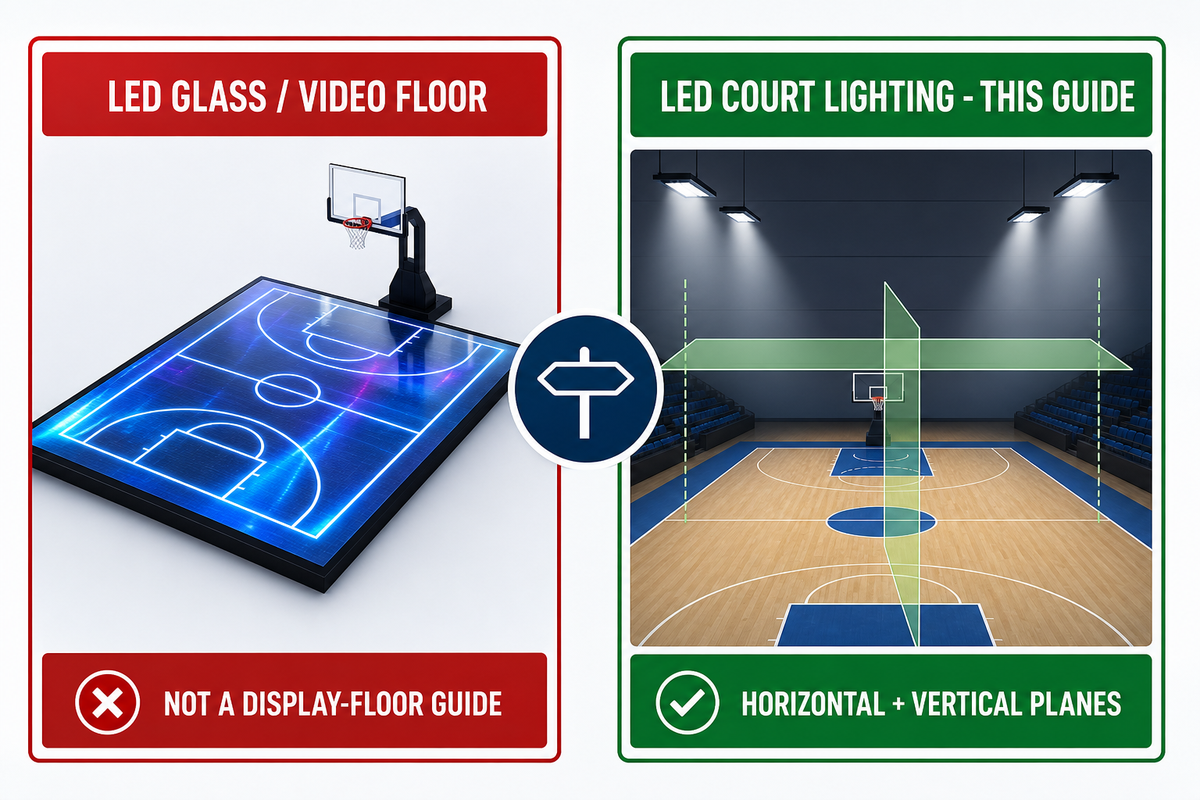
LED basketball court has two search meanings. One refers to an illuminated glass or video playing surface. Another refers to LED luminaires that illuminate a conventional basketball court. This article addresses the second meaning only: indoor high-bay or sports luminaires, outdoor pole-mounted floodlights, controls, aiming, and the calculations used to evaluate them.
That distinction affects every specification. Video floors combine a display with a playing-surface system. Court lighting is a visual-performance and electrical system whose output is measured on horizontal and vertical planes. It must respond to court geometry, mounting conditions, optics, surface reflectance, maintenance, neighboring property, and the way the venue will actually be used.
Specification mismatch is the risk: search pages about display floors don’t answer lighting questions about maintained lux, uniformity, glare, or photometric verification. For the display-floor meaning, compare FIBA’s LED glass-floor announcement with the luminaire-based design process below.
Start With Court Area and Maintained Illuminance
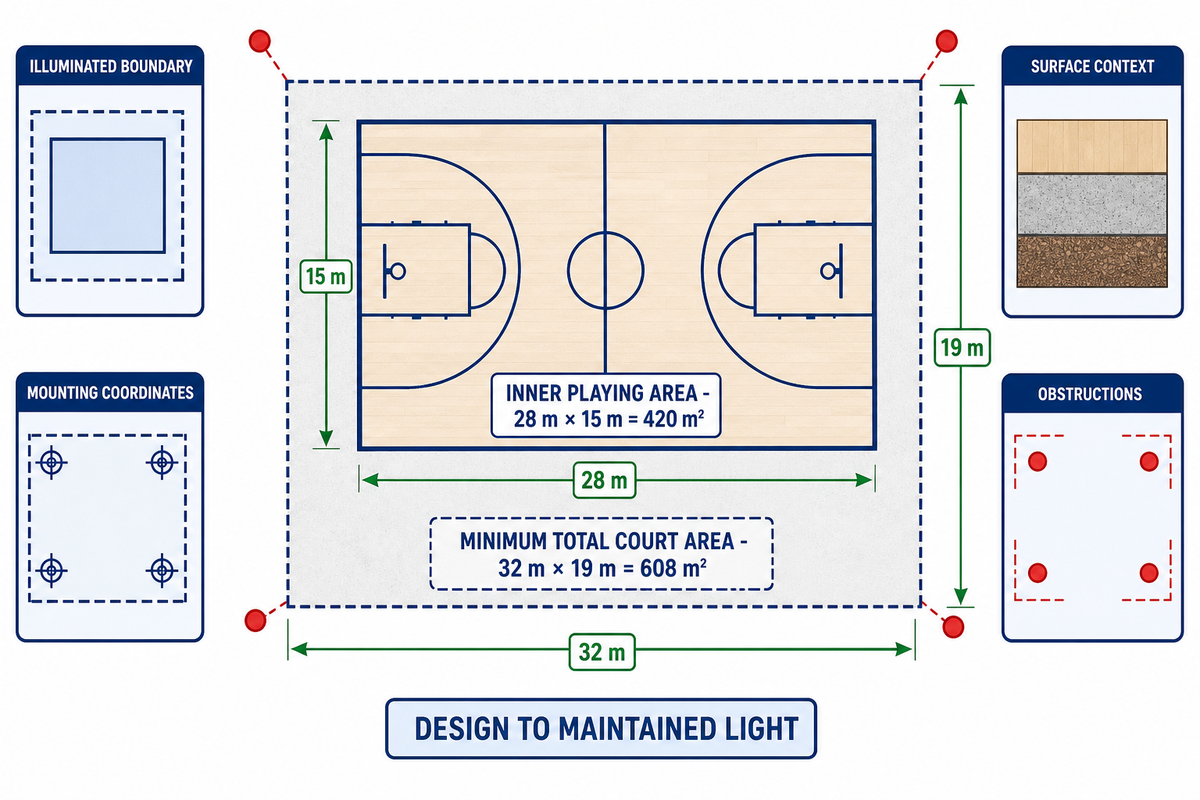
Fixture calculations fail early when the area is undefined. FIBA’s Venue Guide gives an inner playing area of 28 m by 15 m and a minimum total court area of 32 m by 19 m. Those are 420 m² and 608 m² respectively. Preliminary counts based on the painted playing rectangle will therefore differ from counts based on the full court and safety area.
Choose the area that the project must illuminate and state it on the calculation sheet. For a school gym, that might include sidelines and team areas. For an outdoor community court, it might include runoff space but exclude unrelated paths. For a multipurpose hall, the basketball grid may not be the only calculation plane. Dimensioned plans are more useful than the phrase “full-size court.”
| Geometry input | Record this | Why it changes the design |
|---|---|---|
| Illuminated boundary | Length, width, runoff and exclusions | Sets area, grid points and spill boundary |
| Mounting coordinates | Pole or ceiling points and clear height | Controls throw distance, aiming and obstruction risk |
| Surface context | Floor finish, reflectance and surroundings | Affects reflected light, contrast and glare |
| Obstructions | Backboards, roof structure, seating, trees and property lines | Removes unsafe aiming paths and buildable locations |
Use maintained illuminance for the design target. Initial output describes a new system. Maintained output accounts for lumen depreciation, dirt and the maintenance strategy over time. If one proposal is based on initial lux and another on maintained lux, their headline values aren’t directly comparable.
Basketball Court Lux Targets by Use
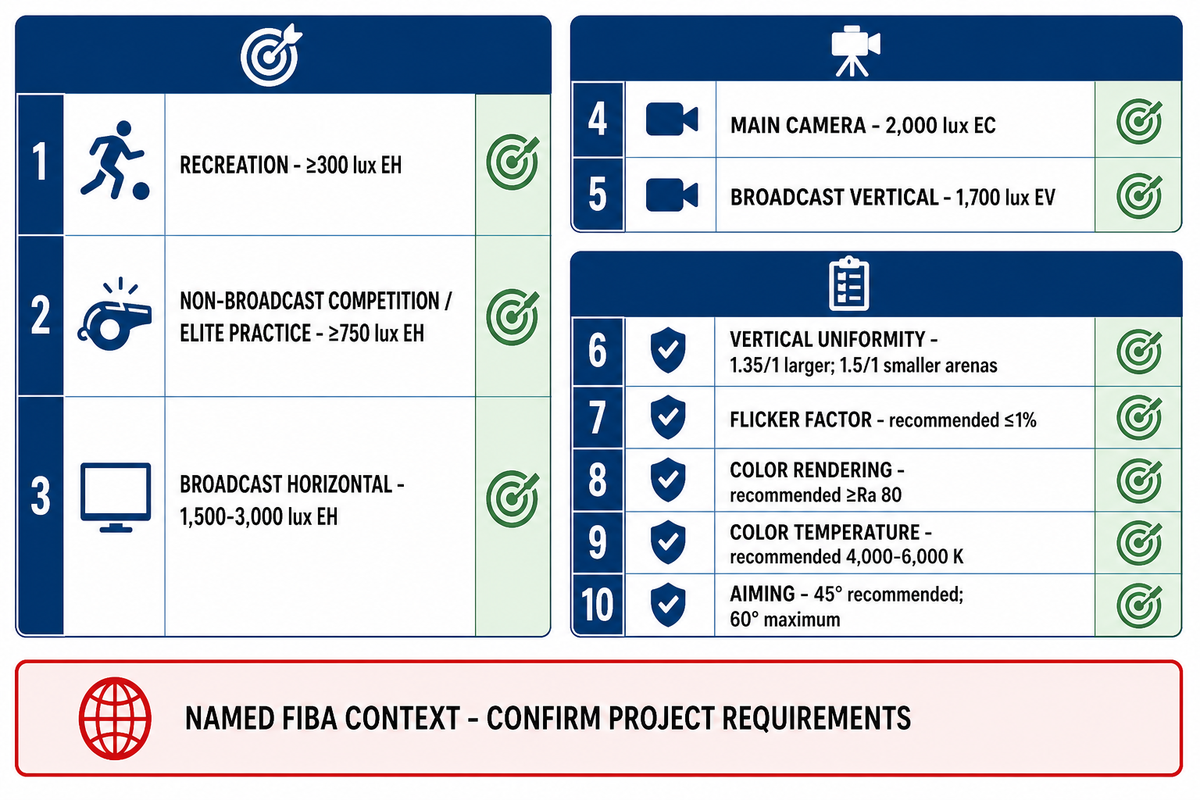
There is no responsible one-number answer for every venue. Required targets depend on whether the court supports recreation, competition, elite practice, recording, streaming, or major broadcast. FIBA recommends at least 300 lux average horizontal illuminance for community facilities focused solely on recreational participation. It recommends at least 750 lux for competition venues without broadcasting needs and/or elite-level practice facilities.
Broadcast venues use a different brief. FIBA lists 1,500–3,000 lux average horizontal illuminance, with 3,000 lux recommended for venues intending to host major competitions; 1,700 lux average vertical illuminance; and 2,000 lux toward the main camera. These figures belong to their named venue context. They are not a universal outdoor-court code and do not replace a league, client, broadcaster, or local requirement.
| Verification category | Published FIBA value | Design interpretation |
|---|---|---|
| Community horizontal light | At least 300 lux EH | Recreation-only community scope |
| Competition/practice horizontal light | At least 750 lux EH | Non-broadcast competition and/or elite practice |
| Broadcast horizontal light | 1,500–3,000 lux EH | 3,000 lux recommended for major competitions |
| Main-camera light | 2,000 lux EC | Model toward the defined main camera |
| Broadcast vertical light | 1,700 lux EV | Separate from horizontal floor light |
| Vertical uniformity | 1.35/1 larger; 1.5/1 smaller arenas | Use only in the named FIBA context |
| Flicker factor | Recommended ≤ 1% | Check the driver and recording brief |
| Color rendering | Recommended ≥ Ra 80 | Evaluate players, court markings and cameras |
| Color temperature | Recommended 4,000–6,000 K | Confirm appearance and project constraints |
| Aiming | 45° recommended; 60° maximum | Review player sightlines before using any maximum |
Scope warning
Do not convert this table into a promise that a specific fixture count will meet FIBA, NCAA, broadcast, or local requirements. Project briefs, current governing documents, actual photometry, and field acceptance control that decision.
Ask about cameras even when organizers call a game “non-broadcast.” A venue may record coaching footage, stream selected events, produce social content, or use high-frame-rate replay. NCAA’s basketball streaming-broadcast guidance is a separate example of why a media use case needs its own brief.
Average Lux Is Not a Pass: Uniformity, Vertical Light, and Glare
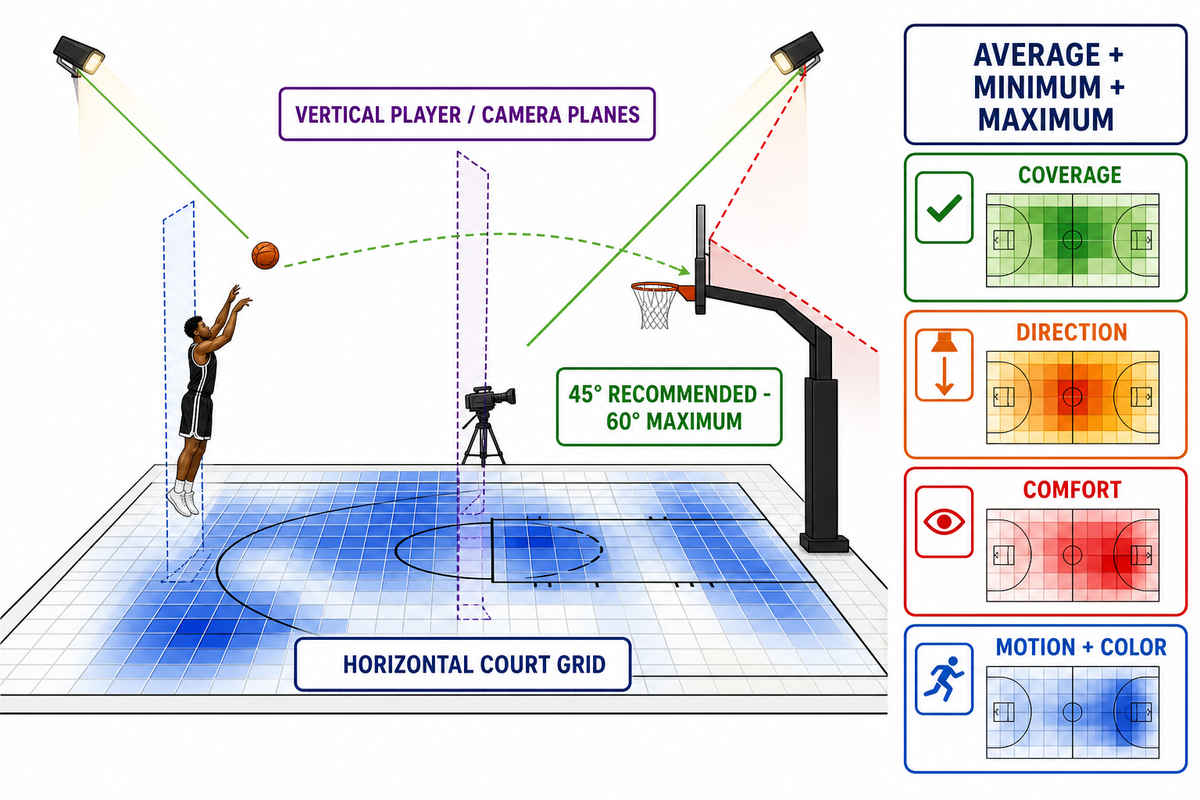
An average can conceal a poor court. Ten bright grid points can offset ten dim ones mathematically, yet players still move through alternating hot spots and dark zones. Review average, minimum and maximum values together, and use the uniformity definition required by the project. Don’t compare ratios unless the calculation method and plane are the same.
Vertical illuminance matters because players, jerseys, faces and the ball are three-dimensional. Cameras don’t see the court only from above. FIBA’s broadcast guidance therefore separates horizontal, vertical and main-camera values and gives vertical-uniformity guidance of 1.35/1 for larger arenas and 1.5/1 for smaller arenas. Those ratios belong to that FIBA context; they shouldn’t be copied into an unrelated specification without confirming applicability.
Glare is also directional. From the sideline, a luminaire may look acceptable yet sit directly behind the rim from a shooter’s viewpoint. FIBA recommends an aiming angle of 45° from downward vertical, with 60° as a maximum, and calls for extra care where luminaires may interfere with shooting positions. Use that as a prompt to model sightlines, not as permission to aim every fixture at the maximum angle.
Four independent quality questions
- Coverage: Are maintained average, minimum and maximum values acceptable on the defined grid?
- Direction: Is enough light reaching players and relevant camera-facing planes?
- Comfort: Do aiming, shielding and luminaire luminance control player and spectator glare?
- Motion and color: Do driver flicker, color rendering and color temperature fit live play, recording and photography?
Similar multi-metric principles appear in lighting research outside basketball. A Pacific Northwest National Laboratory study, available as a U.S. Department of Energy-hosted archival copy, reports that luminance uniformity can affect perceived lighting quality, discomfort glare and efficacy. In practical terms, “bright enough” and “comfortable to play under” are different questions.
Indoor vs Outdoor Basketball Court Lighting
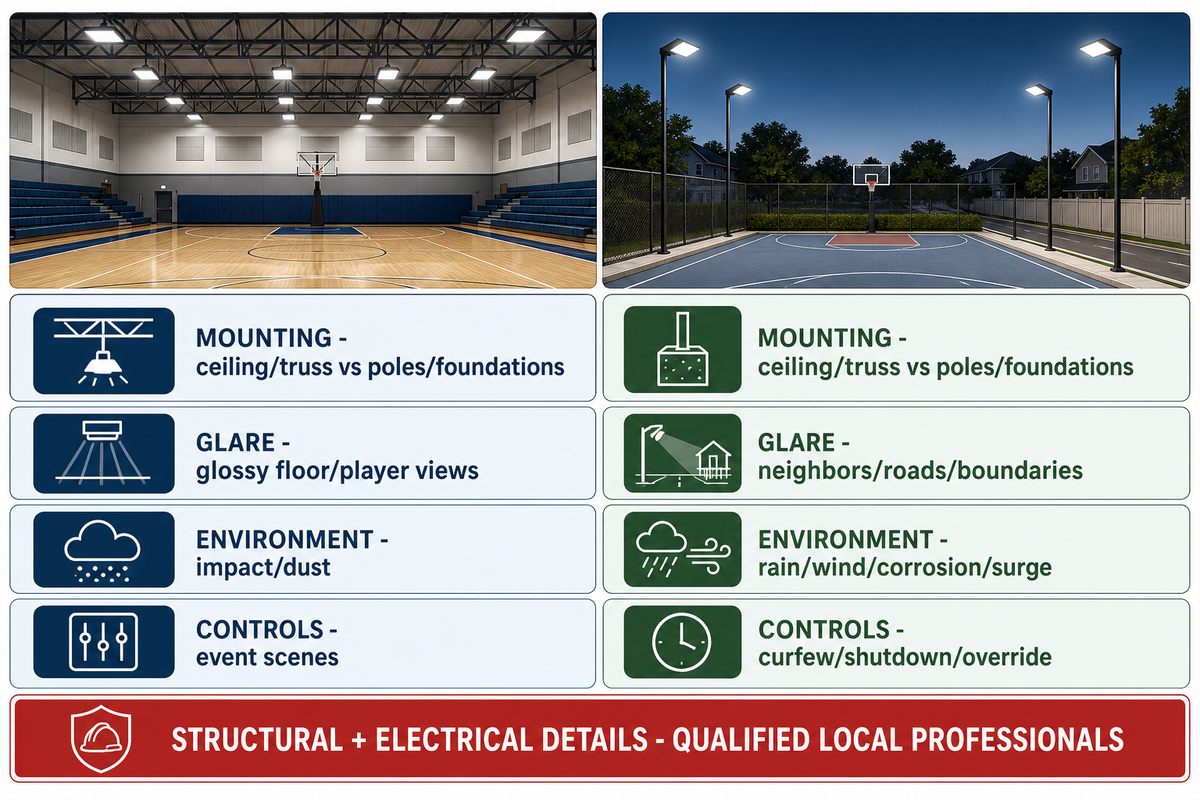
Indoor basketball court lighting and outdoor designs may target similar court tasks, but their constraints aren’t interchangeable. Indoor luminaires work with ceiling structure, glossy floors, backboards, roof obstructions and impact risk. Outdoor luminaires work with light poles, setbacks, wind and foundation design, weather exposure, property boundaries, curfew and spill light.
| Design issue | Indoor court | Outdoor court |
|---|---|---|
| Mounting | Ceiling, truss or side structure; check clear height and impact zones | Pole coordinates and height; engineer poles and foundations for local loads |
| Glare context | Glossy floor reflections and high-angle player views | Player sightlines plus neighbors, roads and property boundaries |
| Environment | Ambient temperature, dust, ball impact and ceiling conditions | Rain, dust, corrosion, wind, surge and temperature range |
| Controls | Practice, competition, cleaning and event scenes | Booking, dimming, curfew, shutdown and authorized override |
Electrical design, pole and foundation design, wind loading, grounding, wiring, protection and local approvals belong to qualified professionals with site-specific information. No blog layout can safely supply those values. For outdoor light control, use the project-scoped tests in the DarkSky Outdoor Sports Lighting Guidelines where that approval framework applies.
Pole Layout: Compare Four-Pole and Six-Pole Candidates
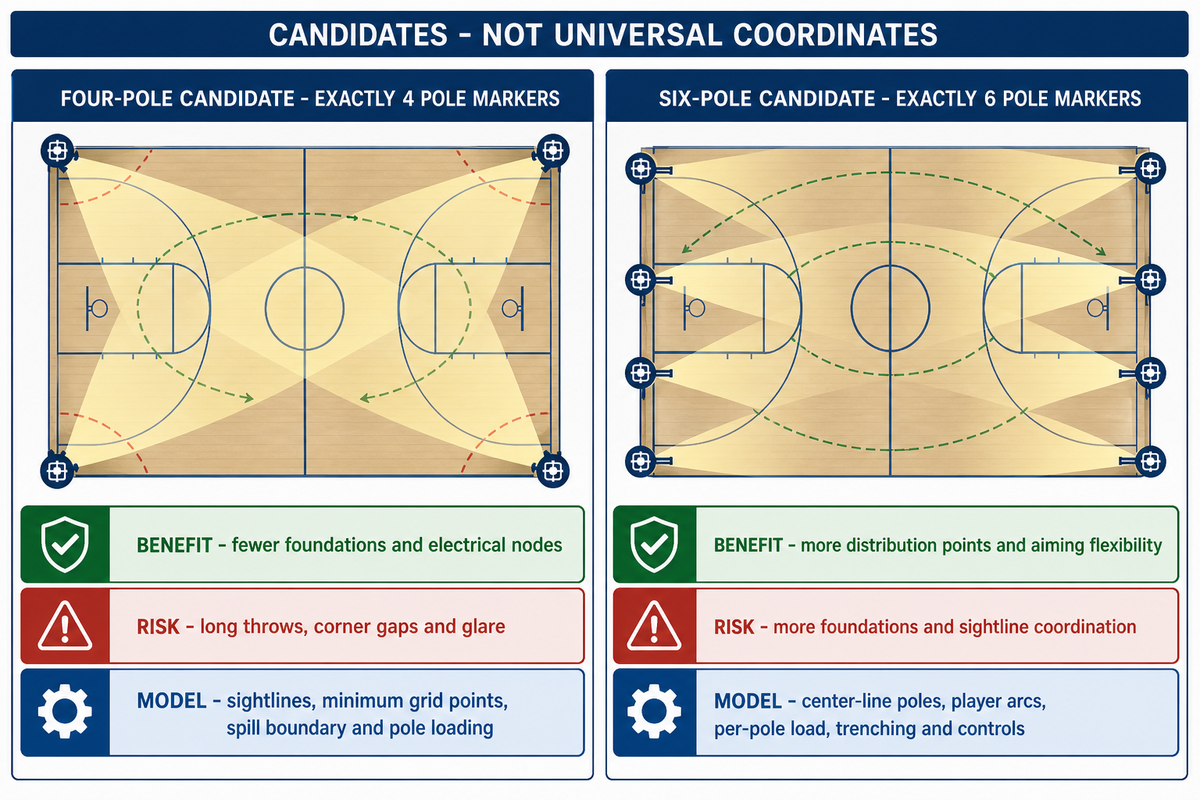
A four-pole or six-pole diagram is useful for early comparison, but neither is a universal basketball lighting layout. Correct geometry depends on the illuminated boundary, available setbacks, pole height, fixture light distribution, backboard and hoop sightlines, surrounding uses, structure, and the acceptance criteria. The outdoor model should also carry forward the targeted-area, glare, spill-light, aiming and control checks defined by the applicable sports-lighting guideline.
| Candidate | Why a team may test it | What can fail | Model before deciding |
|---|---|---|---|
| Four poles | Fewer foundations and electrical nodes; may fit a constrained perimeter | Long throws, steeper aiming, corner gaps, glare or higher intensity per pole | Sideline/end-line views, minimum grid points, spill boundary and pole loading |
| Six poles | More distribution points can reduce throw distance and create aiming flexibility | More foundations, coordination points and potential sightline conflicts | Center-line poles, player view arcs, per-pole load, trenching and control zones |
Mounting height and beam choice must be evaluated together. Raising a luminaire changes throw distance, beam footprint and glare geometry; changing the optic changes where lumens land. “Use taller poles” and “use a wider beam” aren’t independent fixes. Test the combination using the exact photometric file and permitted tilt range.
Don’t place a pole from a drawing alone. Survey the buildable locations, property setbacks, underground services, access routes and obstructions. Then have locally licensed structural and electrical professionals resolve pole, foundation and electrical details.
Fixture Count: The 5-Input Preliminary Rule
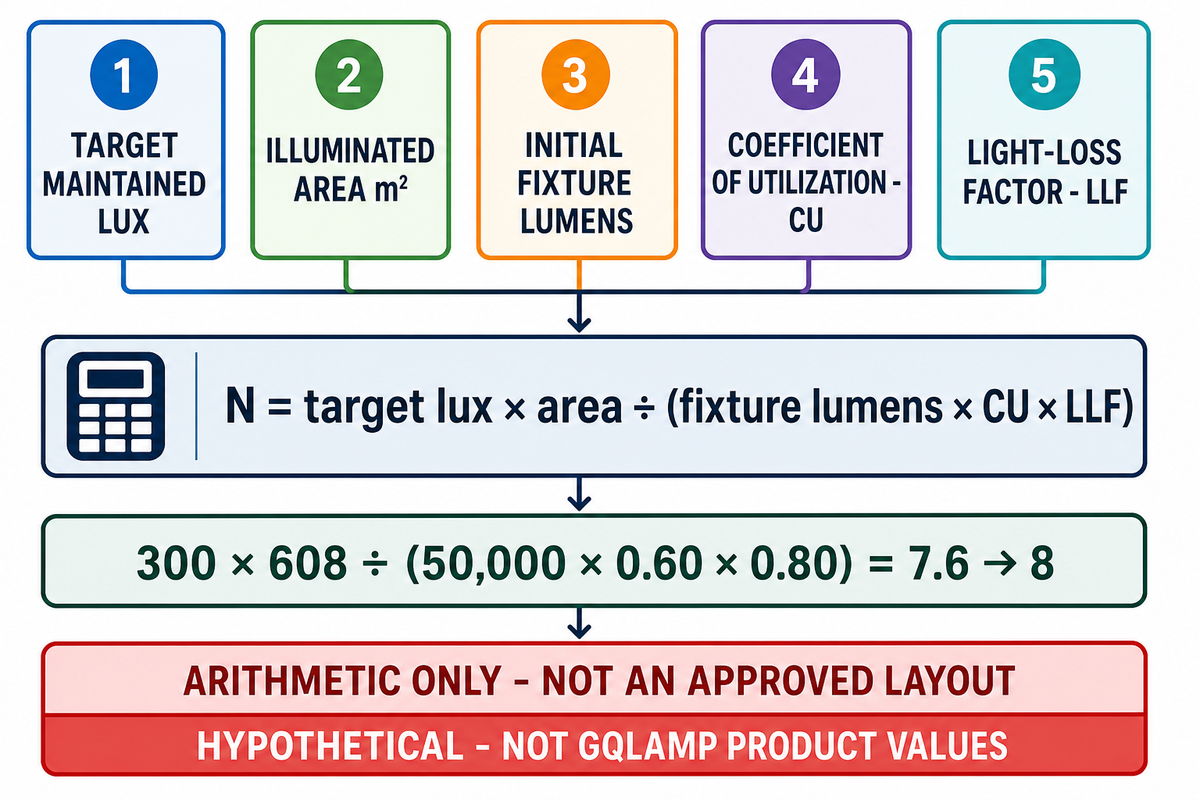
A lumen-method calculation can produce a first quantity for budgeting and option screening. It needs five explicit inputs:
- Record the target maintained illuminance in lux.
- Measure the illuminated area in square metres.
- Use initial fixture lumens from the actual proposed luminaire.
- Estimate the coefficient of utilization (CU), representing the share of fixture output expected to reach the defined plane under the selected geometry.
- Light-loss factor (LLF) represents maintained output under the agreed depreciation, dirt and maintenance assumptions.
Five-Input Preliminary Fixture Count
N = target maintained lux × illuminated area ÷ (initial fixture lumens × CU × LLF)
Hypothetical example: use the 608 m² total-court area, a 300-lux maintained target, 50,000 initial lumens per fixture, CU of 0.60 and LLF of 0.80.
N = 300 × 608 ÷ (50,000 × 0.60 × 0.80) = 7.6
Rounding up gives an arithmetic minimum of eight fixtures. It doesn’t mean eight fixtures will produce an acceptable layout. Uniformity targets, pole geometry, glare limits, spill boundaries, optic choices, equipment availability or redundancy requirements may change the quantity. These 50,000-lumen, 0.60 CU and 0.80 LLF values are editable assumptions for this example, not GQLAMP product values or a project promise.
For an early site-input check, GQLAMP’s stadium fixture count calculator can compare court length, width, mounting height and pole count. Its result still needs project-specific photometric validation.
This is also why dividing total lumens by a wattage label is unreliable. Two equal-watt fixtures can have different luminaire output, intensity distributions, driver behavior, shielding and maintained performance. The number of lights cannot repair dark spots caused by the wrong geometry. Ask for the luminaire photometric file and the exact configuration being priced.
Terminology matters when quotations are compared: a light-emitting diode is the source technology; a light fixture or luminaire includes the source, driver, optic and housing; and an LED flood light describes an application or distribution family, not a guaranteed court result. Different LED floodlights can send the same lumen output to very different places. Ask suppliers to identify the exact light fixtures and optic codes in the model.
Select Photometry Before Wattage
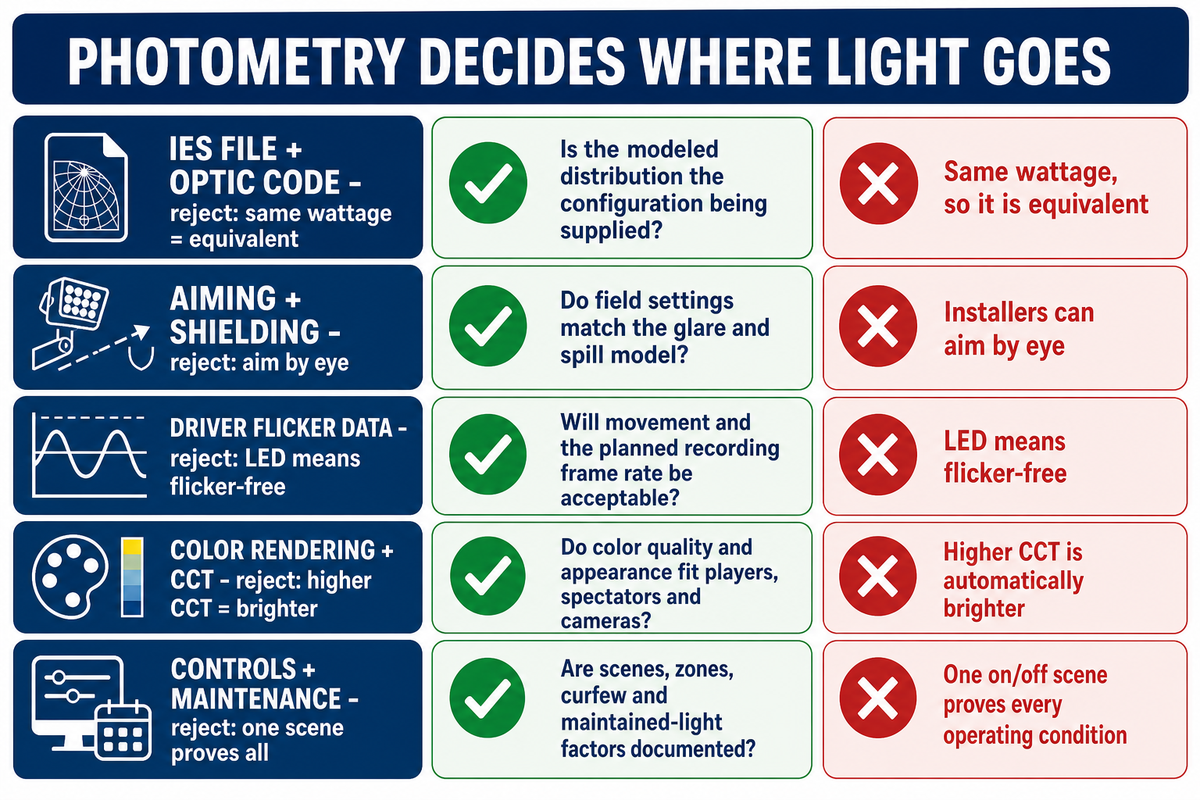
Fixture wattage matters to connected load, but photometry decides where the light goes. Review the IES file for the proposed optic, its initial output, the aiming limits used in the calculation, and any visor or shield included in the quoted configuration. Its current Lighting Library lists ANSI/IES RP-6-24 for lighting sports and recreational areas; the catalogue identity doesn’t authorize anyone to invent the paid standard’s values.
| Submittal item | Question it must answer | Reject this shortcut |
|---|---|---|
| IES photometric file and optic code | Is the modeled distribution the configuration being supplied? | “Same wattage, so it is equivalent” |
| Aiming and shielding schedule | Do field settings match the glare and spill model? | “Installers can aim by eye” |
| Driver flicker data | Will movement and the planned recording frame rate be acceptable? | “LED means flicker-free” |
| Color rendering and CCT | Do color quality and appearance fit players, spectators and cameras? | “Higher CCT is automatically brighter” |
| Controls and maintenance assumptions | Are scenes, zones, curfew and maintained-light factors documented? | “One on/off scene proves every operating condition” |
The Court–Light–Pole–Glare Worksheet and Final Verification
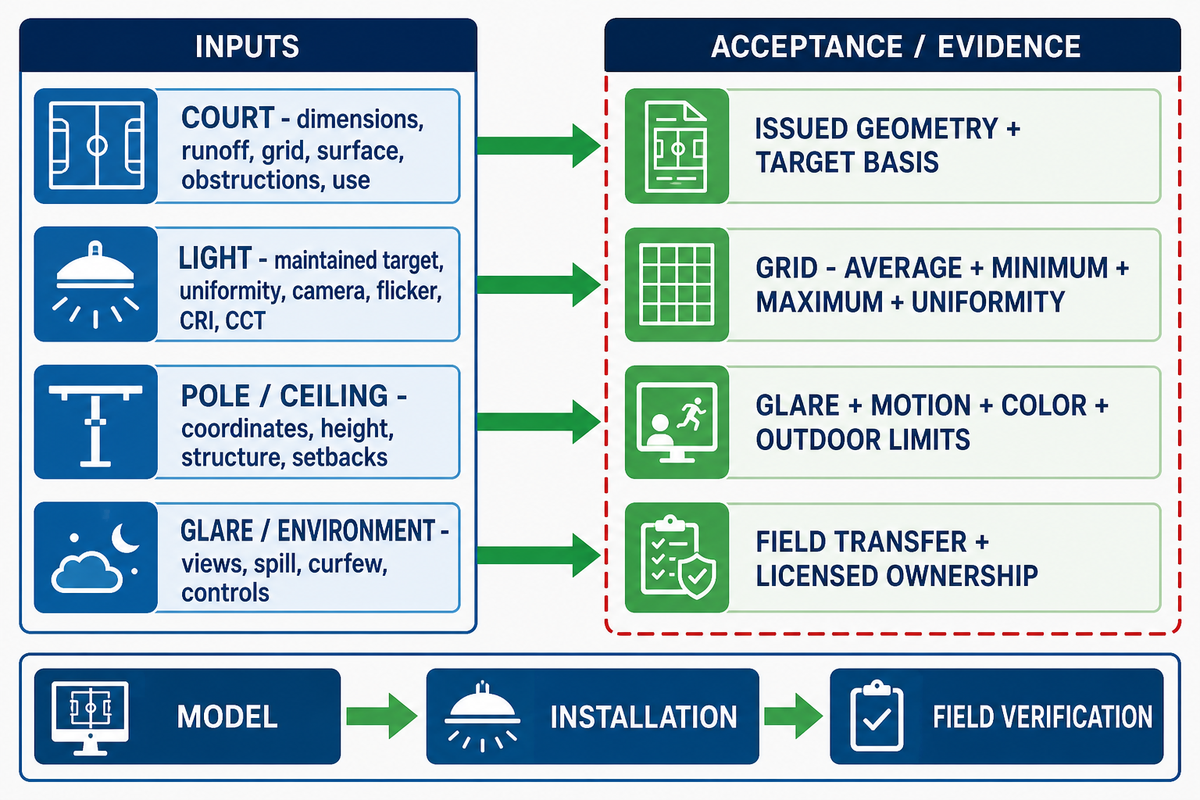
Use this worksheet before requesting a final quotation. It’s deliberately short enough to complete, but detailed enough to stop a supplier from guessing the design basis.
1. Court
Dimensioned playing and runoff area, grid boundary, surface, obstructions and use class.
2. Light
Maintained target, uniformity definition, vertical/camera needs, flicker, CRI and CCT.
3. Pole or ceiling
Coordinates, mounting height, structure, setbacks, access and prohibited zones.
4. Glare and environment
Player views, property lines, spill, curfew, zones, dimming presets and shutdown.
Complete output packages should include the calculation grid, luminaire and optic schedule, coordinates and mounting heights, aiming schedule, maintained-light assumptions, control narrative, and clearly labeled maximum, minimum and average results. Add vertical grids and camera directions when the media use requires them. Record unresolved structural, electrical and permitting items rather than hiding them inside “by others.”
Outdoor projects pursuing DarkSky approval need an additional scope. DarkSky’s Outdoor Sports Lighting guidelines include no direct uplight for non-aerial sports, at least 85% of lumens in the targeted area, a 1,000-candela glare criterion at the specified evaluation offset, CCT no higher than 5700 K, automatic curfew controls, shutdown no later than 11 p.m., and field verification. These are program criteria for a project seeking that approval, not universal basketball-court law.
Photometric Acceptance Checklist
| Acceptance check | Evidence to retain |
|---|---|
| Issued geometry | Court plan, mounting coordinates and supplied optic files used by the model |
| Target basis | Initial or maintained labels plus visible LLF assumptions |
| Grid results | Average, minimum, maximum and required uniformity on the defined grid |
| Glare views | Reviewed player, spectator and relevant camera sightlines |
| Motion and color | Flicker, color rendering and color temperature matched to the operating and recording brief |
| Outdoor limits | Spill light, property boundaries, curfew and operating scenes where applicable |
| Field transfer | Aiming marks and a field-verification plan connecting the model to installation |
| Licensed ownership | Named local structural and electrical professionals for poles, foundations, wiring, protection and code decisions |
For fixture families, photometric design support, and a project-specific commercial handoff, review GQLAMP’s LED sports lighting page after the worksheet is complete.
Have a Court Plan and Lighting Target?
Send the dimensions, use class, mounting constraints and target brief for a project-specific review. Include planned recording, glare and spill constraints, plus any available photometric files before a quotation is issued. Final structural, electrical and code decisions remain with qualified local professionals.
Frequently Asked Questions
How many lux does a basketball court need?
Match the target to the venue use and governing brief. FIBA recommends at least 300 lux average horizontal illuminance for community facilities focused solely on recreation and at least 750 lux for non-broadcast competition or elite practice. Broadcast venues use separate horizontal, vertical and camera-facing requirements. Confirm whether games will be recorded or streamed, then verify the current league, client, broadcaster and local requirements before design. Document every source clearly.
How many LED lights are needed for a full basketball court?
There is no fixed number. Preliminary counts need the maintained lux target, illuminated area, actual fixture lumens, coefficient of utilization and light-loss factor. Next, test the result against the real pole or ceiling geometry, optic, aiming, uniformity, glare and spill criteria. The worked eight-fixture example in this guide is arithmetic only; it isn’t a GQLAMP product recommendation or an approved layout. Record whether one failed fixture matters.
What pole layout works best for an outdoor basketball court?
Four- and six-pole layouts are useful candidates, not universal answers. Four poles may reduce foundations but increase throw distance and per-pole intensity. Six can add aiming flexibility but create more structural and electrical coordination points. Test both with the surveyed court boundary, setbacks, mounting heights, actual photometric files, player sightlines and property limits. Choose the candidate that passes the defined court illumination, glare, spill and constructability checks with its actual optic, not the diagram with the fewest symbols before ordering or disturbing the site boundary. Licensed local professionals must design poles, foundations and electrical work.
How can basketball court lighting glare be reduced?
Reduce glare by coordinating mounting height, optics, shielding and aiming. Keep luminaires outside critical player view arcs, then review sightlines toward both baskets and from rebounding positions. For outdoor courts, include neighbors and roads. Verify the exact optic and aiming schedule in the photometric model.
Can a lumen calculation replace a photometric plan?
No. Lumen methods estimate how many fixtures may be needed to deliver a target amount of light after utilization and loss assumptions. They can’t show where the light lands, the darkest grid point, vertical illumination, player glare, spill light or camera performance. Such methods also can’t demonstrate compliance with project lighting standards or prove energy efficiency. Use them to compare early options and budgets; use a photometric model with the actual luminaire files, controls and site geometry to evaluate the lux level and final layout across every scheduled operating, event, recording, and maintenance scene under the agreed controls.
References & Sources
- FIBA Venue Guide, Venue Design
- Illuminating Engineering Society, Lighting Library Standards Collection
- NCAA, Basketball Streaming Broadcast Best Lighting Practices
- DarkSky International, Outdoor Sports Lighting Guidelines
- Abboushi et al., Pacific Northwest National Laboratory, SPIE proceedings — DOE-hosted archival copy
- U.S. Department of Energy, LED Outdoor Area Lighting Fact Sheet
![Stadium Lighting Compliance & Commissioning Playbook [2026]](https://gqlamp.com/wp-content/uploads/2026/04/1-24-768x512.png)