Get in Touch with GUANGQI



By DD · Updated October 2026
Effective light pollution solutions illuminate a target, keep light out of unwanted areas, and decrease its output or operating time when conditions allow. A warmer lamp, for instance, doesn’t correct a floodlight aimed at a bedroom window.
Usually, the starting point for a facility manager is a particular complaint, for example, parking lot lights shining past the boundary, or decorative lighting running past closing. The next step relates each complaint to a change, operating rule and night check.
Light pollution solutions that work together
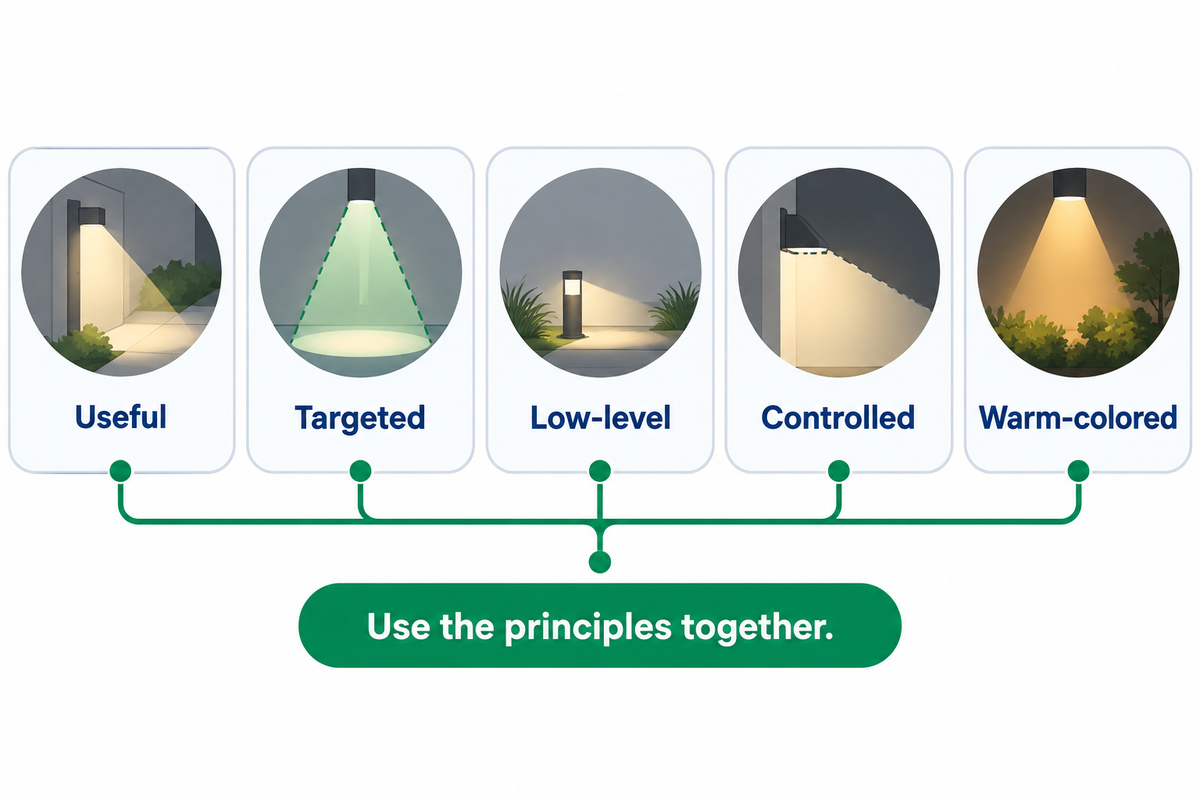
The five principles for responsible outdoor lighting are useful, targeted, low-level, controlled, and warm-colored lighting. The Illuminating Engineering Society and DarkSky International developed these principles to aid outdoor lighting practices. Together, removing unnecessary light, containing the beam, adjusting the output, shortening the runtime, and selecting the spectrum help solve different aspects of the problem.
Light pollution affects outdoor spaces in different ways. Glare makes a source uncomfortable or difficult to look past. Light trespass reaches an unwanted location, such as a neighboring window. Sky glow brightens night skies through scattered light. An outdoor light can contribute to all three, but the methods and measurements differ.
The National Park Service explains the direct and reflected paths: lights that shine upward send light into the atmosphere, while other surfaces reflect light back to the sky. Shielding is used to stop the first, while the second is addressed by reducing excess light.
“Some light does reflect off the ground and scatter through the sky”
When choosing a replacement bulb, the purchasing team should first locate the unwanted beam. Changing the color temperature leaves the geometry unchanged. The joint DarkSky and IES principles provide a good starting point for both new lighting design and existing installations.
Start with the light you do not need
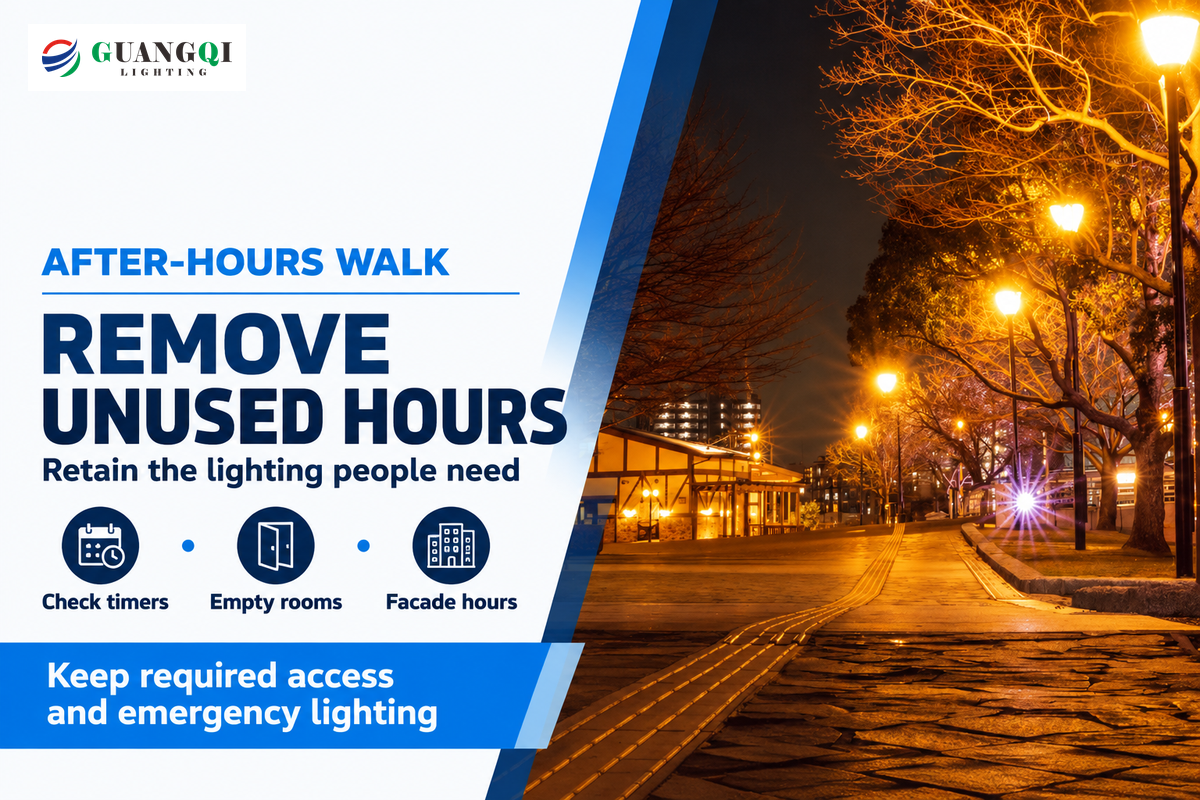
Before determining which light fixtures need replacement, remove unnecessary operating hours and decorative output. Walk the site after hours to identify active tasks and separate them from empty areas. Pay special attention to timer settings, indoor lighting that is visible through windows, and unused facade lighting. Street lighting also deserves attention. Be sure to maintain required access and emergency functions.
A lamp left on over an empty display wastes energy, even if the lamp is efficient. Office buildings may also spill light through glazing, long after staff leave. Closing blinds can contain this nighttime light. Set a closing routine to turn off lights in empty rooms, but retain lighting needed by staff in other rooms.
Make a list of circuits, their purpose, and their actual hours of operation. Identify the staff member who controls each. Then compare an adjustment, a shield, and a replacement against the complete installed cost. A small hardware change may require a significant amount of time, access and extra expense to complete. There’s no universally cheapest retrofit.
What are two ways to reduce lighting energy?
Reduce unnecessary output and hours and use energy-efficient equipment for remaining tasks. If combined, these strategies could be effective. A lower-wattage fixture, for example, saves less energy than expected if it runs longer than necessary or produces excessive light. Compare the actual input power and operating time while retaining the required illumination.
The Department of Energy’s exterior lighting purchasing guidance shows that operating hours and energy costs belong in a cost comparison. Examples of worked purchases use assumptions; a project with different hours requires a different calculation.
Shield the fixture and check its installed angle
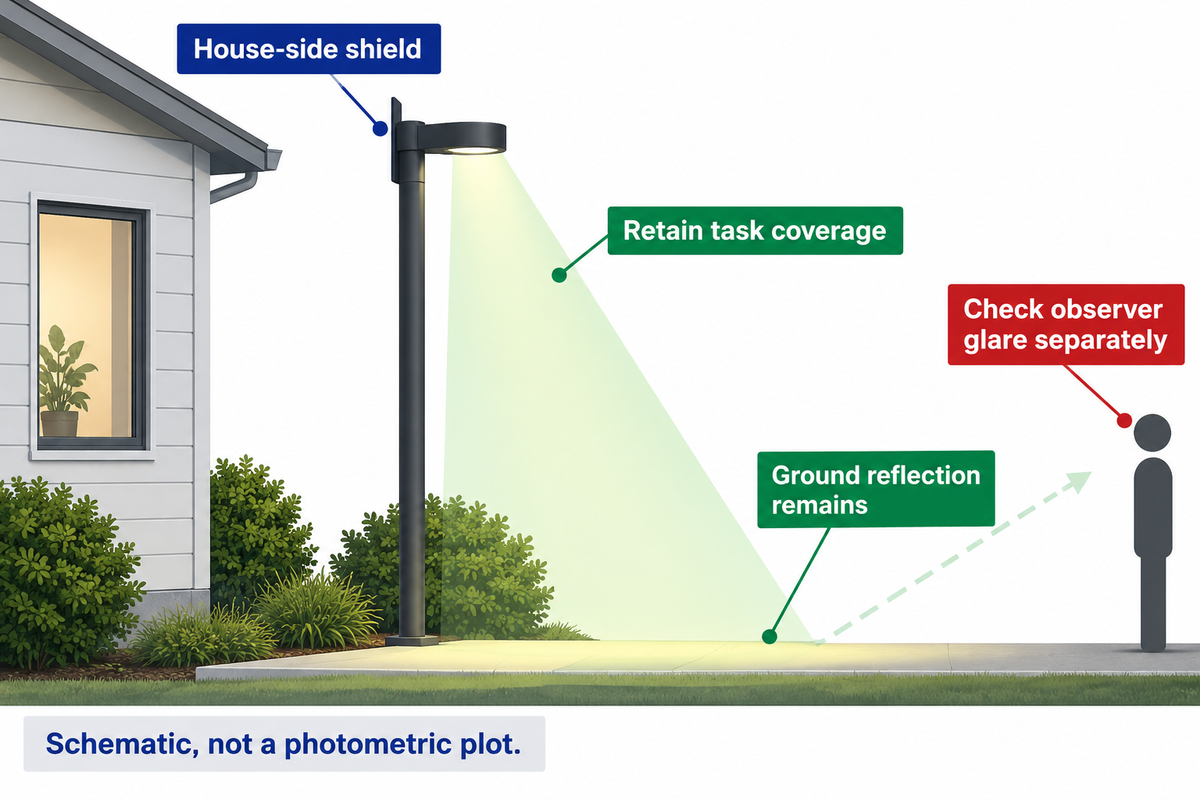
Use shielding and suitable optics to limit direct light to the intended cutoff and avoid light pollution in sensitive directions. Check the entire fixture in its installed position. A shield placed on the house-side can address light spill in the rear. An appropriate optic can shape the main distribution. These don’t replace a design that places light where the task occurs.
A shade is like a cap brim that obstructs some view directions. Light reflected from walls and the ground can still contribute to glare for a driver. A poorly positioned source may remain visible to a driver even when it sends little light directly upward. Treat glare and light trespass as separate checks.
Picture a small office located next to a residential boundary with a pole between the two. Parking is active until 9 pm and one of the bedroom windows faces the back of the luminaire. The manager’s first idea is to put warmer light bulbs throughout the site. A night walk showed that the rear distribution touches the window. The plan is to fit a manufacturer-compatible house-side shield and check the occupied spaces and the walking route. If the shield removes useful coverage and spill, the designer returns to look at the optic and/or pole position. The purchasing decision now follows the beam problem, not a plan to replace the entire site based on color.
Use the exact model’s approved accessories. A custom cover can block the vent or change the airflow and distribution. If aiming is changeable, lock the agreed position and mark it so maintenance doesn’t move it.
Aim the beam at the task, away from the boundary
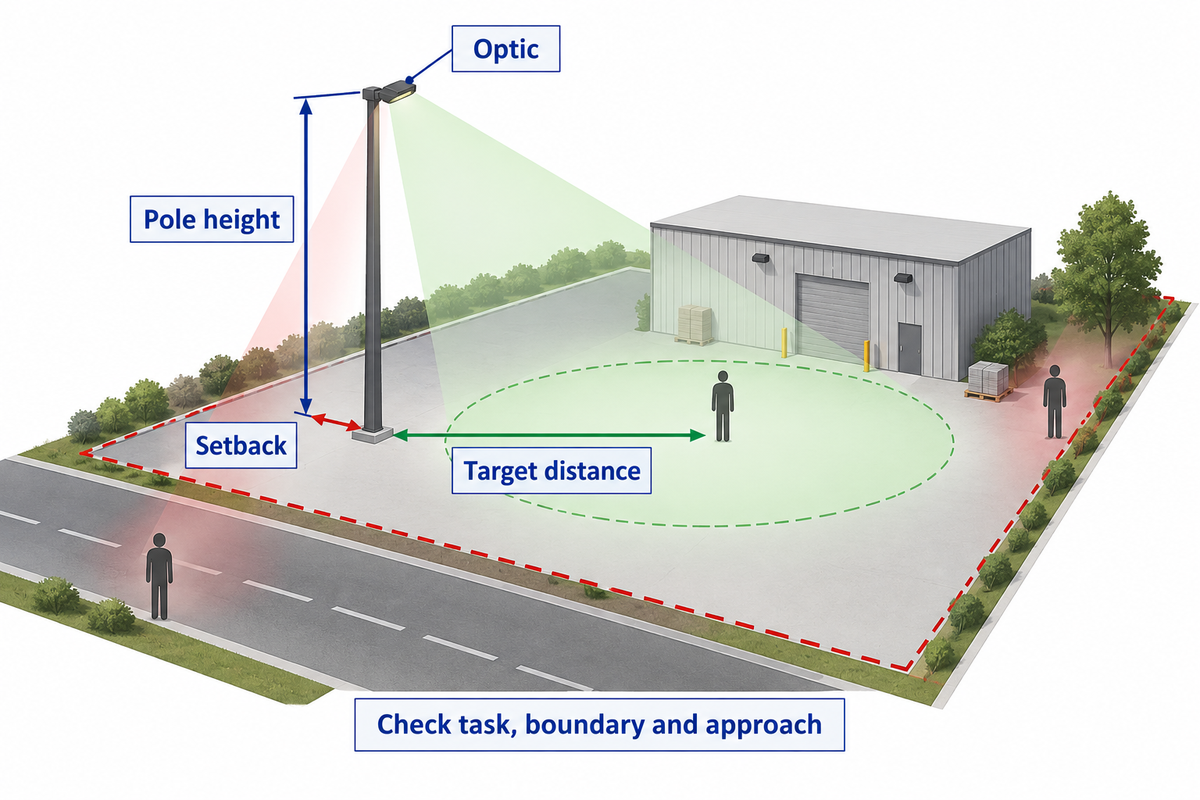
Aim an adjustable light at the area that needs illumination and check the beam from affected observer positions. Different adjustable mounting angles work for different sites; pole height, setback, optic and target distance determine where light lands. The important thing to remember is that the useful result is adequate task lighting with less direct view of a big, bright light source.
There’s a proper way to set up lighting as designed and manufactured by the O.E.M., with the manufacturer’s installation orientation and a photometric layout. There are, of course, many variations to accomplish the same job. For example, depending on location, tilting a narrow beam across a long yard can expose the source to approaching drivers; a different light distribution from another position may serve the same task and reduce glare for the driver. A particular beam angle printed on a box is only part of that particular geometry.
Discussions about neighbor lights are predominantly about screens and barriers, but it’s better to address the source with the owner. DarkSky’s neighbor-lighting guidance suggests talking about direction, shielding, brightness and controls.
When performing an acceptance walk, stand at the task and affected boundary and the approach route. Photograph the aiming position as a reference for maintenance, recording the camera exposure. Acceptance should use measured task and boundary conditions; a photograph alone is insufficient.
Use controls to dim only where conditions allow
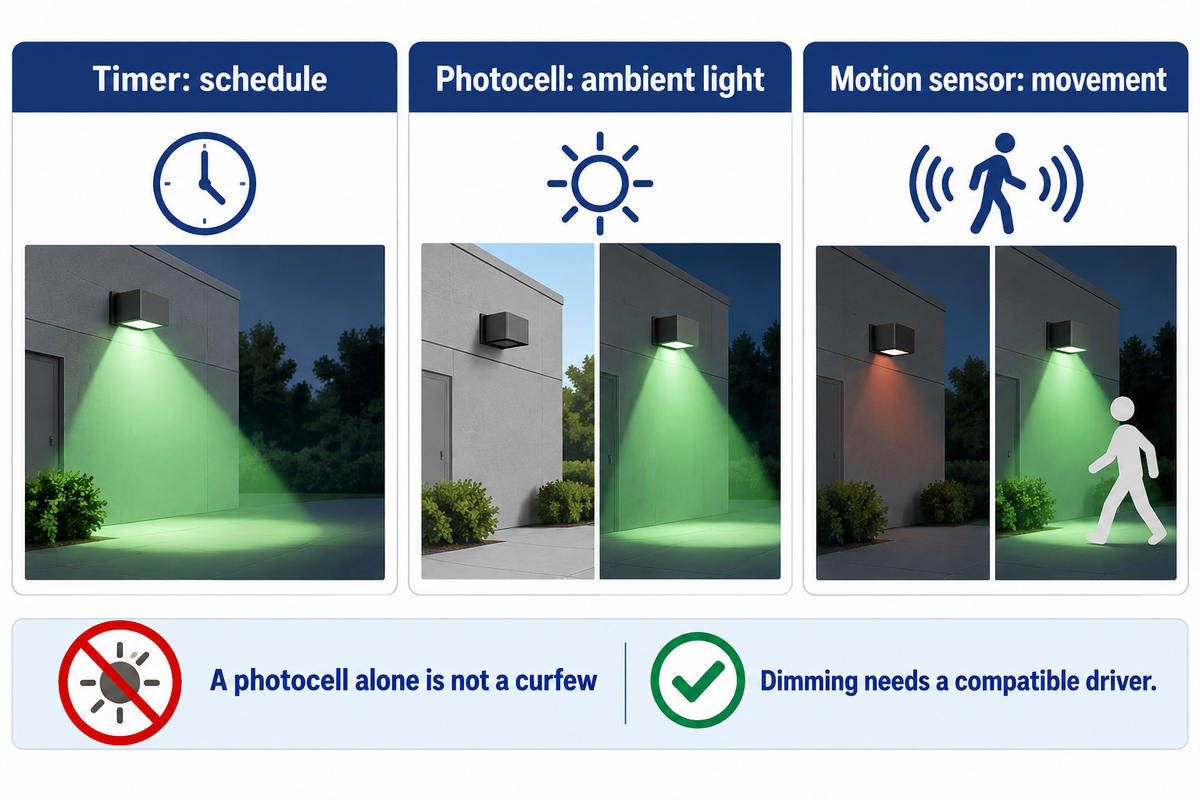
A timer follows a schedule, a photocell responds to ambient light, and motion sensors respond to detected movement. Use the functions as appropriate to the site. A dusk-to-dawn photocell allows operation during the night and prevents daytime operation. However, a photocell alone does not create a late-night curfew. Dimming also requires a compatible driver and a control strategy.
The DOE Guide on efficient lighting strategies explains these control inputs. For current LED lighting in outdoor applications, the order must match the controller, driver, and desired behavior. A 0-10 V or DALI interface doesn’t mean automatic scheduling.
In the Tucson 2019 experiment, changing streetlight power from 90% to 30% was associated with zenith brightness reductions of 5.4 ± 0.9% at the city-center site and 3.6 ± 0.9% at the suburban site. The Barentine and colleagues study excluded road intersections, crosswalks and certain areas with high late-night pedestrian activity. About 81% of the test luminaires reported the intended midnight state. The comparisons were limited by weather conditions and field execution.
That case makes command verification part of the commissioning process. A dashboard schedule and light levels may not be identical. For control system architecture, see our guide on connected street light systems. Cabinet-level switching is covered in our guide on light control panel arrangements.
Does an efficient LED automatically reduce light pollution?
No. Efficiency describes useful light output per unit of electrical power, while unwanted light depends on where, when and how much light is emitted. LEDs can support accurate optics and dimming, but a large or misaimed installation can still create glare. Keep intended task and operating hours in the specification.
Design a curfew around how the site is used
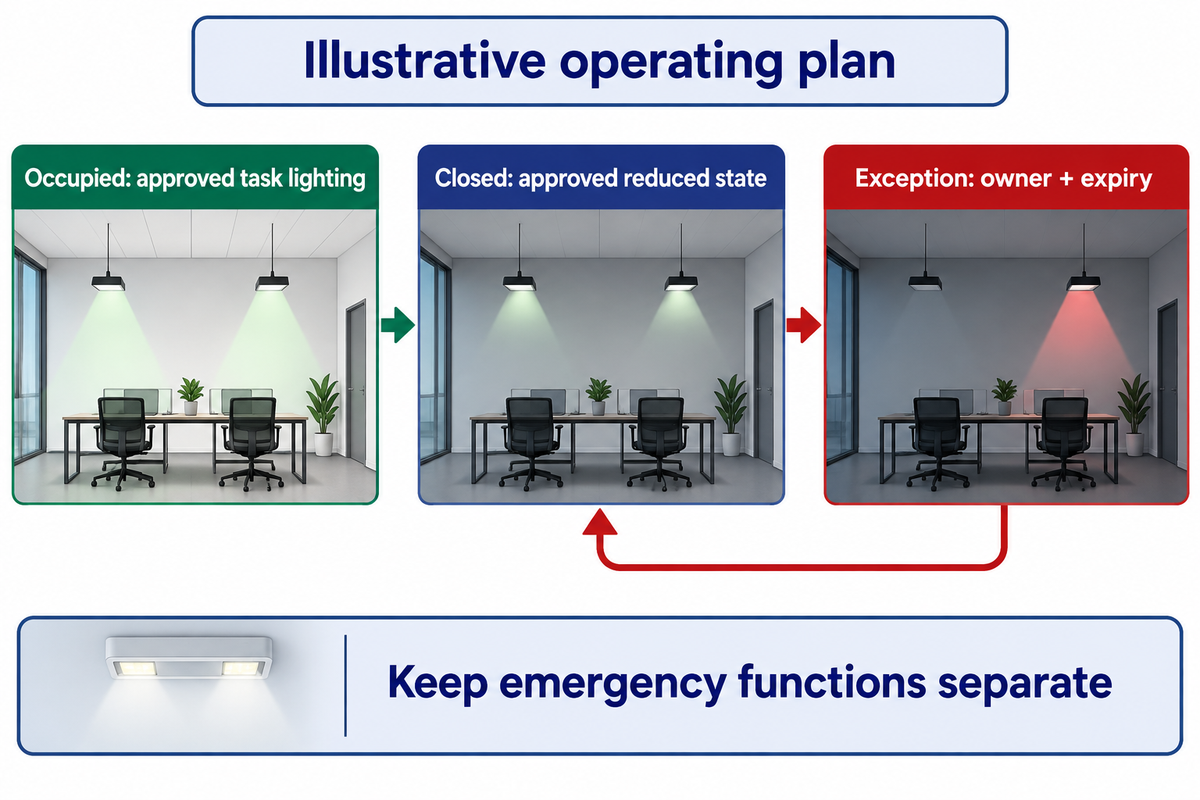
Use a three-state night plan: occupied operation, closed operation and a temporary exception. Assign a state to each zone instead of treating the entire property as one switch. Decorative lighting can be turned off at closing. Maintain necessary lighting. Give exceptions a time-limited duration, a responsible party, and a defined condition for returning to the prior state.
Example site: An office closes at 9 p.m., with occasional cleaning ending at 11 p.m. and an entryway remaining open all night. The table below shows how to document the sequence before selecting numerical dimming levels. Those levels are based on the site task requirements and an approved layout.
| Zone / state | Operating instruction | Owner and return condition |
|---|---|---|
| Parking / occupied | Approved task level while staff use the lot | Facilities; transition at closing |
| Parking / closed | Approved reduced state; retain necessary route coverage | Facilities; scheduled next opening |
| Parking / exception | Occupied level for an authorized late departure | Duty manager; expiry after agreed activity |
| Entrance / occupied | Required approach and door-task lighting | Facilities; closing sequence |
| Entrance / closed | Retain required access provision | Security; next opening |
| Entrance / exception | Approved arrival response where sensors are suitable | Security; tested reset after departure |
| Facade / occupied | Limited decorative scene during agreed hours | Property manager; off at 9 p.m. |
| Facade / closed | Off; access lighting operates separately | Property manager; next approved evening |
| Facade / exception | Timed scene for an approved event | Event lead; expiry at event end |
The sequence created by the author incorporates the principles of DarkSky/IES, and is based on the findings from the Tucson implementation. Emergency functions and required routes need separate provisions.
In the presence of sensitive habitats, add an ecological window to the schedule. In a French study of a rural area, five of eight species of bats showed no significant activity difference between part-night lighting and full-night lighting. Azam and colleagues found varying responses among taxa. A closing time set for the benefit of humans may miss activity times for nocturnal animals. Ecological consultants should address dusk and dawn and the seasonal usage of the habitat.
Test holidays, clock changes, temporary overrides and restoration after a power failure. An override that never expires can quietly restore all-night operation.
Choose spectrum for the setting, not just a CCT label
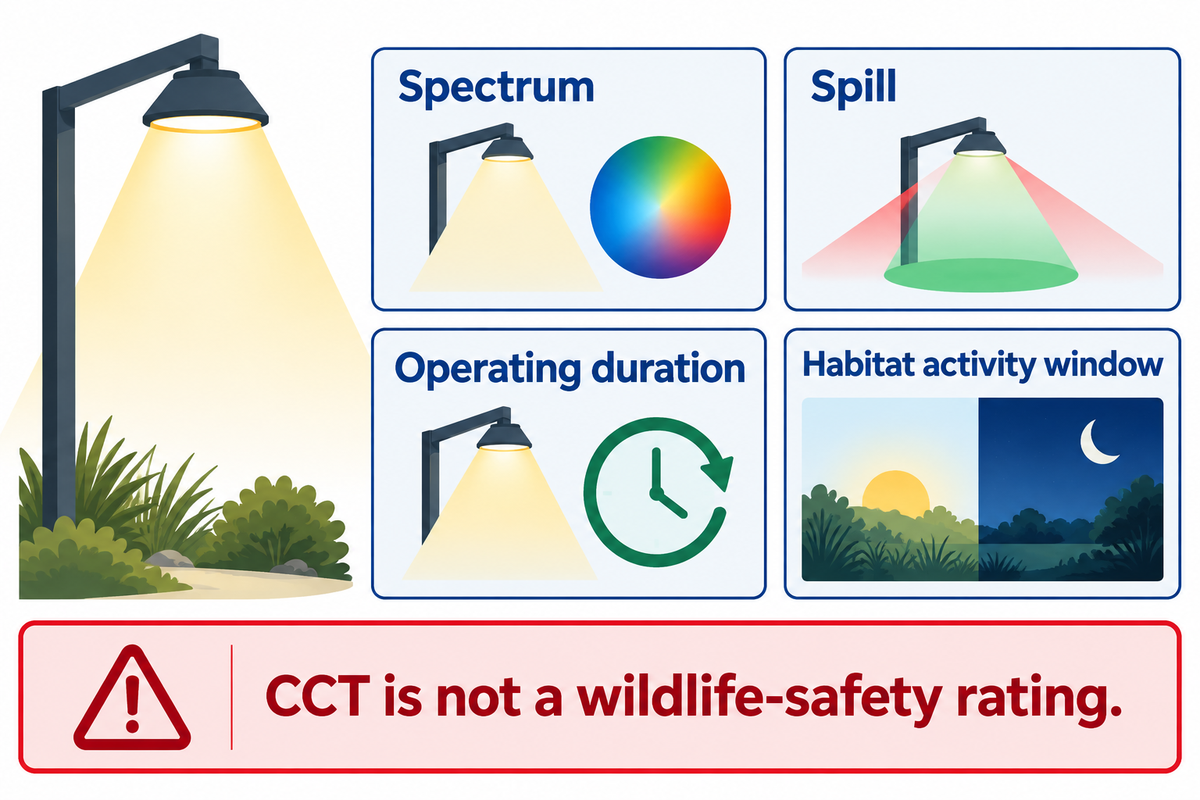
Consider the spectral distribution and the setting that will be affected when designing with warm colored light. Correlated color temperature describes white-light appearance; it isn’t a universal wildlife-safety rating. The amount, direction and duration of artificial light at night remain relevant even when a lamp appears warm.
DarkSky’s values-centered lighting policy uses CCT as a practical proxy and considers short-wavelength emission as well as the other aspects. Reducing blue light complements a directed beam and shorter operation. Appearance choices and their application are covered in more detail in our street-light color-temperature guide.
A good counterexample is an English project from 2014 reported by Wakefield and colleagues. In the study, overall insect attraction did not differ significantly between the tested 2700 K and 5000 K domestic LED lamps. However, some responses differed among moth families. Integral LED supplied equipment and partly funded the project. The result concerns the types of lamps studied and the field conditions; it doesn’t prove that cooler white light lamps are generally preferable.
Imagine a visitor facility adjacent to a wooded corridor. The proposal is to replace 4000 K lights with 2700 K lights and leave the existing all-night lighting schedule. The facilities team has a recurring complaint about light spillover into the woodland. A better project brief would address spillover into the woodland, separate the visitor route from decorative lighting, and identify when the route is actually used. A sensitive activity window could be identified by an ecologist before the lighting schedule is locked down. From a purchasing standpoint, warmer lights (2700 K) can be paired with less spill and a defined operating period. Acceptance would include the boundary and route, not just the new lamps appearing warmer.
Sea turtles show the importance of species-specific requirements. For turtle-sensitive installations, considerations include spectral provisions and shielding; a blanket statement of “eco-friendly lighting” won’t suffice. The use of artificial light can disrupt nocturnal activity; reducing light at night will help protect the night environment, while claims about human health or an entire ecosystem require evidence beyond a lamp’s Kelvin value.
Compare retrofit choices before ordering lighting
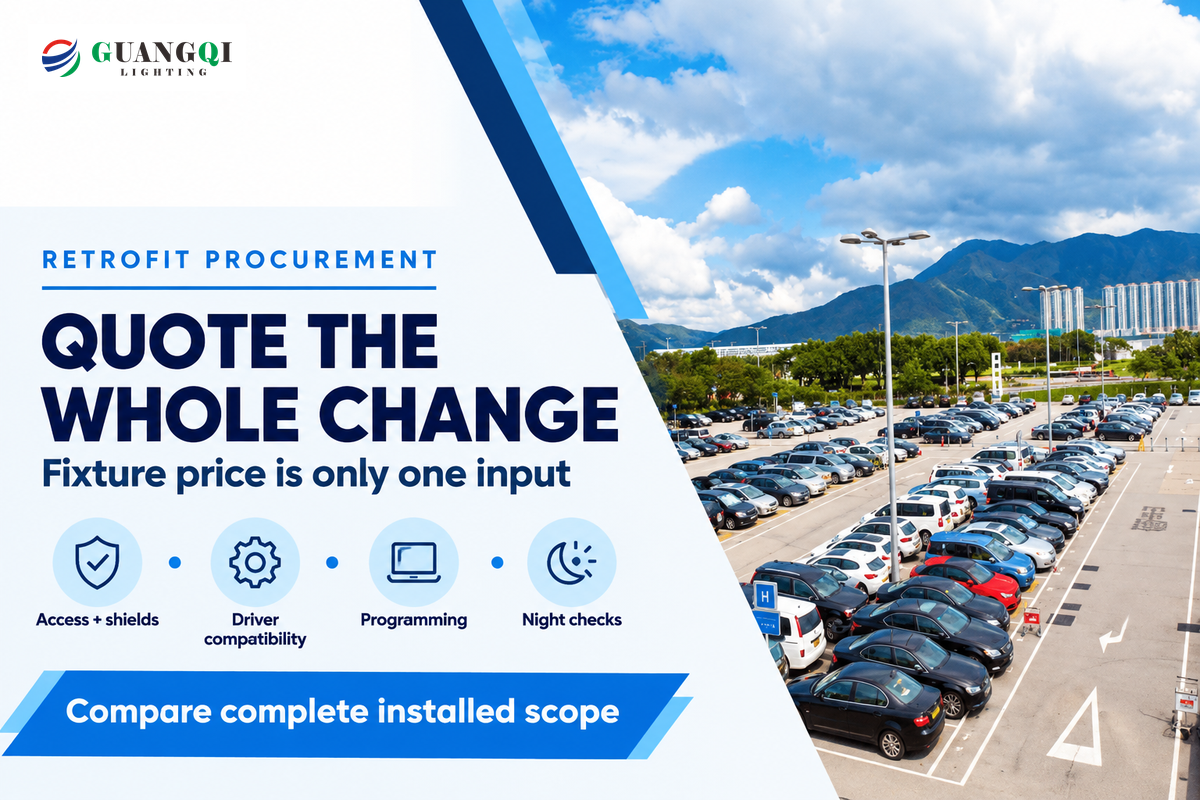
Compare alterations by the problems they address and their complete installed scope. Keep appropriate equipment if a change solves the problem; replace it if optics, controls or condition prevent the desired result. When obtaining equipment, consider access, accessories, compatibility and commissioning in addition to the fixture. Finance should analyze operating hours, not assume broad cost savings.
| Observed problem | Candidate change | Constraint to include in the quote |
|---|---|---|
| Lights operate after closing | Reprogram existing timer | Circuit separation, exceptions and override expiry |
| Lights operate in daylight | Correct photocell setup | Sensor position and controller compatibility |
| Rear spill reaches windows | Compatible house-side shield | Lost useful coverage and lift access |
| Adjustable beam overshoots | Re-aim and lock position | Task coverage and observer glare |
| Output exceeds the task | Approved lower-output setting | Driver range and nighttime task check |
| Intermittent use, continuous lighting | Suitable occupancy response | Detection coverage, response and reset |
| Distribution misses the area | Different optic or luminaire | Photometric layout and mounting fit |
| Sensitive habitat receives light | Reduce spill, duration and suitable spectral output | Species advice and preserved dark areas |
| Old controls cannot implement the plan | Control and driver replacement | Wiring, programming, maintenance and fallback state |
Editorial comparison based on the DOE cost methodology, DarkSky guidance, and configuration specific product criteria. This is an intervention map, not a price map.
Example: Say 20 luminaires each use 100 W for 12 hours. Baseline energy use is 20 × 100 × 12 ÷ 1,000 = 24 kWh. Suppose an approved schedule keeps 100 W for six hours and uses a measured 40 W input for six hours. Energy becomes 20 × [(100 × 6) + (40 × 6)] ÷ 1,000 = 16.8 kWh, a reduction of 7.2 kWh per night. At $0.15/kWh that’s a savings of $1.08 per night before taking into account standby energy use and/or other costs. Finance can compare that to the cost of the controls that were installed. The approximately 30% savings is electric energy savings, not a predicted savings in sky brightness.
Provide details such as the exact luminaire, optics, shield, driver and controls, and the control sequence. Specify the proposed mounting position, task area, windows, habitat, operating states and acceptance checks. The Guangqi responsible outdoor lighting range provides example configurations for street lighting. The project order should define the configuration to deliver the required control and distribution.
Verify the result after dark and keep it working
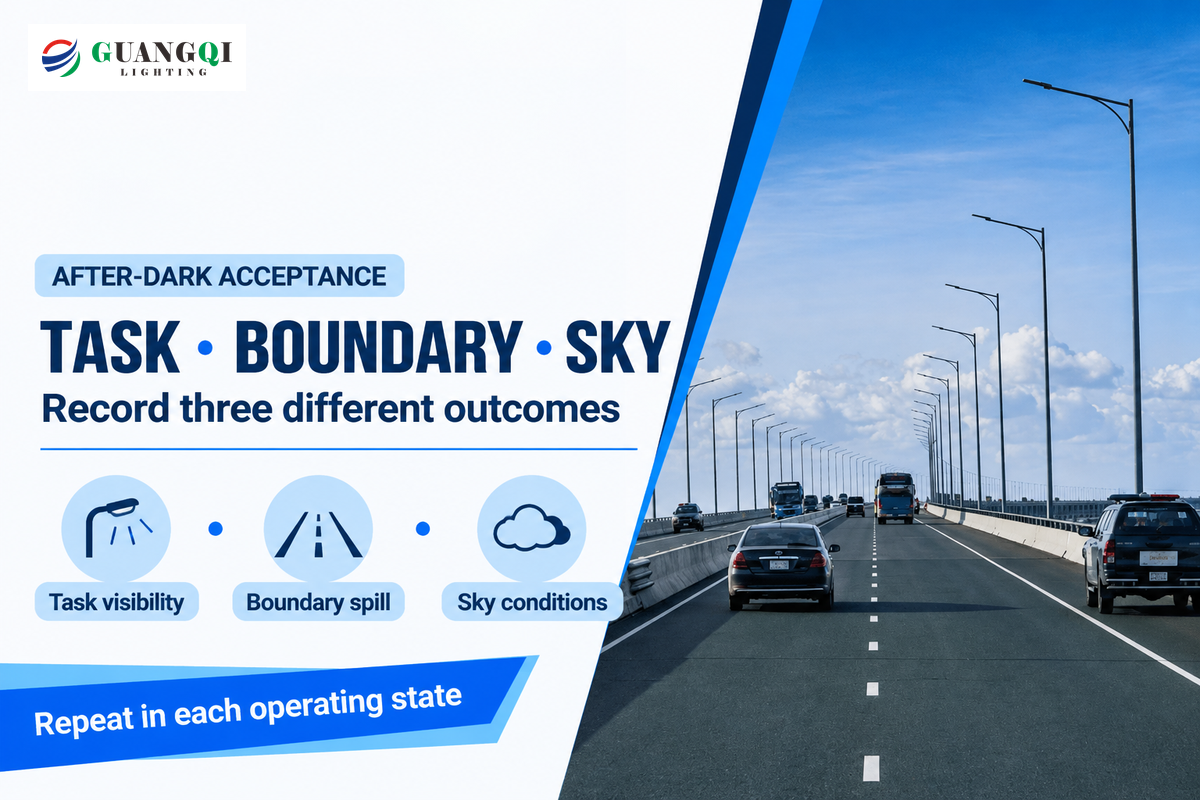
Use the Task–Boundary–Sky Check to record task lighting, unwanted light at affected locations, and sky conditions. Repeat these checks in the occupied, reduced and exception states. Maintain similar measurement positions and conditions. Record the source spectrum and instrument response for a retrofit that changes the type of light.
- Task: inspect the route or work area and measure the design’s specified quantities. Record the control state and any visibility problem.
- Boundary: return to the affected window, property edge or habitat boundary. Record spill and direct source visibility using the agreed method.
- Sky: use an appropriate sky-monitoring method where skyglow is a project objective. Record weather, observing direction, instrument and spectral band.
In a Chelan County retrofit study, ground-based V-band skyglow increased, while satellite day-night band upward radiance decreased. These are different observations. Sky Quality Meter spectral response also indicates that comparison of light sources is complicated. A lux reading can’t be replaced by a photo, or a photo replaced by a satellite value.
For parking lots, keep the applicable tasks and environmental objectives separate; our parking-lot lighting requirements guide provides more information. File the settings and aiming photographs with maintenance records. Recheck after replacement drivers, changed landscaping, altered hours of operation or a complaint.
Industry Outlook
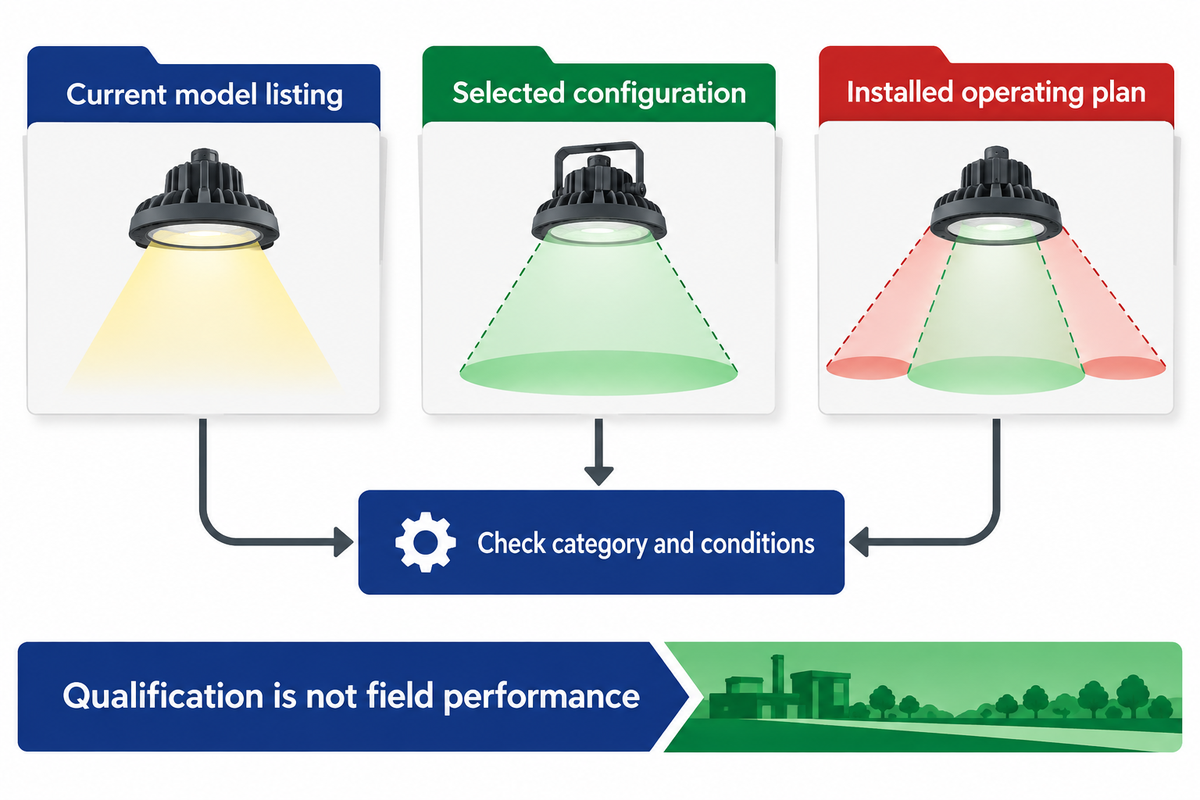
DLC LUNA V2.0, which took effect January 5, 2026, altered controllability reporting and spectral information, and added new pathways for non-white light sources. For consumers, the main change is a more detailed qualification conversation. For lighting products, a current model listing, the selected configuration and the installed operating plan each answer a different question.
The DLC transition guidance describes new reporting and pathways for amber and turtle lighting. During the qualification-list transition, the absence of new data fields shouldn’t be assumed to indicate lack of the function. These are product-program requirements, and not a general lighting ordinance.
DarkSky’s Approved Luminaire Guidelines v3.1 (Oct 2025) also incorporate criteria specific to categories. For example, under the residential category, up to 50 lumens of uplight is allowed, while the Sea Turtle Sensitive criteria stipulate no emission in the 90-180-degree zone above nadir. Hence, an approval needs its category and conditions stated; “dark-sky approved” doesn’t mean all approved products have the same light distribution.
Specifications for sustainable lighting are becoming more helpful when they link product data with operating intent. A procurement brief can stipulate which spectral report is needed, what the controller must do after closure, and which installed conditions to assess. This makes bids easier to evaluate than a request for “environmentally friendly lighting”.
Policies to limit light pollution still vary by location. The project’s lighting designer should apply the local requirements. Maintain the distinction between equipment qualification and field performance: a listed fixture can still be badly aimed or be left on unnecessarily.
For a new project, provide operating hours, troublesome viewing positions and a site sketch to help turn a wish to “protect the night sky” into a clear equipment and control brief.
Frequently asked questions
What is light pollution and why is it a problem?
Light pollution is human-made alteration of outdoor light levels from their natural condition.
It includes unwanted light at windows, uncomfortable glare and brighter night skies. These effects can waste energy and disturb wildlife. The useful response is to identify the source, direction, operating hours and lighting task before choosing changes that retain necessary visibility. Start with the location that experiences the problem, then trace the light back to its source.
What is the prevention of light pollution?
Prevent light pollution by designing the task, beam, output and operating hours before ordering fixtures.
Keep light within the areas that need it and choose a suitable spectrum as part of that design. Then check the installed system after dark. A product label does not determine where a finished layout sends light or how long it runs. Include affected windows and boundaries in the review, alongside the routes people need to use.
Will we ever fix light pollution?
Individual sources can be improved immediately; restoring regional dark skies requires coordinated action.
Many properties contribute to the same sky, so one shielded fixture may not produce a visible regional change. Start with measurable improvements at the sources you control. Communities can then combine better design, operating rules and maintenance. The aim is to retain useful lighting while reducing unnecessary emissions, rather than expecting one product to restore every celestial view.
Do light pollution solutions work?
Yes, when the changes address the actual source and operating conditions.
Check the result at the affected location. Lower electricity use alone does not establish less spill or glare; the beam and installed state still matter.
Can light pollution solutions be dangerous?
Poorly chosen changes can leave necessary tasks inadequately lit.
Switching off alternating parking-lot fixtures may leave uneven visibility; lowering a setting without checking access routes can make a task harder. Have the responsible designer or facility team identify required lighting before changing it. Use compatible shields and controls, and qualified personnel for electrical or elevated work. Test occupied and reduced-output states separately, including sensor activation and restoration after a power interruption. Correct an inadequate task-lighting result before accepting the change, and retain emergency functions throughout the operating plan.
Have light pollution solutions been successful?
Documented projects, including the Tucson dimming study, show that reductions are possible.
Results depend on the equipment, baseline and measurement method. Another city’s percentage is not a forecast for your site; establish your own acceptance conditions.
Does a lighting curfew mean every light must turn off?
No. A curfew defines a change in operation at an agreed time or event.
Decorative lights may turn off while necessary access lighting follows an approved lower-output schedule or remains available on demand. Emergency functions and required routes need their own provisions. Write the exceptions explicitly, give temporary overrides an expiry and test the transition after dark. Local requirements, the approved design and actual operating hours determine the arrangement. Near sensitive habitat, include ecological activity windows. Midnight is not a universal requirement, and a schedule that suits a business may not suit local wildlife.
Planning an outdoor-lighting change? Send Guangqi the site layout, mounting positions, operating hours and the places where unwanted light is a problem. We can discuss the street-light configuration and control options for your project.
References & Sources
- DarkSky and IES: Five Principles for Responsible Outdoor Lighting.
- National Park Service: Light Pollution Sources.
- DOE: Purchasing Energy-Efficient Exterior Lighting.
- DOE: Efficient Lighting Strategies, historical control-function guidance.
- Barentine et al.: Recovering the city street lighting fraction from skyglow measurements in a large-scale municipal dimming experiment, 2020.
- Azam et al.: Is part-night lighting an effective measure to limit the impacts of artificial lighting on bats?, 2015.
- DarkSky: Values-centered outdoor lighting.
- Wakefield et al.: Experimentally comparing the attractiveness of domestic lights to insects, 2016.
- Hung et al.: Changes in night sky brightness after a countywide LED retrofit, 2021.
- Sánchez de Miguel et al.: Sky Quality Meter measurements in a colour changing world, 2017.
- DLC: Transition to SSL V6.0 and LUNA V2.0 Requirements.
- DarkSky Approved Luminaire Guidelines v3.1, October 2025.
- DarkSky: My Neighbor’s Lighting.