Get in Touch with GUANGQI



By DD · Updated November 2026
A dusk to dawn sensor for outdoor lighting will respond to changes in ambient lighting. It can bring lights on at dusk and switch them off when daylight returns, but the detector, response delay and supported load differ between products. A light that stays on at noon requires an exposure and control check before a new unit is ordered.
Start with these distinctions
- A photocell detects light; a motion sensor detects movement.
- Light thresholds, response delays and motion hold time are separate settings.
- Voltage, LED load rating and the fitting must match the complete lighting system.
- Observe from a safe position. Leave hardwired testing and replacement to a qualified electrician.
How does a dusk to dawn sensor work?
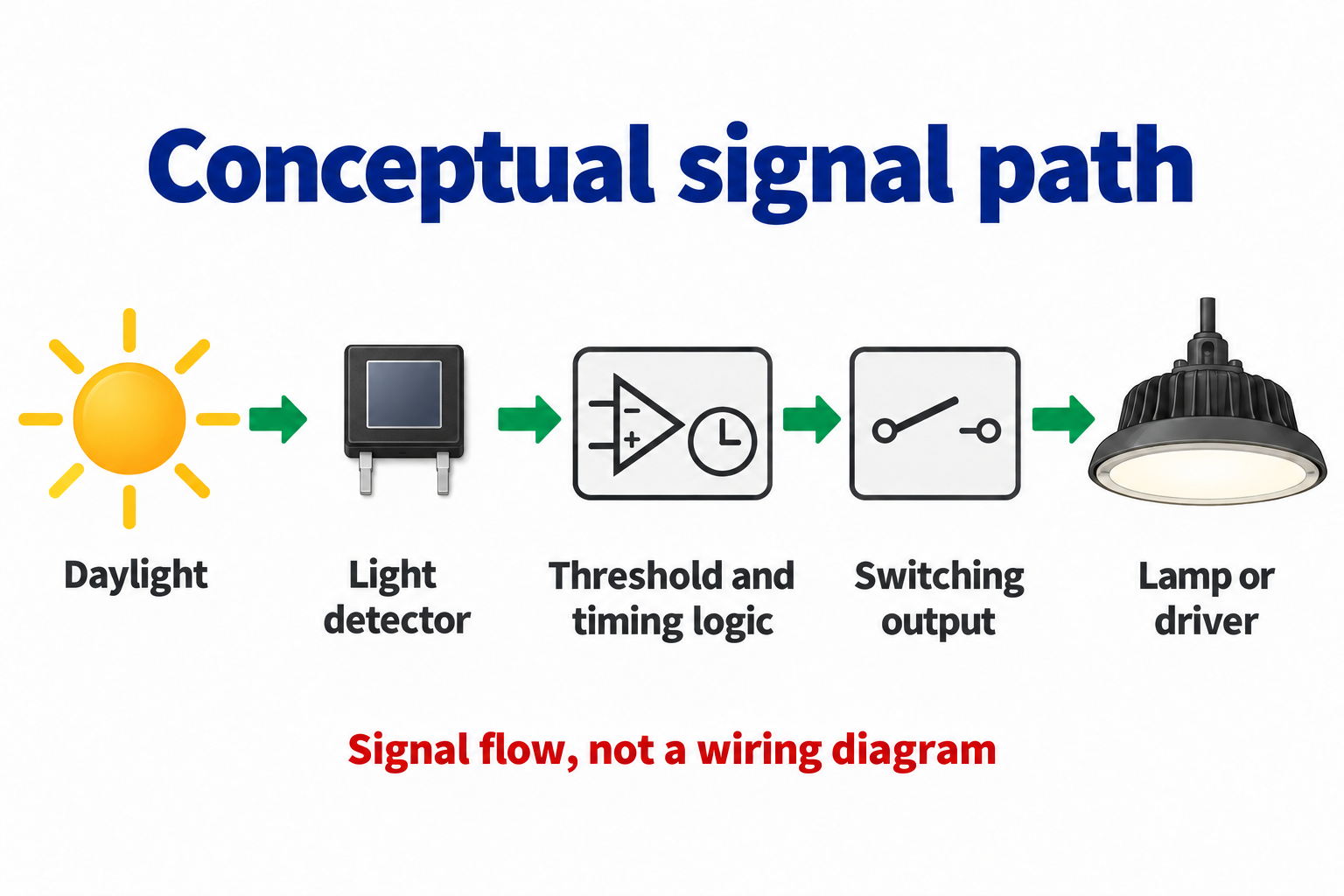
A dusk to dawn sensor works like a brightness-operated switch: a detector senses ambient light, a control circuit compares the signal with its switching thresholds, and an output operates the light. When the light level drops far enough, the controller can turn on the fixture; rising daylight triggers the opposite action.
The light-sensitive element is not always a resistor. Resistance changes in a light-dependent resistor; a change in light level creates an electrical signal in a photodiode. Clemson University’s ambient light sensor explanation describes photoresistors, photodiodes, and phototransistors. Photoresistors may exhibit memory effects, where the response depends on previous exposure to light.
Conceptual signal path
Daylight → light detector → threshold and timing logic → switching output → lamp or driver
A photocell light sensor may be built into a luminaire or provided as a separate photocontrol. A photoelectric sensor that measures brightness may or may not provide dimming, motion sensing and an astronomical timer control.
The sensor provides the brightness input; the control circuit turns the light on or off. It responds to changes in light at the detector, not to how bright the whole property looks. If ambient light drops under deep shade, that local reading can differ from natural light levels in the open.
Dusk-to-dawn vs motion sensors and timers
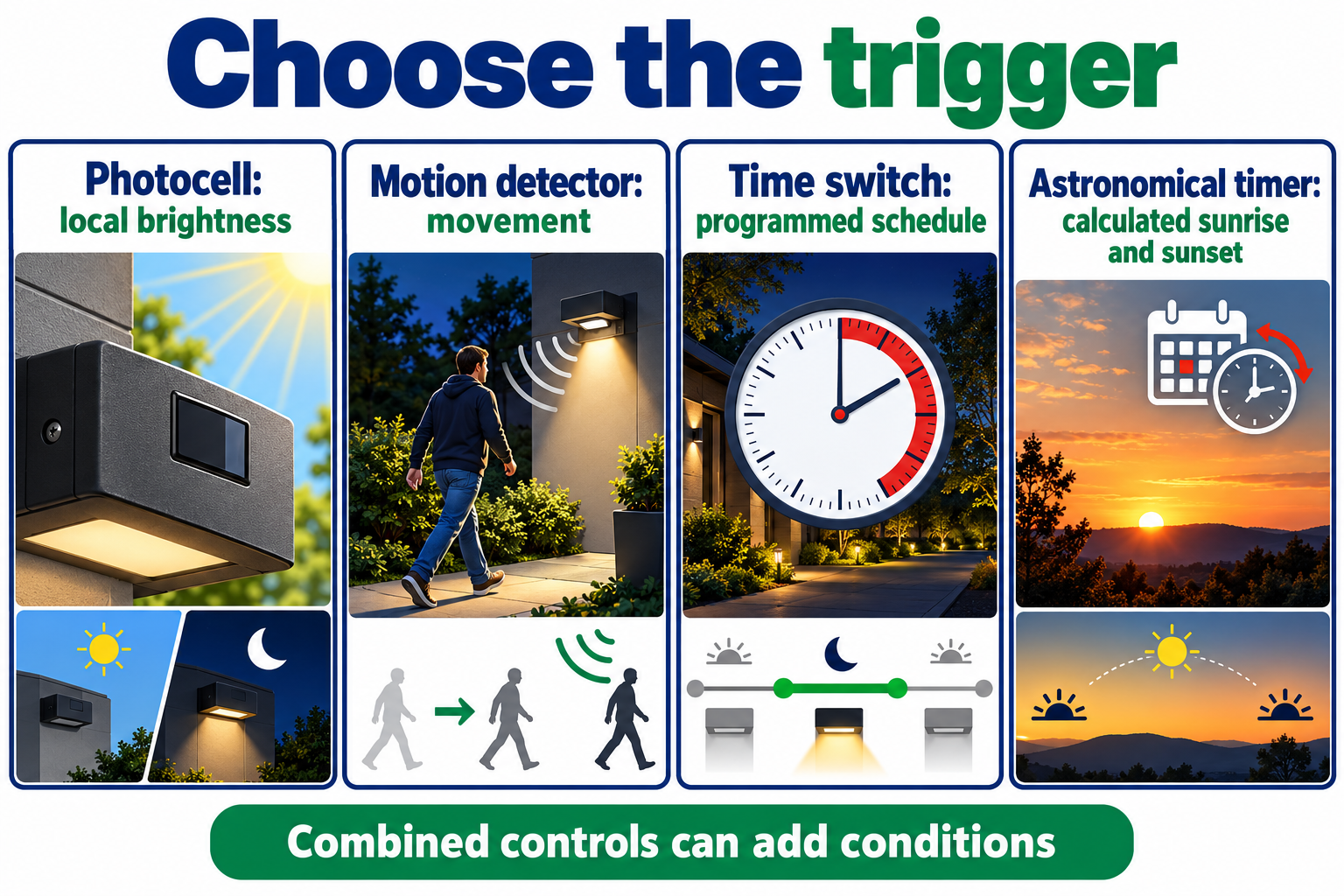
Choose a photocell based on ambient light levels for switching, a motion sensor for movement-activated lighting, and a timer for scheduled operation. Combinations can restrict motion activation to darkness or switch lights off before dawn. The required control arrangement also depends on the building rules applicable to the project.
| Control | What triggers it | Useful behavior |
|---|---|---|
| Photocell | Changes in local brightness | Daylight-based on/off switching |
| Motion detector | Movement in its detection zone | Light when an area is approached |
| Time switch | A programmed schedule | A closing-time or curfew cutoff |
| Astronomical timer | Calculated sunrise/sunset times | Seasonal scheduling without a local light detector |
PNNL’s lighting-controls guide covers exterior combinations of photocells, motion sensors, and timers. For a doorway, a photocell with a timer can end decorative illumination after closing. Another option would be to use a motion sensor with a detector that’s activated only in the dark. This may not require keeping the light on all the time. Planning the detection zone is covered in a separate guide to selecting a motion sensor light.
A photocell switches lighting for outdoor spaces based on ambient light levels; a timer switches lighting according to a schedule. However, if a complete system is deployed to allow remote management, smart lighting can also achieve the same result. Lights equipped with a simple photocell switch still need a separate suitable control if the owner wants a closing-time cutoff. Specify whether the lights operate all night, stop at closing time or respond to movement before selecting an app or controller.
California example: the Energy Commission’s 2025 residential lighting FAQs, Sections 150.0(k)3 and 160.5(a)3, specify manual-switch and automatic-control arrangements for applicable permanently mounted residential outdoor lighting. Options include a photocell plus motion sensing, a photocell plus an automatic time switch, or astronomical time-clock control. The 2025 code edition provides requirements for buildings with permit applications on or after January 1, 2026. The requirements should be applied to the actual building and work scope.
Which photocell sensor type fits your outdoor light?
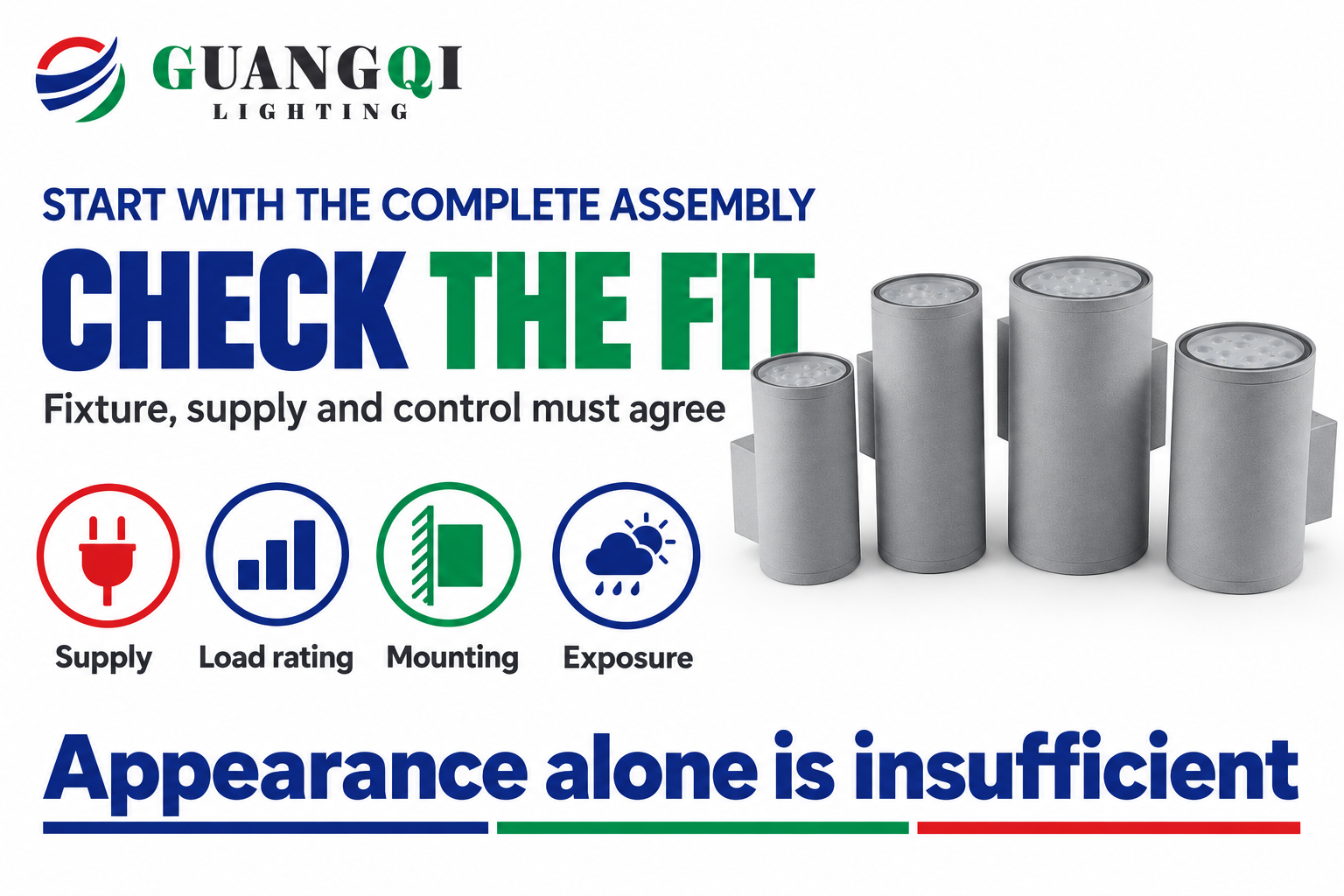
Pick the sensor type the fixture and supply are built for: typically an integrated detector for a porch or wall-mounted luminaire, a twist lock photocell for area lights and pole-mounted fixtures, a screw-in adapter for a compatible socket retrofit, and a low-voltage DC accessory for a compatible landscape lighting circuit. A built-in photocell sensor, a screw-in adapter, and a locking photocontrol with its mating receptacle each constitute different assemblies. For a sensor for outdoor light replacement, determine where the detector is and how the control is connected; similar appearance doesn’t ensure electrical compatibility.
These types of dusk to dawn controls cover different lighting needs. When planning outdoor wall lights, leave the sensing window exposed to representative daylight rather than hiding it behind a decorative cover.
A light sensor for outdoor use belongs in an assembly suitable for its weather exposure. String lights may need a compatible outdoor plug-in controller; patio lights on a hardwired circuit need the corresponding rated control arrangement. Neither becomes weather-suitable simply by adding an automatic light sensor.
| Arrangement | Typical application | First check |
|---|---|---|
| Integrated detector | Porch light or wall-mounted luminaire | Approved operating modes and detector exposure |
| Button-style sensor | Fixture-mounted sensing window | Mounting opening and control rating |
| Stem-mounted control | External enclosure or luminaire connection | Mounting provision and weather protection |
| Twist lock photocell | Area lights and pole-mounted fixtures | Receptacle, supply and load compatibility |
| Locking dimming control | Compatible dimmable outdoor LED lighting | Specified control interface and driver |
| Sensor-equipped bulb | Suitable replaceable-lamp fixture | Lamp suitability and unobstructed detector |
| Screw-in sensor adapter | Compatible light socket retrofit | Base, clearance, enclosure and load rating |
| Low-voltage DC accessory | Compatible landscape lighting circuit | DC voltage, current and controller arrangement |
| Networked controller | Managed outdoor lighting systems | System integration and commissioning responsibility |
For example, Armacost Lighting specifies its dusk-to-dawn accessory for 12 V or 24 V DC white lighting, at 5 A, with listed maximum loads of 60 W at 12 V and 120 W at 24 V. That accessory belongs on its compatible low-voltage system, not on a mains circuit. Solar lights likewise use their own controller arrangements; the solar flood-light specification guide covers the complete solar assembly.
Pathway lights and post lights can be supplied through different circuit arrangements, so the installer needs the actual supply details. Parking lot lights may share a control for several drivers. A barn light with its own detector presents a different replacement task from that grouped installation.
What do photocell lux and delay settings mean?
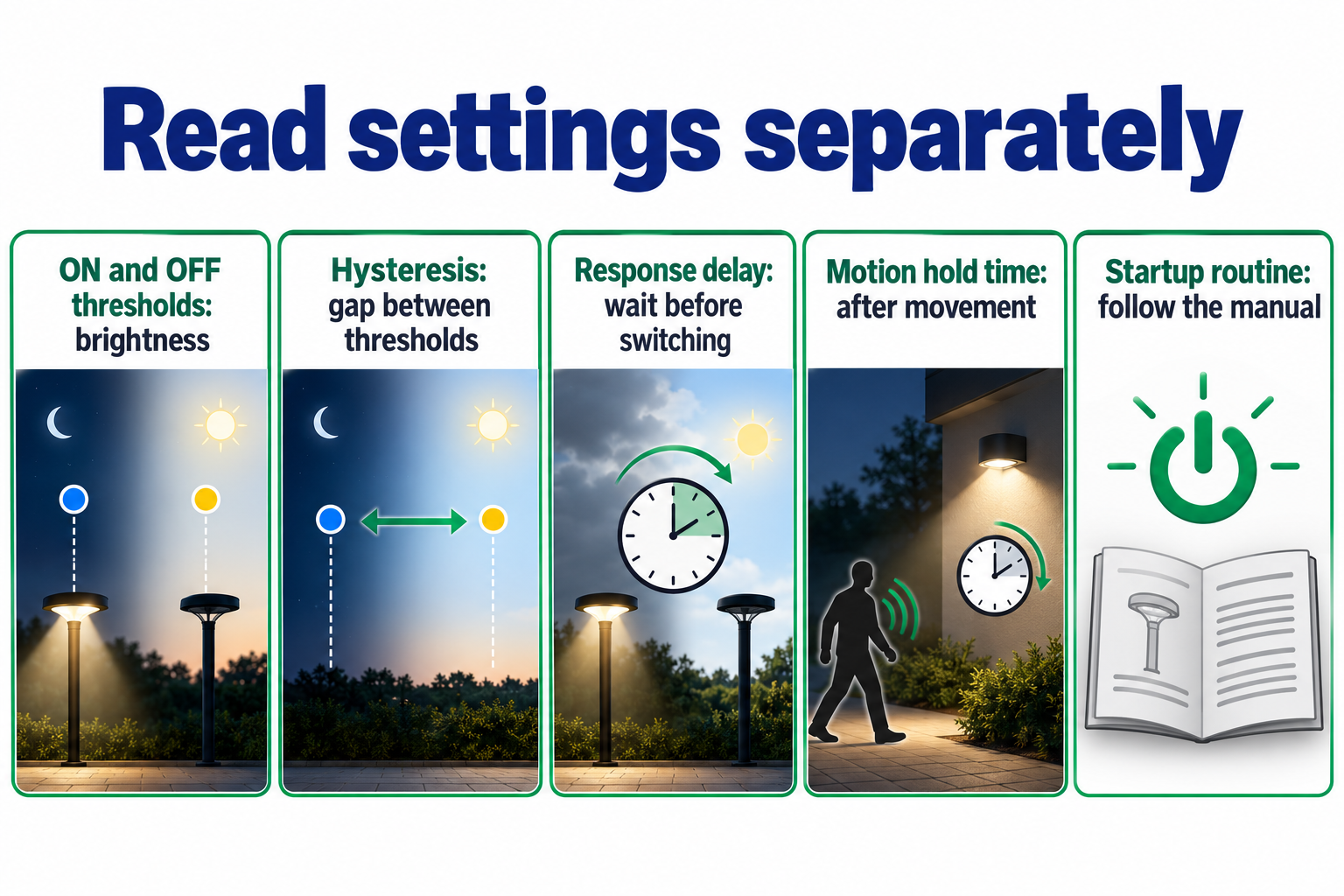
A lux or foot-candle threshold defines the brightness level at which a photocell switches; a delay sets how long the control waits before responding. Separate ON and OFF thresholds create a gap, or hysteresis, in switching. Use your selected model’s stated values and adjustment procedures rather than using a universal lux setting or waiting period.
Picture a thermostat with different start and stop points. A light control can similarly retain its present state between two brightness thresholds, which reduces switching around a single borderline value. CMU’s input-hysteresis teaching example separates those thresholds from elapsed-time conditions. Hysteresis isn’t the same specification as a delay.
One model example: Intermatic’s NF10KL page lists 1.5 fc ON and 2.25 fc OFF , with an instant ON response and a 2–5 second OFF delay. Its use of a silicon diode also illustrates the incompleteness of the resistor explanation.
Read each function separately
- Identify the ON threshold.
- Identify the OFF threshold.
- Read the delay direction and any startup routine.
Keep these distinctions
- An OFF delay postpones switching the light off; an ON delay postpones switching it on.
- Published specifications can describe fixed thresholds and delays as well as adjustable settings.
- Motion hold time controls how long the light remains on after movement, while the photocell threshold sets the brightness condition for operation.
A control labeled “time” on a combination motion light may determine how long the lamp stays on after it detects motion. A separate dusk to dawn photocell sensor may not have a user dial at all. For an adjustable model, use its documented range and adjust only accessible controls as instructed; opening an enclosure to search for an adjustment is electrical work.
When a combined system’s sensor activates, its selected mode decides whether the lamp stays on or waits for movement. Therefore, the operation of lights follows both the condition of light and the additional control logic. Read the mode description and threshold hand-in-hand.
Where should the sensor sit, and how do you check it?
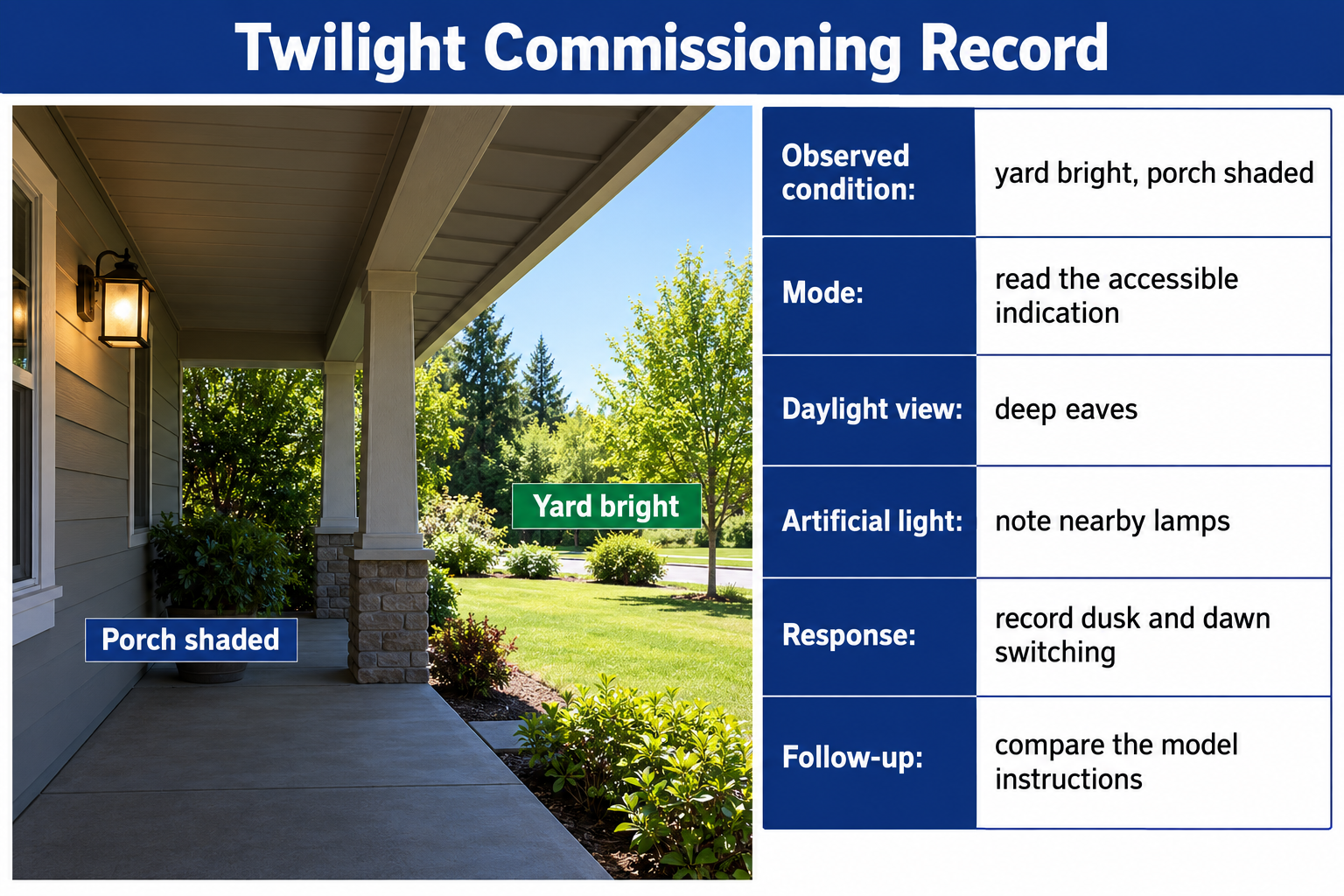
Position the sensing window where it can detect representative daylight without looking into the controlled lamp or a strong reflection. Observe a complete dusk and dawn transition from a safe position. Record exposure, mode and response before marking the photocell unit as defective; follow the mounting instructions and test the unit in the manner described by the manufacturer.
Intermatic’s cycling guidance identifies the controlled light source and excess ambient light as possible nighttime triggers. Placing a sensor in a location under deep eaves can make local conditions quite different from an open yard. A fixed north-facing rule can’t replace the selected product’s instructions or the actual lighting design.
Twilight Commissioning Record
A Twilight Commissioning Record pairs the control’s settings with daylight exposure and observed switching so maintenance staff can separate optical problems from electrical investigation.
| Record | What to enter | How it helps |
|---|---|---|
| Model and location | Part identifier and fixture position | Connects the observation to the right instructions |
| Operating mode | Automatic, timed, motion-enabled or override | Separates a mode choice from a fault |
| ON threshold | Published value or permitted setting, with unit | Defines expected dusk behavior |
| OFF threshold | Published value or permitted setting, with unit | Defines expected dawn behavior |
| Delay | ON/OFF direction and startup condition | Prevents a premature fault judgment |
| Daylight view | Eaves, foliage, dirt or an obstructing cover | Reveals shading at the sensing window |
| Artificial-light exposure | Nearby signs, controlled lamp and reflective surfaces | Identifies possible feedback conditions |
| Observed transition | Date, time, weather and switching sequence | Lets the electrician compare repeat events |
| Measurement and follow-up | Meter, position, reading and person responsible | Keeps observations separate from acceptance testing |
Example: A covered porch light remains on when the yard is still bright. Record the shade at its detector and the selected mode before replacing parts. If illumination is measured, record the instrument and its position. NIST’s photometer calibration research explains the importance of detector response and calibration; routine site readings should not be treated as a product acceptance test without the specified method and suitable equipment.
Can you test a photocell in daylight?
Yes, when the manufacturer’s instructions provide an accessible daylight test. If instructed to cover the photocell, the cover reduces the light reaching the detector and simulates darkness. Use the specified test method and waiting period; a rapid hand shadow may be too brief for the control’s response.
Record light conditions without opening the fixture or approaching exposed wiring. If reaching the sensing window requires unsafe access, observe the normal twilight transition instead and arrange professional testing. A cover test may reveal a response to darkness, but a failed response can be due to the mode, supply, or connected lamp. Remove any temporary test cover as instructed and ensure the sensor has its normal daylight view.
Why is the dusk to dawn sensor not working?
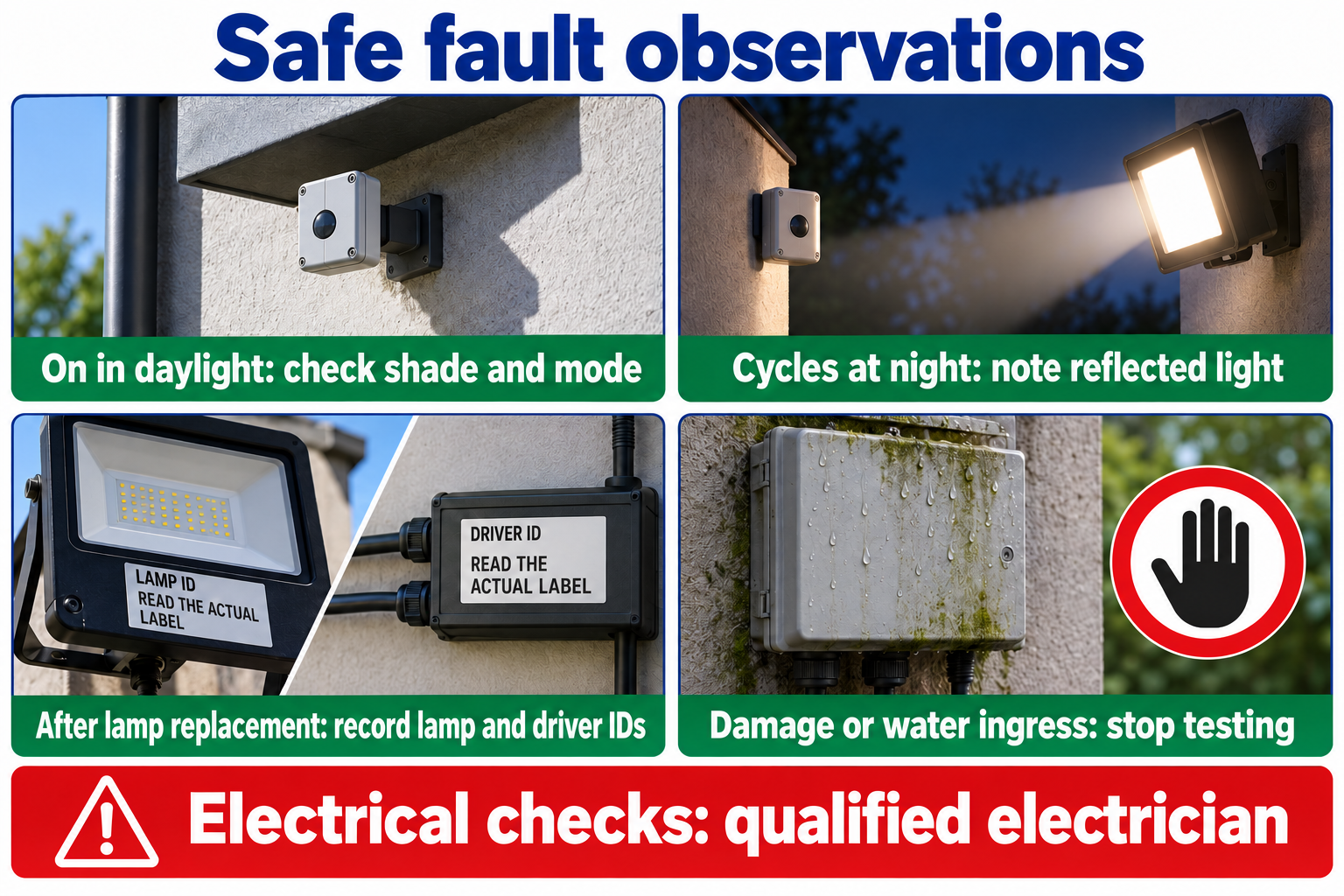
Shading, artificial light, operating mode, power supply and lamp or driver faults are possible causes when a light stays on, stays off or cycles repeatedly. Observe what’s being looked at and when the problem occurs. One cover or flashlight test cannot identify every failed component.
Intermatic distinguishes daytime cycling, which can involve incorrect line/load connections, from nighttime cycling involving light feedback. Such differentiation can be helpful to an electrician in deciding the course of an investigation. It’s, however, not an instruction to change the line/load connection. Hardwired diagnosis needs safe isolation and the installation diagram for the exact control.
“The circuits and equipment to be worked on shall be disconnected from all electric energy sources.”
The lockout/tagout provisions of OSHA’s US workplace procedure also contain requirements for qualified-person verification. A light switch in the OFF position isn’t an electrical isolation procedure. Perform routine observations from outside the enclosures and leave electrical tests to a qualified person in accordance with the applicable local rules.
| Symptom | Safe observation | Next decision |
|---|---|---|
| On in daylight | Look for shade or a blocked sensing window | Record exposure; use the approved cleaning/mounting instructions |
| On continuously | Read the accessible mode/override indication | Resolve the mode first; escalate unexplained operation |
| Off throughout the night | Note nearby artificial light and other affected fixtures | Have supply, lamp/driver and control checked professionally |
| Cycles at night | Record whether the controlled lamp lights the detector | Investigate optical feedback and approved placement |
| Cycles in daylight | Record timing without opening the enclosure | Electrician checks installation and electrical causes |
| Turns on late | Note signs or adjacent lights facing the detector | Compare actual exposure with the documented threshold/mode |
| Delayed after a test | Record test method and elapsed time | Allow the specified directional/startup delay |
| Problem after LED replacement | Record old/new lamp or driver identifiers | Review LED load compatibility before another swap |
| Damage or water ingress | Observe from a safe distance | Stop testing and arrange qualified inspection |
Example: A lamp reflects light off of a wall and sends it to its detector. The lamp then switches off. That sequence calls for checking optical feedback and the approved placement before the photocell is replaced. Taping over the detector removes daylight control rather than repairs the cause.
LED compatibility, replacement parts and costs
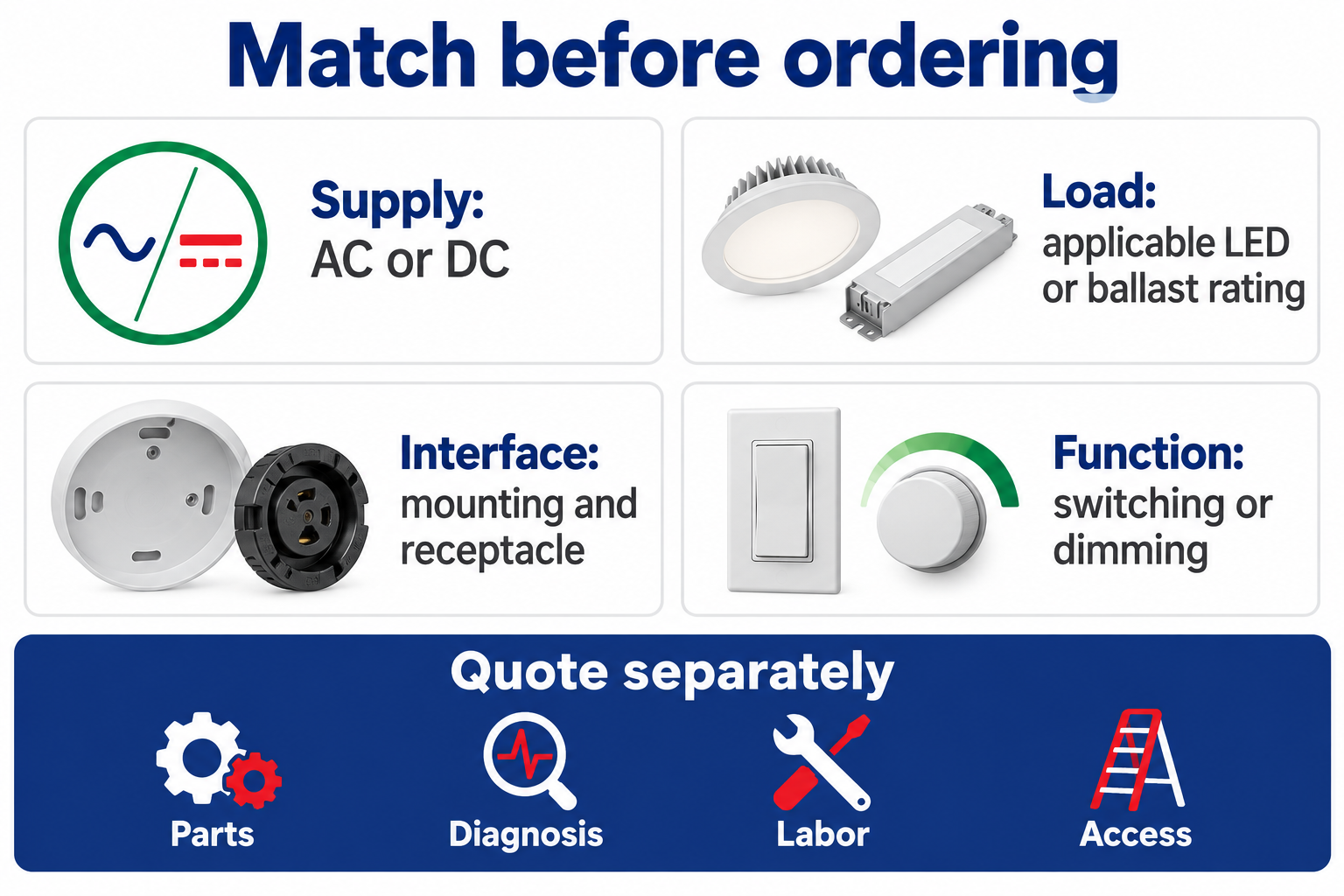
Choose an appropriate replacement based on the supply voltage (AC/DC), LED load rating, required control function, and fitting. Compare the costs of parts, diagnosis, labor, and access. The least expensive sensor may cost more overall if it requires a second visit or can’t operate the existing driver bank.
An incandescent wattage rating isn’t a substitute for the applicable LED or electronic-ballast rating. Intermatic’s compatibility references include those load categories. Starting behavior is important when several LED drivers switch on together; the control/driver combination requires the proper ratings rather than an approximation based only on steady-state watts.
For example, the Intermatic photocell NF10KL is rated for 120 – 277 V AC, with a 6 A Electronic ballast rating. Use the complete product instructions for the intended LED load. A 120 V AC line voltage application and a 24 V DC Accessory are different purchasing cases, even if they both turn on a light after dark.
The ANSI catalog public listing has ANSI C136.10-2023 for Locking-type Photocontrols and Mating Receptacles, and ANSI C136.41-2025 for the specified external locking interface for dimming control. Match the required interface and driver; a familiar-looking plug does not make ordinary switching equivalent to dimming control.
What should a replacement quote include?
Request the exact part, supply and load rating, mounting/receptacle, environmental suitability and required operating mode. Ask who will diagnose the fault, provide access equipment, install the part and commission the lighting. Separate these line items, so quotes for equivalent work may be compared without confusing a sensor-only price with the cost of a completed job.
Sensor-only price example: Intermatic listed NF10KL at US$24.92 on November 2, 2026 . An installed replacement also includes the site’s diagnosis, labor and access costs; tax and delivery may add to the part price. Obtain an itemized quote for the complete work. Prices can change.
A lighting buyer should also identify whether the quote is for an independent control, light bulbs with integral sensors or complete outdoor lighting fixtures. For pole-mounted work, the commercial LED street-light guide addresses fixture-level purchasing decisions.
Provide a description of the type of light and driver being controlled when requesting lighting products. Modern outdoor luminaires can have control features that an older standalone switch lacks; preserve the required function when replacing either part of the assembly.
When should dusk-to-dawn lighting switch off?
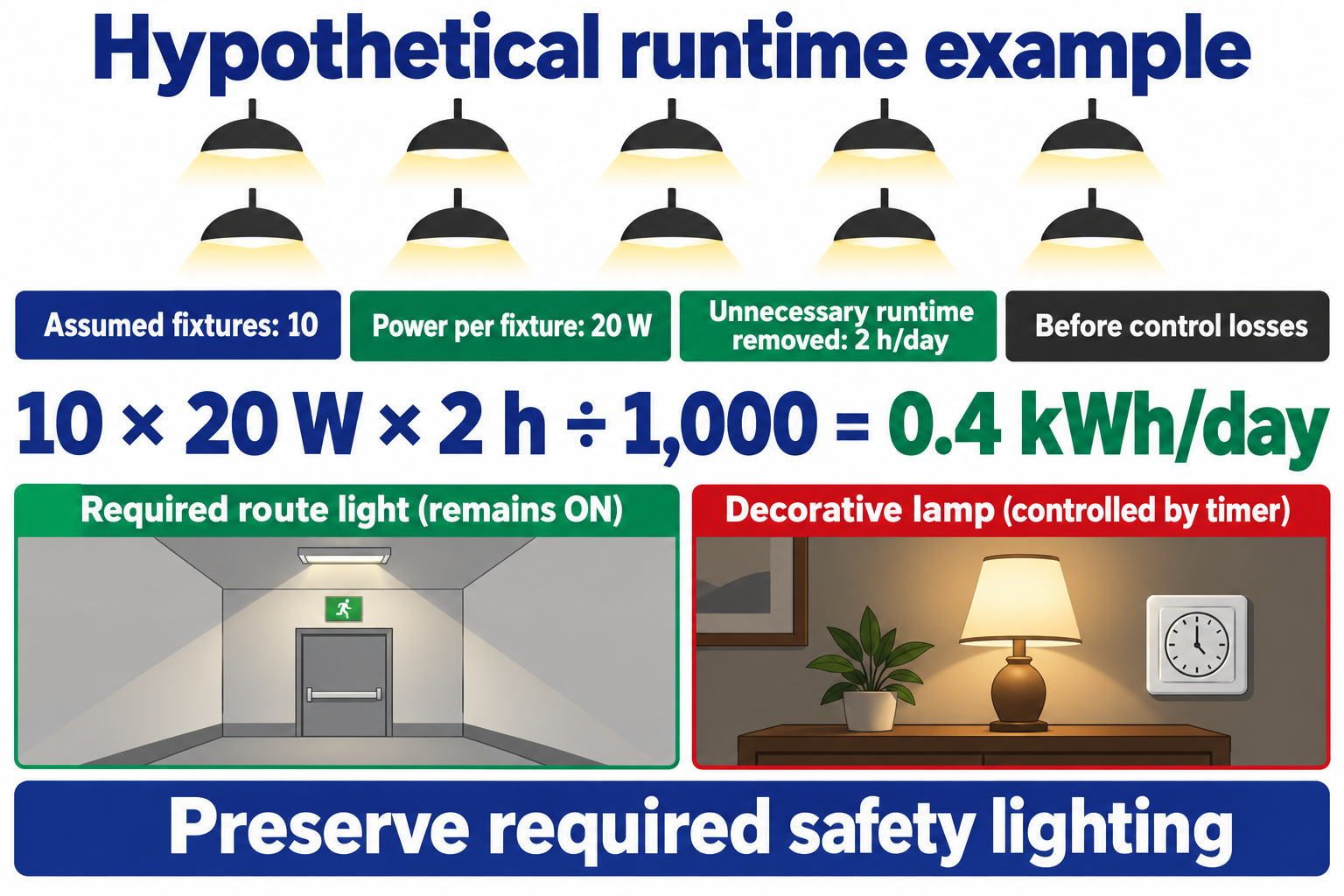
Switch off when daylight returns, or earlier under an allowed curfew; for ten assumed 20 W fixtures, removing two unnecessary operating hours saves 0.4 kWh per day before control losses. A site that needs illumination can have all-night lighting controlled by a schedule. A site that doesn’t need constant lighting can use a motion-detector response. Required egress and other safety lighting must remain available as specified.
Example: runtime, not a guaranteed savings percentage
10 × 20 W × 2 h ÷ 1,000 = 0.4 kWh/day. Multiply by the actual energy tariff for an energy-only cost estimate. Use measured input power and the hours the site is allowed to remove.
DarkSky’s Five Principles for Responsible Outdoor Lighting recommend controls that limit light to when it’s needed. A dusk to dawn light can prevent daytime operation yet still run longer at night than necessary to cover an entrance. The broader light pollution solutions guide covers shielding and curfew design alongside control choice.
A dusk to dawn outdoor light that runs all night has a different operating window from a scheduled entrance light. The controller turns lights on when its conditions are met; a suitable schedule can remove unnecessary hours.
In its federal exterior-lighting purchasing guidance, the US Department of Energy recommends automatic controls to reduce unnecessary operation in unoccupied areas. Set a schedule that preserves the lighting needed for the site to be used as permitted.
For a photocell operated night light, maintain the illumination required for the route and limit spill. Assign each control to its specific lighting purpose rather than putting discretionary decorative lights and required route lighting on the same shutdown schedule.
Example: an owner wants welcoming lights around a closed commercial entrance, while finance wants shorter runtime. Retain the required route lighting and assign a suitable timer or dimming scheme to the discretionary fixtures. The installer must provide compatible controls and drivers for that behavior.
Key takeaway
Match the control function and electrical ratings, observe the detector’s daylight view, then investigate unresolved faults with a qualified electrician.
For a complete landscape lighting design, adjust fixture positions and the detector’s daylight view. To request a fixture and control from Guangqi Lighting, provide the fixture model, supply voltage and the desired operating hours.
Discuss fixture and sensor compatibility
Frequently asked questions about dusk to dawn sensors
These questions about dusk to dawn controls cover safe fault checks and response time. A photocell’s name identifies light sensing, while the complete product determines voltage, load and operating modes. When requesting instructions or a replacement for outdoor areas, keep the control and fixture identifiers together.
Is photocell the same as Dusk to Dawn?
Not exactly. A photocell is the light-sensitive component or control, while dusk-to-dawn describes the intended operating behavior.
Many outdoor lights use a photocell to switch on at dusk and off at dawn when light returns. An astronomical timer can create a sunset-to-sunrise schedule without measuring local brightness. Combined controls can also add a time cutoff or movement condition instead of keeping lights on all night. A local detector reacts to the light reaching its own sensing window.
Can you use a regular light bulb in a dusk to dawn light?
Yes, when the fixture and its separate photocell are rated for that bulb type and load.
A dusk-to-dawn bulb instead contains its own light sensor, which must remain exposed as its instructions require. A suitable incandescent lamp and an LED light bulb can present different loads to a control. Match the complete fixture, lamp and controller instructions rather than relying on the base shape alone.
How do you wire up a dusk to dawn sensor?
Have a qualified electrician install a hardwired sensor using the exact control and fixture instructions.
Lead colors and terminal arrangements aren’t universal wiring instructions. A low-voltage DC accessory isn’t interchangeable with a mains photocontrol. The installer needs the supply, load, enclosure and connection requirements, an appropriate isolation procedure and verification of the completed installation before returning it to service. Don’t bypass the existing control to experiment.
Why does my dusk to dawn light stay on during the day?
Shade, dirt, an active override or a failed control are possible explanations for daytime operation.
Record the detector’s daylight exposure and any accessible mode indication safely; continuous operation alone doesn’t identify which component needs replacement.
How long should a photocell take to react?
Intermatic’s NF10KL has an instant ON response and a 2–5 second OFF delay; use the selected control’s specified response time for the relevant switching direction.
Some models respond differently when turning on and off. A “time” dial on a combined motion light may set motion hold time rather than light sensitivity. A documented startup routine after a power interruption can also affect an observation. Record the mode and elapsed time before deciding the unit has failed.
If the manual gives no test or response time, obtain that procedure from the manufacturer rather than applying a universal minute-long test. A brief startup event and repeated nighttime cycling need different investigations.
Can I bypass the photocell to test the light?
Don’t bypass a hardwired photocell as a casual troubleshooting step.
Changing the control circuit can expose hazardous voltage. A qualified electrician can follow the manufacturer’s diagnostic procedure and investigate the supply, load and control safely.
Is a cheap replacement sensor enough?
Yes, if it is compatible with the whole installation; settle compatibility before comparing price.
Match supply voltage, AC/DC operation, the applicable LED or ballast rating, fitting, weather exposure and switching behavior. Include qualified labor and access equipment in an installed quote. A physically similar photocell can still be unsuitable, and a changed lamp or driver may require a fresh compatibility check. Keep the part identifier in the maintenance log for the next replacement.
References & Sources
- Ambient Light Sensors Clemson University Vehicular Electronics Laboratory.
- Lighting Controls for Multifamily Buildings Pacific Northwest National Laboratory, Building America Solution Center.
- 2025 Residential Dwelling Units Lighting FAQs California Energy Commission.
- 2025 Building Energy Efficiency Standards California Energy Commission.
- Exercise: Input Hysteresis Carnegie Mellon University.
- Spectral responsivity based calibration of photometer and colorimeter standards National Institute of Standards and Technology, George P. Eppeldauer, 2013.
- Selection and use of work practices, 29 CFR 1910.333 US Occupational Safety and Health Administration.
- ANSI C136.10-2023 American National Standards Institute catalog.
- ANSI C136.41-2025 American National Standards Institute catalog.
- Five Principles for Responsible Outdoor Lighting DarkSky International and the Illuminating Engineering Society.
- Purchasing Energy-Efficient Exterior Lighting US Department of Energy, Federal Energy Management Program.
About this sensor guide
DD prepared this guide for Guangqi Lighting to explain photocell operation, control selection and fault observations for outdoor fixtures. Manufacturer examples identify the relevant products; the commissioning record is a practical observation aid. Installation, diagnosis and project compliance belong with the qualified professionals responsible for the site.