Get in Touch with GUANGQI


Low Voltage Landscape Lighting Transformer: Procurement Guide for B2B Buyers

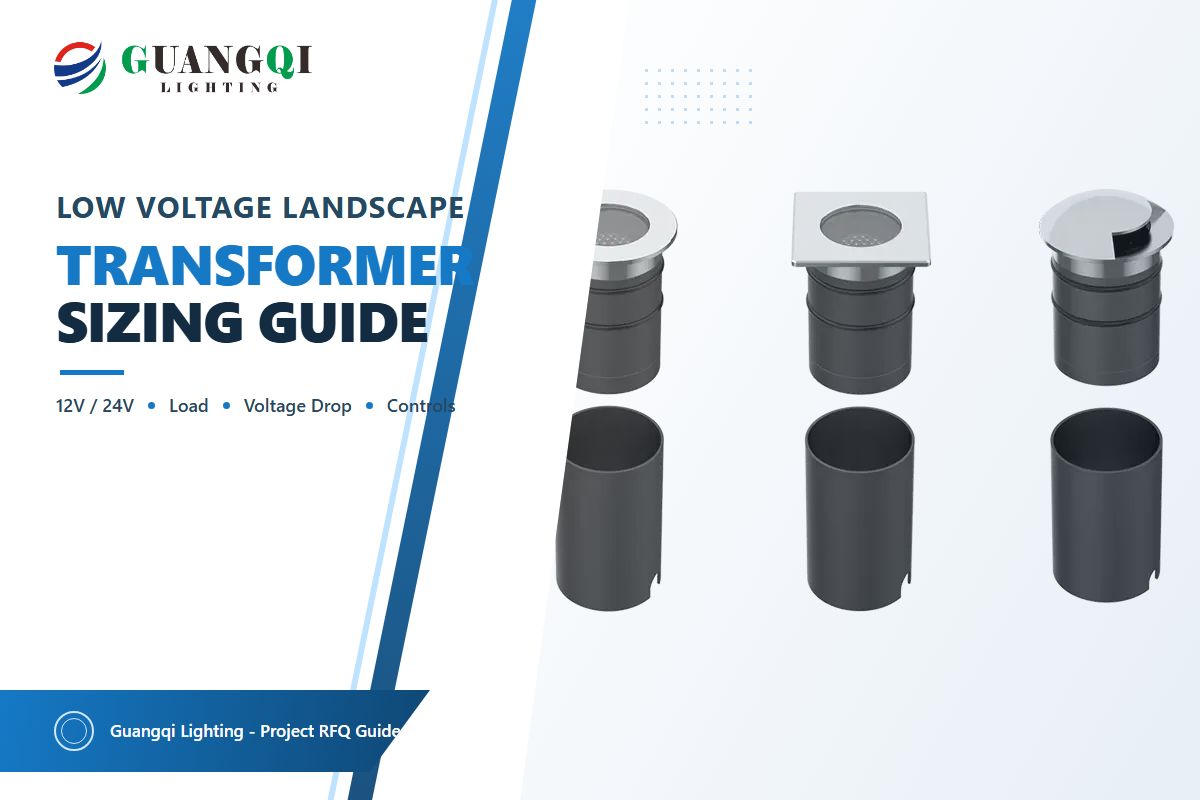
Procurement guide for commercial landscape lighting projects
A low voltage landscape lighting transformer is the outdoor power unit that steps line voltage down for landscape fixtures, often 12V or 24V. For a hotel path, villa garden, resort courtyard, municipal plaza, or commercial facade, the right choice begins with the fixture schedule, cable layout, control intent, and approval scope, not a wattage label alone. This guide turns that information into a practical supplier RFQ.
Quick Procurement Snapshot
| Start with | Fixture voltage, watts or VA, quantity, zones, and cable runs |
| Planning check | Connected load, reserve, output circuits, wire gauge, and voltage drop |
| Do not confuse | AC landscape transformer output and constant-voltage DC LED driver output |
| Ask the supplier to confirm | Listing scope, output ratings, enclosure, controls, wiring limits, and service access |
When a Low Voltage Transformer Is the Right Power Choice
Use a low voltage landscape lighting transformer when the outdoor lighting plan centers on low-voltage luminaires, often 12V or 24V fixtures, and the project needs safer distribution, flexible fixture placement and serviceable outdoor wiring circuits. It steps line voltage down for the landscape lighting circuit, while the fixture schedule determines the actual load the transformer must support; the public UL 1838 catalog page also frames a low-voltage landscape lighting system as the power unit, cable or cord, and luminaires together.
For B2B purchasing of a landscape transformer, the first question isn’t about the best model of transformer.
Instead, focus on “What fixtures, how long will they run on each circuit, and what control system does this power supply need to manage?” That distinction matters because the head term turns up thousands of transformer product listings. Procurement teams still must translate the lighting design into supported load, voltage drop, outdoor enclosure type, listing expectations and control requirements.
Landscape lighting designers and electricians rely on GQLAMP’s extensive product catalog to aid them with this specification work.
GQLAMP’s range of commercial and residential landscape and garden lighting supplies includes a broad spectrum of outdoor fixtures, and our landscape spot light page showcases various voltage and wattage options, from compact accent lights to higher-output models. Although this first-party fixture data is useful during transformer planning, the ultimate transformer model, final electrical layout and installation method must be vetted by the transformer supplier and the project’s electrical contractor.
Buyer rule: request a quote only after fixture voltage, connected load, cable length, output circuits and controls are mapped.
This distinction reduces risk because a 12V or 24V fixture schedule from Guangqi Lighting, Guangqi Lighting catalog data, and Guangqi Lighting certification references are evidence inputs, not transformer model proof. Send those details to the transformer supplier as a specific RFQ, then ask for output rating, enclosure notes and installation limits in writing.
The Transformer Reserve Factor: Fixture Schedule, Total Load and the 80% Ceiling
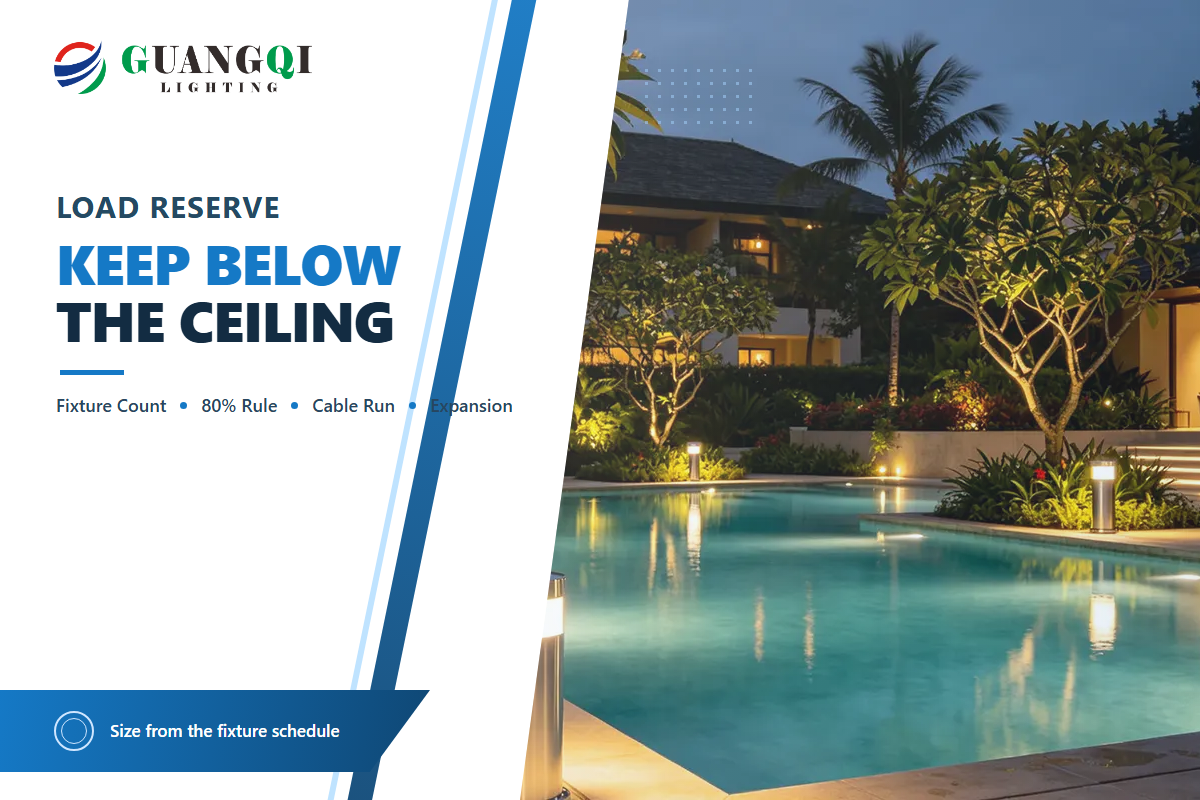
The most straightforward way to size the landscape lighting transformer for your project is to start by creating the fixture schedule.
Document each luminaire, list its operating voltage, and specify its wattage or volt-amperes along with the total quantity required and its intended circuit or zone. Now, sum the connected load. A plan with ten 10W fixtures will have a 100W connected load, exclusive of any transformer reserve.
GQLAMP uses this same example in its landscape lighting guidelines: ten 10W LED spot lights in total equate to a 100W load on the landscape transformer; a 150W unit would supply the necessary reserve.
This reserve is often referred to as the transformer reserve factor. Simply put, the transformer shouldn’t be operated at its maximum output designation during regular design plans.
Many suppliers of landscape and garden lighting equipment follow a rule of thumb of 80% capacity of the transformer’s maximum rated output, which creates an 80% working-load ceiling and can help prevent under-ordering a transformer for your project. This means a 150W transformer would be considered equivalent to about 120W of usable power, a 300W transformer to 240W, and so forth. While not a replacement for following the manufacturer’s product manual, listing scope, or local electrical codes, this approach is effective in avoiding the costly mistake of ordering too small of a transformer; use the UL 1838 system scope as a reminder that the power unit and output circuits must still be checked as part of a complete landscape lighting system.
| Transformer nameplate | 80% planning load | Typical procurement use |
|---|---|---|
| 150W | About 120W | Small path, garden or facade accent zone |
| 300W | About 240W | Medium residential, hotel path or courtyard zone |
| 600W | About 480W | Large project area with multiple runs or outputs |
| 900W | About 720W | Large multi-zone project, subject to output-circuit verification |
Treat these charts and guidelines only as an estimate, not a final design. Installing an oversized transformer is still not a fail-safe measure. Improper sizing still happens if the fixture load isn’t evenly distributed among the outputs, if one run is excessively long, or if the cable size and gauge are too small for the current it’s intended to carry.
Supplier loading specifications, plus an electrical review by the contractor, are the surest guides to success.
6-Step Transformer Reserve Factor Worksheet
When a client asks for a low voltage transformer for landscape work, translate it to fixture voltage, load, run distance, and controller data prior to discussing model numbers. Purchasing departments can start with four columns: fixture type, quantity, watts or volt-amperes per fixture, and zone. Add a fifth column for reserved capacity and a sixth for assigning a transformer output.
This provides engineers sufficient specification without overwhelming buyers, designers, and suppliers in a meeting, and avoids the common pitfall of aggregating non-addable loads (accent lighting, high-output tree lights, future add-ons) under an abstract total.
A transformer for landscape lighting must be integrated with the fixture plan rather than based on unassigned wattage groupings.
Your spreadsheet should note whether fixture data, estimated quantities or control details still await vendor clarification, so real transformer capacity is separated from assumed loads. That distinction becomes a risk control when a scheme involves multiple fixture families or a phase-two expansion, because GQLAMP fixture data and supplier transformer data need to be checked against the same 12V or 24V schedule.
Hidden reserve mistakes can become expensive when a buyer treats 80%, 150W and 300W as final engineering approval rather than planning numbers. Use the Guangqi Lighting fixture schedule, Guangqi Lighting wattage data and Guangqi Lighting catalog voltage fields to build the worksheet, then ask the transformer vendor for the tested loading limit, output assignment and thermal notes.
Keep factory evidence, certification language and ISO 9001 quality-system references separate from transformer approval. GQLAMP fixture documents can support the load worksheet, but transformer certification and output testing must come from the selected transformer vendor.
12V, 15V and 24V Runs: Voltage Drop Before the Last Fixture
Cable voltage drop is a primary cause of transformer failures. Even when wattage looks adequate, the terminal fixture on a prolonged run can receive deficient voltage.
Kichler has outlined public transformer specifications and a procedure for checking for voltage loss on each circuit. Fine Homebuilding also offers that long low-voltage spans might give the final lights a faint or yellowish illumination, while Iowa State University Extension identifies overload, end-of-run voltage drop and wiring problems as practical troubleshooting patterns.
Before buying a transformer, insist upon a cable-run schematic for the procurement team. Map details should include transformer location, run length, fixture spacing and load data, wire gauge, and whether each circuit pattern is straight-run, looped, branched, split-run, multi-output, or hubbed. Voltage decline is a practical risk in 12V schemes because the system has less voltage buffer. A landscape lighting wire calculator or low voltage lighting wire size calculator can support the discussion, but an outdoor lighting transformer still has to be confirmed against fixture load and field layout. Although many landscape transformer orders step a 120V input down to a low-voltage output circuit, performance at the most distant fixture is a function of the entire circuit.
On longer commercial circuits, 15V transformer voltage and 24V fixtures might be viable but require synchronization with their own input voltage and the manufacturer’s instructions.
Because GQLAMP landscaping fixtures often incorporate 12V and 24V types, the voltage transformer request for quotation (RFQ) needs to reference particular fixture voltage inputs, rather than general requests for “low-voltage lighting” transformers.
When the project includes distinct short-run accent zones plus longer stretches for border or tree lighting, a single transformer model may be inadequate and won’t resolve cable voltage drop. Confirm whether separate transformer outputs, different wire gauge material, or a 24V fixture layout is the right call before the RFQ becomes a purchase order.
Voltage-drop mismatch risk rises because a Guangqi Lighting fixture list may combine short accent runs, longer tree-lighting runs and different wattage groups in one project. Pair the Guangqi Lighting 12V/24V fixture data with the supplier’s voltage-drop calculation, and have Guangqi Lighting project notes, cable distance and wire gauge checked before approving a transformer for shipment.
Factory-side fixture certification, ISO 9001 references and product data sheets help define the lighting load, yet they don’t certify the voltage performance of the cable run. Treat voltage-drop review as a separate vendor and installer check.
AC Landscape Transformer vs DC LED Driver
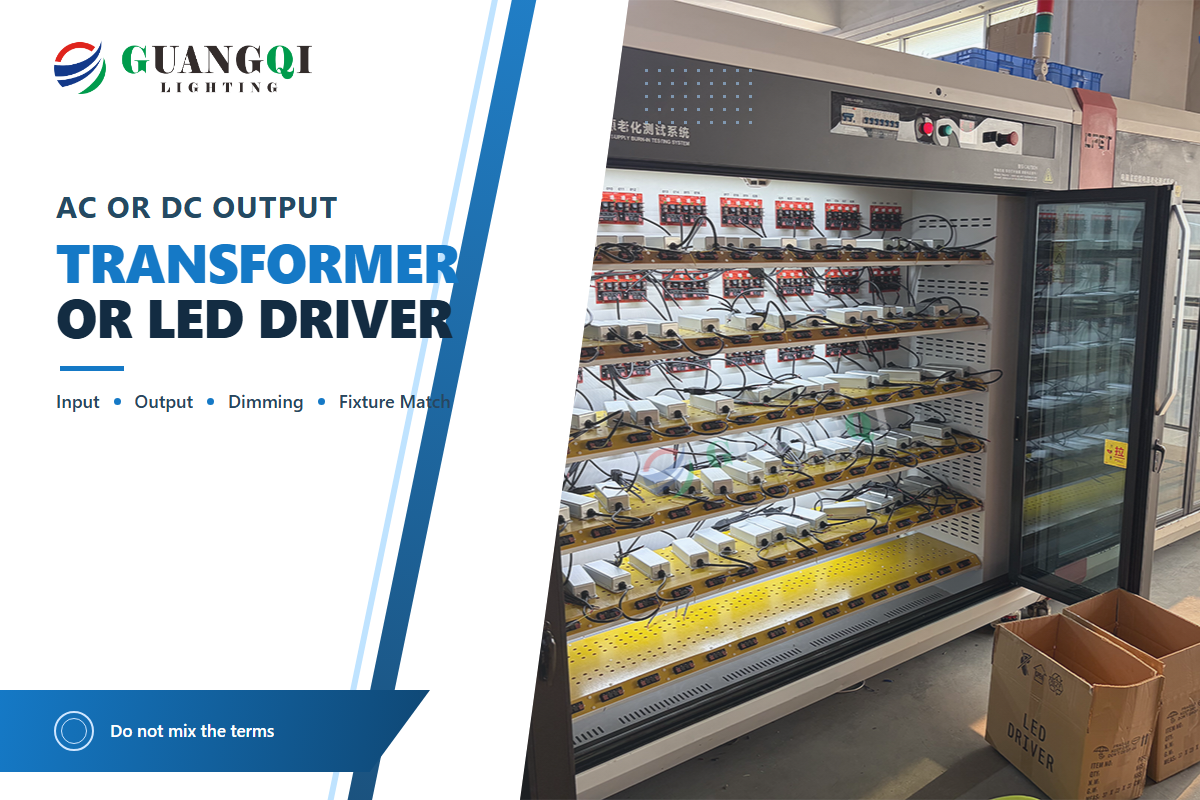
While a lighting transformer and an LED driver are related electrical power products, they’re distinct on the procurement side. A conventional low-voltage landscape lighting transformer decreases the AC line voltage; whereas, a DC LED driver converts AC to regulated direct current (DC) voltage used to supply an LED fixture, lighting element, or control system.
This boundary is the defining factor for GQLAMP projects because the LED driver power supply range is based on constant-voltage DC outputs such as 12V, 24V, 36V and 48V. It provides 100-277V AC input options, power bands from 20W to 600W, and control options such as DALI, DALI-2, 0-10V, TRIAC, PWM etc. That’s a different specification conversation from a magnetic or electronic landscape transformer feeding outdoor fixture runs.
In the RFQ, state the fixture input first. If the fixture needs 12V or 24V AC from a landscape transformer of a listed model, ask for the landscape transformer. If the fixture or control package needs regulated DC ask for the LED driver and control interface. UL 1838 public catalog language shows how the system view matters: landscape lighting systems include the power unit, low-voltage cable or cord and luminaires, and LED components bring UL 8750 context into the conversation. The buyer must avoid collapsing all power supplies into one item code.
On export projects, vocabulary differences create real procurement risk because the buyer, lighting supplier, electrical contractor and local inspector may not use the same terms. An RFQ that just states “12V power supply” creates ambiguity between an outdoor landscape transformer, an indoor LED driver, a dimming driver, a class 2 supply or a custom control cabinet. Better contract language names the fixture input, power-unit location, required control signal, enclosure environment and certification expectations.
Capacity Bands: 150W, 300W, 600W and 900W Project Examples
Capacity bands are meaningful when related back to a fixture schedule. In practice, a 150W transformer could support a small commercial garden path with 12 to 16 low-wattage fixtures. Meanwhile, a 300W transformer might be suitable for a hotel courtyard with several zone accents. Resort landscape or perimeter designs can push toward a 600W or 900W aggregate package, but those higher bands require more careful segmentation.
High-wattage examples must not be presented as one undifferentiated output run. The UL 1838 public catalog information makes output-circuit limits part of the system context. Treat a 600W or 900W example as aggregate project capacity, not permission to place all load on one cable run or one output. At 12V, current rises quickly with wattage, so output count and circuit segmentation matter.
Aggregate capacity becomes a procurement trap when the RFQ hides output-circuit detail. A GQLAMP fixture schedule can show connected load, but the transformer supplier still needs to confirm whether the package requires several outputs, multiple runs, or more than one transformer location.
Use the 150W, 300W, 600W, and 900W bands as planning language only. Ask for the selected transformer datasheet, rated output per circuit, wiring diagram, enclosure notes, and installation limits that match the actual schedule.
| Project type | Typical fixture mix | Transformer scale | Procurement check |
|---|---|---|---|
| Small garden path | 8 to 14 low-watt path lights | 150W class | Confirm connected load, reserve and burial route |
| Villa facade accent | Spot lights plus step lights | 150W to 300W class | Separate wall runs from garden runs when distance differs |
| Hotel courtyard | Path lights, wall washers and tree accents | 300W class | Split zones for scene control and service access |
| Resort walkway | Repeated fixtures across long runs | 300W to 600W class | Check voltage drop before selecting one central location |
| Commercial entrance | High-output accents and signage lighting | 300W to 600W class | Confirm inrush, controls and enclosure placement |
| Municipal plaza | Multiple public-facing zones | 600W aggregate class | Confirm listing, maintenance access and local review path |
| Long boundary lighting | Low-watt fixtures spread over distance | 600W aggregate class | Evaluate 24V fixture strategy or distributed transformers |
| Tree and palm lighting | Mixed 5W to 24W accents | 150W to 600W class | Group by tree cluster, cable path and aiming service access |
| Future expansion phase | Reserved fixtures not yet installed | Project-specific class | Reserve capacity only where outputs and enclosure allow it |
| Pool or fountain adjacency | Nearby landscape fixtures only | Separate review required | Do not assume ordinary landscape transformer scope covers water locations |
Use this table as a sourcing segmentation tool, not a guarantee that every project of the same sort will use the same transformer. By forcing the buyer to list lighting scale, fixture family, distance problem and approval risk in one spot, it gives the supplier a reasoned basis to choose one transformer, multiple smaller transformers, another output voltage or a different cable route.
Use this practical sequence in the RFQ:
- Send the fixture schedule with model, voltage, watts and quantity.
- Request that the supplier show the connected load and reserve load in each zone.
- Ask if the transformer selected has sufficient number of output circuits to handle the proposed run.
- Ask the electrical contractor to confirm wire gauge, run length, voltage drop and local code requirements.
- Keep at least one spare capacity path for future fixtures only if the enclosure, output circuit and thermal conditions support it.
Controls, Zones and Enclosures: Timer, Photocell, Wi-Fi and Weatherproofing
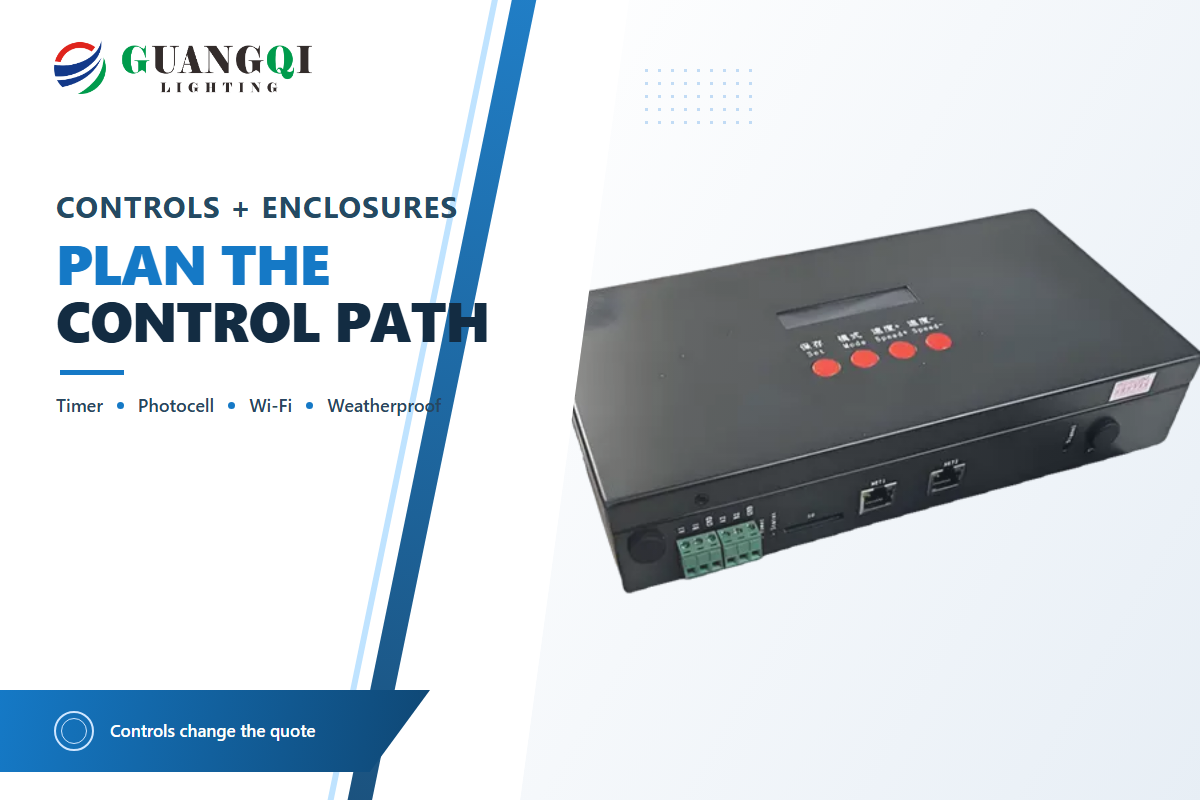
Controls aren’t decorative add-ons. Control choices change how the transformer is selected and how the buyer writes the RFQ.
Basic installations may need a timer and photocell. Hospitality or commercial projects may need separate zones, app scheduling, local schedule memory, override rules, energy-saving behavior or integration with a broader site control plan. Search labels such as smart low voltage landscape lighting transformer, low voltage landscape lighting transformer with timer and low voltage landscape lighting transformer with photocell should therefore be translated into zone count, override behavior, daylight shutoff assumptions and enclosure location.
Controls can also affect approval, wiring, and maintenance responsibilities. The City of Chicago’s electrical permit guidance is a useful example of why electrical-work documentation must be considered before installation. State the intended operation, override behavior, mounting location, and service access in the RFQ, then have the responsible electrical professional confirm local requirements for the specific project.
It’s still a useful procurement lesson: ask the electrical contractor which exterior lighting control requirements apply before buying a transformer with the wrong control package.
For outdoor enclosures, specify the location and service condition.
Is the transformer wall-mounted, post-mounted, hidden in a service area or exposed to irrigation spray?
Does the project require stainless steel, lockable enclosure, NEMA-style outdoor protection, photocell socket, timer bay or smart control antenna clearance?
Fixture IP ratings don’t automatically solve transformer enclosure selection, and ordinary landscape lighting is different from pool, spa, fountain or submersed lighting scope. With a US buyer or public agency, the risk is late inspection delay; for GQLAMP fixture procurement, the answer is to send the supplier a specific RFQ with 12V or 24V fixture voltage, control mode, enclosure exposure and the responsible jurisdiction listed.
RFQ Checklist for B2B Landscape Lighting Projects
Well-written RFQs make the supplier answer the engineering questions before the purchase order is issued. For permitting and documentation context, the City of Chicago electrical permit guidance is a useful example of why photos, plans, load data and electrical drawings can matter before installation.
Use this checklist when the project includes GQLAMP landscape fixtures or any comparable low-voltage outdoor lighting schedule.
| RFQ field | What to provide | Why it matters |
|---|---|---|
| Fixture schedule | Model, input voltage, watts, quantity and zone | Defines connected load and transformer reserve |
| Voltage and output type | 12V AC, 15V tap, 24V AC, 12V DC, 24V DC or other | Prevents transformer and LED driver confusion |
| Cable layout | Run length, wire gauge, branch method and farthest fixture | Controls voltage drop and fixture brightness consistency |
| Output circuits | Number of outputs, current per output and load by run | Critical for 600W/900W aggregate projects |
| Controls | Timer, photocell, Wi-Fi, zone count and override behavior | Links procurement to operating schedule and code context |
| Listing and installation | Applicable listing, NEC/Article 411 context and local code review | Reduces approval, inspection and liability risk |
| Special locations | Pool, spa, fountain, pond or submersed fixture status | Prevents using ordinary landscape-lighting assumptions in excluded locations |
| Spare capacity plan | Expected future fixtures, added load and reserved output path | Keeps expansion assumptions visible instead of hidden in a wattage total |
| Service location | Wall, post, cabinet or equipment area with access clearance | Helps maintenance teams reset controls, inspect wiring and replace components |
| Local-code checkpoint | Responsible reviewer, jurisdiction and exterior-control assumptions | Prevents late approval issues after the product has already shipped |
RFQ Wording Map for Buyer Search Phrases
Search phrases often mix product labels, installation language and warranty claims. Use the map below to turn common wording into a clearer transformer RFQ field.
| Buyer phrase | RFQ translation |
|---|---|
| voltage transformer for landscape lighting; transformer for low voltage landscape; outdoor landscape lighting transformer | State the low voltage lighting system scope, fixture voltage and whether the transformer for outdoor use will be wall-mounted, cabinet-mounted or distributed. |
| multi-tap low voltage; multi-tap low voltage transformers; multi-tap | Ask which voltage taps are available and whether each tap is suitable for the proposed run length, gauge and fixture load. |
| led transformer; led light; compatible with led | Confirm whether the fixtures need AC transformer output, an LED power supply or a regulated DC driver before approving the item code. |
| low-voltage transformers; best low voltage transformers | Compare by tested load, output circuits, enclosure, listing, wiring diagram and service access rather than by generic ranking language. |
| toroidal; toroidal transformers; toroidal cores | If magnetic construction is specified, request transformer type, primary coil and secondary coil data, noise expectations and thermal limits. |
| magnetic transformers; magnetic landscape lighting transformers; electronic transformers | Ask whether the supplier recommends magnetic or electronic transformers for the exact fixture mix and control package. |
| etl listed; lifetime warranty | Request the actual listing document, warranty scope, exclusions and replacement procedure instead of accepting a short badge claim. |
| 120v ac to 12v ac; transformer 120v | Write input voltage, output voltage, frequency and outdoor enclosure location in the RFQ. |
| 300w landscape lighting; transformer 300 watt; 300 watt | Treat 300W as aggregate capacity and ask for connected load, reserve margin and output assignment by zone. |
| 600w landscape | Ask whether the 600W aggregate plan needs several outputs, several runs or more than one transformer location. |
| wi-fi low voltage; smart landscape lighting; mechanical timer; transformer with photocell sensor | Specify timer, photocell, Wi-Fi schedule, override behavior, daylight assumptions and service access for controls. |
| weatherproof transformer; transformer weatherproof; sensor and weather shield; stainless steel cabinet | Define enclosure exposure, irrigation risk, corrosion environment and lockable cabinet requirements. |
| built-in mounting brackets; compact aluminum casing; easy installation | Translate convenience claims into mounting surface, clearance, conduit entry, maintenance access and installation responsibility. |
| pool lighting | Separate ordinary landscape fixture areas from pool, spa, fountain or submersed lighting applications and require a specialist review. |
| converter; inline power converter | Do not use converter as the final product name; identify whether the device is a transformer, LED driver, dimming interface or control accessory. |
| slim line led; lighting low voltage; transformer landscape lighting; transformer landscape lighting transform | Clean up marketplace wording into fixture model, input type, voltage, wattage and transformer output requirements. |
| higher voltage; high performance and energy savings | Replace broad claims with measurable voltage strategy, load data, control schedule, efficiency notes and supplier test evidence. |
For first-party fixture context, link the RFQ to GQLAMP’s landscape spot light specifications and the broader landscape garden lighting catalog.
Then ask the transformer supplier to confirm the power unit around that schedule.
Retail search terms can still be useful when they are converted into procurement fields. If a buyer starts with a 600W transformer, replacement transformer, or installation query, turn the label into load by zone, output-circuit current, mounting location, enclosure rating, control package, and service-access requirements before requesting a final quote.
Commercial buyers should expect more than a quotation. The handover package should include the selected transformer datasheet, input and output ratings, wiring diagram, load calculation, control description, enclosure notes, warranty terms, and installation restrictions. Call out irrigation, coastal exposure, public access, buried cable, long tree-lighting runs, and pool or fountain areas before pricing so exclusions are visible before shipment.
Mistakes That Make Transformer Orders Fail
Ordering by total watts only is the common mistake.
Total watts matter, but they don’t answer whether the last fixture sees enough voltage, whether the output circuit current is within the product’s listing, whether the enclosure is appropriate, or whether the control package matches local requirements.
Choosing a larger transformer as the first repair is another common error. More wattage can’t address a wet splice, corroded connector, damaged cable, shorted fixture, inefficient hub layout or one long run with a substantial voltage drop. Iowa State Extension and field discussions both identify these practical failure modes. In procurement language, specify diagnosis and circuit mapping before approving a larger wattage transformer.
Power terminology creates a third risk. DALI or 0-10V controls, DC LED drivers, and low voltage AC landscape transformers with taps all require different specification language. Even when two products look similar in writing, an LED driver and a landscape transformer don’t always produce the same output or meet the same installation assumptions.
Delaying electrical-code and equipment specification questions until installation creates the final error. Exterior low-voltage lighting can look like the right-looking product on paper and still require electrical-work documentation when the responsible party is involved early. Although a buyer isn’t their own code inspector, the RFQ should force early engagement from the party who owns approval.
FAQ
What size transformer do I need for low-voltage landscape lighting?
Start by adding the wattage or volt-ampere load of every fixture in the zone, then apply a reserve factor instead of loading the transformer to its full nameplate capacity. An 80% working-load screen is a practical starting point, so 100W of connected LED load commonly points toward a 150W transformer. Final sizing still depends on output circuits, cable length, wire gauge, voltage drop and the product manual.
Can I use one 600W transformer for a large landscape lighting project?
Sometimes, but only if the transformer, output circuits and wiring layout are suitable for the actual runs. A 600W nameplate should be treated as aggregate project capacity, not as one unlimited output. Large hotels, villas, resorts or public landscapes should ask the supplier to split load by run and output, confirm current per output, verify voltage at the farthest fixture and document which loads belong to each circuit before purchase approval.
Is a low voltage transformer the same as an LED driver?
No. A landscape transformer usually steps line voltage down for low-voltage outdoor lighting circuits, while a constant-voltage LED driver supplies regulated DC output for fixtures or control systems that require DC power. Some LED systems bring driver and control requirements into the same project, so the RFQ should state the fixture input voltage and whether the power source must be AC transformer output or DC driver output. This wording also helps export buyers avoid confusing a transformer, dimming driver and control cabinet in the same purchase order.
Do smart controls change transformer selection?
Yes. They change zoning, scheduling, override conditions, box locations and service access points.
Should I choose 12V or 24V for landscape lighting?
Select the voltage that corresponds with the fixture voltage and the site routes. 12V is common, but 24V is useful on longer routes with corresponding fixtures and power supplies. Avoid mixed voltages without consulting the supplier, and avoid using a 24V system as a substitute for better cable routing or correct wire sizing.
References & Sources
- UL Standards & Engagement, UL 1838 Low Voltage Landscape Lighting Systems
- City of Chicago, Electrical Permit Application Instructions
- Iowa State University Extension, Landscape Lighting Troubleshooting
- Kichler, Choosing the Right Transformer for Your Landscape Lighting Job
- Fine Homebuilding, Low-Voltage Landscape Lighting
Request a Transformer Sizing Review
Send the fixture schedule, site plan, voltage, load by zone, cable lengths, control requirements, and site conditions. GQLAMP can help turn the information into a clearer fixture and power-supply discussion before supplier selection.
About This Guide
This procurement guide is structured around the questions that change a transformer quote: fixture input, connected load, voltage drop, output circuits, controls, enclosure, documentation, and handover responsibility. It is a planning resource, not an electrical design or local-code substitute; final equipment selection and installation require confirmation from the transformer supplier and qualified electrical professional.
Trending now

![Industrial LED Bulbs: Bases, Voltage & Heat [Checklist]](https://gqlamp.com/wp-content/uploads/2026/10/industrial-led-bulbs-blog-featured-150x150.png)