Get in Touch with GUANGQI



Updated November 2026
An E12 light bulb is any lamp with a 12 mm Edison screw base, the small thread North American catalogs call the candelabra base. The code tells you how the bulb fits the socket. It says nothing about shape, brightness and color, so they still need to be checked on the box.
Most US households encounter E12 in chandeliers, wall sconces, night lights and ceiling fan kits. The medium E26 base covers around 90% of bulb sales in the US, so many people only notice the smaller E12 thread when a decorative fixture needs a replacement.
Short answer: An E12 light bulb uses a 12 mm candelabra screw base. Replace it with another E12 bulb, choose by lumens rather than the “watt equivalent” claim, and check that the bulb is rated for your dimmer.
Key points
- Sylvania lists its 40 W clear B10 candelabra lamp at 400 lumens on 120 V, below the 450 lumens ENERGY STAR gives for a 40 W household replacement.
- E12 and E14 look similar. E14 is the 14 mm European candelabra base and won’t fit in an E12 socket.
- Lutron says the watt minimums on its controls apply to incandescent and halogen bulbs; for LEDs, check the dimmer manufacturer’s LED rating.
- The federal general service lamp rule covers lamps from 310 to 3,300 lumens, minus certain shapes and specialty lamps, and candelabra incandescents also have a separate 60 W cap.
Quick Specs: E12 Candelabra Base
| Base designation | E12, Candelabra Edison Screw (IEC 60061-1 sheet 7004-28) |
| Nominal diameter | 12 mm (0.472 in) |
| Thread pitch | 2.6 mm |
| Line voltage in the US | 120 V |
| Federal incandescent cap | 60 rated watts per candelabra base lamp |
| Common shapes | B10, B11, CA10, G16.5, T6, C7 |
E12 Light Bulb Basics: What the Code Means on a Candelabra Base
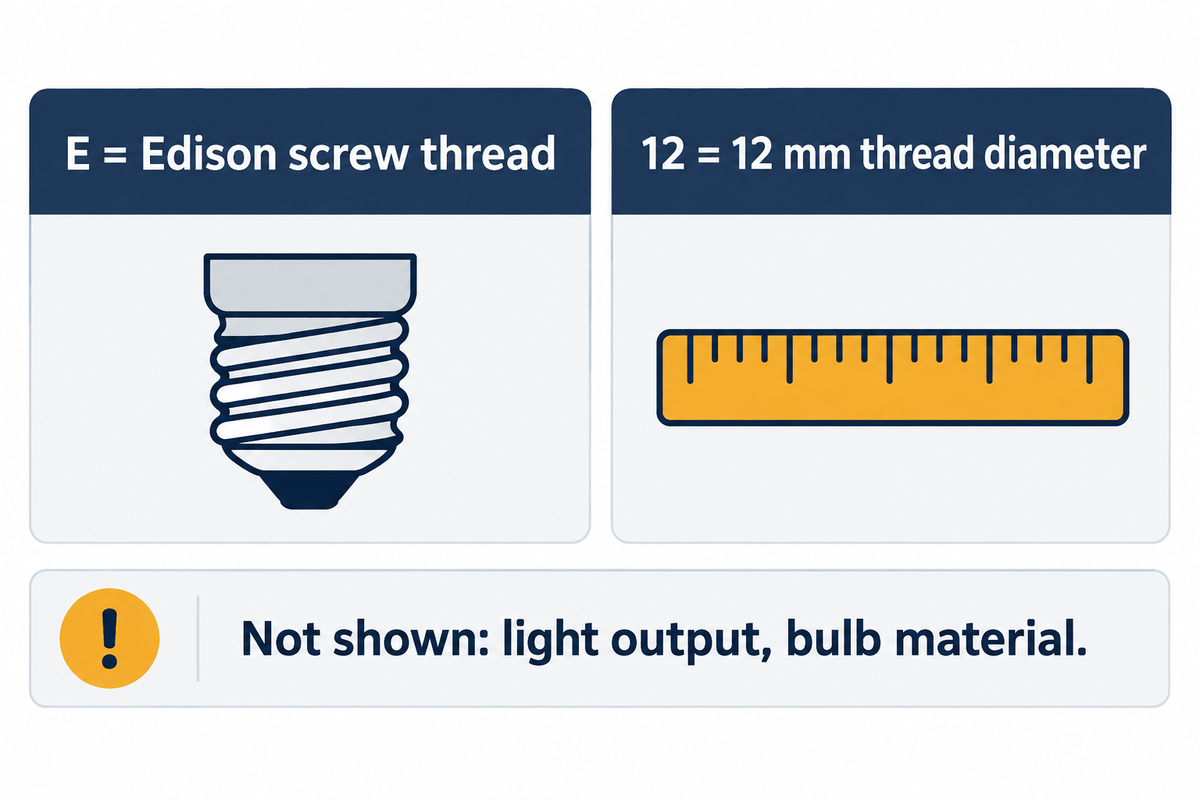
The E12 code is made of two parts. The first part, E, is for Edison Screw, which is the thread base found on most household lamps. The second part, 12, represents the nominal thread diameter in millimeters. An E12 candelabra base is about half the width of a medium E26 base found on a standard A19 LED light bulb, which measures 26 mm.
Three things the code doesn’t tell you: the shape of the glass, the light output and the bulb material. An E12 LED bulb, an E12 incandescent light and an E12 halogen lamp share the same thread. For an explanation on how an LED bulb transforms current into light, see our article on how LED light bulbs work.
| Part of the code | What it means | What it does not mean |
|---|---|---|
| E | Edison screw thread | LED or incandescent |
| 12 | 12 mm nominal thread diameter | Watts or lumens |
| Candelabra | Common North American name for E12 | A flame-shaped glass |
Is an E12 bulb the same as a candelabra bulb?
Yes, in the US and Canada a candelabra base bulb is an E12 bulb. The base is named candelabra, so an E12 candelabra bulb can be a candle, a small globe or a short tube. The one exception to watch for is imported fixtures: European sellers also say “candelabra” for the larger E14 thread used on 230 V chandeliers.
If a fixture came from a 220 to 240 V market, check for E14 before buying a pack of E12 bulbs. The fastest way to tell is to check the fixture label or the base of the old bulb.
E12 Base Size and the Ruler-and-Thread Base Check
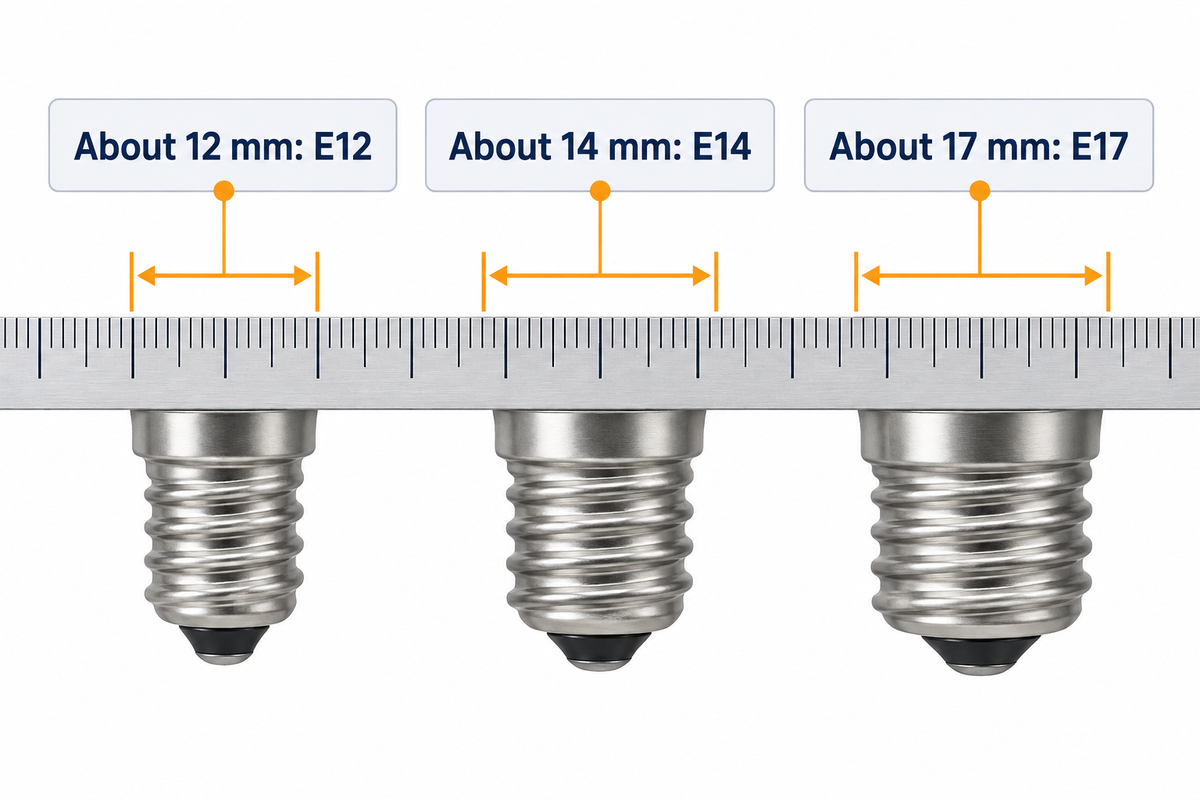
An E12 base measures 12 mm (0.472 in) across the thread, a little under half an inch. The nearest neighbors are 11 mm (E11), 14 mm (E14) and 17 mm (E17), so a careful measurement settles almost every case.
The base can be identified with a two-part ruler-and-thread check using the old bulb. It works when the base has no printed code.
- Measure across the threads: hold a millimetre ruler or caliper across the widest point of the metal screw. A reading of about 12 mm points to E12; about 14 mm points to E14; about 17 mm points to E17.
- Count the turns into the socket: with power off, thread the bulb in. An E12 bulb in an E12 socket turns smoothly and seats firmly. An E12 bulb in an E14 socket spins loose and may not touch the center contact.
Measure the old bulb, not the socket opening, because socket shells and paper sleeves hide the thread. If the reading falls near 11 mm and the bulb is a small halogen capsule, you’re holding an E11 mini-candelabra lamp, not an E12 one.
What size is an E12 light bulb base?
An E12 light bulb base is 12 mm (0.472 in) in nominal diameter, about half of the 26 mm width of a medium E26 base on standard household bulbs. If the ruler shows a measurement of about 14 mm instead, then the bulb is a European E14.
Bulb size is independent of base size. A B10 candle bulb on an E12 base is 1.25 in across the glass, and a G16.5 globe on the same base is about 2 in across.
E12 vs E26, E14, E17 and Other Look-Alike Bases
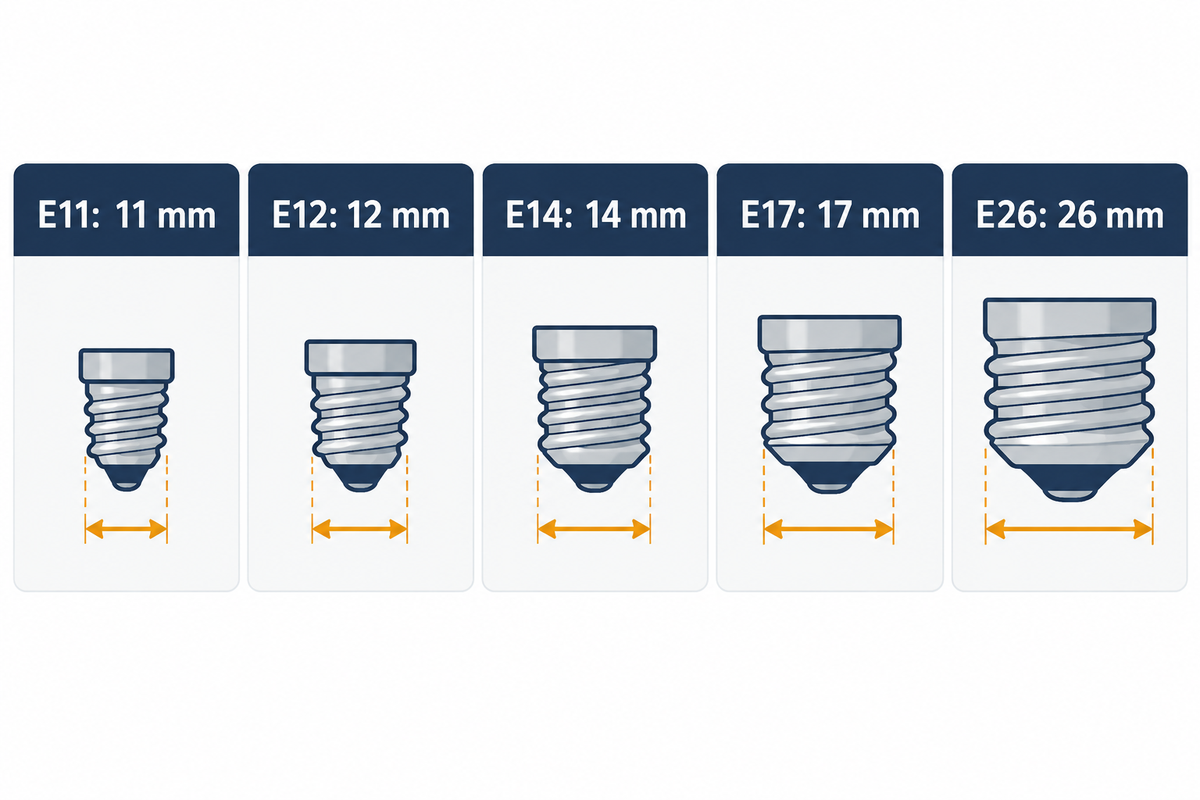
E12 differs from E26 by 14 mm of thread diameter, so the two never fit each other without an adapter. The bases most often confused with E12 are E14 (European candelabra) and E17 (intermediate), which look similar on a shelf. The E-Number Look-Alike Matrix below lists the nine Edison screw sizes a US shopper is likely to meet.
| Base type | Diameter | Common name | Typical fixture type |
|---|---|---|---|
| E5 | 5.5 mm (0.217 in) | Lilliput Edison Screw | Indicator and decorative lights |
| E10 | 10 mm (0.394 in) | Miniature Edison Screw | Flashlights, bicycle lights |
| E11 | 11 mm (0.433 in) | Mini-candelabra | 120 V halogen mini-candelabra |
| E12 | 12 mm (0.472 in) | Candelabra Edison Screw | 120 V candelabra and night lamps |
| E14 | 14 mm (0.551 in) | Small Edison Screw (SES) | 230 V candelabra, chandeliers, pendants |
| E17 | 17 mm (0.669 in) | Intermediate Edison Screw | 120 V appliance and decorative lamps |
| E26 | 26 mm (1.024 in) | Medium Edison Screw | Standard 120 V lamps |
| E27 | 27 mm (1.063 in) | Edison Screw (ES) | Standard 230 V lamps |
| E39 | 39 mm (1.535 in) | Mogul Edison Screw | 120 V lamps of 250 W and up |
Two base-identification mistakes can lead to incorrect orders. The first is SES: the name belongs to E14, so a listing that calls an E12 bulb “SES” is mislabelled. The second is E11, a halogen mini-candelabra base that’s 1 mm narrower than E12 and sometimes turns up in older track heads and pendants. Bi-pin and tube bases follow a different naming system; our guide to T8 tube sizes and bases covers those.
Is an E12 bulb the same as a B12 bulb?
No. B12 is a bulb shape, not a base: a candle envelope 12/8 in, or 1.5 in, across, while E12 identifies the screw base. A B12 bulb with an E12 base is a candelabra-base bulb, just like the smaller B10 and B11 candles.
The base line mark tells you the thread size. E12 indicates that the thread matches an E12 socket; you still have to make sure the glass fits inside the shade.
Bulb Shapes and Finishes That Use an E12 Base
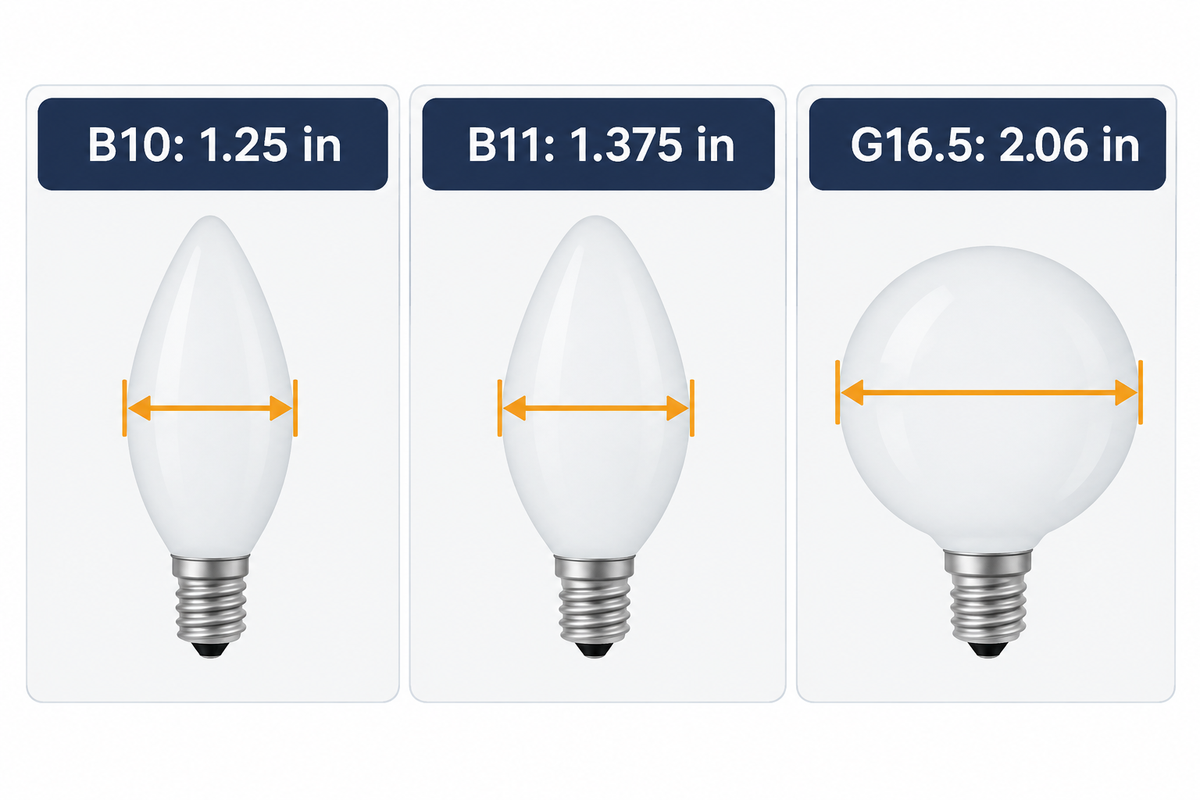
Shape codes give the bulb’s envelope shape as a letter and its maximum diameter in eighths of an inch. A B10 is a blunt candle shape 10/8 in, or 1.25 in, across. A G16.5 globe is 16.5/8 in, about 2.06 in. Federal lamp definitions use the same eighths-of-an-inch convention.
Satco lists its A3684 B10 candelabra lamp with a 1.25 in maximum diameter and 3.75 in overall length, which matches the code. Use the diameter to check shade clips and glass cups before you buy.
| Shape code | Bulb shape | Max diameter | Typical fixture |
|---|---|---|---|
| C7 | Small cone | 0.875 in | Night lights, window candles |
| B10 | Blunt tip candle | 1.25 in | Chandeliers, sconces |
| B11 | Larger blunt tip candle | 1.375 in | Chandeliers with open arms |
| CA10 | Bent or flame tip candle | 1.25 in | Exposed candle arms |
| G16.5 | Small globe | 2.06 in | Vanity strips, pendants |
| T6 | Slim tube | 0.75 in | Display cases, small lamps |
The shape of a bulb doesn’t make as much of a difference as the finish. A clear glass LED filament bulb has sparkles and shows the filament, while a frosted bulb finish diffuses the glare. A filament clear glass chandelier LED light bulb has a look like a small flame.
A dimmable white filament clear E12 lamp has filaments that appear to be white when turned off; its Kelvin rating, not the filament color, determines the color of light given off. A vintage LED lamp, often sold as a vintage Edison LED light bulb, uses long visible filaments inside clear or amber glass to imitate an old carbon lamp. Among the three bulbs, a clear E12 LED vintage Edison light has the most visible filament.
Small globes and tubes are similar. A G16.5 clear glass dimmable E12 globe fits vanity strips and most retail filters offer a globe dimmable option. A slim LED tube on an E12 base fits display cases and small accent lamps where a candle shape won’t.
LED E12 Brightness: Lumens and Watts for 25 W, 40 W and 60 W Replacements
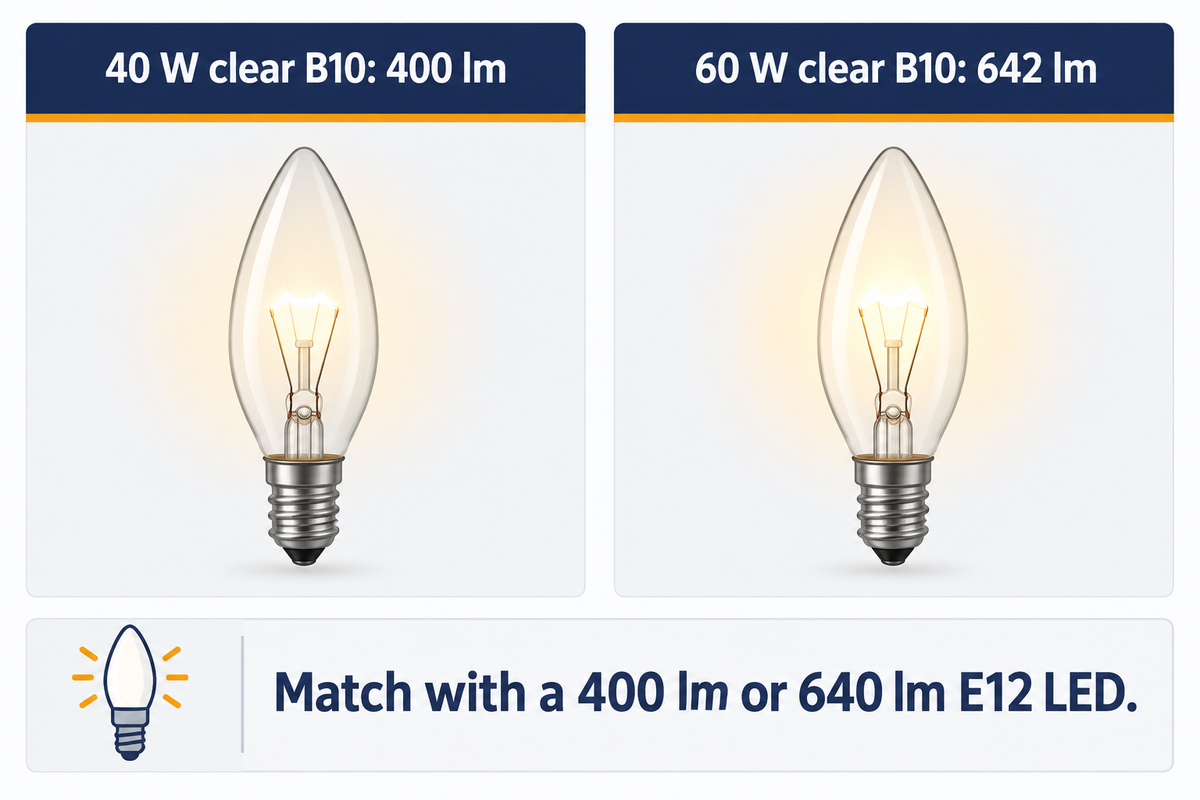
Candelabra incandescents give less light than household bulbs of the same wattage. Sylvania lists its 40 W clear B10 candelabra lamp at 400 lumens, and Satco lists a 60 W clear B10 at 642 lumens on 130 V. ENERGY STAR’s general replacement table puts 40 W at 450 lumens and 60 W at 800 lumens.
Satco sells a 4 W LED B10 filament lamp rated 300 lumens and labelled as a 40 W equivalent. California’s minimum-lumen table for watt-equivalence claims doesn’t cover E12 lamps, so that table sets no lumen floor for an E12 “40 W equivalent” claim. For an E12 box, the lumen number is the only brightness figure you can compare.
These lumen numbers are single listed models at their stated voltage, so consider them as examples rather than a firm number.
400 lm40 W clear B10 candelabra (Sylvania listing)
642 lm60 W clear B10 on 130 V (Satco listing)
300 lm4 W LED B10 sold as a 40 W equivalent
Use the Arm-Count Brightness Table to size the bulbs for a whole fixture. Assumed inputs: the old bulbs match the two listed incandescent models above. The replacement LED runs at about 75 lumens per watt, the efficacy of the 4 W, 300 lm filament lamp.
| Old bulbs | Arms | Old fixture load | Fixture lumens | LED lumens per bulb | Estimated LED load |
|---|---|---|---|---|---|
| 40 W, 400 lm | 3 | 120 W | 1,200 lm | 400 lm | 16 W |
| 40 W, 400 lm | 5 | 200 W | 2,000 lm | 400 lm | 27 W |
| 40 W, 400 lm | 6 | 240 W | 2,400 lm | 400 lm | 32 W |
| 40 W, 400 lm | 8 | 320 W | 3,200 lm | 400 lm | 43 W |
| 40 W, 400 lm | 12 | 480 W | 4,800 lm | 400 lm | 64 W |
| 60 W, 642 lm | 3 | 180 W | 1,926 lm | 642 lm | 26 W |
| 60 W, 642 lm | 5 | 300 W | 3,210 lm | 642 lm | 43 W |
| 60 W, 642 lm | 6 | 360 W | 3,852 lm | 642 lm | 51 W |
| 60 W, 642 lm | 8 | 480 W | 5,136 lm | 642 lm | 68 W |
Worked example: a six-arm chandelier of 40 W clear B10 bulbs draws 240 W and gives about 2,400 lumens. Six 4 W, 300 lm LED bulbs draw 24 W but give about 1,800 lumens, a quarter less light. Choosing 400 lm E12 LED light bulbs at about 5.3 W each keeps the room as bright for about 32 W in total. To match a 60 W clear B10 at 642 lumens, pick an E12 LED near 640 lumens, about 8.6 W at that efficacy. Those totals also matter on a shared branch circuit; see how many LED lights a 15-amp circuit can run.
Color Temperature, CRI and the Lighting Facts Label Check
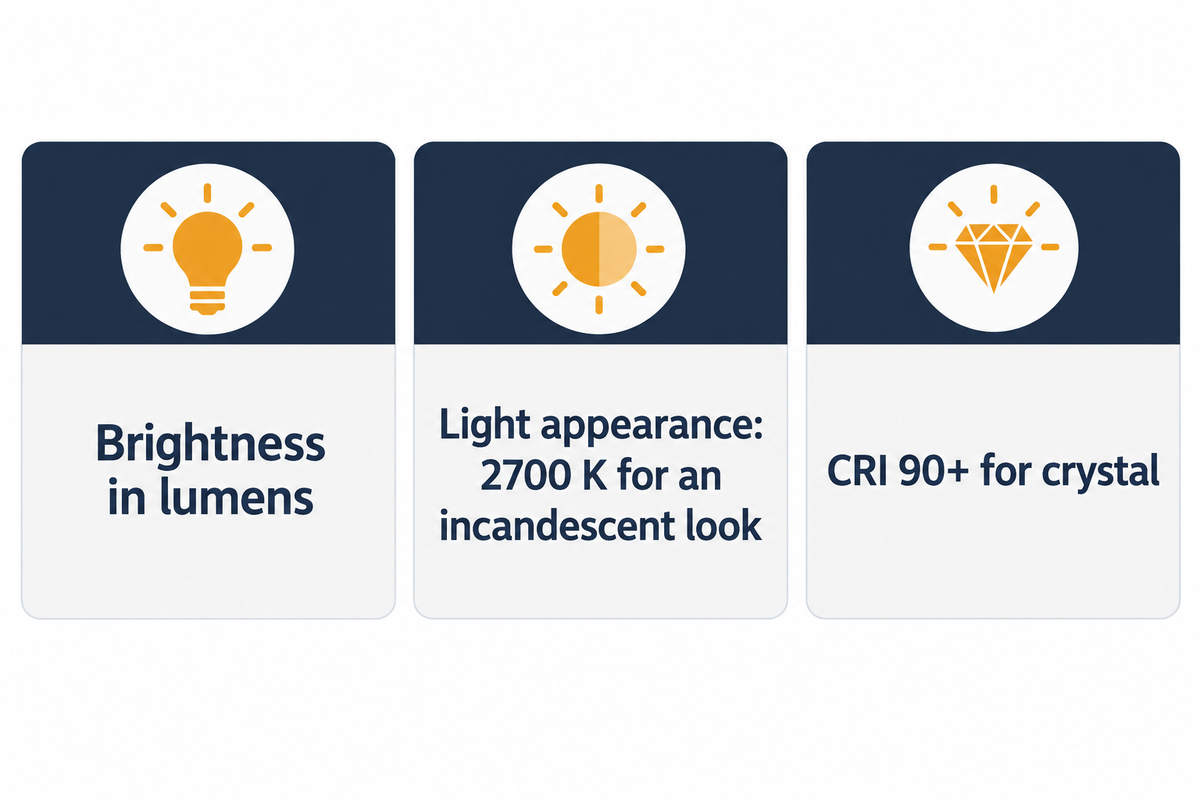
A 2700 K soft white E12 bulb is the closest match to a warm incandescent candelabra lamp. On a box marked LED light bulb 2700K soft white, the Kelvin figure should also appear in the light appearance line. The Lighting Facts label shows that color as “light appearance”, next to lumens, yearly energy cost, expected life in years and wattage; bulbs that contain mercury also say so. Those fields let you compare boxes from different brands.
Variations in brand names exist for the same color.
Daylight labels sit near 5000 K. An LED light bulb 5000K daylight pack appears cooler and whiter than a 2700 K soft white bulb. A light bulb daylight rating is more suitable for task lighting than for a dining room.
Choose a chandelier LED light bulb soft white at 2700K. Mixed color temperatures of lighting in the same fixture look patchy. Clear glass dimmable E12 LED lamps keep the sparkle of crystal, and a dimmable E12 LED light bulb with CRI 90+ keeps wood and fabric colors accurate. Frosted glass dimmable E12 LED lamps provide a softer look and obscure the filaments.
Many E12 packs carry the shorter specialty-lamp version of the label, and small blister cards may print “See Back for Lighting Facts”. For color quality, CRI 80 was the ENERGY STAR floor until the program’s lamp specifications ended on December 31, 2024. It remains a sensible minimum, and CRI 90+ suits crystal and art lighting. Our pages on warm white light bulb color and color rendering index (CRI) go deeper on both numbers.
“Manufacturers may use the Lighting Facts label required for general service lamps or the smaller version of the Lighting Facts label for most specialty consumer lamps, as long as it appears on the principal display panel.”
Federal Trade Commission, Lighting Facts label Q&A for manufacturers
Retail titles compress product specifications into a single line, so it helps to read them in pieces. A title that opens with “60-Watt Equivalent B11 Dimmable E12 Candelabra” gives the brightness claim, the B11 shape, the dimming feature and the base. A title ending in “Clear Glass LED Vintage Edison Light Bulb” refers to a filament-style LED bulb behind clear glass.
E12 label checklist: copy these targets before you shop
| Parameter | Target | Why it matters | Where it appears |
|---|---|---|---|
| Base | E12 (sold as candelabra in North America) | E14 and E17 will not fit | Box front or base line |
| Brightness | 400 lm to match the Sylvania 40 W B10 at 120 V; about 640 lm to match the Satco 60 W B10 at 130 V | Watt-equivalent claims vary | Lighting Facts, brightness |
| Light appearance | 2700 K for an incandescent look; 2200 K for candle glow | Mixing CCT in one fixture looks patchy | Lighting Facts, light appearance |
| Color rendering | CRI 80 minimum; 90+ for crystal | Low CRI dulls reds and wood | Spec line or side panel |
| Dimming | “Dimmable” plus your dimmer on the maker’s list | Non-dimmable LEDs flicker on dimmers | Box front, dimmer list |
| Enclosure | “Rated for enclosed fixtures” if the shade is closed | Trapped heat shortens LED life | Caution panel |
Dimmable E12 LED Bulbs: Flicker, Buzz and Minimum Load
Flicker on a dimmable E12 LED points to the dimmer and bulb pairing, not to the base. ENERGY STAR notes that not every LED works well with every dimmer and advises checking the dimmer maker’s list of recommended bulbs. Lutron’s application note on minimum loads states that watt ratings printed on its controls are based on incandescent and halogen lamps. For LED lamps, the minimum load is a number of lamps found by testing.
“each candelabra base incandescent lamp shall not exceed 60 rated watts.”
A six-arm fixture of 60 W candelabra lamps at that cap draws 360 W, while six 4 W LEDs draw 24 W. Lutron states that the 25 W minimum of its Grafik Eye QS control at 120 V applies to incandescent or halogen lamps, not to LED lamps. Its own testing found that one 8 W LED lamp can be enough on that control.
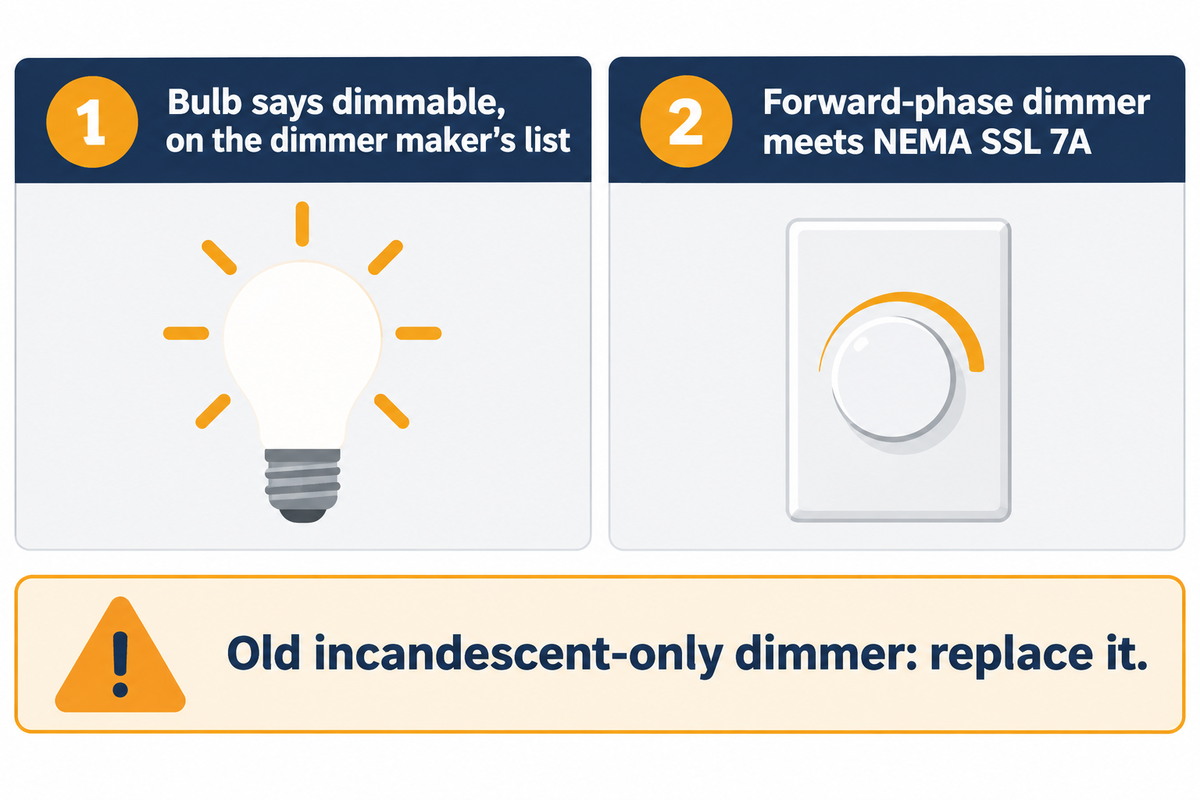
Two checks settle most dimming problems. First, the bulb must say dimmable, and the dimmer maker should list that exact bulb model as compatible. Second, a forward-phase dimmer should meet NEMA SSL 7A, the basic phase-cut dimming standard for LED light sources. Since January 1, 2017, California has required this for interior LED lamps in new homes and major renovations under Title 24 Section 150.0(k)2A.
If the dimmer is an old incandescent-only model, replacing it is the usual fix. A trade comment in the federal lamp rulemaking put an LED-compatible dimmer at about $20 to $80, plus $100 to $200 for an electrician, depending on location. For the different dimmer families, see dimmer switch types and our guide to LED light bulb flickering causes.
Are E12 LED bulbs dimmable?
Many E12 LED bulbs are dimmable, but only those labeled “dimmable” are designed for a dimmer switch, and they still need a compatible dimmer, ideally one whose manufacturer lists that LED bulb. If a non-dimmable LED bulb is used with a dimmer switch, it can buzz, flicker, or fail early.
Satco’s 4 W B10 filament lamp, for example, is specified for 120 V phase-cut dimming only, which covers the common wall dimmers sold for chandeliers.
Substitutes and Adapters for an E12 Socket
The only bulb that fits an E12 socket directly is another E12 bulb. E14, E17 and E26 bulbs are wider and won’t thread in. A listed E12-to-E26 adapter lets an E26 bulb screw into a candelabra socket, but it doesn’t raise the fixture’s wattage label, which stays the limit.
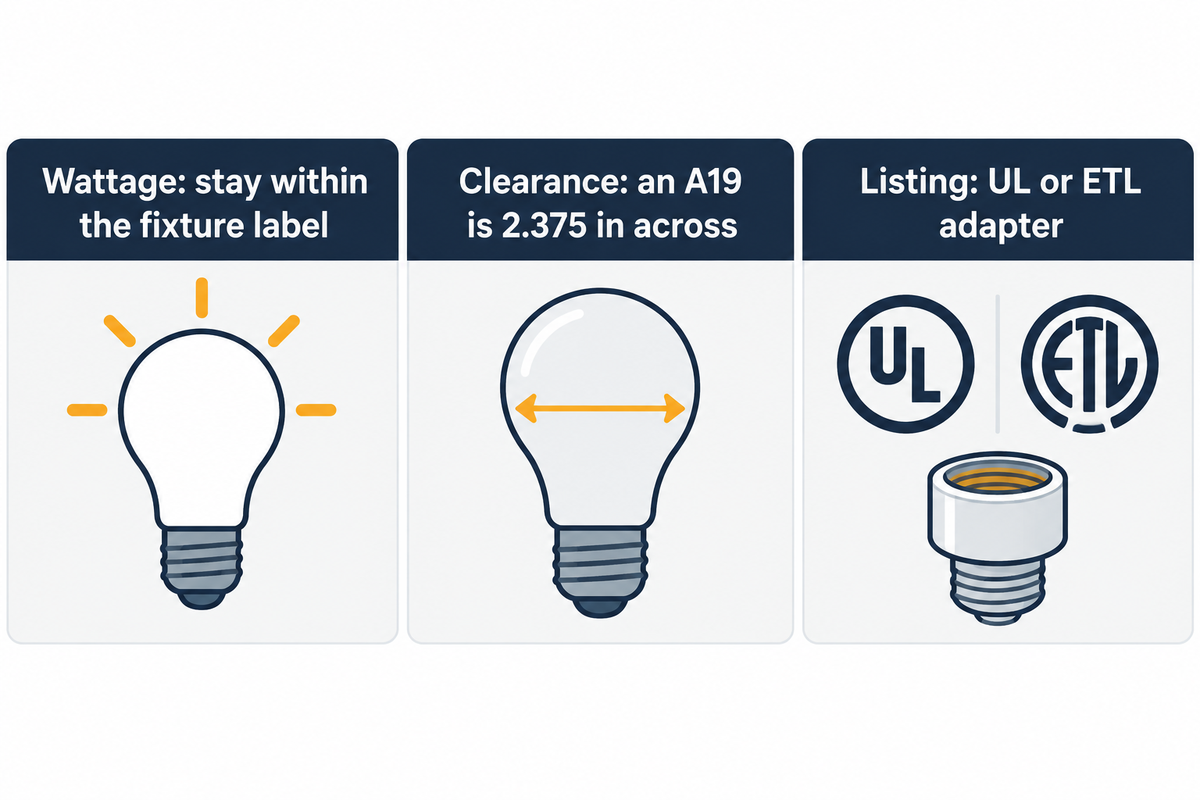
Three checks are performed to determine if an adapter is acceptable in a given fixture. The wattage check is the fixture label: many fixtures print a per-socket limit that an adapter does not raise, and candelabra incandescent lamps themselves are capped at 60 rated watts under 10 CFR 430.32. The clearance check is physical: an adapter adds length, and an A19 bulb is 19/8 in, or 2.375 in, across, wider than most candelabra cups and shades. The listing check is the mark: use an adapter that carries a UL or ETL listing, and stay under the wattage printed on the adapter itself. An adapter changes only the thread, so the bulb must still match the 120 V supply.
Adapters work for lamps/pendants that have an open shade with space above the socket. For chandeliers with glass cups or close candle sleeves, use an E12 bulb.
What can I use instead of an E12 bulb?
You can use another E12 bulb of a different shape, finish or light source, such as an LED candle, small globe or tube. It must fit the shade, be the correct voltage, be within the fixture’s wattage label, and have an enclosed or damp rating if needed for the fixture. Swapping for an E14, E17 or E26 bulb requires a listed adapter or a new socket.
For a dim fixture, a brighter E12 LED usually works better than an adapter. A 400 lm E12 LED matches the listed 40 W clear Sylvania B10 without altering the socket.
Fixtures That Use E12 Bulbs and What Each One Needs
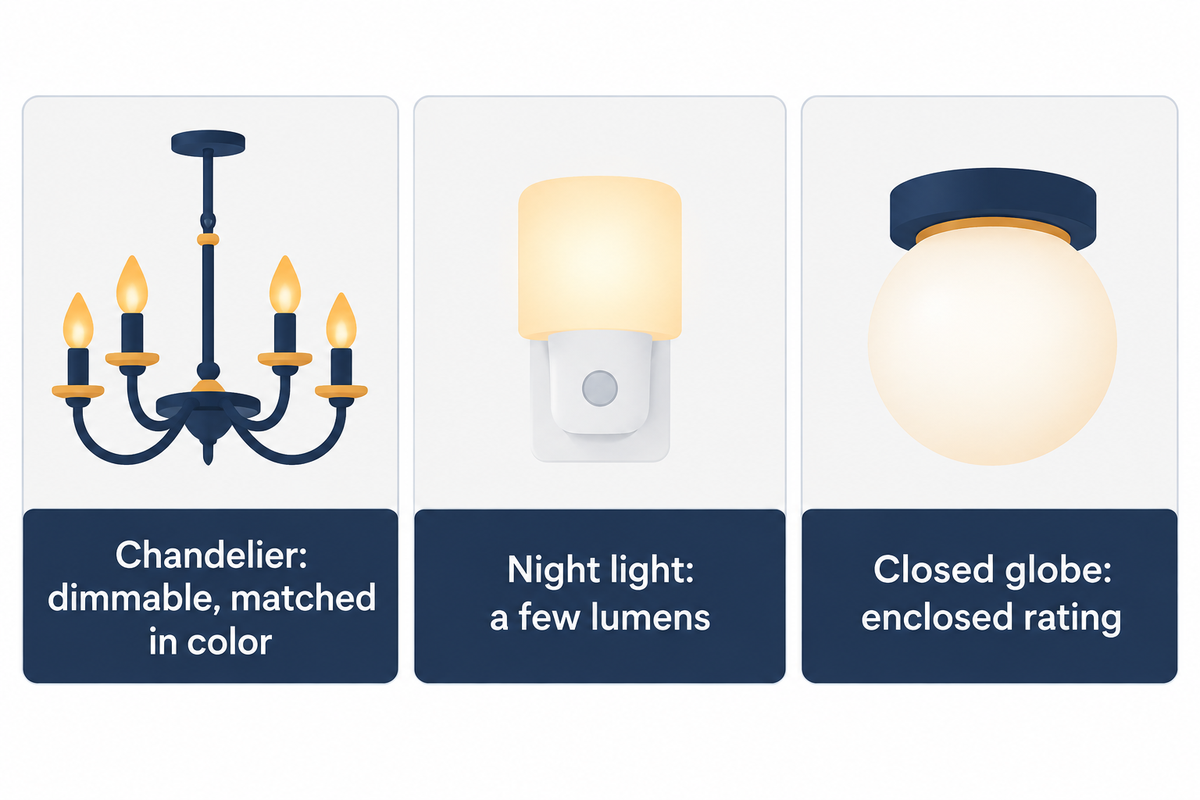
E12 bulbs sit mostly in chandeliers, wall sconces, night lights, salt lamps, window candles, bulbs for string lights and ceiling fan light kits. Each type of fixture dictates what type of bulb is purchased. A chandelier LED bulb should be dimmable and matched in color; a night light needs only a few lumens; a closed globe needs an enclosed rating.
Ceiling fan light kits have their own federal history. Kits made on or after January 1, 2009, and prior to January 21, 2020, with candelabra sockets were required to ship with lamps and be designed not to operate with lamps totaling more than 190 watts. With older kits, replacement bulbs must stay within both the kit’s total rating and its per-socket limit, which may be lower than 190 W.
Enclosed fixtures are the Achilles heel for LED candelabra bulbs. Satco’s 4 W B10 filament lamp, for example, isn’t rated for enclosed fixtures and is specified for -20 °C to +45 °C ambient air. When using a sealed globe or outdoor lantern, look for bulbs that say “rated for enclosed fixtures”.
Energy savings in multi-arm fixtures really add up. A comment in the federal rulemaking said a fixture with eight candelabra bulbs uses 10 times the energy of one 100 W-equivalent LED.
What Is Changing for E12 Incandescent Bulbs in the US
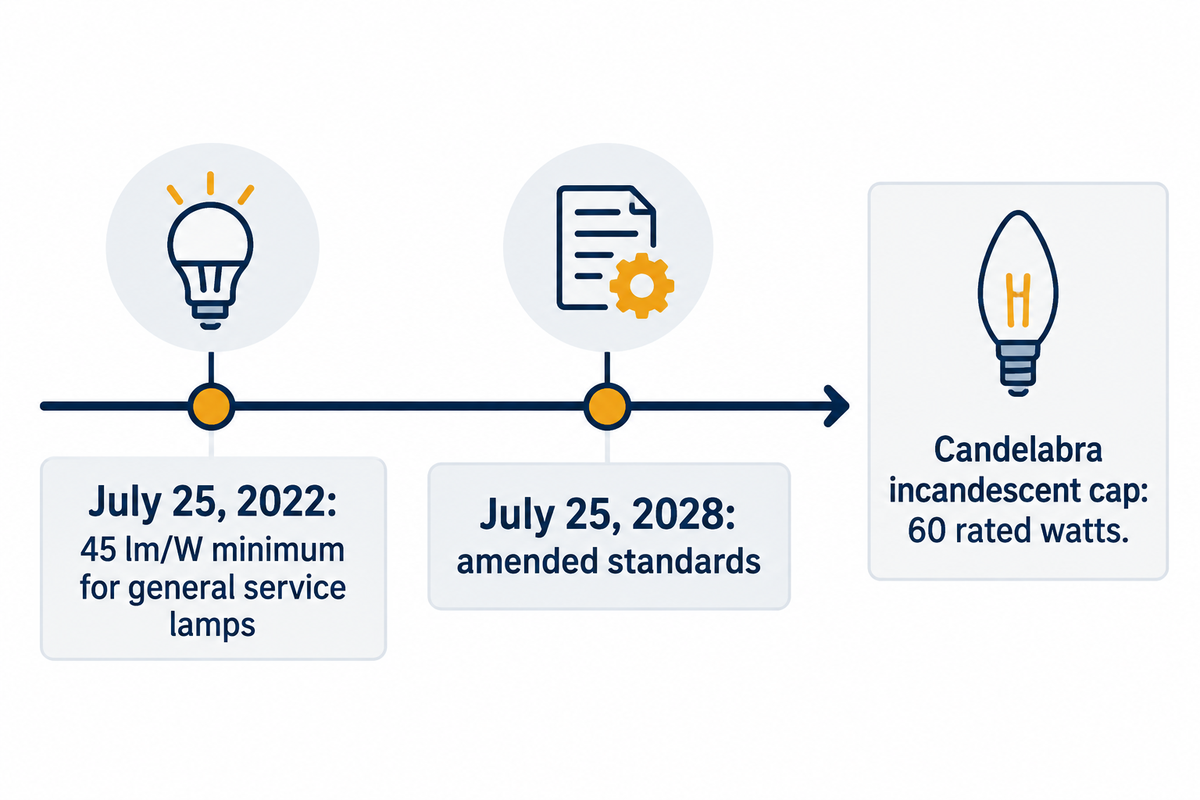
E12 incandescent bulbs that meet the general service lamp definition now fall under the federal 45 lumens-per-watt minimum. Since July 25, 2022, a general service lamp that misses 45 lm/W may not be sold. A general service lamp has an ANSI base and an initial output of 310 to 3,300 lumens.
Coverage depends on lumens and shape, so two E12 bulbs can sit under different rules. A 400 lm candle-shaped E12 incandescent sits inside the lumen window. A dim decorative E12 under 310 lm sits outside it, as do small S or G globes of 1.5625 in or less and slim T tubes of 1 in or less under 12 in long. Any candelabra incandescent is still capped at 60 rated watts.
The next federal step is set for July 25, 2028, when amended general service lamp standards take effect. DOE notes that specialized lamps such as bug lights and oven bulbs are outside the rule. A 2025 Senate bill, S.1568, would repeal the 45 lm/W floor, but it’s a proposal, not law.
California adds a state layer for LEDs. E12 LED lamps under 150 lumens are exempt from its performance standards but must still be tested, marked and certified. For a homeowner, the practical step is the same in every state: replace failed 40 W and 60 W candelabra lamps with dimmable 2700 K LEDs of matching lumens.
Frequently Asked Questions
Q: Where can I buy E12 bulbs?
E12 bulbs are sold in US home-improvement stores, big-box retailers, lighting suppliers and online marketplaces, usually in a candelabra or E12 section.
Home Depot, Walmart, Amazon and Bulbs.com all run E12 category pages. GE, Philips, Feit Electric, EcoSmart, Satco and Sylvania all sell E12 LED ranges in the US. Bring the old bulb or its box, and compare lumens, color temperature and the dimmable mark rather than the watt-equivalent claim.
Q: Are E12 light bulbs LED?
Some are and some aren’t because E12 specifies the base and not the light source.
Incandescent, halogen, and LED bulbs can have the same E12 thread. The box will say LED if the bulb is an LED; inside, a white LED or LED filament takes the place of the old tungsten filament. A clear LED light bulb like a 4 W filament candle gives about 300 lumens, while Sylvania lists its 40 W clear incandescent B10 at 400 lumens, at ten times the power.
Q: How long do E12 bulbs last?
E12 LED bulbs are commonly rated at around 15,000 hours, while candelabra incandescents are rated in the low thousands.
Satco rates its 4 W LED B10 filament lamp at 15,000 hours and its 60 W clear B10 incandescent at 2,500 hours. Heat shortens LED life, so a bulb in an enclosed globe should carry an enclosed-fixture rating. Expected life in years also appears on the Lighting Facts label.
Q: Does Lowe’s carry E12 bulbs?
Yes. Lowe’s lists E12 candelabra LED bulbs, including GE and Philips models.
Search the site for “E12” and check the lumen figure on each listing.
Q: Is E12 the standard light bulb size?
No. The standard household size in the US is the medium E26 base, which covers around 90% of bulbs sold.
E12 is the second common size and is used mainly in decorative fixtures. The E26 base is 26 mm across, more than twice the 12 mm E12 thread, so the two bulbs are never interchangeable without an adapter. If your fixture takes a standard bulb, look for E26 or “medium” on the box. If it takes a small decorative bulb, look for E12 on the box.
Q: Are E12 light bulbs bright?
The E12 listings cited in this guide run from about 300 to 642 lumens each, less than a standard 60 W household bulb at about 800 lumens.
Several bulbs in one fixture add up, so a six-arm chandelier can produce over 2,000 lumens.
Q: What are E12 bulbs used for?
Chandeliers, sconces, night lights and fan kits.
Window candles and salt lamps use them too.
Need Outdoor Fixtures Instead?
Guangqi Lighting makes project floodlights for building exteriors and yards, street lights and landscape luminaires. If your lighting plan goes beyond decorative E12 lamps, our team can help select appropriate fixtures for your site.
About This Analysis
This E12 light bulb guide pulls base dimensions, candelabra lumen listings and US lamp rules into one place. Federal dates were checked against the eCFR and the Federal Register in November 2026; California and ENERGY STAR dates come from the sources cited in each section.
References & Sources
- Edison screw: base designations and IEC 60061-1 sheets (Wikipedia)
- 10 CFR 430.2, definitions including general service lamp (eCFR)
- 10 CFR 430.32, energy and water conservation standards (Cornell Legal Information Institute)
- Definitions for General Service Lamps, final rule, May 2022 (Federal Register)
- Energy Conservation Standards for General Service Lamps, final rule, April 2024 (Federal Register)
- Learn About Brightness (ENERGY STAR)
- Light Fixtures for Partners, specification history (ENERGY STAR)
- Shopping for Light Bulbs (Federal Trade Commission)
- The FTC Lighting Facts Label: Questions and Answers for Manufacturers (Federal Trade Commission)
- State-Regulated LED and Small Diameter Directional Lamps FAQ (California Energy Commission)
- Debunking Myths about Phasing Out the Incandescent Lightbulb (U.S. Department of Energy)
- Indoor lighting options: terms, types and measurements (University of Maryland Extension)
- New Bill Pushes to End Incandescent Light Bulb Ban (inside.lighting)