Get in Touch with GUANGQI



Updated August 2026
Bollard lights are short, ground-mounted luminaires that light a walking surface from below eye level. Bollard lights commercial projects rely on do the same job at specification grade, on mains power, to a published illuminance criterion. They are also the line item most often ordered wrong, because the word “bollard” names two unrelated products: a luminaire, and a post engineered to stop a vehicle. This guide covers the specification, spacing, code and procurement decisions that sit behind the catalogue.
What a Commercial Bollard Light Is, and the Question That Decides Everything Else
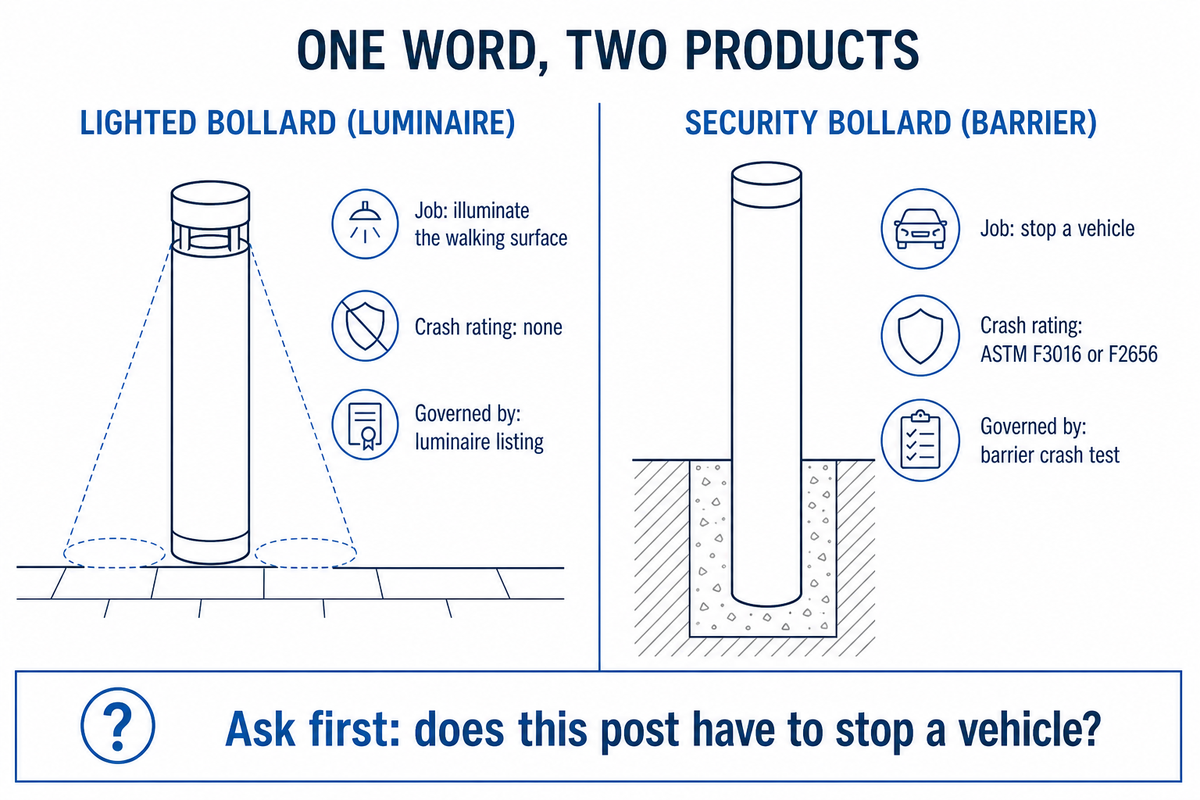
A commercial bollard light is a short vertical luminaire, typically 18 to 45 inches tall, that pushes light downwards onto pathways and walkways from below eye level. A US Department of Veterans Affairs lighting design manual defines it as a luminaire “having the appearance of a short, thick post, used for walkway,” with the optical components usually top-mounted.
What it is not is a barrier. A lighted bollard carries no crash rating of any kind, and this is where projects lose money.
⚠️ The Impact-Duty Question
Before anything else, ask one question about every post on the drawing: does this post have to stop a vehicle? If yes, you are buying a tested barrier and lighting is a secondary feature. If no, you are buying a luminaire and no amount of wall thickness makes it a barrier. Answering this first routes the entire specification, the standard, the budget line and the supplier.
Two product families, two separate standards, and each standard has its own scope. ASTM F3016/F3016M is a surrogate test method for vehicle impact protective devices at low speeds, using a 5,000 lb surrogate vehicle at 10, 20 or 30 mph — the storefront and pedestrian-protection case. ASTM F2656/F2656M-23 is the crash test method for perimeter barriers as a class, covering gates, cable systems, fences and bollards alike; it rates them across a set of test-vehicle classes running from small car up to heavy goods vehicle, with a penetration class appended. Sources outside the standard itself disagree on how many classes the current edition defines, so confirm the class list against the edition your specification cites rather than against a vendor summary. M designations most often quoted (M30, M40, M50) refer to the medium-duty-truck class at a 15,000 lb test weight and 30, 40 or 50 mph, paired with P1 to P3 penetration. Older K4, K8 and K12 labels still in circulation come from a US Department of State test standard rather than from ASTM. Federal anti-ram barrier schedules list products under both nomenclatures side by side, K ratings alongside M ratings, which is why a supplier can quote you either one — and why asking which standard a rating came from is a fair question rather than a pedantic one. Scope for each is set out in ASTM F2656/F2656M-23 and ASTM F3016/F3016M.
Municipal design standards are explicit that the lighted version does a different job. Issaquah, Washington’s design guidance says internally illuminated bollards “may be used, and are appropriate to highlight pedestrian routes, demark changes between users (e.g., pedestrian and vehicular).” Demarcation, not protection.
| Post type | Primary job | Is it a luminaire? | Impact rated? | Governing standard family | Not suitable for |
|---|---|---|---|---|---|
| Lighted bollard (LED) | Illumination for pathways | Yes | No | Luminaire listing (UL/ETL), IEC 60529 | Any vehicle-strike location |
| Solar lighted bollard | Illumination without trenching | Yes | No | Luminaire listing | Deep-shade or north-wall sites |
| Low-voltage landscape bollard | Garden and landscaping accent | Yes | No | UL 1838 low-voltage systems | Long runs without a voltage-drop check |
| Illuminated security bollard | Barrier with a light fitted | Partly | Yes, if tested | ASTM F3016 or F2656 plus listing | Being assumed rated without a test report |
| Fixed steel security bollard | Stop a vehicle | No | Yes | ASTM F2656/F2656M-23 (vehicle class + speed, plus P1–P3) | Providing any illumination |
| Removable / retractable bollard | Controlled vehicle access | No | Varies by model | ASTM F2656 / SD-STD-02.01 | Permanent perimeter duty |
| Traffic delineator post | Visual channelization | No | No, designed to deflect | Highway device specifications | Any protective function |
| Concrete or cast decorative bollard | Streetscape appearance | No | Rarely, only if tested | None unless crash tested | Being specified as protection by mass alone |
| Bollard sleeve or cover | Cosmetic refresh of an existing post | No | No, inherits the core | None | Upgrading a post’s rating |
The LED Bollard Spec-Sheet Fields That Actually Decide the Order
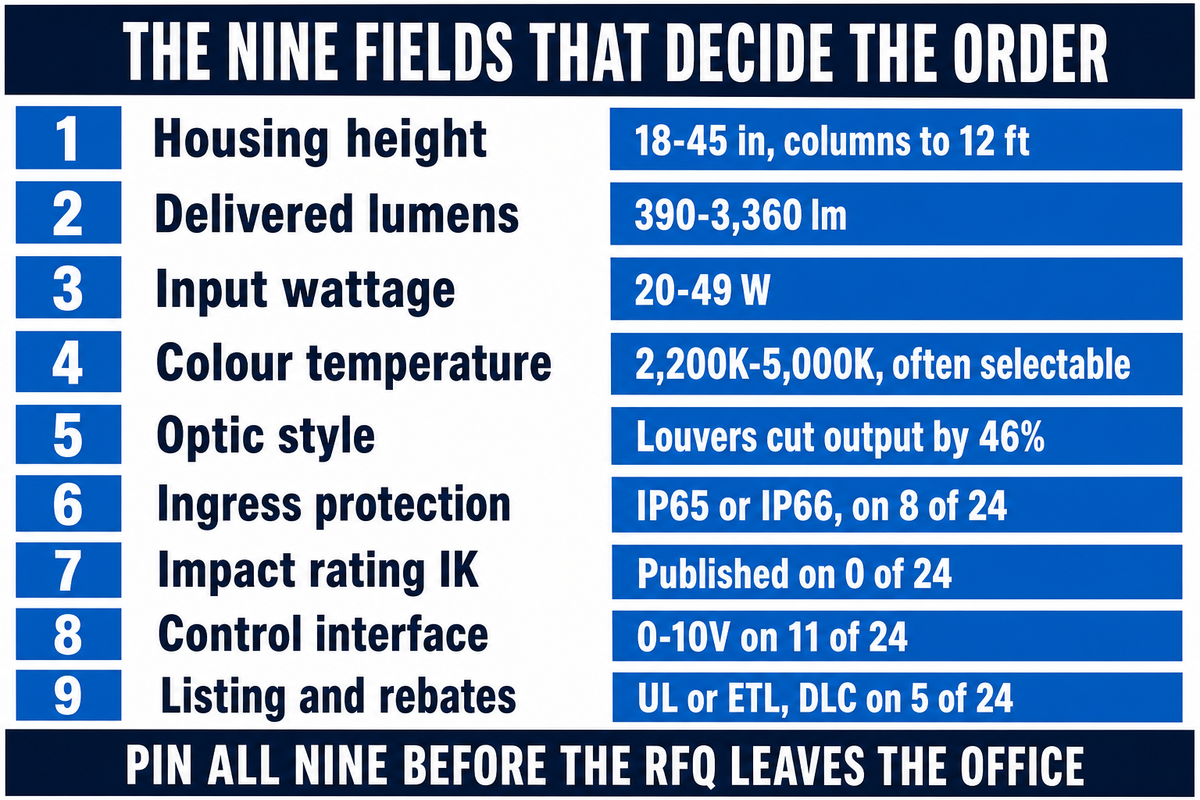
Nine fields decide whether two quotes are comparable. Everything else on a commercial-grade LED bollard lights datasheet is either derived from these or is decoration. Pin all nine before the request for quotation leaves the office and the returned quotes line up; leave any blank and the cheapest bid wins on a specification nobody agreed to.
This matters because bollard light fixtures are quoted from catalogues that describe commercial LED bollards in marketing language rather than in comparable numbers. Two LED bollard fixtures can share a photograph, a height and a price and still differ by a factor of two in delivered output. Narrowing the bollard options starts with forcing every quotation onto the same nine lines.
Those nine fields are the register below. Those ranges come from a cross-manufacturer read of 40 catalogued commercial models across three suppliers, not from any single brand’s line.
18–45 in
Observed height span
390–3,360 lm
Delivered output span
15×
List-price spread
0 of 24
Models publishing an IK code
| Field | Observed range | Why it decides the order | Limitation if left blank |
|---|---|---|---|
| Housing height | 18–45 in (column variants to 12 ft) | Sets spacing and how far light throws | Layout cannot be calculated |
| Delivered lumens | 390–3,360 lm | The only output figure that reaches the ground | Source lumens get quoted instead |
| Input wattage | 20–49 W | Drives the exterior lighting power allowance | Energy-code submittal stalls |
| CCT and whether selectable | 2,200K–5,000K; selectable CCT and wattage on many | Ordinance compliance and appearance | A 4000K default can fail a local cap |
| Optic and distribution | Cone reflector, louvers, lens, cover plates | Decides glare and usable spread | Output figures stop being comparable |
| Ingress protection | IP65 or IP66 where stated (8 of 24 in one catalogue) | Base of a bollard sits in standing water | You inherit an unrated enclosure |
| Impact rating (IK) | Rarely published — 0 of 24 in one catalogue | Ankle-height fixtures take real abuse | No vandal-resistance evidence exists |
| Control interface | 0–10V on 11 of 24; photocell and timer common | Determines whether it can dim at all | Curfew controls become impossible |
| Listing and qualification | UL/ETL; DLC on 5 of 24; Title 24 on 5 of 24 | Utility rebates and state compliance | Rebate applications are rejected late |
Two of those rows deserve emphasis. Dimming is not a given on this product class — in a 24-model catalogue with structured filter facets, 0–10V control appeared on 11 models, fewer than half. And the impact rating that would justify the phrase “vandal resistant” appeared on none of them.
What CCT Options Should a Commercial Bollard Light Offer?
At minimum, 3000K. Increasingly the answer is 3000K or lower with a field-selectable switch, because the compliance target is moving and a fixed 4000K fixture cannot follow it. Across the catalogues reviewed, 3000K was available on every model, with 4000K and 5000K on most.
Availability is not the same as permission, and several jurisdictions now cap outdoor lighting below 4000K. Manufacturers serving coastal wildlife zones also offer LED bollard lights in 3000K alongside 2700K, 2200K and 590 nm amber LED bollard variants, the last of which exists because long-wavelength amber light disturbs and attracts nesting sea turtles far less than white light does — reduced sensitivity, not invisibility, which is why Florida Fish and Wildlife Conservation Commission (FWC) certification also demands shielding rather than wavelength alone. If the site is anywhere near an ordinance boundary, selectable CCT and wattage is worth the small premium purely as an option on future compliance.
Optic Style Compared: Flat Top, Dome Top, Louvered and Cone Reflector
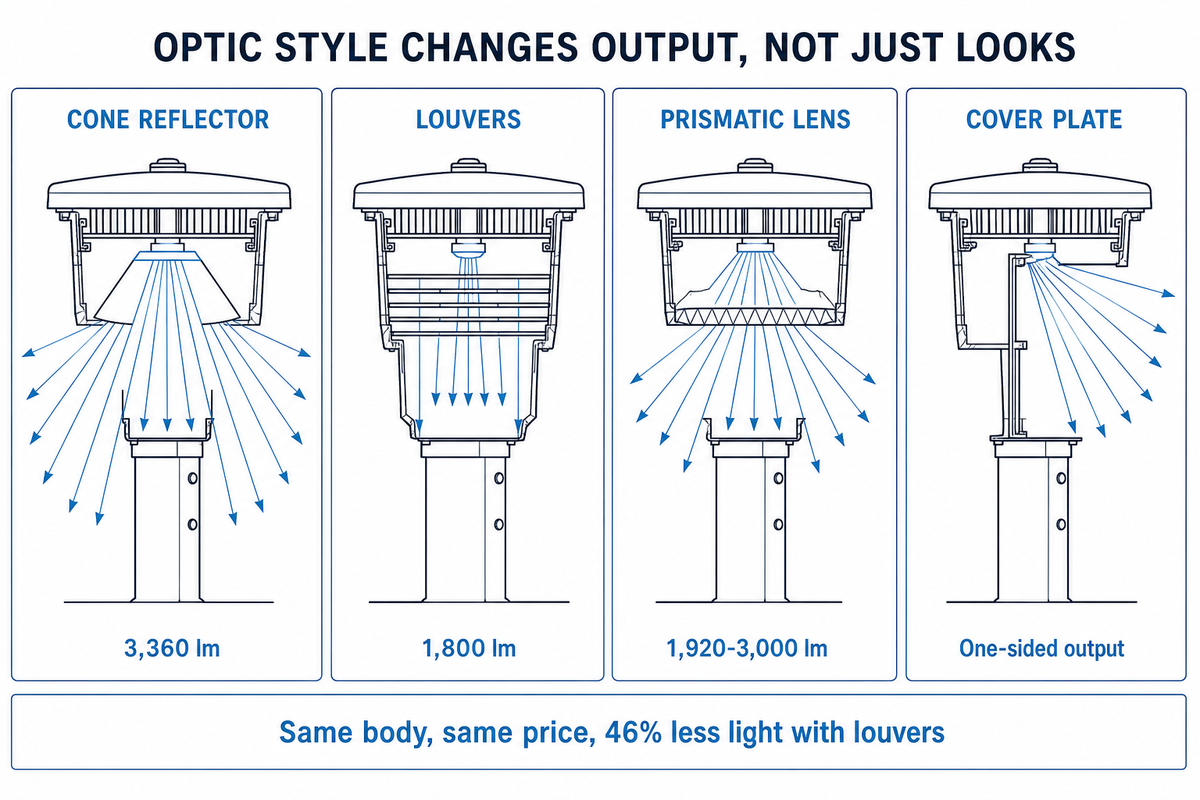
Unlike housing finish, optic style is not cosmetic — it changes measured output. Within one manufacturer’s identical bollard body at the identical list price, the aluminum cone reflector variant is rated 3,360 lumens and the louvered variant 1,800 lumens. Glare control costs roughly 46% of delivered light on the same fixture.
✔ Louvered opticsDie-cast aluminum louvers reflect light downwards in a 360° pattern, minimizing glare for pedestrians and drivers. Exposed louvers without a polycarbonate lens are the more durable, vandal-resistant build. Cost: about 46% less delivered output.
⚠ Cone reflector opticsLEDs mounted in the head aim down and reflect off an aluminum cone reflector for wide 360° distribution and far more usable light. Cost: a brighter visible source, so it needs more care where people look toward the fixture.
Four head families cover the wide range of styles catalogues advertise: flat top, round dome top, round bevel edge and square flat top, each available with either louvers or cover plates for directional light control. Round LED bollard bodies are the volume shape; square bodies are usually an architectural choice rather than a photometric one. A round flat top LED bollard with a cone reflector throws the most light; a top LED bollard with louvers throws the least and offends the fewest eyes. Federal design guidance puts the same point in one line: consider luminaire placement and optics to mitigate glare, which is exactly what the choice between these four families decides. Louvers or cover plates also let you kill output on one side entirely, which matters on a path that runs alongside a bedroom window or a dark-sky boundary.
| Optic | Downward control | Uplight | Relative output | Not suitable for |
|---|---|---|---|---|
| Aluminum cone reflector | Good | Low | Highest (3,360 lm class) | Seated plazas with long sightlines to the head |
| Aluminum louvers | Highest | Near zero | Lowest (1,800 lm class) | Wide paths needing long spacing |
| Prismatic or optical lens | Moderate | Low to moderate | Middle (1,920–3,000 lm) | High-vandalism sites (lens is the weak point) |
| Cover plates / shields | Directional by design | Blocked on shielded side | Reduced on the blocked arc | Paths needing symmetric coverage |
Power Architecture: 120–277V, 12V Low Voltage, or Solar
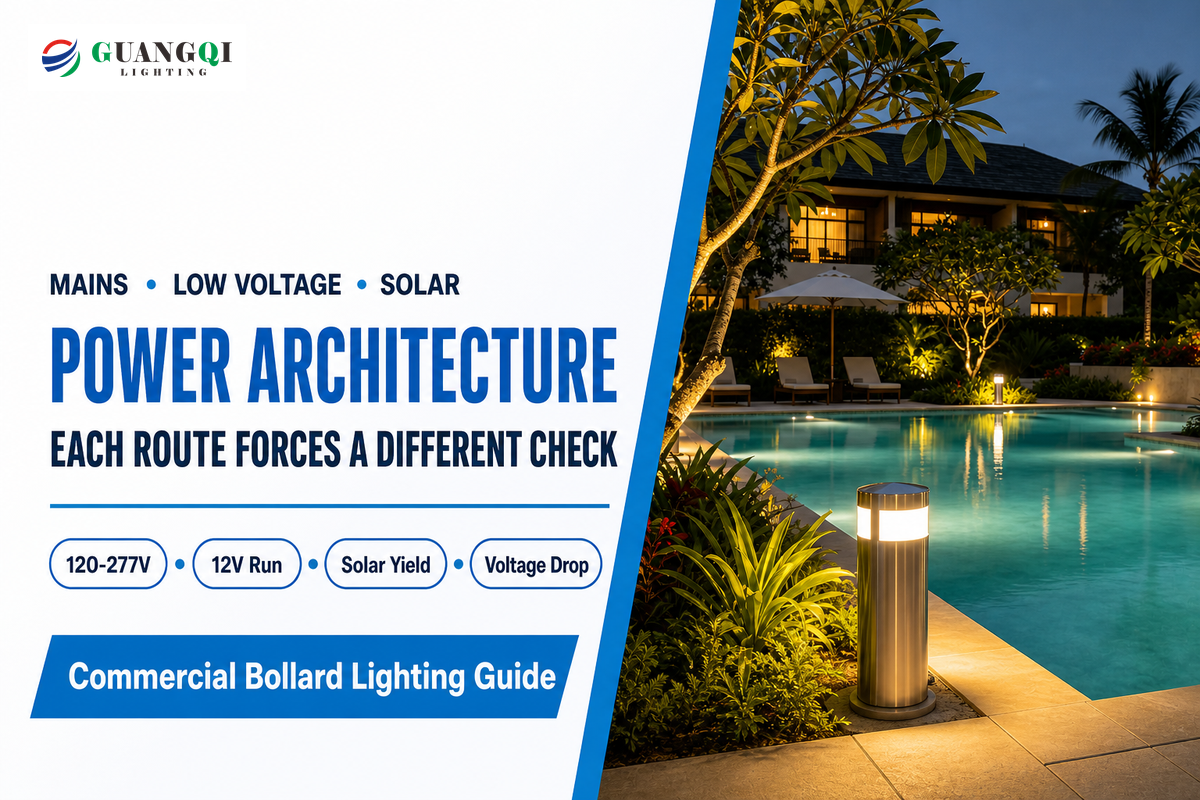
If the site already has a lighting circuit, mains is almost always the answer: every mains bollard in the surveyed catalogues is a universal 120–277 VAC input, which removes voltage as a selection variable entirely. Low voltage and solar are the two cases where that changes, and each one commits you to a check the mains route does not require.
A point that costs projects real money: a 12V landscape supply and a constant-voltage DC LED driver are not interchangeable procurement items, even though both are called “the power supply” in conversation. An AC landscape transformer feeds AC fixtures; a DC driver feeds DC fixtures at 12V, 24V, 36V or 48V with a dimming interface of its own. Your request for quotation has to state fixture input, output type and control interface as three separate lines. Low-voltage landscape systems also sit inside UL 1838, which caps each output circuit at 25 A.
Buyers searching for solar bollard lights commercial projects can actually use are usually asking this question without knowing it. Suppliers describe all three as outdoor lighting solutions, but they are not interchangeable lighting solutions: each one moves a different constraint onto a different trade. Mains moves it onto the electrical contractor, low voltage onto the cable calculation, and solar onto the site survey.
Worked example — sizing a low-voltage supply. Take a courtyard with twelve 12V bollards drawn from a landscape line whose energy-efficient LED fixtures run from 3W to 120W and are offered in both 12V and 24V versions. Specify the 15W option: 12 × 15W = 180W connected load. Hold the supply at an 80% working ceiling, so 180 ÷ 0.8 = 225W minimum, which rounds up to a 300W transformer. Then check voltage drop separately — capacity alone never proves the last fixture on a 130-foot run still receives usable voltage, and the far bollard is the one that dims first. Size the supply, then size the cable; doing it in the other order is how a fully “correct” schedule still ends with a dim corner. A power sizing and voltage drop calculator will do the second half in a minute.
| Architecture | Best when | Mandatory check | Not suitable for |
|---|---|---|---|
| 120–277V mains | A circuit already reaches the area | Exterior lighting power allowance | Sites where trenching is refused |
| 12V low voltage | Landscaping or architectural accent runs | Supply sizing plus voltage drop | Long runs specified on wattage alone |
| Commercial solar | No trenching or cabling is possible | Winter solar yield at the actual latitude | Shaded sites and code-mandated egress routes |
Housing, Ingress and Impact: What Survives Ten Years Outdoors
IP65 per IEC 60529 means the enclosure is dust-tight and protected against water jets from any direction — the first digit is solid-particle ingress, the second is liquid. IP66 raises the second digit to powerful water jets. For a fixture whose base sits where water pools and where de-icing salt collects, that second digit is doing more work than on any pole-top luminaire.
Housing choices come down to four families. Aluminum bollards are the volume option: die-cast aluminum housing with a chromate conversion coating under powder coat, usually in black or bronze. Type 316 stainless with a minimum 2% molybdenum content is the coastal and salt-belt option. Cast iron and concrete are appearance-led. Marine-grade specifications go further: AAMA 2605 paint salt-spray tested for 4,000 hours, with L70 ratings above 100,000 hours on extended-life families.
DoAsk for the IK code in writing, because the datasheet almost certainly will not carry one. Ask which enclosure classification the listing covers. Ask where the gear tray sits.
Don’tRead salt-spray hours as a service-life prediction. Treat an IP number as equivalent to a North American enclosure type. Assume a stated rating survives assembly — a system inherits its weakest component.
On salt spray specifically: ISO 9227:2022, with Amendment 1:2024, is the current edition of the test. It is a process-control check. It is not intended for comparative material ranking and not intended to predict long-term corrosion resistance, so “4,000 hours salt spray” tells you the coating process was under control, not that the fixture lasts a given number of winters. Our IP rating guide for lighting decodes both digits in full. Impact resistance has its own scale — the IK code under IEC 62262 — but as the register above showed, almost nobody publishes it for this product class, so it has to be requested.
Siting and Spacing: How Many Bollards a Walkway Actually Needs
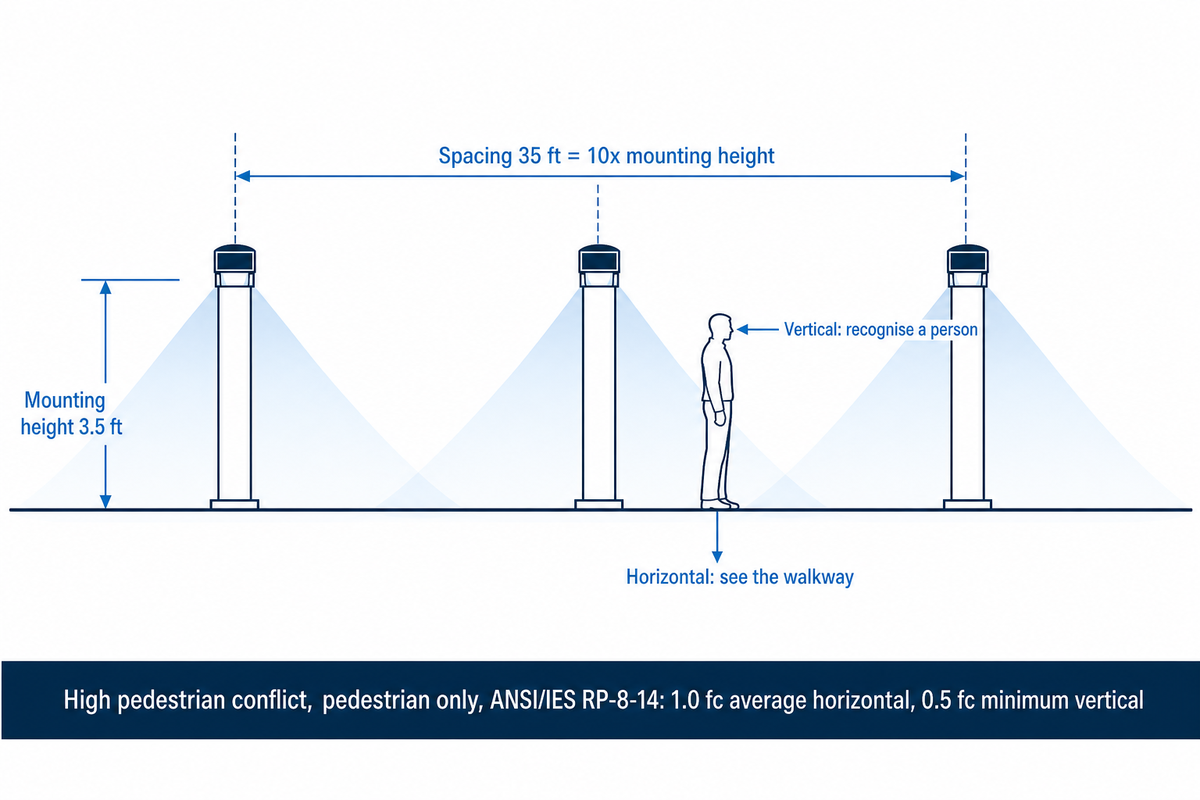
For a pedestrian-only walkway in a high pedestrian conflict area, ANSI/IES RP-8-14 sets 1.0 footcandle average horizontal illuminance with a 0.5 footcandle minimum vertical illuminance and a 4:1 average-to-minimum ratio, as reproduced in the Texas DOT highway illumination manual. Medium and low conflict areas drop to 0.5 and 0.2 footcandles, so the conflict class has to be settled before any spacing is calculated. Spacing follows from those numbers, not from a rule of thumb.
One caveat on the edition: the values below are the RP-8-14 set that this state manual reproduces, and RP-8 has been revised several times since — through RP-8-18, RP-8-21 and RP-8-22 to the current ANSI/IES RP-8-25, published by the Illuminating Engineering Society in 2025. Use these figures to understand how the criteria are structured, and check the edition your jurisdiction has actually adopted before a design is signed. Many state manuals still reference the older edition, which is exactly why the adopted version has to be confirmed rather than assumed.
Distinguishing the two planes is the part almost every spacing guide misses. Horizontal illuminance helps a pedestrian see the walkway. Vertical illuminance helps a pedestrian see and recognize another person on it. Any layout tuned only to horizontal footcandles can meet its own target and still leave you unable to identify someone approaching.
| Area classification | E avg horizontal (fc) | EV min vertical (fc) | E avg / E min |
|---|---|---|---|
| High pedestrian conflict — mixed vehicle and pedestrian | 2.0 | 1.0 | 4.0 |
| High pedestrian conflict — pedestrian only | 1.0 | 0.5 | 4.0 |
| Medium pedestrian conflict | 0.5 | 0.2 | 4.0 |
| Low pedestrian conflict — rural or semi-rural | 0.2 | 0.06 | 10.0 |
| Low-density residential (≤2 dwellings per acre) | 0.3 | 0.08 | 6.0 |
| Medium-density residential (2.1–6.0 per acre) | 0.4 | 0.1 | 4.0 |
| Pedestrian underpass — night | 4.0 | 2.0 | 3.0 |
How Far Apart Should Bollard Lights Be?
Around ten times the mounting height for normal bollard heights, when the design criterion is a modest horizontal minimum — and that qualifier is the whole answer. Manufacturer photometric data shows the pattern: an 18-inch mounting height needs about 15 ft spacing and a 3-foot height about 30 ft, both exactly 10x.
Very low fixtures break the ratio upward — an 8-inch mounting height still needs about 8 ft, which is 12x. Absolute spacing does fall as the source drops, from 15 ft to 8 ft; it simply does not fall as fast as the mounting height does, so the ratio climbs even though each fixture is covering less ground.
All three of those figures are computed to hold roughly 0.1 fc between fixtures. Arithmetic here is additive: if each bollard delivers 0.05 fc at 10 ft, two placed 20 ft apart sum to 0.1 fc at the midpoint.
Worked example — a 200-foot campus path. Take 42-inch bollards, so a mounting height of 3.5 ft, and the Spacing-to-Height Ratio Band of about 10× for that height: 3.5 ft × 10 = 35 ft. 200 ft ÷ 35 ft = 5.7, so six bollards, with the end pair set back roughly half a spacing from each end. That is your first-pass count. Now check it against the criterion that actually applies: if the path is a high-conflict pedestrian-only route needing 1.0 fc average and 0.5 fc minimum vertical, a band computed for 0.1 fc is nowhere near it, and either the spacing tightens or the fixture gets brighter. Practicing landscape architects working to that standard report designing bollard schemes around 0.5–1.5 fc rather than a tenth of a footcandle. The ratio band is a sanity check on a layout, not a substitute for a photometric plan.
Two constraints sit alongside the photometrics. On an accessible route, ADA rules limit a free-standing object with a leading edge between 27 and 80 inches above the ground to a 12-inch maximum overhang from its post, allow any protrusion at or below 27 inches because it falls inside cane sweep, and prohibit any protruding object from reducing the minimum clear width of the route. That is why bollard heads are narrow, and it is why a wide-cap fixture set close to a path edge can create a compliance problem the photometric plan never sees.
The same fixture behaves differently across outdoor spaces with different traffic. On enclosed campus outdoor areas the criterion is uniformity; in exposed outdoor settings next to vehicle routes it is strike exposure. Bollards are also not the only option at this scale — low-mounted pathway lights cover shorter throws at lower cost, and a pole-top fixture covers longer ones.
| Site type | Governing criterion | Typical fit | Not suitable for |
|---|---|---|---|
| Office campus footpath | Pedestrian-only illuminance | Strong | Routes doubling as egress discharge |
| Retail plaza and entrance | Entrance illuminance plus appearance | Strong | Seated areas with long sightlines |
| Parking-lot edge and islands | Mixed vehicle and pedestrian | Supporting only | Lighting the parking field itself |
| Driveway and vehicle approach | Strike exposure | Weak without a barrier | Any location a vehicle can reach |
| Landscape and garden paths | Low-voltage system design | Strong | Runs specified without voltage drop |
| Coastal boardwalk | Corrosion plus wildlife rules | Strong with 316 stainless and amber | Standard powder-coated aluminum |
Dark Sky Compliant? The Codes and Ordinances That Bind an Exterior Bollard
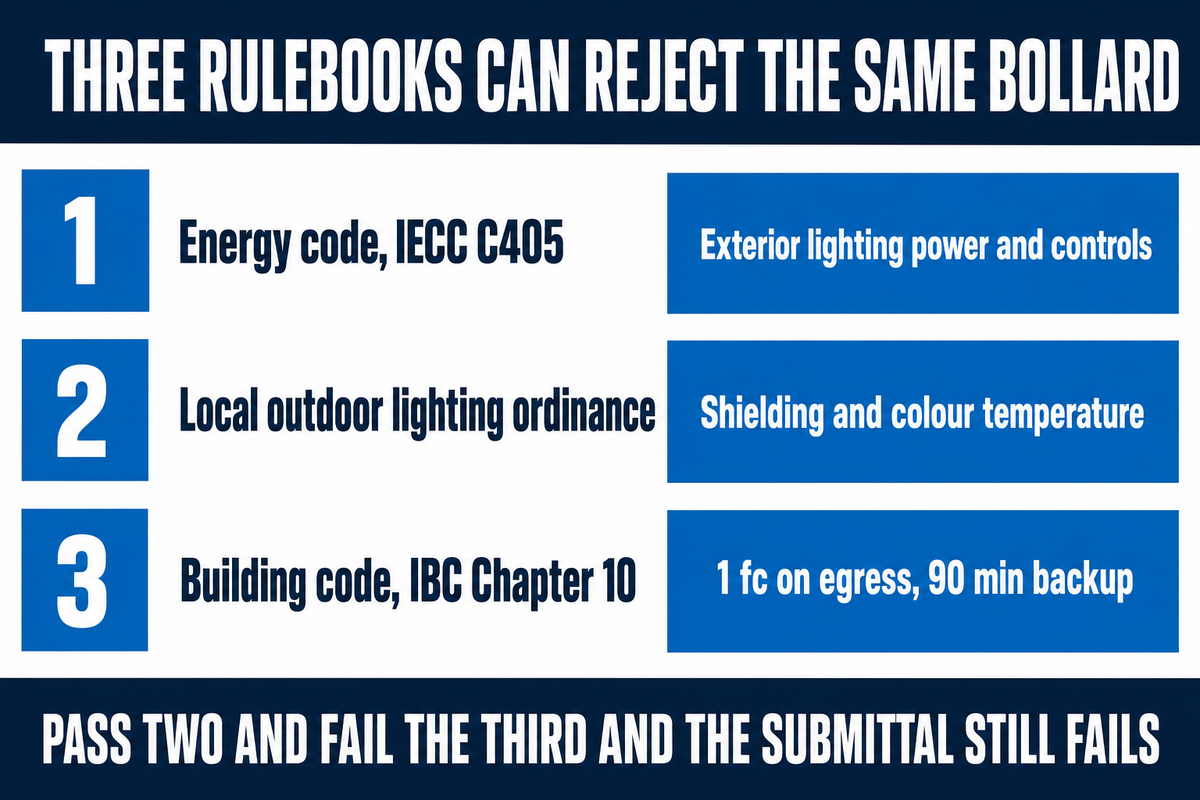
Commercial lighting submittals fail at three separate rulebooks, and each is enforced by different people at different moments. Note that none of the three is a security lighting standard. The model building and energy codes set illumination for egress and cap it for energy; neither requires a walkway to be lit for crime prevention, though some local ordinances do impose security lighting requirements on specific property types. Each of the three rulebooks below is written for a different purpose, which is why one submittal can satisfy two of them and still be rejected by the third.
The energy code governs how much power the exterior lighting may draw and what controls it must have. Local outdoor-lighting ordinances govern shielding and color temperature. And if the path is part of a means of egress, the building code sets a floor on illumination that has nothing to do with either.
On the energy side, the commercial provisions sit in the IECC Section C405 family — exterior lighting power is allocated by space type including parking, walkway and entry, with separate exterior lighting control requirements. The 2024 edition, published by the International Code Council in August 2024, reduces lighting power allowances and expands mandatory controls requirements. California runs its own path: Title 24’s outdoor lighting chapter sets minimum control requirements, maximum allowable power levels, minimum efficacy requirements, and cutoff zonal lumen limits for uplight and glare.
Two tools shorten this check: a dark sky compliance checker for the ordinance side and an exterior lighting energy code compliance checker for the power and controls side.
Egress is the rule that catches people. Where a walkway forms part of a means of egress, the International Building Code — the 2021 edition text is quoted here, and a 2024 edition has since been published — requires illumination of not less than 1 footcandle (11 lux) at the walking surface, extends that requirement along the exit discharge from each exit to the public way, and requires emergency power for not less than 90 minutes, delivering an initial average of 1 footcandle with a minimum of 0.1 footcandle at any point. Catalogue bollards carry no battery and no emergency listing. If the path from a building exit to the street is the exit discharge, standard bollards cannot be the only thing lighting it.
How to Install Bollard Lights: Foundations, Anchorage and Concrete Retrofit
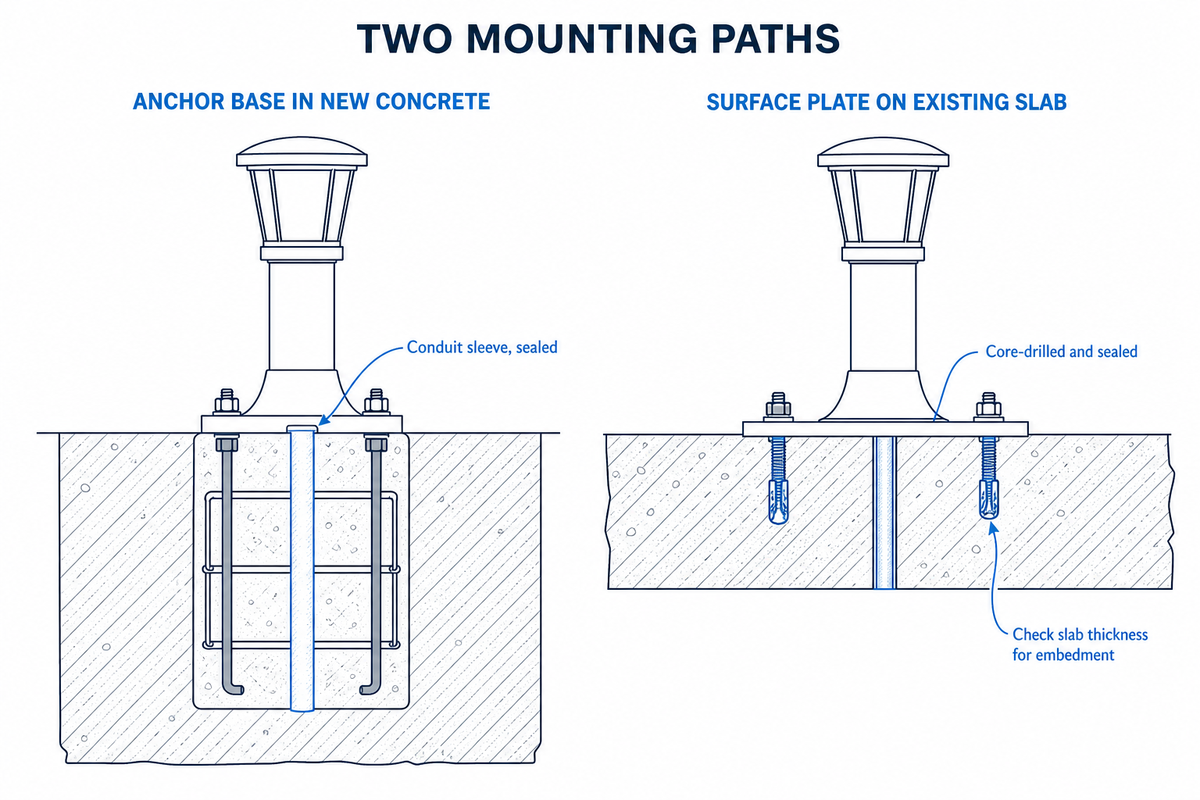
Installation for bollard lights splits into two paths: a poured concrete footing with an embedded anchor kit, or a surface-mount plate bolted to an existing slab. Twenty of the twenty-four models in one surveyed catalogue were surface-mount, which is the retrofit-friendly option and the reason many suppliers advertise the ability to retrofit existing concrete applications.
Anchorage is where field failures cluster. Practitioners describe replacing driveway bollards that fell over in high wind and became unsafe — a base and anchorage problem, not a lamp problem. If a bollard is going into landscaped ground rather than structural slab, the pad has to be sized for overturning, not just for weight, and the cable entry has to be cored and sealed rather than left as a gap for water.
How Can You Install Bollard Lights in Existing Concrete?
Core-drill for the conduit, then bolt a cast mounting plate to the slab with anchors sized by the manufacturer. Vandal-resistant designs typically fix the head to the body with tamper-resistant set screws and anchor the plate into cement with steel bolts.
Two details decide whether the retrofit lasts: seal the core penetration so water cannot track down the conduit into the base, and confirm the slab is thick enough for the specified anchor embedment before the order is placed. Where the existing slab is thin or cracked, a surface plate on an inadequate substrate simply relocates the failure from the fixture to the concrete. Setting the plate on a shallow pad cored for the cable, rather than directly on suspect slab, is the common field fix.
Controls and Integration Requirements
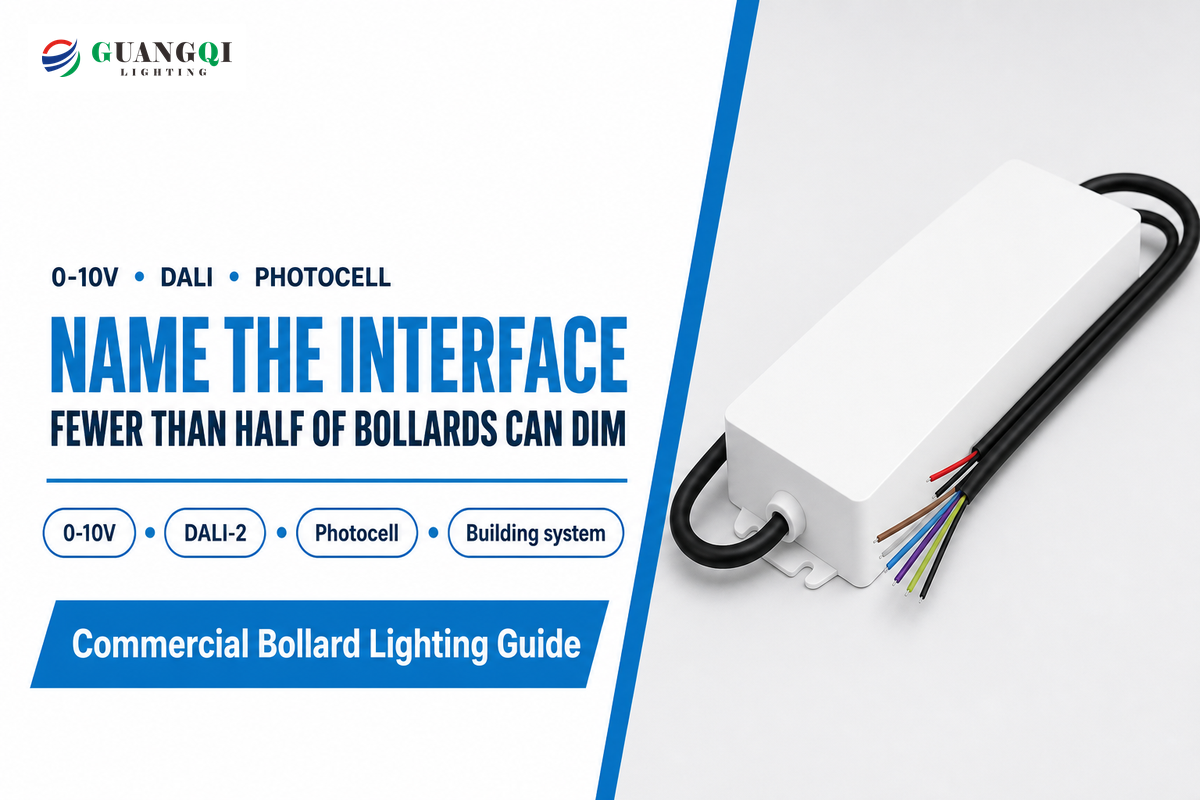
If the site runs on a schedule, the fixture schedule has to name the control interface, because fewer than half of commercial bollard models carry one. In a 24-model catalogue, 0–10V dimming appeared on 11 models; the rest offer photocell and timeclock switching only, which is on-or-off and nothing between.
That matters more than it used to, because ordinances are starting to require curfew behavior rather than merely permitting it, and a fixture that cannot dim can only be switched off. Customizable lighting — field-selectable output and color on the fixture, plus a dimming interface back to the panel — is what turns a curfew clause from a rewiring job into a commissioning setting. Where a building-management head-end is involved, the schedule also has to state the protocol path to it. Guangqi publishes a first-party integration compatibility list naming Honeywell WEBs-AX and Niagara, Johnson Controls Metasys, Siemens Desigo, Schneider EcoStruxure and Trane Tracer as supported head-ends for its DALI-2 control products, alongside a lighting control protocol selector for choosing between DALI, 0–10V and DMX paths, and a BMS integration compatibility checker that names the head-ends directly. Naming the head-end in the request for quotation converts “BMS compatible” from a marketing phrase into something the controls contractor can verify before installation.
When Bollard Lights Are the Wrong Choice, and What Goes Wrong in the Field
Unlike most fixture categories, bollards fail in ways that show up on the walkway rather than in a maintenance log — glare at eye level, a dark midpoint, a post knocked flat. An institutional lighting study makes the point more bluntly than any supplier would:
Bollards have been used in some entry plazas [which] have very little optical control and are offensively glaring to pedestrians.
— University of Virginia Exterior Lighting Study, Office of the Architect
That is an owner describing its own installation, which is worth more than any vendor caveat.
A related misconception is that more light is safer. Beyond a point it is not. Federal research on pedestrian lighting reports that the benefit saturates: past a moderate level of illuminance on a pedestrian’s face, more light stops improving recognition. Which level counts depends on the metric, because vertical and semi-cylindrical illuminance are measured on different geometries and do not convert into one another, so a saturation threshold has to be read against whichever plane the specification actually uses. DarkSky International documents the American Medical Association’s finding that glare from nighttime lighting creates hazards at every level from mild discomfort up to frank visual disability, alongside a 2015 study across 62 local authorities in England and Wales in which reducing, dimming or switching off street lighting did not worsen collisions or crime. The honest reading is not that light is harmful — other research finds improved illumination reduces pedestrian injury — but that the benefit saturates and then reverses into glare. At bollard mounting height, where the source sits near eye level for a seated or approaching person, that reversal arrives sooner than it does on a pole.
Search behavior around this product is itself a clue to where buyers get stuck. People look for commercial LED bollard lights, commercial solar bollards and commercial bollard light fixtures interchangeably, and then narrow to concrete bollard lights or to residential bollard lights once they realize the two markets carry different listings and different price bands. If a quotation cannot tell you which of those it is answering, it is not yet a comparable quotation.
Serviceability deserves its own line in the quotation. Medium-socket designs accept standard A19 and A21 LED bulbs, so a lamp change is a two-minute job; integrated-array fixtures require a gear-tray or whole-head replacement instead. Neither is wrong, but they carry very different ten-year labor costs.
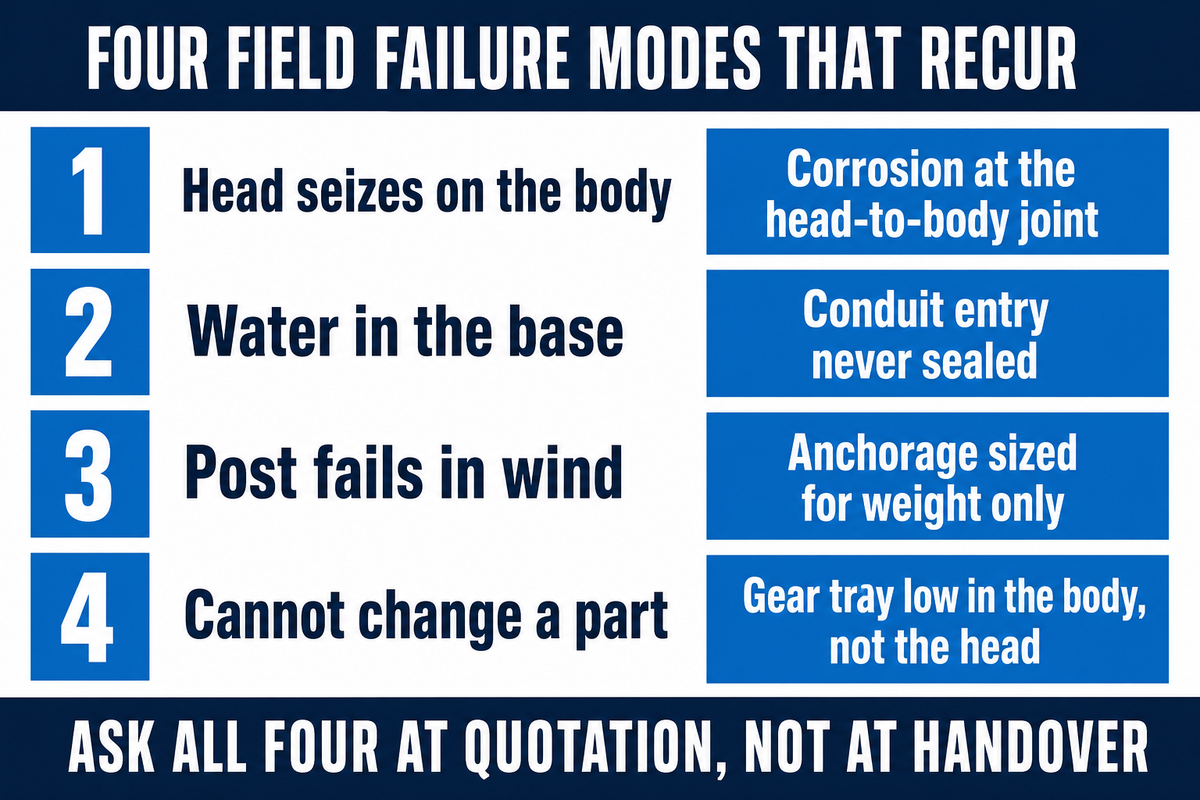
Four field failure modes recur: corrosion seizing the head-to-body joint so the gear cannot be reached; water tracking down the conduit into the base after a professionally installed job; anchorage failure in wind; and a gear tray mounted low in the body rather than in the head, which means the whole fixture has to come apart to change a component. That last one is a serviceability question worth asking at quotation, because it decides whether a ten-year maintenance visit is twenty minutes or a replacement.
RFQ checklist — copy these into your quote request:
| Parameter | Recommended range | Why it matters | How to verify |
|---|---|---|---|
| Delivered lumens | Stated per CCT, 390–3,360 lm | Source lumens overstate output | Photometric file (IES) on request |
| CCT and selectability | 3000K or lower; selectable preferred | Ordinance caps are tightening | Switch position photo plus datasheet |
| IP rating | IP65 minimum, IP66 coastal | The base sits in standing water | Test report referencing IEC 60529 |
| IK impact code | IK08 or better on public sites | Rarely published; must be asked for | IEC 62262 test evidence |
| Control interface | 0–10V or DALI if a schedule exists | Under half of models can dim | Wiring diagram plus head-end name |
| Gear tray position | Head-accessible | Decides in-place serviceability | Section drawing of the head |
| Anchorage detail | Anchor kit or plate, with embedment | Overturning is a real failure mode | Foundation detail sheet |
| Listing and qualification | UL/ETL; DLC where rebates apply | Rebates are refused without it | Listing number and DLC ID |
What’s Changing in 2026 and What It Means for Your Next Order
Color temperature has stopped being an aesthetic field and become a procurement-risk field on any project with a lead time. The reason is a wave of municipal outdoor-lighting ordinances arriving with hard numeric ceilings rather than guidance, on a legislative clock that runs slower than a construction program and therefore lands mid-project.
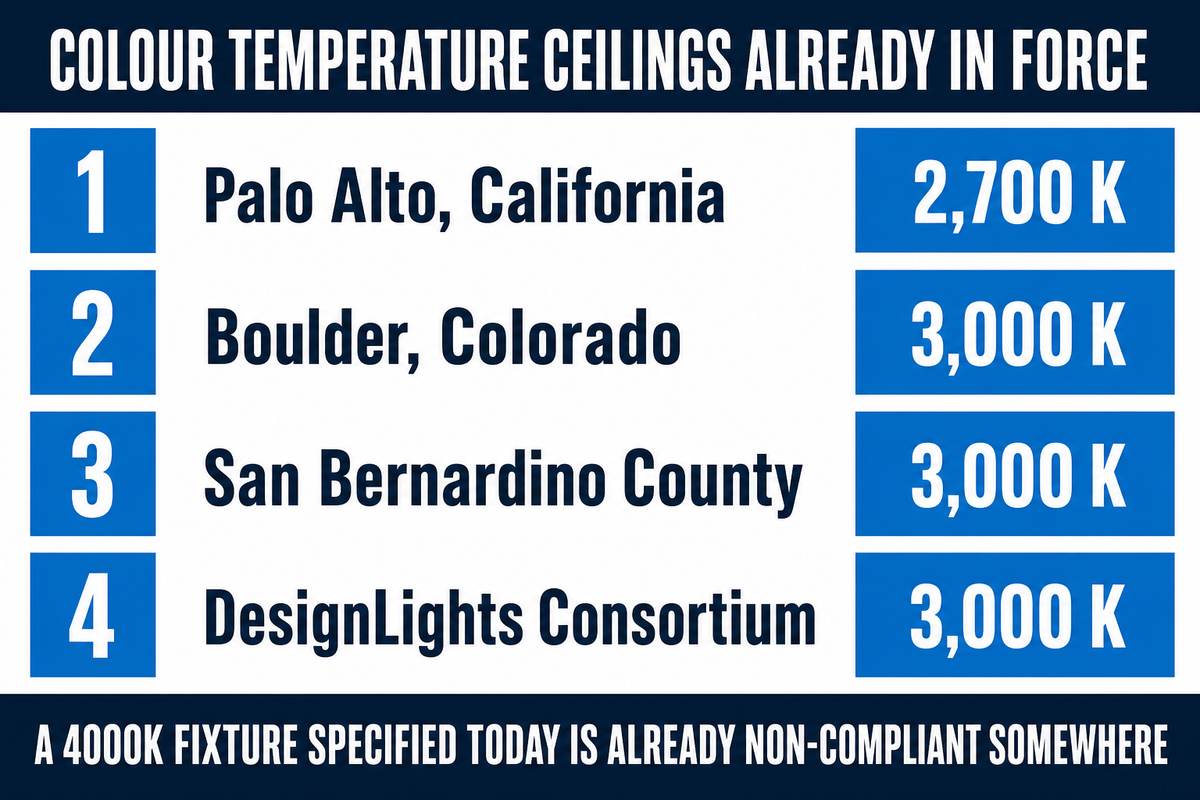
Palo Alto’s updated outdoor lighting regulations took effect on 20 February 2026: all outdoor lighting must be fully shielded, must use warm-colored light at 2,700 Kelvin or less, and must be switched off or on motion control by 11 p.m., two hours after business closing, or one hour after exterior areas stop being used, whichever is later — with existing lighting given until 20 February 2027.
Boulder caps outdoor lighting at 3,000 Kelvin, requires the source to be shielded with no upward projection, and requires a lighting certification signed by an architect, electrical engineer, electrical contractor or lighting consultant. San Bernardino County caps all outdoor lighting at 3,000 Kelvin except seasonal lighting. DesignLights Consortium guidance for ordinance drafters uses the same 3,000K ceiling.
The Amber TurnThe direction of travel is one-way and toward warmer light. A 4000K bollard specified today is already non-compliant in several jurisdictions, and the ordinance calendar runs on a slower clock than a construction program. On any project with a long lead time, selectable CCT is not an upgrade — it is insurance against a rule that changes between specification and handover.
Demand data points the same way. Over the past twelve months, searches for low-voltage and solar bollard variants and for pedestrian-scale lighting rose while the head term stayed flat, and a five-year check reads stable rather than declining. Buyers are not buying more bollards; they are buying different ones.
Frequently Asked Questions
Q: What are commercial bollard lights?
Commercial bollard lights are short vertical luminaires, typically 18 to 45 inches tall, that illuminate pathways and walkways from below eye level, most often on a universal 120-277V input and at a published illuminance criterion rather than by eye.
They are used across commercial spaces to define pedestrian routes, mark boundaries between people and vehicles, and light landscaping or architectural features without the glare of a pole-top fixture. Low-voltage and solar versions exist alongside the mains type. They are luminaires only, and provide no physical protection whatever the housing is made of.
Q: What is the difference between a bollard light and a security bollard?
A bollard light is a luminaire with no crash rating; a security bollard is a barrier tested to stop a vehicle, and the two are governed by entirely different standards.
Impact-rated posts are tested to ASTM F3016 for low-speed protection using a 5,000 lb vehicle at 10, 20 or 30 mph, or to ASTM F2656 using M30, M40 and M50 designations for a 15,000 lb truck. The K4, K8 and K12 labels still in use are legacy US Department of State ratings, not ASTM designations. A lighted bollard carries none of these.
Q: What styles of bollard lights are available?
Four head styles dominate: flat top, round dome top, round bevel edge and square flat top, each offered with louvers, a cone reflector, a lens or cover plates.
Round and square bodies are both common, usually in a black or bronze finish, and one surveyed catalogue also offered white, silver, traffic gray, verde green and dark gray. Body diameters observed run from 6 to 11 inches. Head style is largely chosen to be aesthetically pleasing; the optic inside it is not, because it changes measured output substantially. A louvered head and a cone-reflector head can sit on one body, carry one price, and still differ by roughly 46 percent in delivered light.
Q: Are solar bollard lights bright enough for commercial use?
Often yes for amenity paths, and rarely for anything carrying a code-mandated illuminance floor, because the winter yield at your actual latitude and shading is what governs rather than the summer output printed on the box.
Ask the supplier for the December autonomy figure at your latitude, not the rated lumen output, and ask how many consecutive overcast nights the battery covers. A solar bollard that meets a plaza’s amenity brief in July can sit dark on a January morning shift.
Q: What color temperature should commercial bollard lights use?
Specify 3000K or lower, and prefer a field-selectable fixture wherever an ordinance may apply, because several jurisdictions already cap outdoor lighting at or below 3000K and one now requires 2700K or less.
Boulder and San Bernardino County both cap outdoor lighting at 3,000 Kelvin, and Palo Alto’s ordinance, effective February 2026, requires 2,700 Kelvin or less. DesignLights Consortium guidance for ordinance drafters uses 3,000K as the maximum allowable CCT. Coastal wildlife zones go further still: 590 nm amber is used where turtles nest, because long-wavelength light disturbs them far less than white light, though certification also requires shielding. Because these rules change on a slower cycle than a construction program, a fixed 4000K fixture specified early in a project can be non-compliant by handover, whereas selectable CCT and wattage keeps the decision open until commissioning. Where lighting is customizable in the field, compliance stops being a procurement gamble.
Q: Are concrete bollard lights better than aluminum?
Concrete wins on appearance and mass, while die-cast aluminum housing wins on serviceability and corrosion behavior; for salt-belt or coastal sites, Type 316 stainless outperforms both, and mass alone confers no impact rating on any of them.
The practical difference shows up at year eight rather than year one: a concrete body cannot be refinished on site, an aluminum one can be, and a seized head-to-body joint is the failure that decides whether either can be serviced at all.
Q: Where can you install bollard lights?
Anywhere a pedestrian route needs illumination from below eye level and no vehicle can reach the fixture: campus footpaths, retail plazas, building entrances, garden and landscape paths, and boardwalks. Parking-lot edges work as supporting lighting only, and driveways are the common mistake.
The two placements to check before ordering are a route that doubles as an exit discharge, which carries a code-mandated illuminance floor and a 90-minute emergency-power requirement that catalogue bollards cannot meet, and any position a vehicle can reach, where a luminaire offers no protection whatever its wall thickness.
Related Articles
- IP rating guide for lighting the full IEC 60529 digit decode behind the ingress section above
- low voltage landscape lighting transformer sizing the supply-side calculation in detail
- landscape lighting design guide how bollards fit a wider scheme
- commercial LED street lights the fixture class to use where a bollard is the wrong scale
References & Sources
- Highway Illumination Manual, Pedestrian Areas (ANSI/IES RP-8-14 values) Texas Department of Transportation
- International Building Code, Chapter 10: Means of Egress Illumination International Code Council
- Guide to the ADA Accessibility Standards, Chapter 3: Protruding Objects United States Access Board
- Lighting Ordinance Update, effective 20 February 2026 City of Palo Alto, California
- Outdoor Lighting Ordinance City of Boulder, Colorado
- Outdoor Lighting Regulations San Bernardino County Land Use Services
- Outdoor Lighting, Crime and Safety: the evidence DarkSky International
- ISO 9227:2022, Corrosion tests in artificial atmospheres, Salt spray tests International Organization for Standardization
- ASTM F2656/F2656M-23, Vehicle Crash Testing of Perimeter Barriers ASTM International
- ASTM F3016/F3016M, Surrogate Testing of Vehicle Impact Protective Devices at Low Speeds ASTM International
- DoD Anti-Ram Vehicle Barrier List US Army Corps of Engineers
- Design Standards Appendix J: Lighting City of Issaquah, Washington
- Outdoor Lighting Ordinances guidance DesignLights Consortium
- Lighting Design Manual US Department of Veterans Affairs
About This Specification Guide
The ranges in this guide come from a cross-manufacturer read of 40 catalogued commercial bollard models sold by three manufacturers, not from any single product line, which is why the height, lumen and price spans are wider than one catalogue shows. Where a figure was reported by a source whose underlying dataset we could not obtain — the national pedestrian-lighting saturation research is the main case — it is attributed to the publication that reported it rather than presented as our own measurement. Published by Guangqi Lighting, a manufacturer of commercial outdoor lighting in Zhongshan, China.