Get in Touch with GUANGQI



Updated August 2026
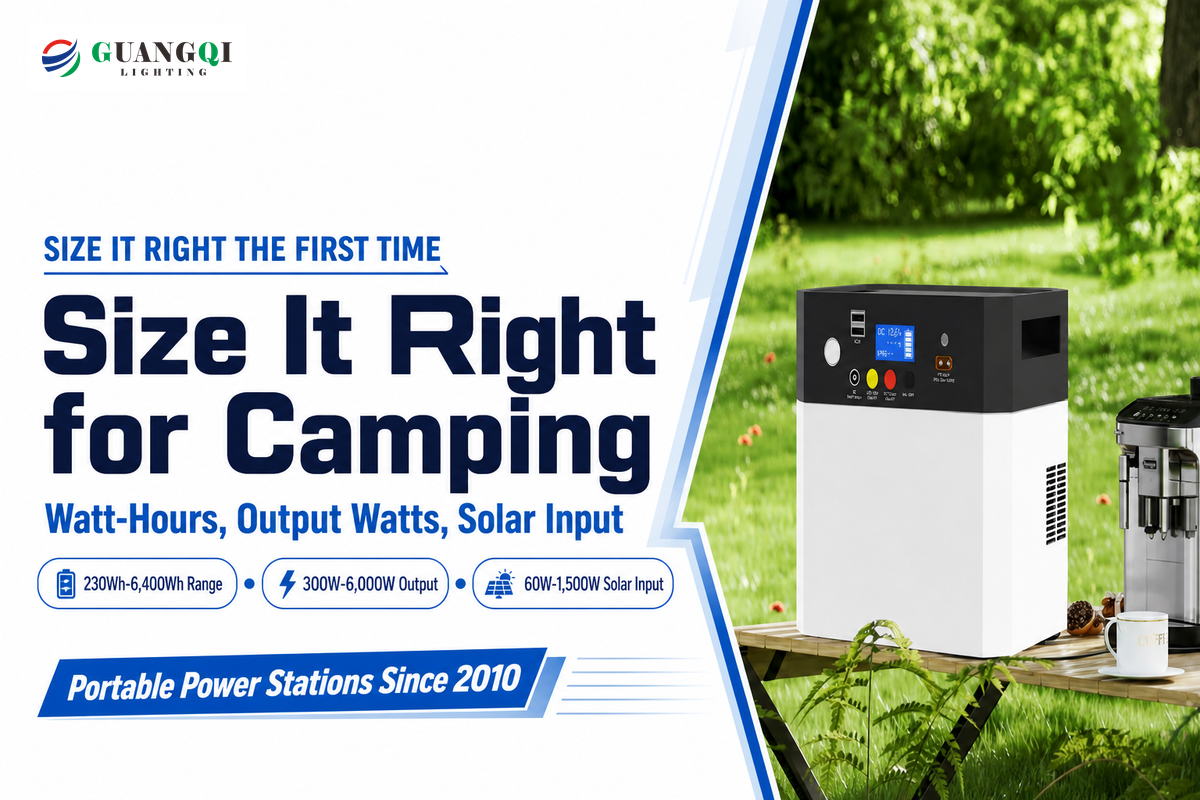
A portable power station for camping is a battery-and-inverter unit that stores power and outputs it as AC, DC, or USB for lights, devices, a cooler, and other camp gear in the field. Sizing one for a specific trip comes down to three numbers: watt-hours (battery capacity) for available energy, output watts (power output) for how fast you can draw that energy, and solar input watts (recharge rate) for how fast you refill it off-grid. Nail all three and the rest is detail. Flop even one and either you’ve spent money on storage you’ll never touch, or you’re stuck with a cooler that dies at 2 AM. Here’s the math behind each one, with some real numbers plugged into a seven-unit product line for context.
Call it the 3-Number Sizing Rule: watt-hours are your carry capacity, output watts are your delivery rate, and solar input watts are your refill speed off-grid — strength on one number never covers weakness on another.
230-6,400 Whbattery capacity, 7-tier lineup
300-6,000 Wpower output range
60-1,500 Wsolar input range
3.4-50+ kgweight, compact to rugged tier
How Big of a Power Station Do You Actually Need?
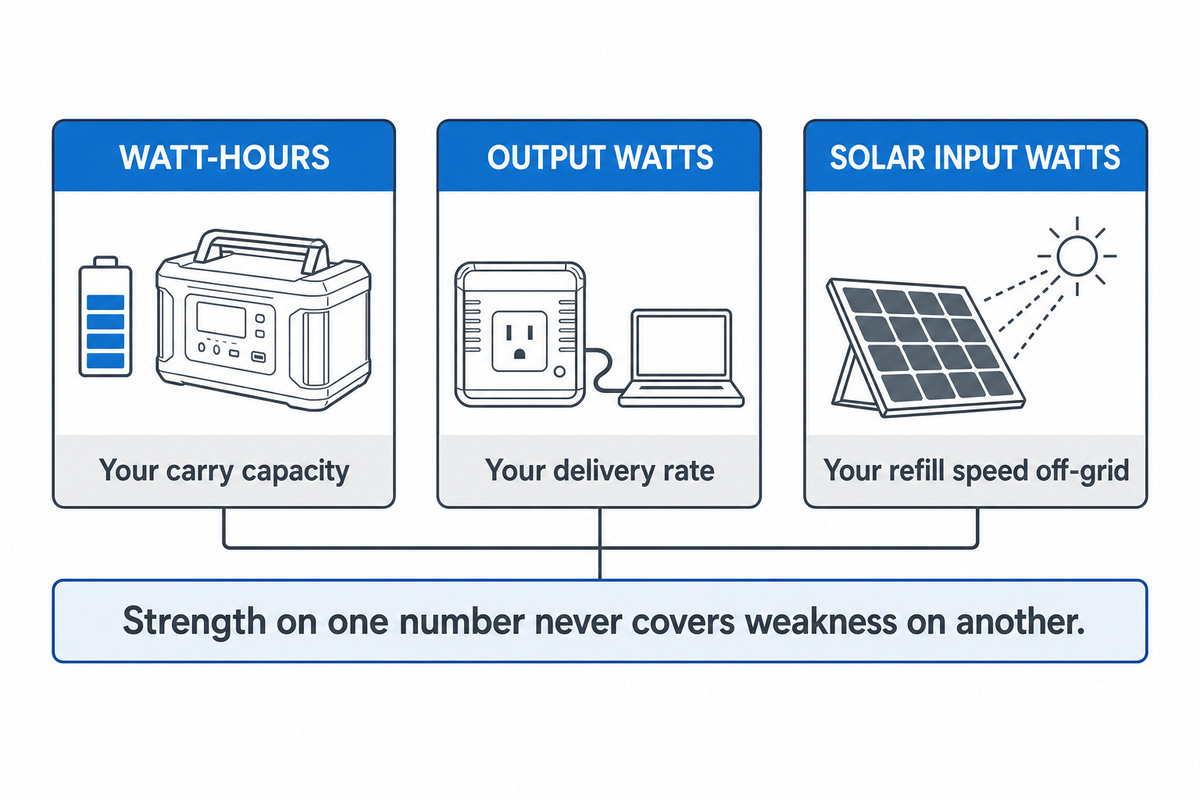
The 3-Number Sizing Rule: Your watt-hours are your carry capacity; output watts are your power delivery rate; and your input watts are how fast you get topped up off-grid. Power in one area doesn’t necessarily compensate for weakness in another — a device with high battery capacity and a low power inverter rating isn’t going to run a compressor cooler; and a fast solar recharge doesn’t help if you’re shaded at your campsite.
Many of the reviews out there pick apart named power stations on the market — a Jackery power station, an Anker power station (Anker Solix), EcoFlow’s Delta 2 and Delta Pro, a BLUETTI power station, the DJI Power 1000, and a Goal Zero Yeti all land on store shelves on the same plane — but few run through this math, and there’s no single best portable power station for every camping scenario; there’s only the size that matches your own power needs. Specialized testing websites do a lot of power station testing for durability and battery performance, and help identify the best power station for a given use case — use them to select a maker that fits your needs, but do your sizing homework first.
Whether for a weekend camping trip or an extended foray into camping and off-grid travel, calculating your own power requirements and power usage before buying a power station will save you money in the short and long run — most people who end up using power stations that die mid-trip skipped this math and bought on price or brand instead. If this is your first time buying a power station, it’s common to let the price or brand be the top factors; this is an opportunity to reverse that decision and let your actual needs come first.
Concretely: a 1,280Wh unit with a 1,000W inverter carries two nights of lights and phone charging without strain, and clears a 12V camp cooler’s startup surge too — but a full-size compressor fridge, measured at over 1,500W of startup surge in one teardown, is what would trip an inverter that size. Which number fails first depends on the load: a spec sheet ranks units by the biggest number on the box, but a real trip fails on whichever of the three you sized last — capacity on a long cooler-equipped weekend, output the moment a big compressor load starts. Capacity, output, and solar-input ranges quoted throughout this guide — 230-6,400Wh, 300-6,000W, 60-1,500W — come from Guangqi Lighting’s own seven-tier LK-series lineup; the sizing math and appliance draws come from a municipal utility’s appliance chart and published appliance-consumption references, not from any single manufacturer’s marketing copy; the certification, travel, and recall context elsewhere in this guide is cited to FAA, UL Solutions, and CPSC directly.
The Watt-Hour Sizing Math
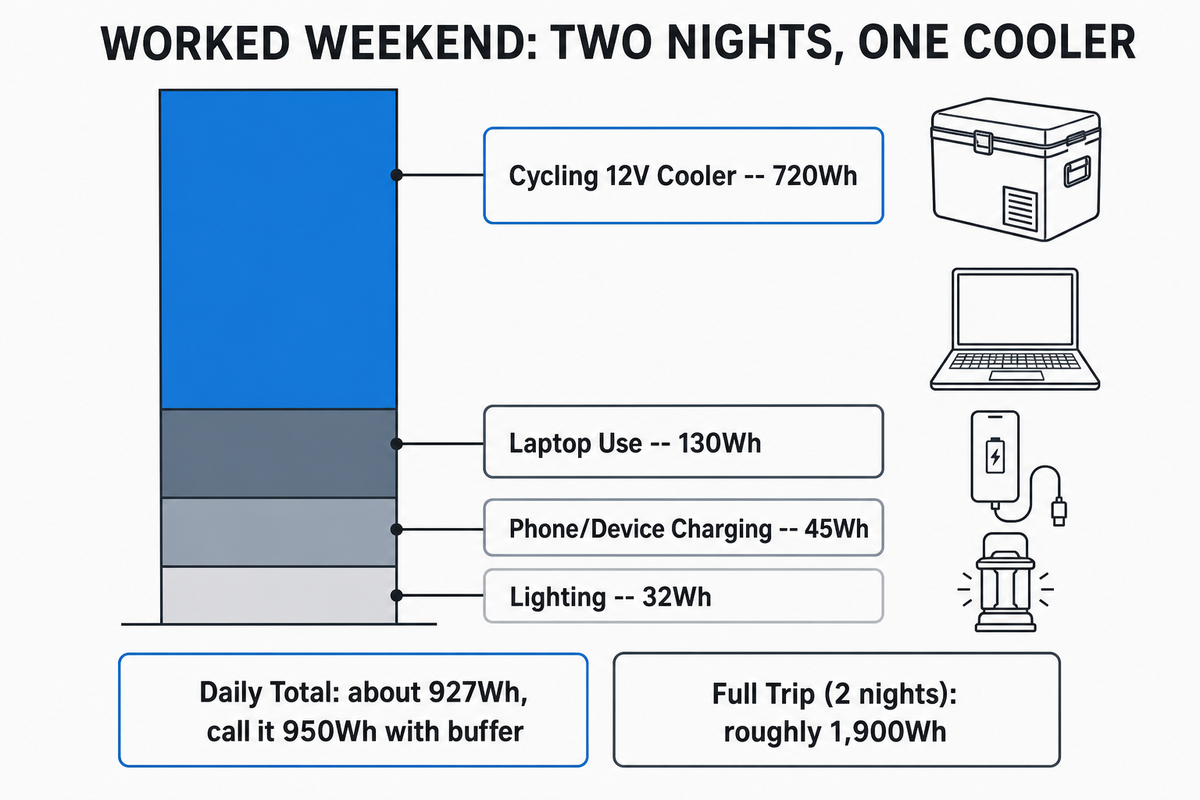
Multiply each device’s wattage by the number of hours it’ll be in use to calculate the Wh (watt-hours) it’ll consume. Cross-verified figures for camp gear: an LED lantern or camp light draws 7-10W, a USB or AC-powered phone charger runs about 15W combined, a laptop pulls 50-100W, and a 12V compressor cooler draws 50-75W while its compressor runs. A power station with 100 watts of power capacity can power lights and chargers; but the 12V cooler, with its cycling compressor, will easily put a strain on most of the smaller, cheaper power stations.
Worked weekend: two nights, a couple, lights, device charging, some laptop use, and a cycling 12V cooler. Lighting adds 32Wh, charging adds 45Wh, laptop use adds 130Wh, and the cooler — because it cycles rather than running flat-out — averages near 720Wh per day. Daily total comes to about 927Wh, call it 950Wh with buffer, or roughly 1,900Wh for the full trip. Against the reference lineup, a 1,280Wh unit runs about 600Wh short before the trip ends; a 2,432-3,072Wh unit covers it with room for an unplanned recharge.
If your own total lands above one unit’s capacity, expansion batteries are the other option besides buying a bigger single box — where a model supports them, an add-on module can be cheaper than stepping up a full tier. Check the spec sheet for expansion support before assuming it. To run your own device list against every tier at once instead of doing this math by hand, plug your numbers into the calculator here.
| Trip Type | Daily Wh Need | Recommended Capacity | Recommended Output | Recommended Solar Input | Limitations |
|---|---|---|---|---|---|
| Day trip, phone charging only | ~50 Wh | 230 Wh | 300 W | 60 W | No headroom for any cooling appliance |
| Solo overnight, lights + phone, no cooler | ~150 Wh | 230-576 Wh | 300-600 W | 60-150 W | Add ~130 Wh if a laptop joins for long sessions |
| Weekend (2 nights), couple, no cooler | ~250 Wh | 576-1,024 Wh | 600-1,000 W | 150-200 W | Add ~900 Wh over the trip if a cooler joins |
| Weekend (2 nights), couple, with 12V cooler | ~950 Wh | 2,000+ Wh | 1,000-1,500 W | 200 W | A 1,280 Wh unit alone runs ~600 Wh short |
| Small group (3-4), 2 nights, cooler + devices | ~1,400 Wh | 3,000+ Wh | 1,500-2,500 W | 200 W | Near this tier’s ceiling with any extra draw |
| Extended camping (4-5 days), cooler, no daily solar | ~950 Wh | 5,000+ Wh | 2,500-3,500 W | not applicable | Heavy (50 kg+) to haul without recharge |
| Extended camping (4-5 days), cooler, with daily solar | ~950 Wh | 2,000-3,000 Wh | 1,500-2,500 W | 200-400 W | Needs 4-5 peak sun hours daily to keep pace |
| Backpacking, minimal, no cooler | ~80 Wh | 230-300 Wh | 300 W | 60 W foldable | 3.4 kg is still heavy for true ultralight trips |
| Van-life / full-time off-grid camping | ~1,800-2,500 Wh | 3,000-6,400 Wh | 3,500-6,000 W | 1,000-1,500 W | Rugged 50 kg+ units are fixed-install, not grab-and-go |
Capacity/output/solar-input columns reference a 7-tier lineup spanning 230-6,400 Wh.
Matching Output Wattage to What You’ll Run
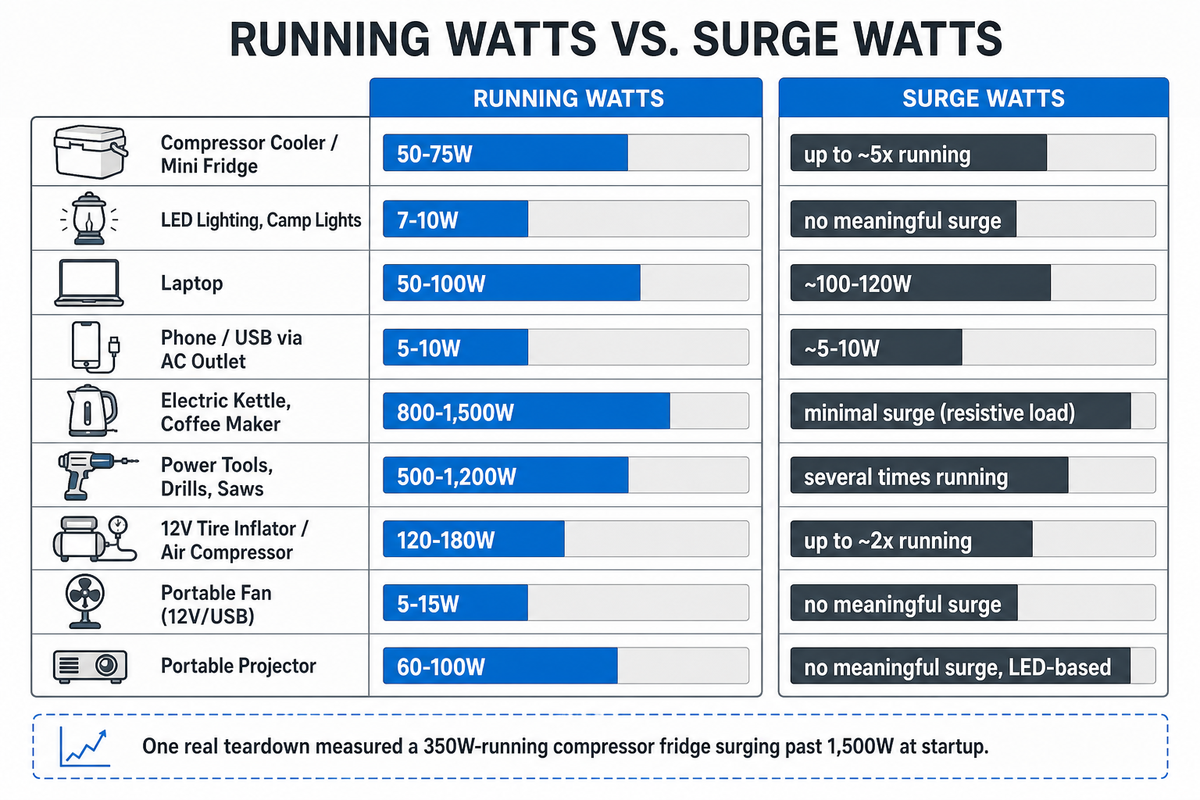
Watt-hours tell you how long you can run something; power output tells you whether it turns on. One real teardown of a 350W-running compressor fridge measured a startup surge near 5x that figure, over 1,500W for a fraction of a second, with a frost-free defrost cycle adding up to 800W more. That’s one real measurement, not a universal constant, but it matches buyer-mistake write-ups that specifically call out ignoring surge ratings as a common way to undersize a unit.
| Appliance Category | Running Watts | Surge Watts | Failure Mode If Undersized |
|---|---|---|---|
| Compressor cooler / mini fridge | 50-75 W | Up to ~5x running (single-source measurement) | Trips at startup if output is sized to running watts alone |
| LED lighting, camp lights | 7-10 W | No meaningful surge | Not a sizing risk |
| Laptop | 50-100 W | ~100-120 W | Rarely an issue |
| Phone / USB via AC outlet | 5-10 W | ~5-10 W | Not a sizing risk |
| Electric kettle, coffee maker (resistive) | 800-1,500 W | Minimal surge, resistive load | A capacity problem, not surge — exceeds compact tiers’ output rating outright |
| Power tools, drills, saws | 500-1,200 W | Several times running, motor-driven | Same undersized-output risk as compressor loads |
| 12V tire inflator / air compressor | 120-180 W | Up to ~2x running, motor startup | Same undersized-output risk as other motor-driven loads |
| Portable fan (12V/USB) | 5-15 W | No meaningful surge | Not a sizing risk |
| Portable projector (camp movie night) | 60-100 W | No meaningful surge, LED-based | Not a sizing risk |
Compressor cooler, LED lighting, laptop, phone/USB, and resistive-load figures are cross-verified against published appliance-consumption references; tire inflator, portable fan, and projector figures are typical manufacturer-spec ranges for those device categories.
Check a device’s surge or “peak” rating, not just its running-watt number, against a station’s power output rating — and for compressor loads, leave real headroom rather than sizing to the running figure alone. Units acting as an uninterrupted power supply for a CPAP or a home router draw their own separate load profile, not covered by this trip-focused math. Using AC power for a laptop charger instead of the unit’s DC or USB-C output loses a small amount to inverter conversion, worth knowing if you’re running the numbers tight.
Sizing the Solar Input
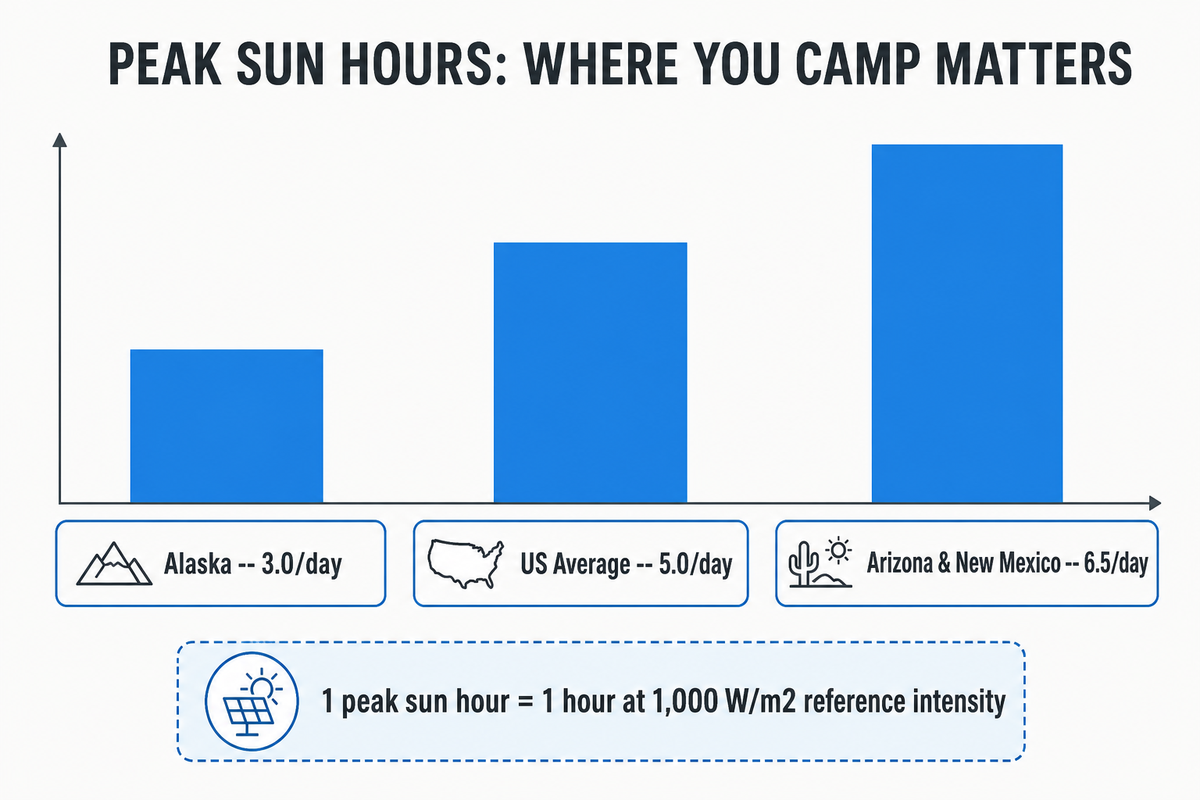
Solar recharge speed is watts of solar multiplied by peak sun hours, not hours of daylight — the gap between those two numbers is where buyers overestimate recharge speed. One peak sun-hour equals one hour at a reference intensity of 1,000 W/m2; the US average runs about 5.0/day, from 3.0/day in Alaska to 6.5/day in Arizona and New Mexico, per state-level peak sun hour tables compiled from NLR/NSRDB data (National Laboratory of the Rockies, renamed from NREL in December 2025).
Summer campsites might see 12-14 hours of daylight but bank only 4-5 peak sun hours — early and late light is too weak to move much solar power. Foldable portable solar panels are the standard field option for off-grid adventures, and pairing one with a mid-tier unit is what actually extends a trip, not just a bigger battery. A 100W portable panel is the common entry point for lighter kits; step up to 200W or more for faster recharge on longer trips. Worked example: a 200W panel at 5 peak sun hours and a realistic 0.8 derate factor delivers about 800Wh in a good day (200 x 5 x 0.8). Against the 950Wh/day weekend load above, that’s close to a wash for a cooler-equipped trip, but it meaningfully extends a mid-size unit before it needs a wall-outlet top-up.
Cold weather adds a variable this math skips by default: lithium batteries, including the LiFePO4 chemistry common in these units, typically hold only 70-80% of rated battery capacity near freezing. A unit sized exactly to a summer trip can fall short on a cold-weather or high-altitude trip for that reason alone — build in headroom, or keep the unit above freezing overnight.
Key takeaway
Panel wattage is a best-case ceiling, not a daily guarantee — size solar input against your state’s peak sun hours, not the number on the box.
See the portable power station category page for a broader look at how portable solar and battery capacity fit into a full off-grid setup — it covers the full lineup referenced throughout this guide.
How Long Is Your Trip?
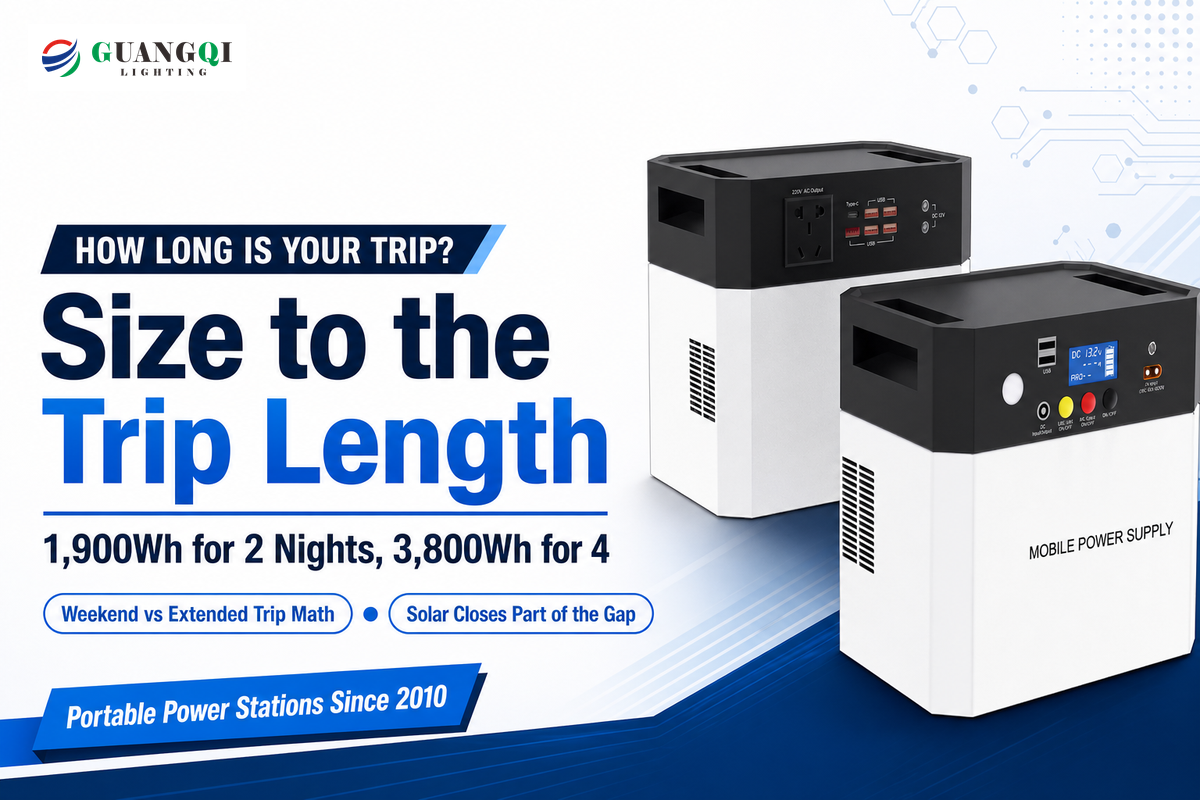
Your trip length influences what size unit you need more than any single piece of gear. Weekend getaways and week-long off-grid outings with the same devices don’t need the same unit — the longer trip needs either several times the storage or daily solar recharge to reset the math.
That calculus applies whether you’re sleeping in a tent, RV, or campervan; a rechargeable battery pack suitable for a two-night camping trip quickly empties in a campervan running lights and an evening laptop charging. Owner threads in overlanding and camping communities repeatedly surface trip length, not appliance choice, as the sizing decision people revisit after a trip — not a single citable statistic, but a consistent pattern across independent buyer discussions. Run the math out: the same 950Wh/day cooler-equipped load from the worked weekend above is 1,900Wh over two nights but 3,800Wh over four — past what any unit below the 5,000Wh tier can cover without a recharge. A 200W panel banking roughly 800Wh on a day with 5 peak sun hours closes most of that gap and keeps a 2,000-3,000Wh unit viable for the longer trip instead of forcing a jump to the next tier up. That same daily load also behaves differently by rig: a tent means everything is carried in with no top-up, an RV gets an occasional shore-power reset, and a campervan build with alternator charging on drive days rarely runs the battery down on its own.
Figure size on the basis of your average travel time – not the most extended hypothetical one. If you’re the kind of person who usually takes only two-night weekend trips with only an occasional week-long outing, you might be better off with a mid-tier unit paired with a solar panel that’ll serve for the less frequent prolonged hauls. That way you’re not schlepping an oversized tier around with you unnecessarily each time.
Portability and Trip Type
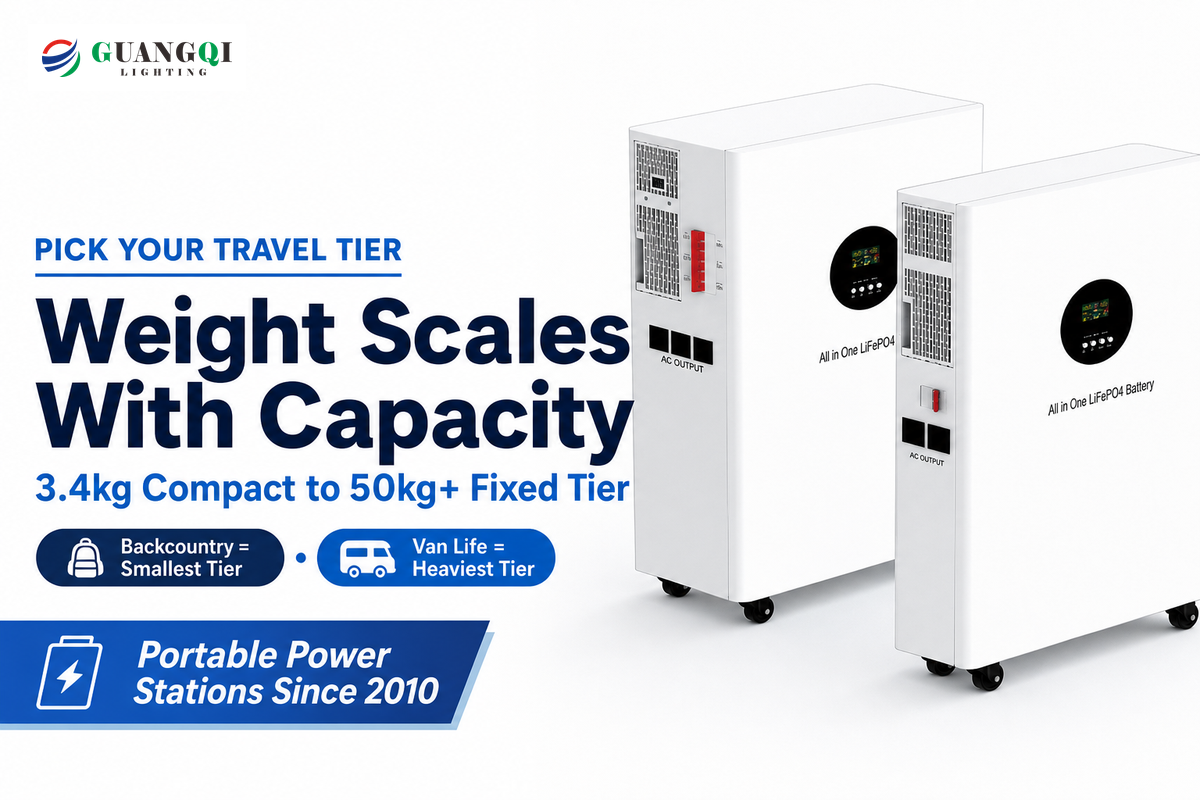
Weight increases with capacity in the referenced tier list, with compact tiers weighing around 3.4kg, mid-tier units between 10.6-19.5kg, and the top-tier unit coming in at more than 50kg — smaller power stations pack easiest, larger power stations trade portability for capacity. That curve maps onto how you travel: the minimalist backcountry site wants the smallest power tier, trunk-to-campsite car camping tolerates the mid-tier setup, and full-time van life or off grid living — where the unit installs once and stays put as a fixed power system — is where the heaviest tier earns its keep. Flying with any of these tiers is a separate question entirely — see the FAA limits in the next section.
Advantages of matching weight to trip type
- Compact tiers are small enough for a backpack side-pocket for light, short-term travel.
- Even with a longer trip in store, mid-tier units store easily in your vehicle of choice.
- Heavy tiers are extremely heavy but don’t need to be hand-moved; your vehicle handles the transport to a single site.
Limitations
- Compact-tier owners won’t be able to power a compressor cooler for an extended trip.
- Mid-range tiers are still awkward for true backpacking distances.
- Portable units at this weight can no longer be carried hands-free and need a vehicle to help with transport.
Common Sizing Mistakes
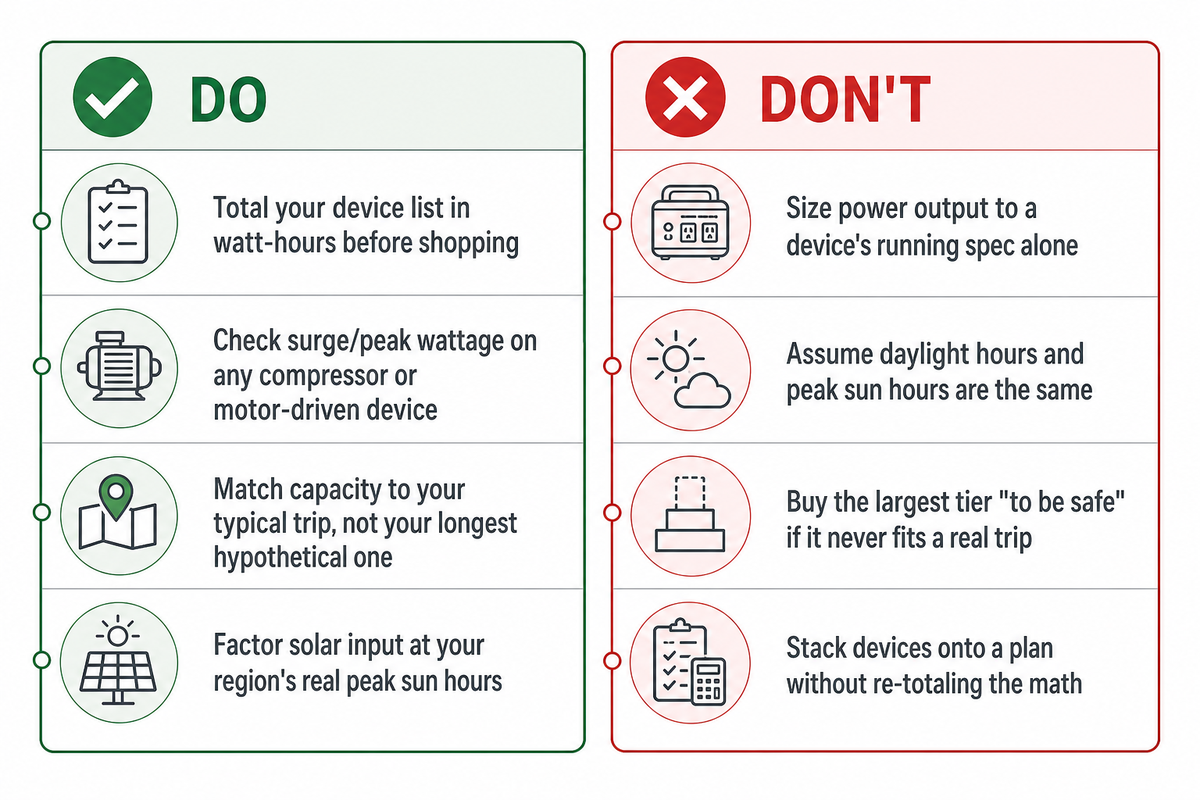
Most regrets boil down to one of two extremes, each operating in opposition to the other. Undersized units, or buying one that only covers a device’s average load, can fail during an unexpected surge event or a more protracted trip; oversized units require paying for and carrying an amount of capacity that, frankly, you won’t typically use or need on a typical weekend venture (on the assumption that more capacity is always the safer bet). Neither is a true safety net, though. Instead, each is a miscalculation between what a trip really needs and what you’ve bought to meet it. Buying a bigger power source just adds complexity and weight when the rest of the math doesn’t demand it.
Do
- Total your device list in watt-hours before shopping
- Check surge/peak wattage on any compressor or motor-driven device
- Match capacity to your typical trip, not your longest hypothetical one
- Factor solar input at your region’s real peak sun hours
Don’t
- Size power output to a device’s running spec alone
- Assume daylight hours and peak sun hours are the same
- Buy the largest tier “to be safe” if it never fits a real trip
- Stack devices onto a plan without re-totaling the math
Scope note: sizing a unit to power your home during an outage, provide emergency backup power at home, deliver the power to run a CPAP every night, or run a full-size refrigerator draws continuously for much longer stretches than a weekend trip and deserves its own sizing pass — home power and backup power at home planning is a genuinely different calculation from this camping-trip math, not a bigger version of it. Big power stations built for that use case are outside this guide’s scope.
Certifications, Safety, and Travel Rules
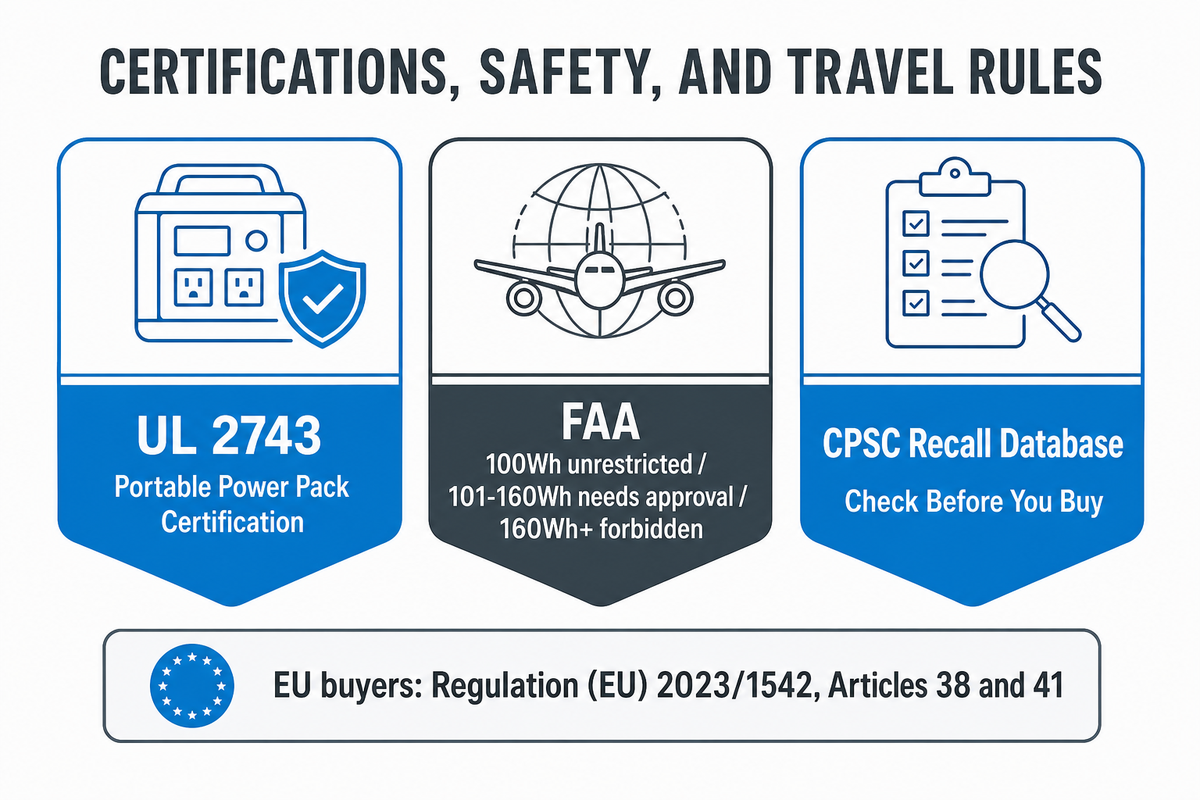
Portable power packs and stationary home backup systems are certified under different standards. UL 2743 covers portable power packs intended for use when normal grid power isn’t available, such as camping — a different certification scope than stationary residential energy storage (see the full UL 2743 vs UL 9540 capacity-ceiling breakdown for where that boundary sits).
When flying to any rental cabin or fly-in basecamp, you’ll be operating under a stricter set of guidelines. FAA rules permit up to 100Wh of lithium-ion batteries unconditionally, require prior airline approval of 101-160Wh spare batteries (two spares max), and forbid batteries larger than 160Wh outright (lithium battery-powered generators, including solar-system backup power, are specifically mentioned as barred from checked or carry-on luggage). This will effectively disqualify almost any camping-capable unit from almost any airline’s cargo hold or passenger cabin. These are drive-to-the-trailhead devices.
EU buyers and importers face Regulation (EU) 2023/1542 (Articles 38 and 41), requiring manufacturer conformity documentation, an EU declaration of conformity, CE marking, and importer verification.
Certification alone doesn’t guarantee a defect-free unit; portable power stations have been recalled by the U.S. Consumer Product Safety Commission over concerns of fires, including a July 2024 recall tied to fires and a smoke inhalation death. Performing a quick check on CPSC.gov’s product recall database just prior to purchase can catch a defect that certification testing missed — good policy whether you’re heading out on the trail or putting it on standby for the next power outage.
Why Camping Power Station Demand Is Rising
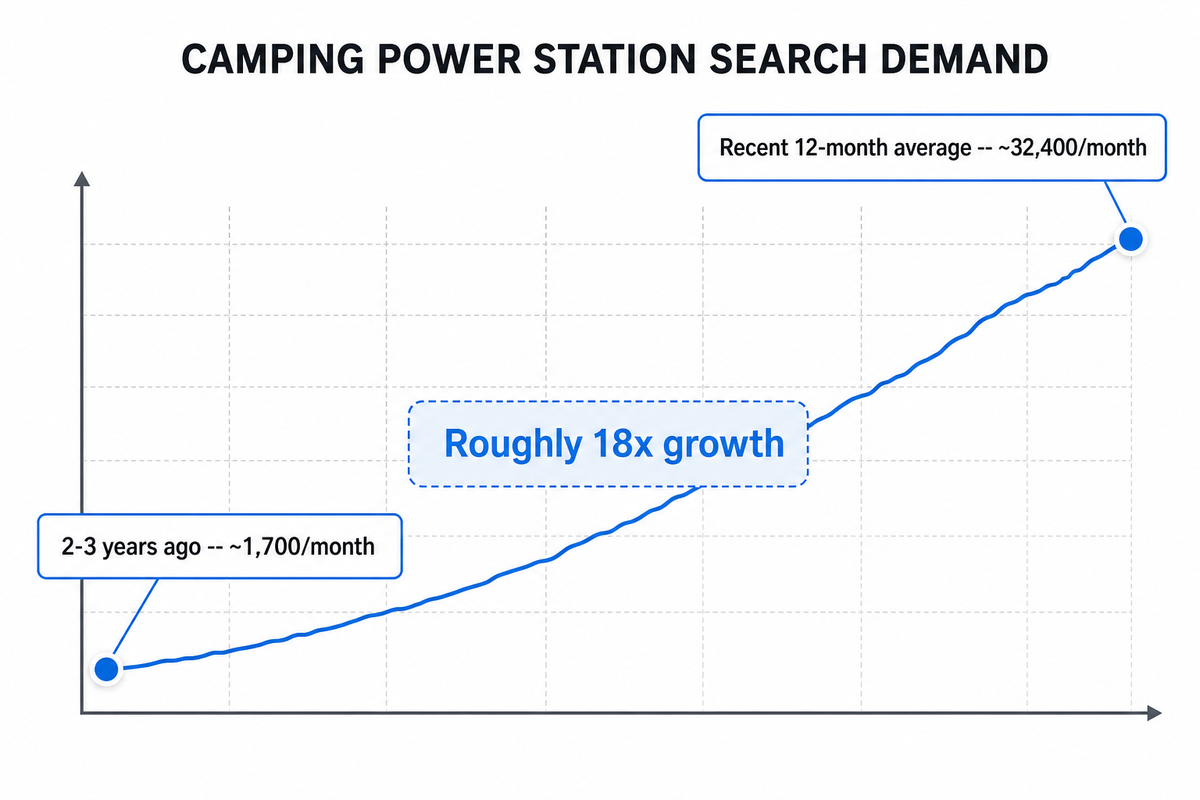
Search interest for sizing a portable power station for camping has grown roughly 18x over two to three years, per DataForSEO Labs historical search-volume data (US, 58-month series): a recent 12-month average of about 32,400 searches per month compared to about 1,700 two to three years ago, a durable shift across a few years rather than a spike across just one season.
This search growth has broader implications for consumers: there are many more power options across a range of prices than a few years ago. The power stations of 2026 range from a rugged power station geared toward van life to a small power station perfect for camping day trips (enough to power a full off-grid setup on one end to a smartphone and lantern for a weekend at the other), giving consumers a closer fit to actual travel than previous options, with more convenient power (faster charging, quieter operation) than older, larger power stations offered even a few years ago — growth that makes the UL 2743 certification and CPSC recall-database check covered above more relevant with each new entrant, not less. For background, analyst estimates indicate the global portable power station industry was about $4.2 billion in 2025 and is expected to reach $19.9 billion by 2033. (This figure provides direction, but isn’t the focus here.)
Frequently Asked Questions
Q: What is the difference between a portable power station and a solar generator?
“Solar generator” and “portable power station” describe the same underlying device — a battery, an inverter, and a charge controller built into one case — just marketed under two different names.
“Solar generator” emphasizes that the unit ships with or commonly pairs with a solar panel; “portable power station” is the broader retail and certification term (UL 2743 uses it). If a unit accepts DC solar input, AC wall charging, and outputs AC/USB/DC power, it fits both labels, same as a portable generator marketed toward off-grid buyers — the difference is framing, not a separate technology or certification class.
Q: What is the difference between a portable power station and a power bank?
Power banks are small USB/DC-only devices built for phones; portable power stations add a real AC inverter and far larger battery capacity for running actual camp appliances.
In general, power bank models store significantly under 50Wh and provide only DC USB or very low-wattage DC power. A camping portable power station starts around 230Wh and comes with an actual AC inverter, so it may power devices that generally use AC power from a wall socket. For a weekend dedicated solely to cell phones, a power bank might be sufficient; for longer trips with a laptop, lighting, a cooler or any other items requiring an AC socket to power, a larger unit becomes necessary.
Q: What’s the fastest way to recharge a portable power station on the road?
Wall/AC charging is fastest where outlets exist; a 12V car socket and solar power are the field options, with solar capped by real peak sun hours, not panel wattage alone.
Outside of a wall outlet, a 12V automotive accessory outlet is an option to trickle charge devices between stops, and solar becomes the only means of off-grid power if you have no car with you. The rate of solar power generation is determined by the amount of solar power collected times the peak hours of sun in your location (not simply the printed wattage of solar cells); losses from shade or off-peak times will reduce the rate of recharge.
Q: Can a portable power station run a mini fridge overnight?
Yes, for a compact 12V cooler-class fridge running on a mid-capacity unit — just check the appliance’s surge-watt rating against the station’s output, not only its total battery capacity.
Yes, provided power output is sufficient to handle the surge draw from a compact 12V compressor cooler — check the surge-watt figure in the output table above, not just the fridge’s running-watt rating.
Q: Is a power station worth it for camping?
For most car camping, van-life, and drive-in outdoor camping trips, yes — quiet, fume-free power for lights, devices, and a cooler, sized once you know your own watt-hour total rather than guessed from a spec sheet.
Compared to a gas generator, a battery-based unit runs silently, produces no exhaust, and needs no fuel supply chain in the field — benefits that increase directly with trip length and remoteness, and matter even more for anyone with a tent or sleeping arrangements near a shared campsite or exhaust-sensitive setup, regardless of brand, price, or how the marketing copy describes it. What matters most is whether the calculations above yield a capacity and weight that actually fit how you camp. An undersized unit, however, may run dry before the trip ends, diminishing any value — and an oversized one is dead weight you paid extra to carry.
References & Sources
- National Laboratory of the Rockies — U.S. Department of Energy solar research lab (renamed from NREL, December 2025)
- Peak Sun Hours by State — Unbound Solar, state-level table compiled from NLR/NSRDB data (source of the 5.0/3.0/6.5 figures cited in this guide)
- LiFePO4 Cold-Weather Capacity — Outbax (single-source figure, per this guide’s cold-weather note)
- Regulation (EU) 2023/1542 — EUR-Lex, Articles 38 and 41 (battery conformity/importer requirements)
- Compressor Fridge Surge-Watt Teardown — single real-world measurement, not a universal constant (per this guide’s surge-wattage section)
- Airline Passengers and Batteries — Federal Aviation Administration
- Q&A: Portable Power Packs (UL 2743 vs UL 9540) — UL Solutions
- Portable Power Station Recall Example — U.S. Consumer Product Safety Commission
- Appliance Energy Use Chart — Silicon Valley Power (City of Santa Clara municipal utility)
- Power Consumption of Typical Household Appliances — Daft Logic
- Portable Power Station Market Report — Grand View Research
About This Analysis
The watt-hour, output, and solar-input reference ranges here come from Guangqi Lighting’s own LK-series portable power station lineup, spanning seven capacity tiers from 230Wh to 6,400Wh. Sizing math and appliance-wattage figures come from independent sources — a municipal utility appliance chart and published appliance-consumption references — not from any single manufacturer’s marketing claims. Regulatory and safety context (UL 2743/9540, FAA battery rules, CPSC recall records, and EU Regulation 2023/1542) is cited to those bodies directly; where a figure rests on a single source, the article says so.