Get in Touch with GUANGQI



Updated October 2026
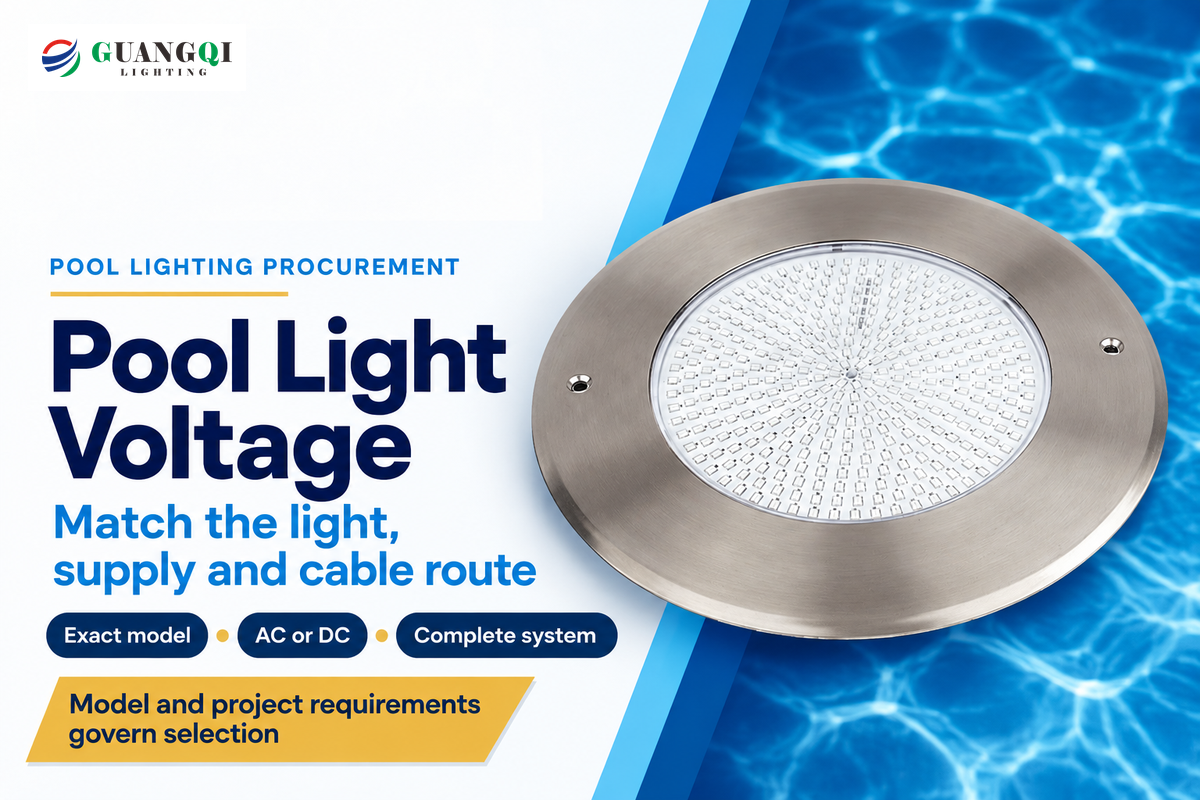
An incorrect replacement at the wrong pool light voltage can result in a fixture that’s unusable and yet another site visit. The building supply number is only the beginning. A low-voltage lighting system can result in a different voltage with an external transformer, and the input can be alternating current or direct current.
Pool light voltage must match the fixture’s specified input, including AC or DC. Choose the complete light, supply and control combination first. Then check the model’s loading limits and the cable run before ordering.
Quick specifications to separate
- Fixture input: the voltage and AC/DC type required by the light.
- Supply output: the transformer or power supply rating delivered toward the fixture.
- Supply input: the incoming building circuit, which may be 120V even when the light is low voltage.
- Project acceptance: equipment suitability, protective measures and lighting performance at the site.
For a commercial pool, the purchase process starts with identifying the equipment and the project location. An electrical test, removal of a fixture, and rewiring should be done by a qualified pool electrician. A light that still turns on can have an incorrect installation. The pool electrical-safety guidance, from the Consumer Product Safety Commission, explains why wet conditions increase the danger of electric shock.
Identify the existing pool light voltage
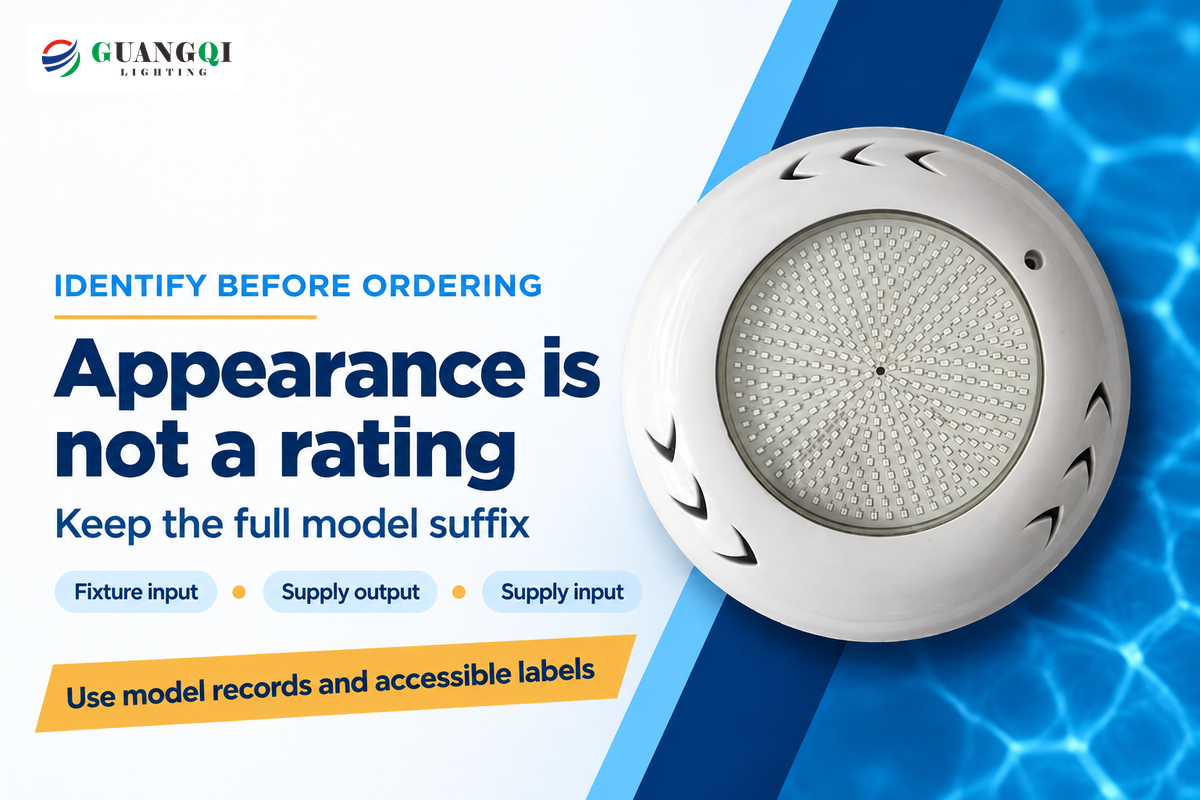
Locate an existing swimming pool light by its model number and input marking. Match this to the supply. A transformer marked 120V on the supply side may supply a 12V fixture. Different electrical versions can be found in the same housing, lamp base and face rings. Appearance alone can’t be relied on as an ordering reference.
How can I tell if I have a 12V or 120V pool light?
Relying on the breaker voltage, cord-jacket printing or brightness to identify the required replacement isn’t reliable. The installed model number and voltage label of the fixture should be compared with the supply or transformer output specification. Accessible invoices, installation manuals and external labels may provide this information. If the fixture identification isn’t accessible, a qualified installer should be called to obtain the ID.
It’s easier to read an equipment list when numbers are associated with named locations. A buyer who reports “120V pool light” from the supply input may order the wrong version for a system where a transformer feeds a 12 volt lamp. Each should be recorded as a separate line item. Ensure the full model suffix is retained for both the fixture and supply.
| Label type | Example | What the buyer records |
|---|---|---|
| Fixture input | 12 VAC | The light requires the specified alternating-current input. |
| DC designation | 24 VDC | Direct-current input; match the exact ordered version. |
| Primary input | 120 VAC | Incoming supply rating, separate from lamp input. |
| Transformer output | 12, 13, 14 VAC | Published PX300 output options, selected under applicable instructions. |
| Light input power | 15 W maximum | GloBrite White model value, not incandescent-equivalent brightness. |
| Supply capacity | 100 W | The supply size used in the GloBrite loading example. |
| Fixture-count limit | Five lights | GloBrite guide’s recommendation for that 100 W example. |
| Cable-run limit | 150 ft / 45.72 m | Separate GloBrite single-light recommendation, not a five-light layout approval. |
| Ingress designation | IP68 | Water-ingress specification; keep electrical input and application approval separate. |
The samples listed are from various product specifications and don’t represent an assembly. Pentair’s GloBrite White guide provides the light and loading examples, while Intermatic’s PX300 specifications provide the transformer-output example. Maintaining these records separately prohibits a catalog comparison from becoming an accidental compatibility claim.
12V vs 24V vs 120V pool lights
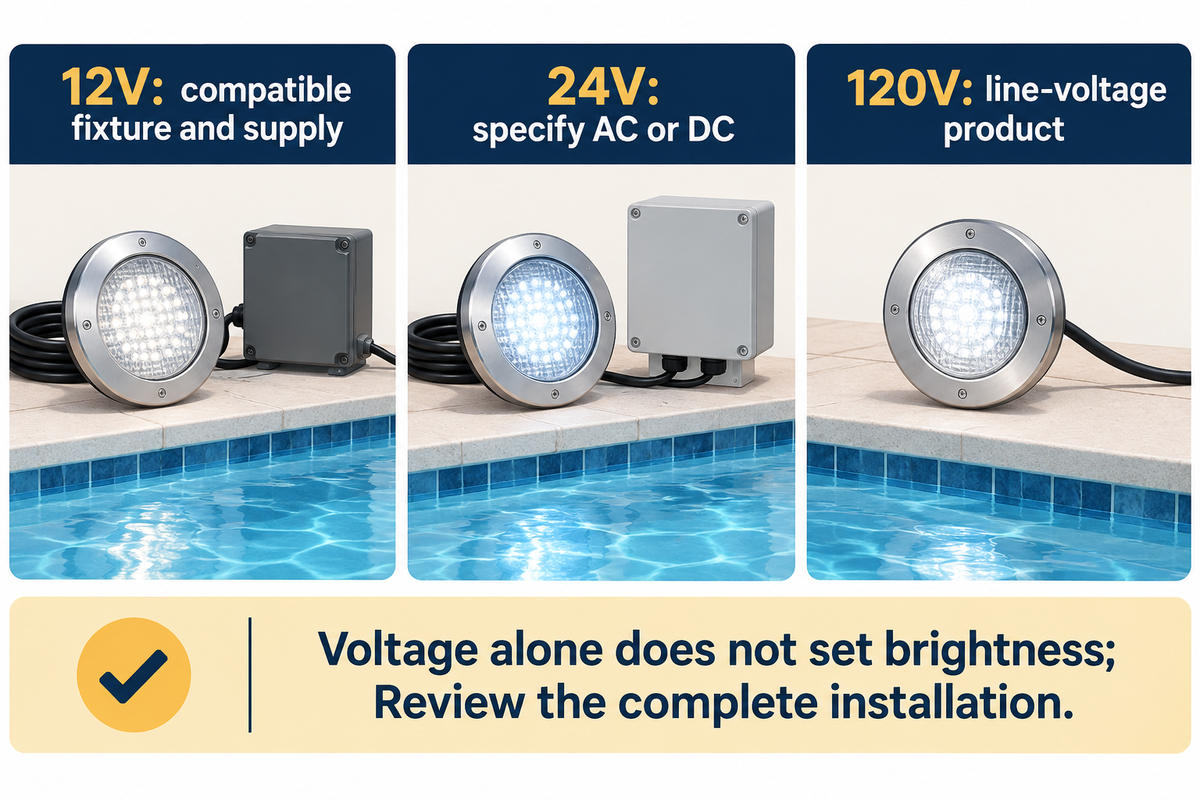
A 12V, 24V or 120V choice is a choice between complete lighting systems. It changes current and supply arrangements, but doesn’t set brightness by itself. For a replacement, the existing equipment and local project requirements narrow the options before cable-loss or price comparisons become useful.
The 12 VAC GloBrite White LED light has three selectable brightness levels in its installation guide. Its supply voltage remains the same. Therefore, a comparison of Low voltage pool lights should be done on the basis of light output and distribution, as well as the electrical input. Also, controls for White LED and color-changing should have their own specifications. Controls can be different for low voltage LED pool products.
12V system
- Retain 12V only with a compatible fixture and supply.
- Check cable loss using the specified input current.
- Keep the manufacturer’s fixture-count limits.
24V system
- Select fixtures explicitly intended for 24V.
- Specify AC or DC, not just the voltage number.
- Review the complete installation’s protective requirements.
A 120V pool light is a line-voltage product. Low voltage lamps require their specified supply configuration rather than a direct connection to a high-voltage source. For workplaces covered by the relevant OSHA pool provisions, 29 CFR 1910.306(j)(4)(i) requires ground-fault circuit-interrupter protection on the branch circuit supplying underwater fixtures operating above 15 volts. That workplace rule isn’t a nationwide ban on 24V systems or a blanket exemption for every circuit feeding a 12V light.
AC or DC: match the complete lighting system
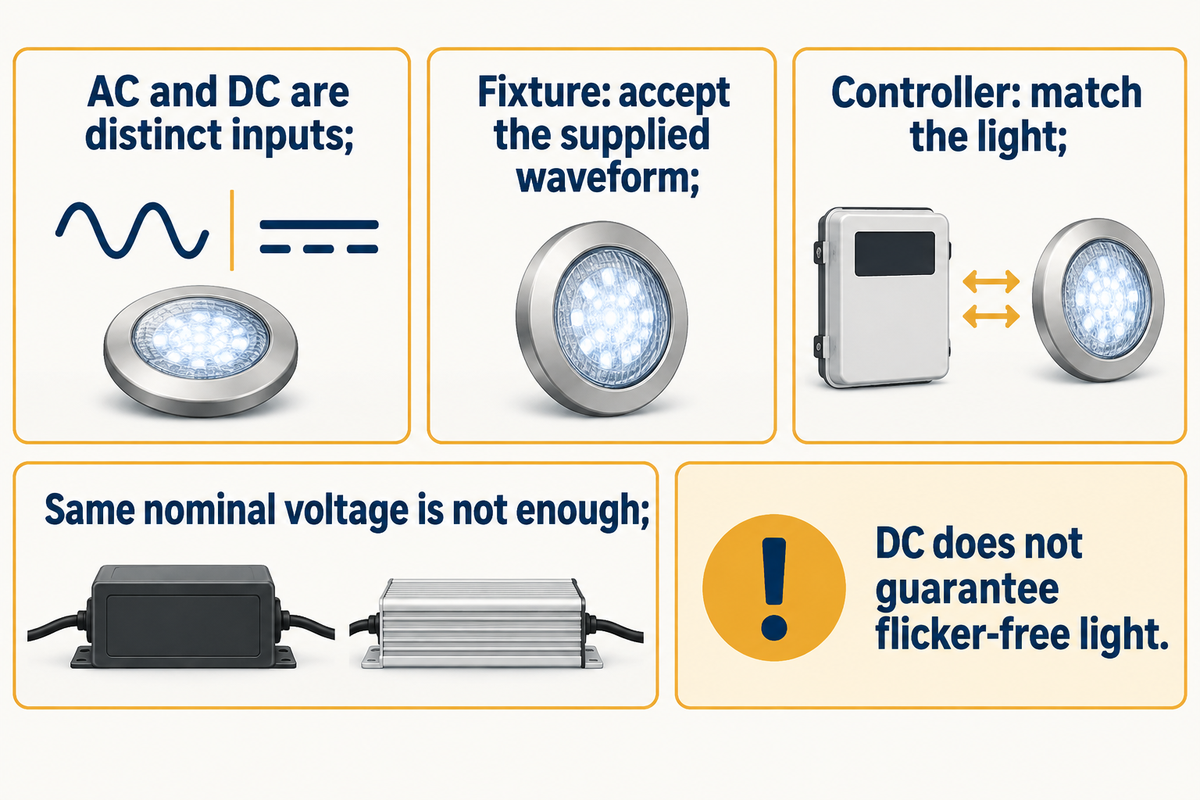
A.C. and D.C. are distinct input specifications, even when the same voltage number appears beside them. The fixture’s electronics have to accept the supplied waveform, and the controller has to be suited to the light. A transformer, regulated DC power supply and color-control unit perform different jobs; one shouldn’t be substituted solely because its label says 12V.
Why do pool lights use AC instead of DC?
An AC isolation transformer supplies the specified AC-input fixtures. Some pool-light families use this configuration and position their internals according to this input. Others use DC. The required type follows the fixture design. LED technology in and of itself doesn’t make every external supply interchangeable. A replacement is successful when the input and control method used in conjunction with the assembly being controlled match. It isn’t successful when the buyer chooses AC or DC in isolation.
The U.S. Department of Energy’s flicker research identifies driver loading, dimming level and the waveform delivered by the dimmer to the driver as interacting variables. This research supports why behavior of an LED light may change after a controller change, even when the nominal voltage stays constant. DC input doesn’t assure flicker free operation.
Consider a replacement that physically fits an existing niche, and has the same nominal input as the fixture being replaced. Its color-changing sequence may still use a different control method. A quote that retains the old controller and doesn’t define the new light’s supported controls leaves an integration issue unsolved. The supplier should be able to describe each of the components and the behavior as desired.
For LED underwater fixtures, power, control, and appearance should be in separate lines of a schedule. Cool white describes appearance. An LED color program does not specify the input waveform. Energy consumption should be on the electrical schedule; a change in nominal voltage doesn’t necessarily mean an improvement in energy efficiency. The same principle applies to underwater lights, water features, and poolside strip lights in the same schedule.
Size the pool light transformer from model data
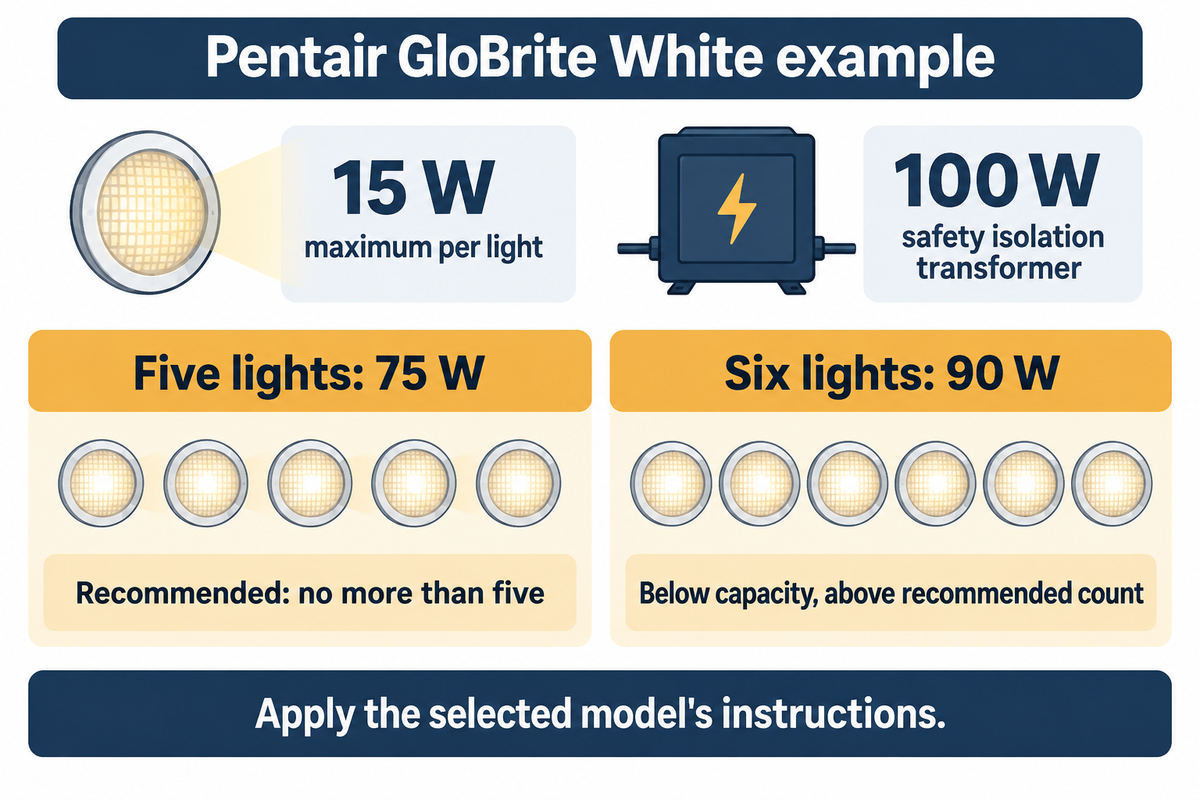
Size a pool light transformer from the connected models’ maximum input requirements and the manufacturer’s allowed loading arrangement. The sum of the lamp watts is one check. Limits on Fixtures, control loads and cables can be separately restrictive, therefore larger power ratings don’t automatically mean that all proposed layouts are allowable.
Pentair’s GloBrite White installation guide, document 620218 Rev. G dated October 23, 2023, lists 15 W maximum per white light. For a 100 W safety isolation transformer, the guide recommends no more than five GloBrite lights. Five at the listed maximum total 75 W. A sixth would bring the sum to 90 W, below 100 W, yet exceed that model’s recommended count.
The example illustrates the limitation of wattage-only division. It doesn’t establish a universal spare-capacity percentage: both adding 20% to the load and reserving 20% of a 100 W rating still yield five whole 15 W lights. Use any design margin specified for the selected equipment and project, rather than presenting one percentage as a rule for all low voltage lighting systems.
AC input, like DC input, requires care with units. The University of Louisville’s network-analysis lesson on AC power clarifies that volt-Amperes aren’t the same as watts, and apparent power is RMS voltage multiplied by RMS current. Real power can be less than apparent power. For an electronic LED pool light, the manufacturer’s input current or VA (volt-amps) should be used, where required, instead of assuming that the division of watts by volts gives the correct value of AC current.
A contractor preparing to place a large multi-fixture order can pre-determine the load schedule, and thus place the supply order, since he/she has determined the pool-light count of the layout, specified the exact models, separated the maximum simultaneous electrical load from the desired illumination. The watts-to-amps conversion for LED inputs explains the difference between a simple DC calculation and an AC load with power factor.
Check pool light voltage drop along the cable
The difference in voltage as it travels away from the supply point is known as the voltage drop. To calculate the drop, the outgoing and returning conductors, and the current carried by each of the supply path’s segment cables must be known. The capacity of the supply and voltage at the fixture are two separate checks. Excess transformer watts don’t remove cable resistance for long wire runs.
Why does pool light voltage drop?
As current flows through cable resistance, there’s a voltage drop. Other factors staying the same, a longer route or a higher current increases the drop. On a circuit, shared cable segments carry the total downstream current and separate branches carry their own currents. Connection condition and power supply behavior must be considered, so dimming doesn’t always indicate a voltage drop.
A Michigan State University-hosted treatment of Ohm’s Law accounts for IR drop and the non-linear behavior of devices such as LEDs. The resistance model can be applied to the cable. It isn’t acceptable to consider the entire electronic fixture as a fixed resistor, or to presume the fixture’s brightness from voltage alone.
2-Voltage Cable-Loss Comparison
This comparison separates nominal load current, cable voltage drop, and resistive loss for two DC supply options.
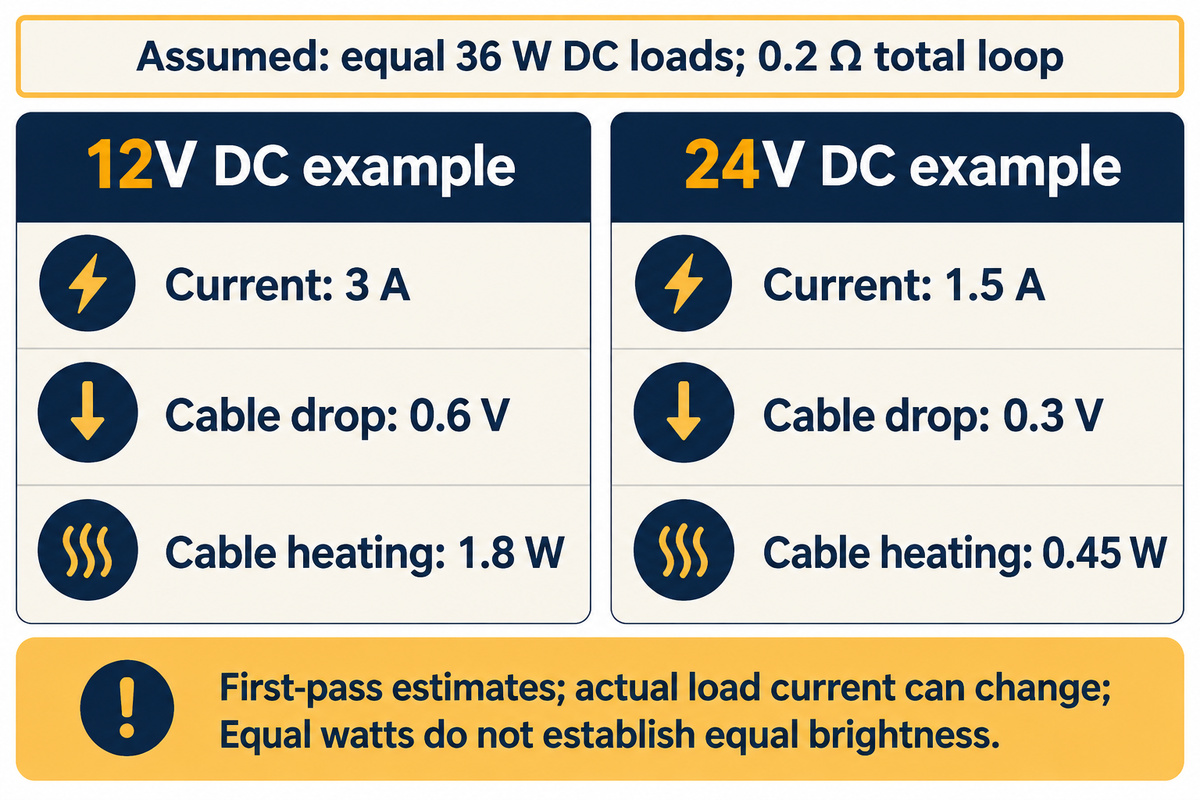
Assumed inputs: compare two 36 W DC loads rated at 12V and 24V, using the same 0.2 Ω total outgoing-and-returning cable resistance. Calculate current at nominal voltage first. The results below are first-pass estimates; actual electronic-load current can change when its terminal voltage changes.
| Quantity | 12V DC example | 24V DC example |
|---|---|---|
| Nominal load power | 36 W | 36 W |
| Nominal voltage | 12 V | 24 V |
| Current, P ÷ V | 3 A | 1.5 A |
| Total loop resistance | 0.2 Ω | 0.2 Ω |
| Cable drop, I × R | 0.6 V | 0.3 V |
| Drop ÷ nominal voltage | 5% | 1.25% |
| Cable heating, I² × R | 1.8 W | 0.45 W |
| Loss relative to 12V example | 100% | 25% |
| Procurement consequence | Check the full route against the 12V model’s limits. | Select a complete 24V-compatible system; retain project approval checks. |
For the 12V example, 36 ÷ 12 = 3 A, then 3 × 0.2 = 0.6 V. Dividing 0.6 by 12 gives 5%. At 24V, the nominal current halves, so the cable drop halves and resistive heating falls to one quarter. Equal input watts don’t establish equal brightness between two different lighting fixtures.
Model limits still apply to the route. For a single light, the GloBrite guide recommends no more than 150 ft (45.72 m) between its 12 VAC isolation transformer and the light. This recommendation doesn’t correspond to its other example for loading multiple lights. A project that’s outside this documented arrangement requires an alternate equipment and cable design, not an improvised increase in supply voltage.
Convert a 120V pool light: define the quotation scope

Converting a 120V installation to low voltage is a system change. The quotation needs the replacement fixture, an appropriate supply and control configuration, plus the electrical and physical work at the site. Local repair rules can also impact the scope, even when the customer initially requested a like-for-like replacement.
For example, Miami-Dade County’s pool-light permit guidance for existing residential pools says existing lights must be low-voltage when repaired or altered. The permit process is for residences located in unincorporated Miami-Dade County. This shows location and use must be resolved before considering a 120V replacement as an option everywhere.
A refurbishment quote may include the cost to replace the cord through existing conduit, work at a junction box, or change the control equipment. An installer should assess the condition of the route before assuming it can be used. Metal conduit, PVC, the enclosure and corrosion-resistant fittings should be assessed as part of this. A bulb-only replacement and a completely sealed assembly are different purchases.
Consider a hotel comparing two bids for the same fixture count. One includes a new power supply, controller checks and commissioning. The other bid is for the lights only. A lower total for the hardware in the second bid doesn’t describe the same completed work. Separating the equipment, cable work, permits and acceptance tests allows procurement to compare the bids and see what was excluded. Finance can see what costs may be incurred.
There’s an example from Maryland’s Public pool Illumination provisions that deals with reflection that obstructs the pool or the spa bottom. Electrical compatibility alone cannot show how the replacement will illuminate the water. The handover should include lighting performance checks that are commensurate with the site’s operating conditions.
Industry outlook: model-specific pool lighting submittals
The current version of the documentation matters for purchasing. Equipment standards, configurations, and models change at different rates. Underwater pool lights, their supply and controls require a coordinated equipment schedule. The applicable sections of the National Electrical Code (NEC) and local code requirements belong in the project review. Provide the exact configuration and supporting documentation at the quotation and handover stages.
The published September 11, 2025 revision summary for UL 676, Underwater Luminaires and Submersible Junction Boxes, includes changes to section 6.5 and a new supplement on potting compounds for pool, fountain and spa equipment. By contrast, the November 2022 summary for UL 379 power units describes a reaffirmation without technical changes. More recent dates do not indicate what changed to a purchaser.
For a 2026 order, match the proposed model to the appropriate documentation and approval route. A waterproof or ingress rating and an electrical rating answer different questions. Our explanation of lighting ingress-protection ratings helps explain the difference. The new potting supplement isn’t, by itself, an instruction to replace every existing fixture.
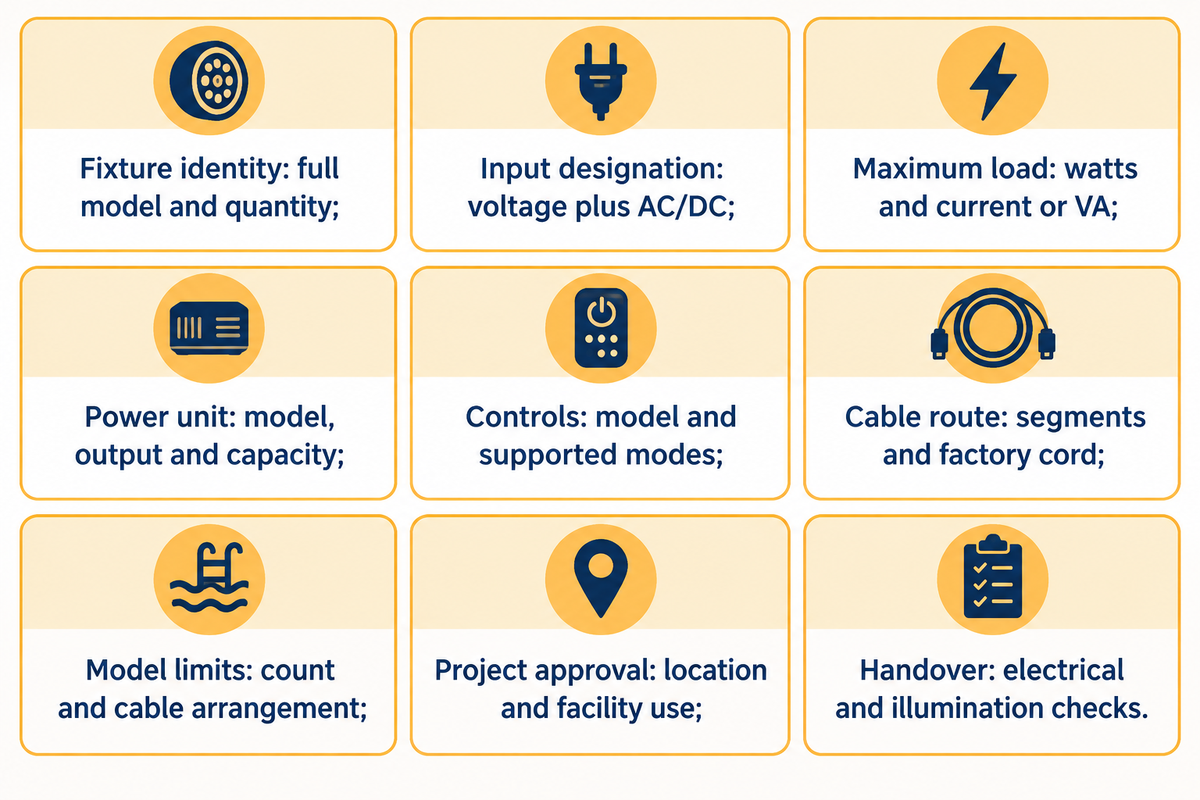
9-Field Supply Match Record
This purchasing record joins the fixture, supply, controls and site constraints in one comparable equipment schedule.
| Field | Record in the quotation | Decision it supports |
|---|---|---|
| Fixture identity | Manufacturer, full model suffix and quantity | Order the intended electrical version. |
| Input designation | Voltage plus AC/DC, such as 12 VAC | Match waveform and rating. |
| Maximum input load | Model watts and required current or VA data | Size against electrical input, not equivalent brightness. |
| Power-unit identity | Exact model, output and capacity | Choose the specified pool-and-spa application. |
| Control arrangement | Controller model and supported operating modes | Preserve switching, dimming or color behavior. |
| Cable route | Complete route, shared segments and factory cord length | Account for current and voltage drop. |
| Model limits | Permitted fixture count and cable arrangement | Apply the manual’s conditions alongside capacity. |
| Project approval | Location, facility use, applicable requirements and listed configuration | Resolve local and workplace constraints. |
| Handover scope | Qualified electrical checks, the specified grounding and bonding arrangement, and required illumination checks | Compare complete bids and acceptance obligations. |
“be sure to have the electrical system inspected, repaired and upgraded to local and National Electrical Code by a licensed contractor”
Send these fields with the proposed swimming pool light configuration. Request the exact input version, matching supply and control information, and the documents mandated by the project. A more detailed equipment schedule is preferable to a request for “the safest voltage” with no model or site context.
Frequently Asked Questions About Pool Light Voltage
Are most pool lights 12V or 120V?
Both 12V and 120V products exist; identify the installed model before choosing a replacement.
Established product families include low-voltage and line-voltage versions, and some projects use other specified inputs. The incoming building circuit can’t settle which version is installed because a transformer can supply a different voltage to the light. Start with the fixture’s full model and its own input rating, then compare the supply output. Treat AC or DC as part of that rating rather than an optional detail.
Are 12 volt pool lights safe?
A correctly specified 12V system still needs suitable equipment, protective measures and sound installation.
Low voltage reduces the operating voltage at the fixture, but the incoming circuit and other electrical equipment remain part of the installation. Damage, water leakage into unsuitable equipment or incorrect component selection can introduce hazards. The complete light and supply arrangement must suit the application and its instructions. A loose or damaged fixture needs qualified attention; a 12V marking isn’t a reason to keep using a suspect installation.
Does a 12V pool light need a GFCI?
A 12V rating alone does not determine protection for the complete lighting installation.
For workplaces covered by OSHA’s pool provisions, the specific underwater-fixture branch-circuit rule applies above 15 volts. Falling below that threshold doesn’t settle every other circuit requirement or local rule. The fixture’s listed arrangement, supply connection and applicable installation instructions still matter. The project’s qualified electrical designer or installer should specify the protection for the complete assembly, including its incoming circuit, rather than infer a general exemption from the lamp voltage.
Which pool light voltage is best?
Choose the voltage supported by the complete system and the project’s installation requirements.
For an existing installation, preserve the documented input unless the project includes a properly specified conversion. A longer run can favor a different complete system, but it doesn’t justify changing only the supply.
Can I replace my pool light with LED?
Yes, when the LED replacement or conversion is specified for the existing fixture arrangement.
Match the niche or assembly, electrical input and controls. Replacing a pool light bulb and replacing a sealed light with its factory cord involve different scopes.
Key takeaway
A 12V or 24V label starts the selection. The exact fixture, power unit, controls and cable arrangement complete it.
For a quotation on a Guangqi project, send your pool lighting specification and cable-route details with the nine-field record. Provide the location of the project and whether the work is a new installation or a replacement.
Manufacturer examples retain their own model limits. The cable comparison uses stated assumptions; the design and approval of the installation remain specific to the project.
References & Sources
- Consumer Product Safety Commission: electrical safety around pools and spas
- Occupational Safety and Health Administration: 29 CFR 1910.306, specific-purpose equipment
- U.S. Department of Energy: Flicker Research
- University of Louisville: ECE 220, AC power and RMS lessons
- Michigan State University Libraries: Ohm’s Law, Resistance and Simple Circuits
- Miami-Dade County: Swimming Pool Light Safety Permit
- Maryland regulations: COMAR 10.17.01.14, illumination
- UL Standards & Engagement: UL 676 public scope and revision summary
- UL Standards & Engagement: UL 379 public scope and reaffirmation summary
- University of Illinois Extension: swimming-pool electrical safety