Get in Touch with GUANGQI


Types of Light Bulbs: Complete Guide to LED, Incandescent, Halogen, CFL Shapes & Bases

Choosing the right light globe types cuts lighting electricity use by 80% to 85% while matching three core specs: internal lamp technology, ANSI glass diameter, and IEC socket base code. Modern light emitting diode lamps deliver 85 to 150 lumens per watt across 15,000 to 50,000 hours. Shade overhang, mirror glare, and premature driver failure are still caused by bulb type or pin spacing.
Electrical contractors, facility managers, and homeowners face regional naming differences when comparing lighting options. In Australia, the United Kingdom, and New Zealand, buyers use “light globe” to describe any household light or commercial lamp. In North America, lighting engineers use this term to describe spherical G-series lamps, which are mounted on a bathroom vanity or an open pendant.
This engineering guide covers all light bulb types and shapes so you can specify any light fixture accurately. We examine the five primary lighting technologies, ANSI eighth-inch diameter formulas, Edison base and bi-pin tolerances, photometric ratings, and enclosed-fixture thermal limits.
What Are the Main Light Globe Types? (Technology vs Envelope Geometry)
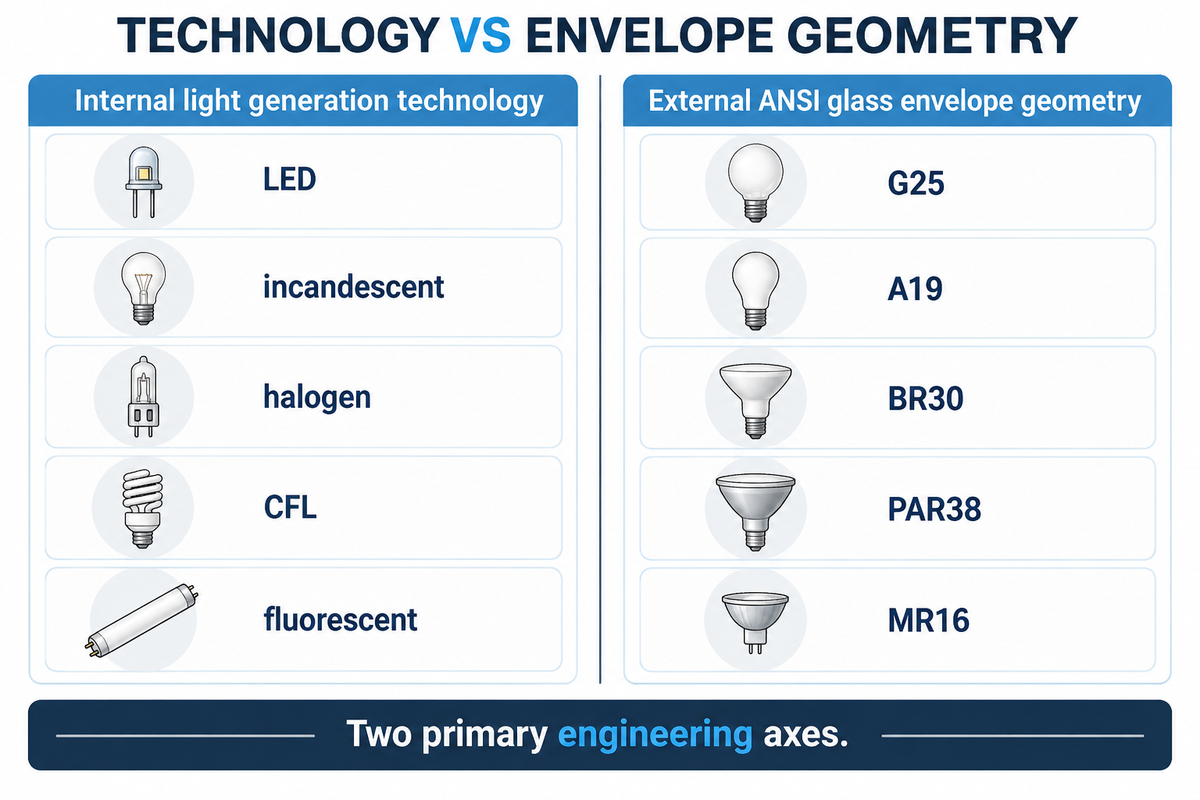
The two primary engineering axes for the main light globe types are internal light generation technology and external ANSI glass envelope geometry. The five core lighting technologies are Light Emitting Diode (LED), traditional incandescent, halogen, compact fluorescent (CFL), and linear fluorescent light tubes. Meanwhile, codes like A19, G25, BR30, PAR38, and MR16 define physical bulb shape and width.
Separating the internal electronics from the outer glass geometry helps avoid costly procurement mistakes on lighting jobs. A single bulb base type can support multiple envelope silhouettes and internal light engines. For example, a G25 vanity sphere can be combined with an Edison base which can support an SMD diode array, a sapphire COB filament, or a resistive tungsten coil.
To standardize lamp dimensions worldwide, the American National Standards Institute publishes glass envelope codes under ANSI C79.1 and ANSI C78.79. We refer to this formula as The Eighth-Inch Envelope Rule (ANSI C79.1 Shape-Diameter Formula). In this rule, the letter designates the shape and number designates maximum width in eighths of an inch.
How Do You Read a Light Bulb Code Like A19, G25, or E26?
You read a light bulb code by splitting the stamp into its letter shape prefix, eighths-of-an-inch diameter number, and millimeter socket base code. In A19 or G25, the letter marks an Arbitrary pear or Globe sphere, while 19 or 25 divided by 8 gives the width in inches. A separate stamp like E26 identifies a 26 mm screw base.
Converting any ANSI shape code to metric millimeters requires just a simple calculation. According to this math, a shape code number multiplied by 3.175 mm equals one eighth of an inch. Therefore, a standard light in an A19 envelope has a diameter of (19 × 3.175 mm) = 60.3 mm at its widest point.
Likewise, a G25 vanity lamp measures 25 × 3.175 mm = 79.4 mm wide. European and Asian lighting catalogs round that figure to G80. Verifying both codes on the box ensures the replacement lamp threads into the socket without hitting the shade harp.
5 Core Lighting Technologies Compared: LED, Incandescent, Halogen, CFL, and Fluorescent
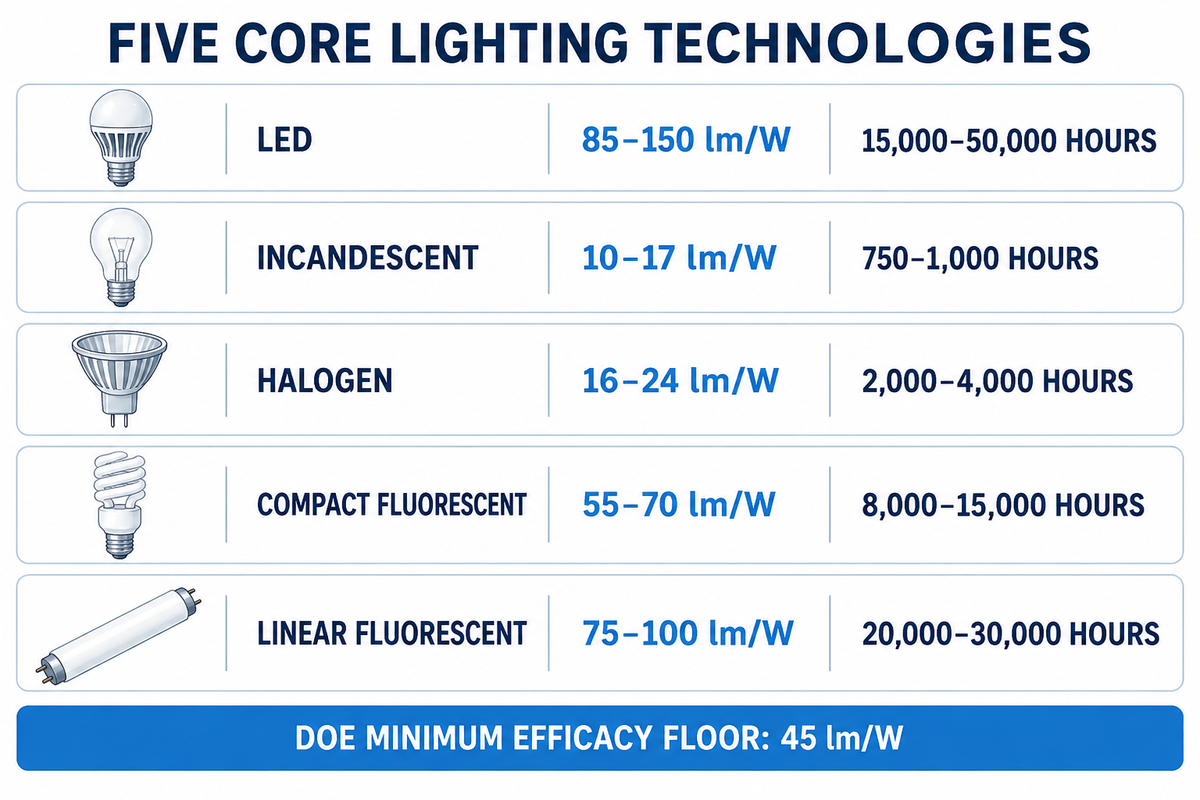
The five core lighting technologies differ in how they convert electrical power into visible light, and thereby determine the lamp’s luminous efficacy, heat load, and operating lifespan. Solid-state LED lamps deliver 85 to 150 lm/W and run for 15,000 to 50,000 hours. Older incandescent bulbs, halogen capsules and fluorescent tubes, waste far more energy as heat.
Reviewing how each light source produces photons explains why building codes have phased out legacy filaments. Traditional incandescent bulbs heat a tungsten wire inside an inert gas glass bulb until it glows. Because 90% of that energy escapes as infrared heat, incandescent light bulbs produce only 10 to 17 lm/W.
Halogen light bulbs are a type of incandescent lamp seals the filament inside a pressurized quartz capsule filled with halogen gas. This halogen cycle redeposits evaporated tungsten back on the coil to boost life to 2,000 – 4,000 hours. Never touch a bare quartz capsule with bare fingers, because skin oil creates a thermal blister on the glass.
CFLs (compact fluorescent lamps) and linear fluorescent tubes pass an arc through low-pressure mercury vapor to produce ultraviolet light. That ultraviolet energy excites a white phosphor coating in the tube to release visible light. Although some fluorescents achieve 55 to 100 lm/W, self-ballasted CFLs warm up slowly and contain 1.5 to 4.5 mg of mercury.
Among the types of light bulb considered for facility upgrades, a modern LED light bulb is likely to route current through a semiconductor diode chip. Whether built with SMD arrays or sapphire filaments, LEDs meet commercial lighting needs with instant output and contain zero mercury. You can review multi-year utility paybacks using our LED vs halogen operating cost calculator.
How Do LED, Incandescent, Halogen, and CFL Light Globes Compare in Luminous Efficacy and Lifespan?
LED light globes lead all lamp categories at 85 to 150 lm/W and 15,000 to 50,000 hours of L70 lumen maintenance. Spiral CFLs provide 55 to 70 lm/W (8,000 to 15,000 hours) while the best linear lamps exceed 30,000 hours. Halogen and incandescent lamps lag behind at 10 to 24 lm/W (750 to 4,000 hours).
Buyers need to recognize two different engineering lifespan metrics when reviewing our 5-Technology Photometric & L70 Lifespan Benchmark Table. The U.S. Department of Energy SSL basics state that LEDs uses L70 lumen maintenance, which indicates the hour when light output falls to 70% of its initial lumens. Unlike LEDs, incandescent, halogen, and fluorescent lamps use B50 life, which is the time by which 50% of the tested units have burned out.
Buyers citing ENERGY STAR Lamps V2.1 (PF ≥ 0.7 residential, PF ≥ 0.9 commercial) should be aware of a regulatory update. The EPA has eliminated the standalone ENERGY STAR Lamps specification, with the termination date of December 31, 2024. Today, federal DOE General Service Lamp (GSL) standards enforce a 45 lm/W minimum efficacy floor nationwide.
| Lighting Technology Type | Luminous Efficacy (lm/W) | Rated Lifespan & Metric Basis | Typical CRI (Ra) | Warm-Up to 80% Flux | DOE 45 lm/W GSL Status |
|---|---|---|---|---|---|
| LED (SMD & Filament COB) | 85–150 lm/W | 15,000–50,000 h (L70 lumen maintenance) | 80–97 (R9 up to 90) | Instant (<0.2 s) | Compliant (Primary Standard) |
| Traditional Incandescent | 10–17 lm/W | 750–1,000 h (B50 filament burnout) | 100 (Blackbody reference) | Instant (<0.1 s) | Phased out for general service |
| Tungsten-Halogen Capsule | 16–24 lm/W | 2,000–4,000 h (B50 filament burnout) | 99–100 | Instant (<0.1 s) | Restricted (Exemptions only) |
| Self-Ballasted Spiral CFL | 55–70 lm/W | 8,000–15,000 h (B50 ballast/cathode life) | 80–85 | 30–120 seconds | Phasing out under state Hg bans |
| Linear Fluorescent (T5/T8) | 75–100 lm/W | 20,000–30,000+ h (B50 programmed ballast) | 80–90 | 1–5 seconds | Transitioning to LED tubes |
G-Series Spherical Light Globes: G16.5, G25, G30, and G40 Dimensions and Fixture Fit
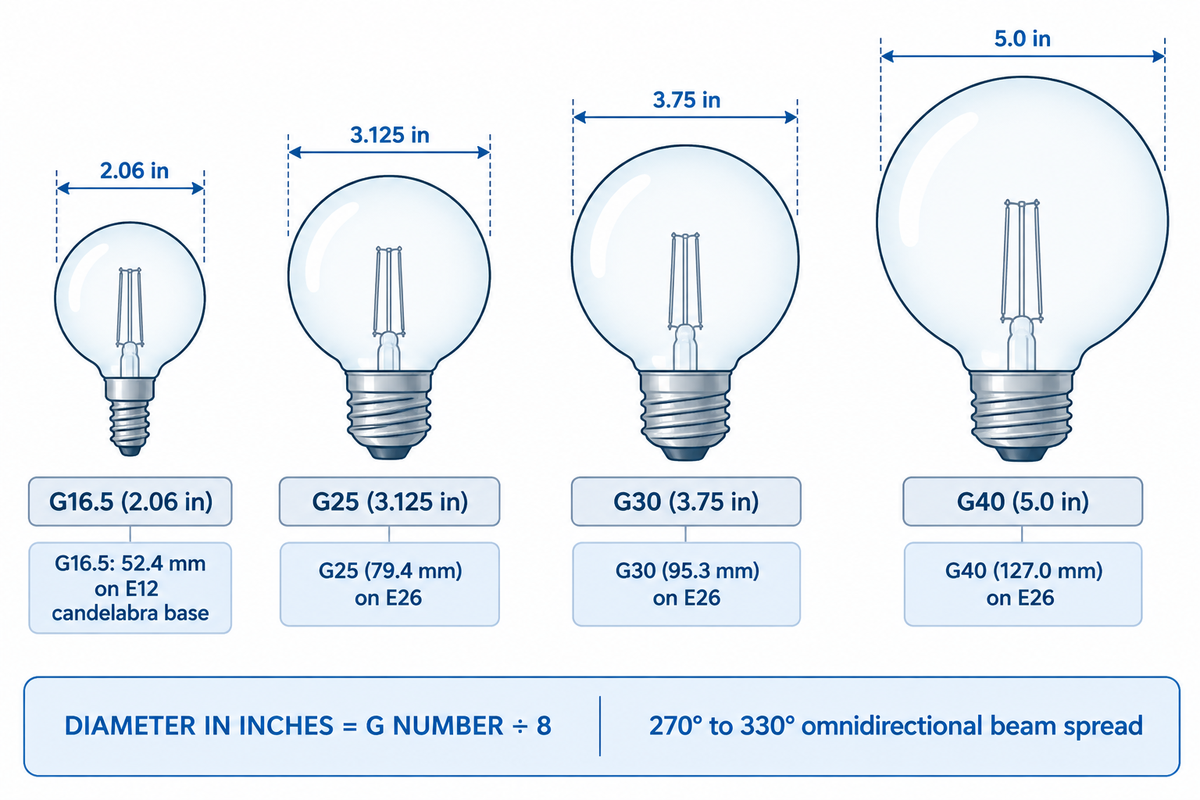
G-series spherical light globes are round decorative lamps sized in eighths of an inch, led by G16.5 (2.06 in), G25 (3.125 in), G30 (3.75 in), and G40 (5.0 in). Their 270° to 330° omnidirectional beam spread makes globe bulbs ideal for bathroom vanity lighting, open pendants, and outdoor festoon strings.
G-series lamps radiate light evenly in all directions. When mounted above or next to a vanity mirror, these spherical lights remove shadows under the nose, eyes and chin. Designers recommend using the G-series lighting when a bare glass sphere is visible as part of the design.
In commercial exteriors, spherical lighting nodes become programmable media elements on building facades. For plazas and theme parks, lighting designers combine weatherproof programmable architectural LED pixel globe lights with their indoor Vanity spheres to achieve a consistent look.
What Is the Difference Between G16.5, G25, G30, and G40 Globe Light Bulbs?
The difference between G16.5, G25, G30, and G40 globe light bulbs lies in their sphere diameter, Maximum Overall Length (MOL), and socket base pairing. A G16.5 globe measures 52.4 mm wide on an E12 candelabra base, while G25 (79.4 mm), G30 (95.3 mm), and G40 (127.0 mm) use E26 medium bases.
Before stepping up from a G25 to a wider G30 or G40 lamp, measure the center-to-center socket spacing on your fixture. Leave at least 15 mm (0.6 in) air gap between spheres, and between spheres and a metal shade to avoid heat build up. The comparison chart covers 10 globe and decorative bulbs in residential and commercial lighting.
| Bulb Type & Model Code | Metric Class | Exact Diameter (in / mm) | Typical MOL (in / mm) | Common Base Type | Primary Lighting Application |
|---|---|---|---|---|---|
| G11 Mini Globe | G35 | 1.375 in / 34.9 mm | 2.25 in / 57.2 mm | E12 Candelabra | Cabinet accent strips, marquee signs, mini vanity sconces |
| G14 Vanity Sphere | G45 | 1.750 in / 44.5 mm | 2.75 in / 69.9 mm | E12 / E14 / E26 | Small European pendants, compact dressing mirrors |
| G16.5 Candelabra Globe | G50 | 2.0625 in / 52.4 mm | 3.00 in / 76.2 mm | E12 Candelabra | Wall sconces, multi-arm chandeliers, Hollywood mirror bars |
| G19 Mid-Size Globe | G60 | 2.375 in / 60.3 mm | 3.50 in / 88.9 mm | E26 / B22 | Ceiling fan light kits, enclosed globe hallway domes |
| G25 Standard Vanity Globe | G80 | 3.125 in / 79.4 mm | 4.38 in / 111.3 mm | E26 Medium | North American 3-light to 6-light bathroom vanity bars |
| G30 Hospitality Globe | G95 | 3.750 in / 95.3 mm | 5.00 in / 127.0 mm | E26 / E27 | Open single-socket pendants, boutique hotel lobby fixtures |
| G40 Architectural Globe | G125 | 5.000 in / 127.0 mm | 6.75 in / 171.5 mm | E26 / E27 | Oversized wire cages, commercial courtyard festoon strings |
| G50 Statement Sphere | G150 | 6.250 in / 158.8 mm | 8.00 in / 203.2 mm | E26 / E27 | Atrium suspension cords, restaurant decorative clusters |
| A19 Standard Pear | A60 | 2.375 in / 60.3 mm | 4.13 in / 104.9 mm | E26 / E27 / B22 | Table lamps, shaded ceiling fixtures, bedroom ambient lighting |
| ST19 Vintage Edison | ST64 | 2.375 in / 60.3 mm | 5.40 in / 137.2 mm | E26 / E27 | Exposed-socket industrial pendants, hospitality wall brackets |
Standard, Reflector, and Decorative Bulb Shapes: A-Series, BR/PAR/MR, Candle, and Tubular
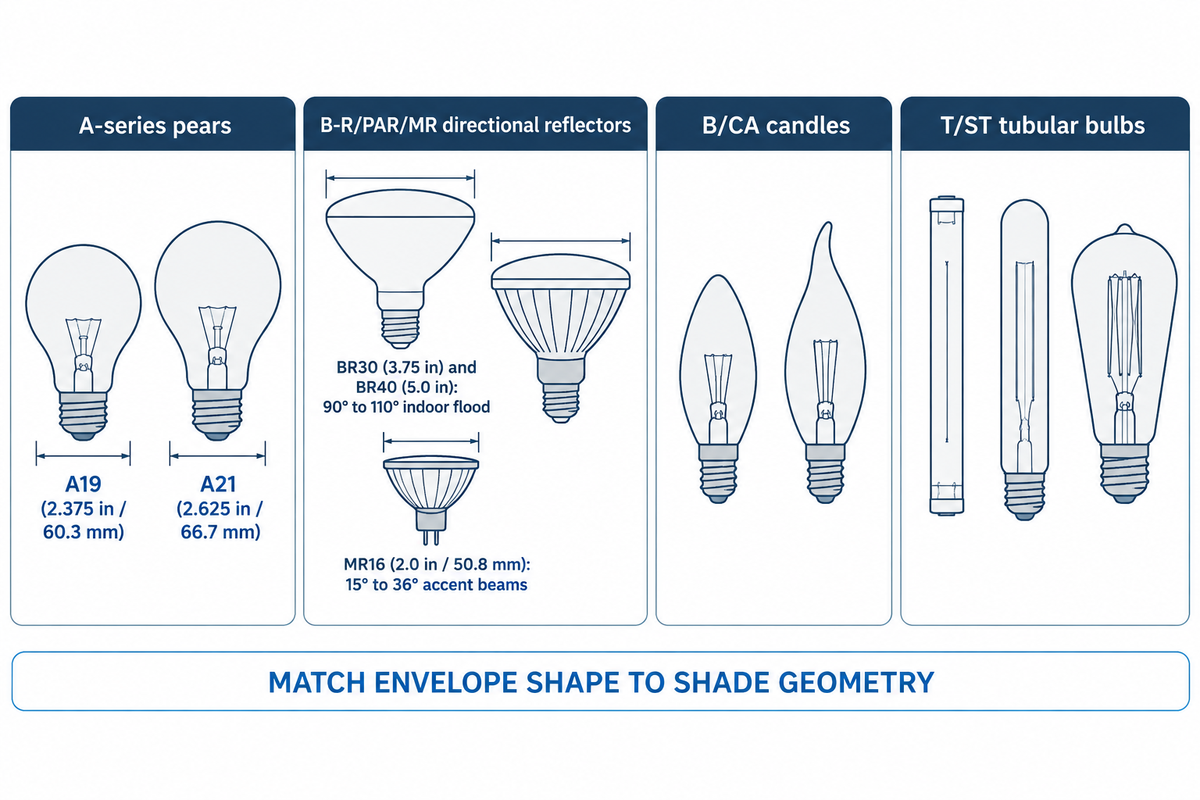
Beyond spherical G-globes, residential and commercial lighting relies on four main shape families: A-series pears, B-R/PAR/MR directional reflectors, B/CA candles, and T/ST tubular bulbs. Choose the proper envelope shape to control beam spread, prevent neck rubs against the socket trim, and harmonize with the luminaire reflector.
A-Series Standard Service Bulbs (A15, A19, A21): The letter “A” stands for Arbitrary, describing the classic pear shape used in table lamps and hallway fixtures. An A19 is the common size for 40W to 75W replacements (2.375 in / 60.3 mm wide). Higher-lumen 100W-equivalent LEDs (1,600 to 2,600 lm) often step up to an A21 body (2.625 in / 66.7 mm wide) for extra cooling area.
BR, PAR, and MR Directional Reflector Bulbs: Recessed fixtures and track heads need internal mirrors that push light forward instead of trapping it inside the ceiling can. The BR30 (3.75 in wide) and BR40 (5.0 in) reflectors cast a soft 90° to 110° indoor flood. PAR lamps (PAR20, PAR30, PAR38) employ heavy pressed glass, and create 25° to 40° beams for outdoor security lighting.
For retail displays, art galleries, and theatrical lighting, multi-mirror reflector MR16 lamps (2.0 in / 50.8 mm wide) shape crisp 15° to 36° beams for precision accent lighting. When building projects graduate from indoor construction displays to outdoor, heavy-duty building facade displays, the engineering team swaps out plug-in PAR lamps with integrated IP65 outdoor architectural spot fixtures.
Candle (B10, CA10) and Vintage Edison Tubular (ST19, T10) Shapes: Decorative chandeliers and wall sconces use blunt-tip (B10) or flame-tip (CA10) candle bulbs measuring 1.25 in (31.8 mm) wide. Vintage ST19 Edison bulbs and cylindrical T10 tubular lamps display linear LED filaments inside clear or amber glass.
Light Bulb Base and Socket Codes Explained: Edison Screw (E12, E26, E27) vs Bi-Pin & Twist-Lock (GU10, GU5.3, G9)
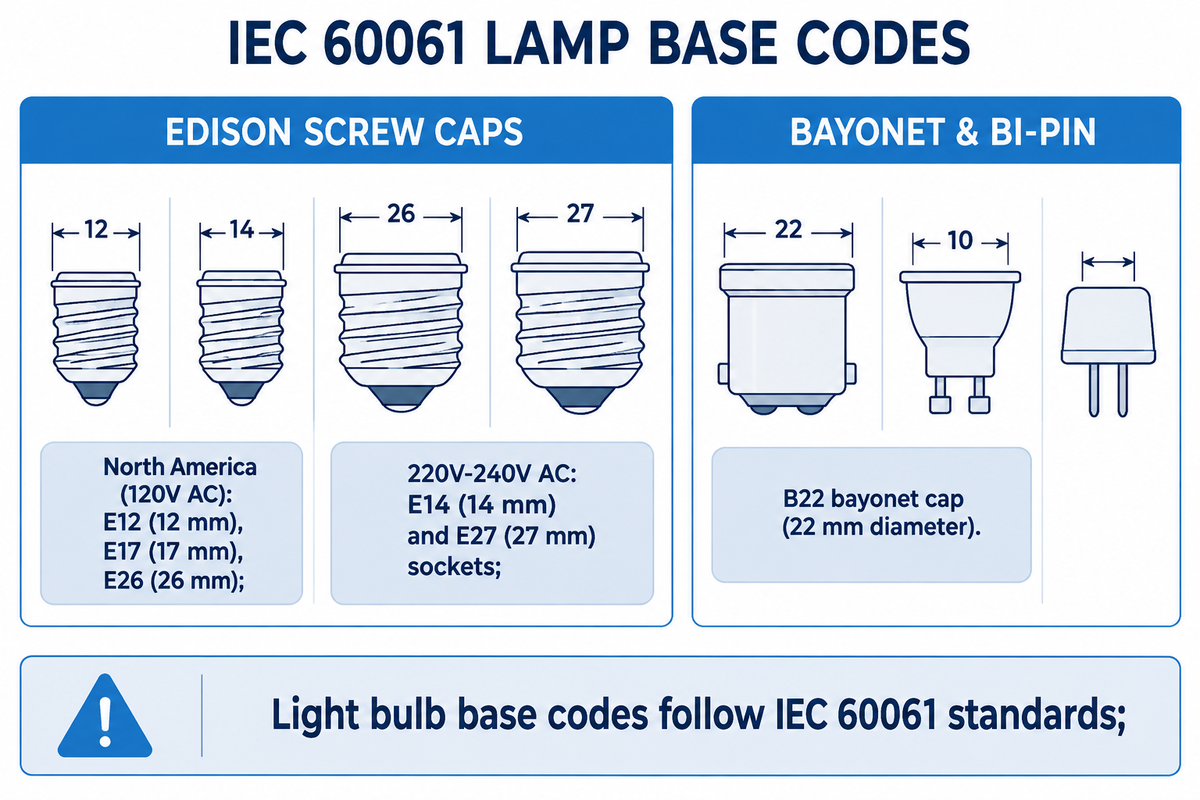
Light bulb base codes follow IEC 60061 standards, where the letter identifies the locking mechanism and the number states thread width or pin spacing in millimeters. In either case, verifying both the physical base code and the supply voltage is of utmost importance before installing a replacement bulb.
The Edison screw base has right-hand metal threads where the bottom button touches the hot wire, and where the shell is connected to neutral. In North America (120V AC), residential lighting uses E12 candelabra (12 mm), E17 intermediate (17 mm), and E26 medium (26 mm) sockets. In Europe, Australia, and Asia (220V, 240V AC), fixtures use E14 (14 mm) and E27 (27 mm) sockets, while warehouse high-bays use E39 or E40 mogul sockets.
Throughout Australia, the UK, New Zealand, and India, millions of ceiling pendants and table lamps are made with the B22 bayonet cap (22 mm diameter) instead of a screw base. A B22 cap has two side pins that lock into J-shaped socket slots with a quarter-turn twist.
Are A19 and E26 the Same Thing, and How Do E12, E26, E27, GU10, and GU5.3 Bases Differ?
No, A19 and E26 aren’t the same thing: A19 refers to the 2.375-inch pear-shaped glass bulb envelope, and E26 refers to the 26 mm screw base. Different bulb shapes (A19, G25, BR30, and PAR38, for example) use an E26 base, while other base types (E12, E27, GU10, and GU5.3) have different socket widths and voltage requirements.
Although E26 (26 mm) and E27 (27 mm) threads physically fit into one another, voltage differences create a serious hazard. Screwing a North American 120V E26 bulb into a 230V E27 socket will burn out the internal LED driver if the lamp doesn’t have a universal 100-277V driver. Always check the voltage print on the neck of the bulb being installed.
Bi-pin and twist-lock bases remove the screw shell to keep spotlights compact. A GU10 base uses two stepped pins spaced 10 mm apart that twist-lock into a 120V or 230V mains socket. By contrast, a GU5.3 bi-pin base on an MR16 bulb has two pins spaced 5.3 mm apart and runs on 12V low voltage, while compact G9 loop-pin bulbs run on line voltage.
Optical Specifications That Matter: Lumens vs Watts, Kelvin Color Temperature, CRI, and Clear vs Frosted Glass
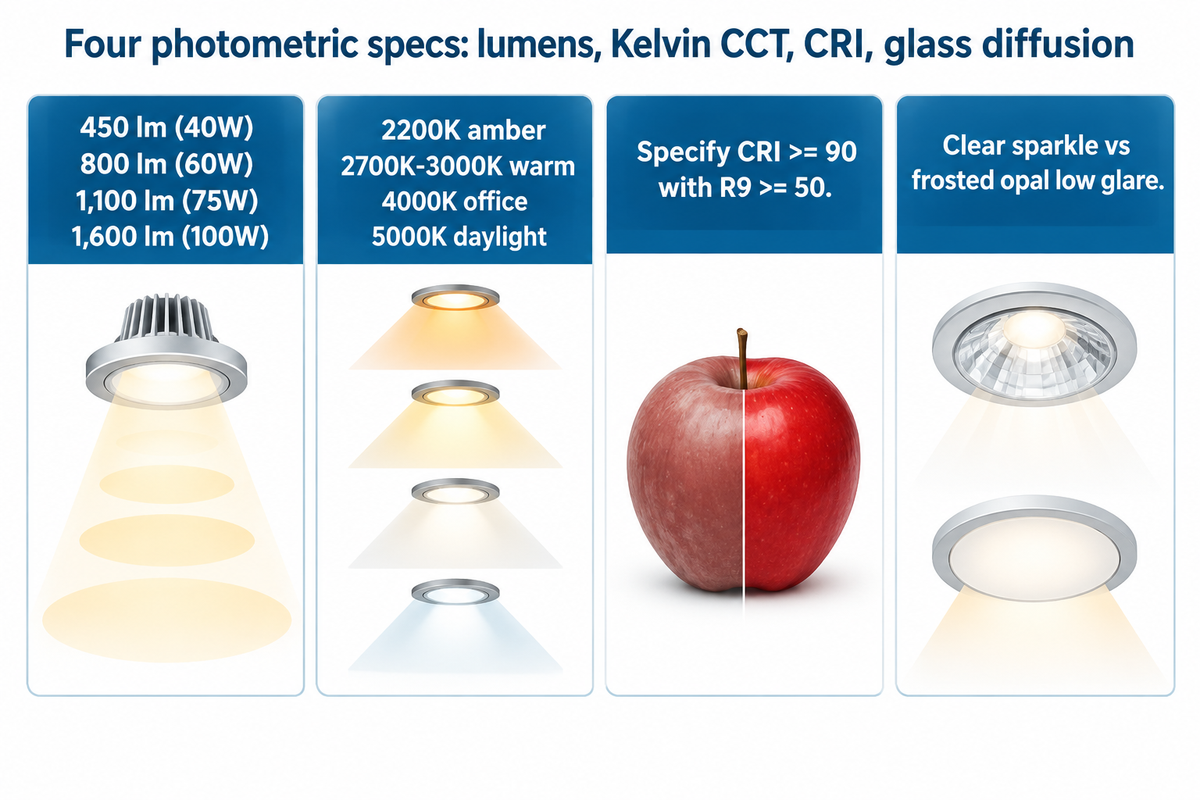
Accurate optical selection uses four photometric specs: lumen light output, Kelvin correlated color temperature (CCT), Color Rendering Index (CRI Ra and R9), and glass diffusion. Buying bulbs by wattage alone is outdated. Watts measure the electrical power draw, not the visible brightness.
According to U.S. DOE FEMP purchasing benchmarks, replacing a 60W traditional incandescent E26 A-type bulb requires an LED rated at 800 lumens, which draws 5.9W to 10.5W. To achieve the proper lumen level in a given room, use these benchmarks:
- 450 lumens (40W incandescent equivalent) draws 4W to 5.5W in LED and suits bedside lamps, wall sconces, and multi-arm chandeliers.
- 800 lumens (60W incandescent equivalent) draws 5.9W to 10.5W in LED and serves bedroom ceiling fixtures, reading lamps, and 3-light bathroom vanity bars.
- 1,100 lumens (75W incandescent equivalent) draws 9W to 12W in LED and fits kitchen worktables, utility rooms, and wide corridors.
- 1,600 lumens (100W incandescent equivalent) draws 13W to 16W in LED and lights large garages, workshops, and high-ceiling commercial pendants.
For outdoor compounds, parking lots and building perimeters with high demand for lumen output, size fixture Wattage using our Commercial LED Flood Light Wattage Calculator.
Kelvin Color Temperature (CCT) and CRI (Ra ≥ 90, R9 ≥ 50): The color of the light emitted by a bulb is rated in Kelvin and choosing the right kind of light shapes room mood. Vintage filament bulbs at 2200K give a nice amber glow, 2700K matches warm incandescents and 3000K matches halogen. Commercial office lighting uses 4000K bright white, while inspection bays use 5000K daylight.
Warm Kelvin ratings still wash out skin tones when red spectrum output is weak. Standard CRI (Ra) averages only eight pastel color samples (R1-R8) and skips saturated red (R9). Always specify CRI ≥ 90 with R9 ≥ 50 for vanities, fitting rooms and dining spaces, to attain natural skin tones and wood finishes.
Clear Filament vs. Frosted Opal Glass: Clear glass globes show LED filament inside directly, causing glare with seeded glass shades. Milk opal glass or frosted opal glass, on the other hand, diffuses light throughout the sphere and makes frosted G25 globes the best type of bulb for bare over-mirror bars.
Application Matching Matrix: Choosing the Right Light Globe for Vanity Bars, Pendants, Recessed Cans, and Outdoor Fixtures
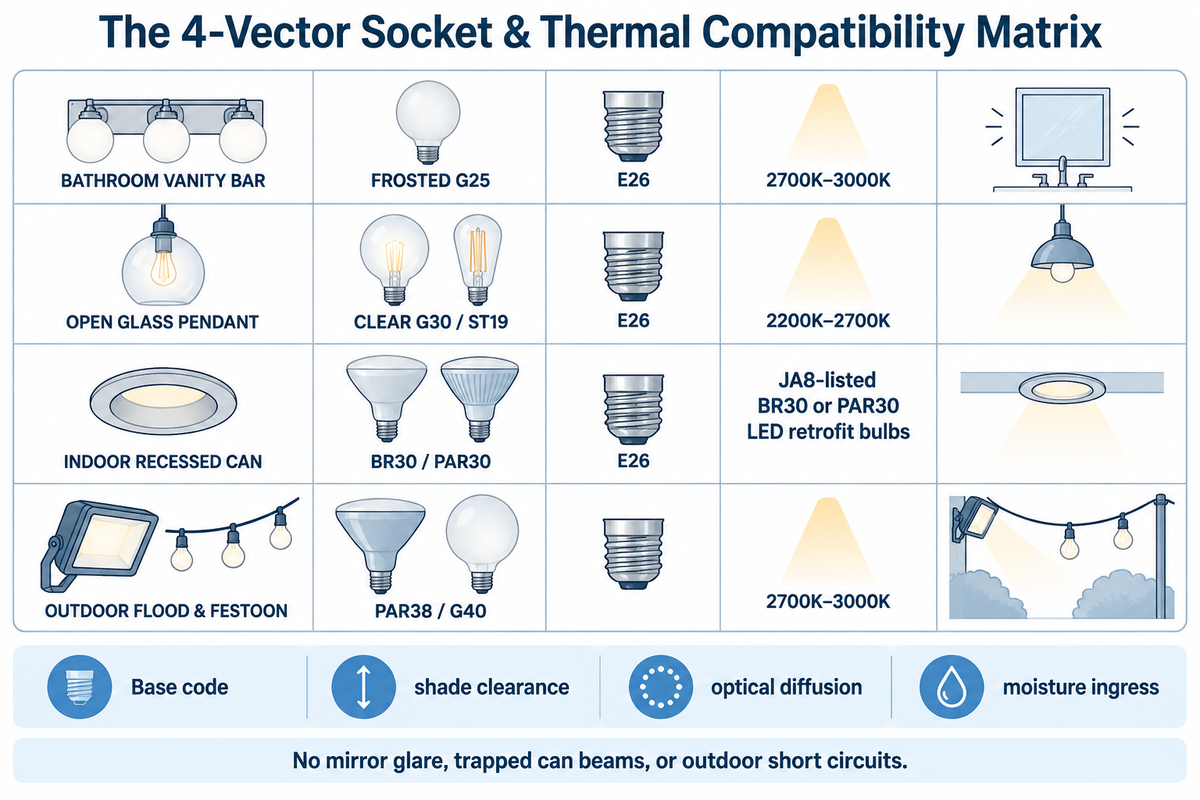
Matching light globes to a room fixture requires aligning four engineering factors: base code of the socket, clearance of the shade, optical diffusion, and protection from moisture ingress. Following the matrix ensures no glare in bathroom mirrors, trapped beams in recessed cans, or water-induced short circuits outdoors.
To simplify project takeoffs, our lighting engineers use The 4-Vector Socket & Thermal Compatibility Matrix below. Each row pairs a common fixture category with its matching ANSI bulb shape, IEC socket base, Kelvin/CRI target, and UL environmental rating.
When planning recessed lighting in California, note a key California Title 24 Building Energy Efficiency Standards rule separating new builds from retrofits. Newly constructed residential recessed ceiling cans can’t use medium E26 screw sockets and require dedicated JA8 LED downlights. Existing recessed cans with E26 sockets can still install JA8-listed BR30 or PAR30 LED retrofit bulbs.
There needs to be a unified lighting plan to use matching interior pendant globes with wall-washers on the exterior of commercial buildings. For more information, see our architectural facade lighting engineering guide.
| Fixture Category & Room Type | Recommended ANSI Bulb Model | Socket Base & Voltage | Optimal CCT, CRI & Glass Finish | Environmental & Thermal Rating |
|---|---|---|---|---|
| Bare Bathroom Vanity Bar | G25 Globe (3.125 in / 79.4 mm) | E26 (120V) / E27 (230V) | 2700K–3000K, CRI ≥ 90 (R9 ≥ 50), Frosted Opal | UL Damp Location; Open Fixture |
| Compact Powder Room Sconce | G16.5 Globe (2.06 in / 52.4 mm) | E12 Candelabra Base | 2700K, CRI ≥ 90, Frosted or Milky Glass | UL Damp Location; Shade Clearance ≥ 15 mm |
| Open Dining Pendant | G30 / G40 Large Globe | E26, E27, or B22 | 2200K–2700K, CRI ≥ 90, Clear Sapphire Filament | UL Dry Location; Warm-Dim Compatible |
| Multi-Arm Dining Chandelier | B10 / CA10 Torpedo Candle | E12 or E14 Screw Base | 2200K–2700K, CRI ≥ 90, Clear Filament | UL Dry Location; Trailing-Edge Dimmable |
| Indoor 6-Inch Recessed Can | BR30 Wide Flood Reflector | E26 Screw (Retrofit) | 2700K–3000K, CRI ≥ 90, Frosted Diffuser | IC-Rated / JA8 Listed (CA Retrofits) |
| High-Ceiling 6-Inch Downlight | PAR30 Long or Short Neck | E26 Medium Screw Base | 3000K–3500K, CRI ≥ 90, 40° Flood Lens | UL Damp Location; High-Lumen Center Beam |
| Sealed Ceiling Drum / Jelly Jar | A19 Thermal-Rated Service Bulb | E26 or E27 Screw Base | 2700K–3000K, CRI ≥ 85–90, Frosted | UL Enclosed Fixture Rated (Mandatory) |
| Retail / Gallery Display Track | MR16 Faceted Reflector Spot | GU5.3 (12V) or GU10 (Mains) | 3000K, CRI ≥ 95 (R9 ≥ 70), Narrow 25° Optic | Open Track; Low-Ripple Electronic Driver |
| Outdoor Patio Festoon String | S14 or G40 Shatterproof Globe | E26 Nickel-Plated Brass | 2200K–2700K, CRI ≥ 80, Polycarbonate Shell | UL Wet Location / IP65 Weatherproof |
Enclosed Fixture Thermal Limits, Dimmer Flicker, and Safe Retrofit Rules for Old Bulbs
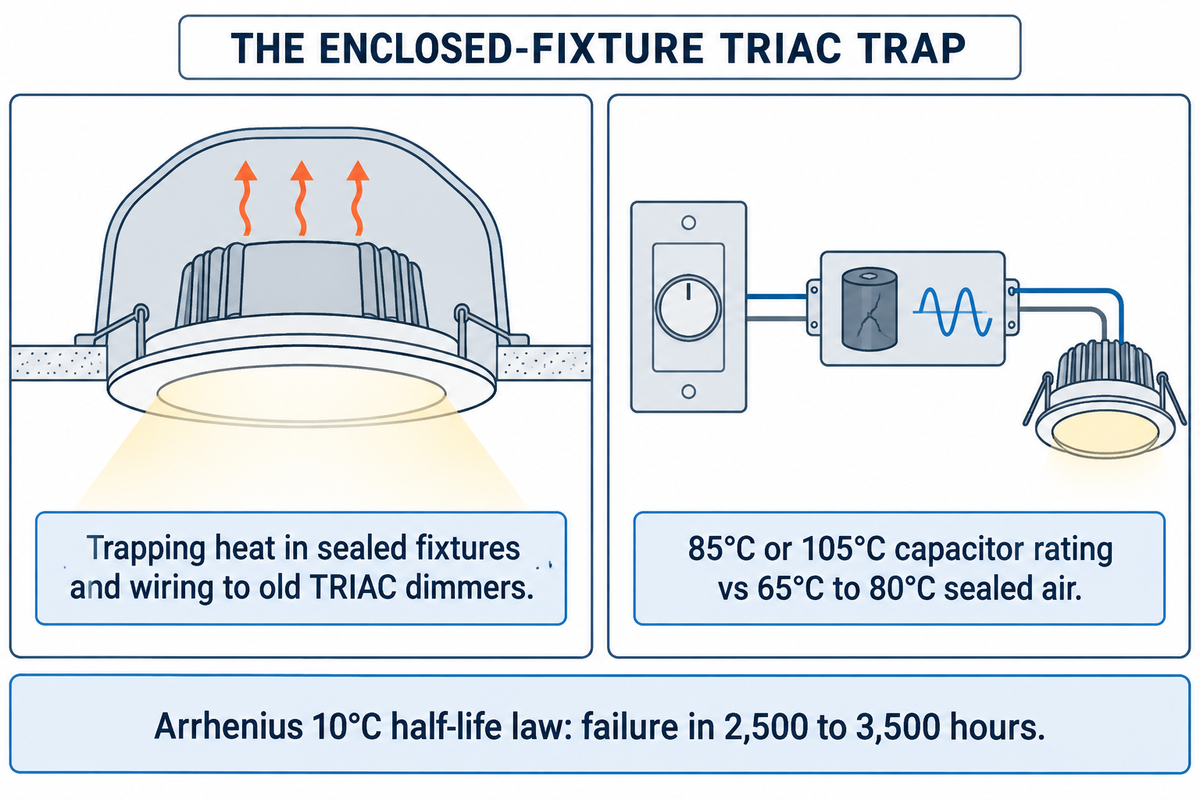
The most common early failures of the LED light globe can be attributed to two thermal-electrical issues. Most early LED light globe failures come from two electrical-thermal mistakes: trapping heat inside sealed glass fixtures and wiring LED drivers to old incandescent TRIAC dimmers. Compatibility testing between dimmers and the fixture prior to installation alleviates capacitor dry-out and visible flicker.
We call this combined failure mode the Enclosed-Fixture Triac Trap (Why High Lumen G25 LEDs Fail at 3,000 Hours). While a tungsten filament runs hot by design, a LED bulb houses a compact AC-to-DC driver circuit inside its neck. That driver employs an aluminum electrolytic capacitor, which has an 85°C or 105°C maximum temperature rating.
Sealing a non-enclosed-rated LED globe inside an airtight glass dome blocks airflow and pushes internal air past 65°C to 80°C. Every 10°C rise in temperature reduces the life of the driver by half, according to the Arrhenius 10°C half-life law. Heat stress from the surrounding environment can cause driver failure or accelerated lumen depreciation within 2,500 to 3,500 hours.
Why Do LED Globe Bulbs Flicker on Old Dimmers or Burn Out Early in Enclosed Fixtures?
LED globe bulbs flicker on old dimmers because legacy leading-edge TRIAC switches need a 40W to 60W resistive load to hold a stable firing current. Meanwhile, sealed fixtures trap driver heat around electrolytic capacitors, causing early burnout unless the lamp carries a UL enclosed-fixture rating.
According to DOE solid-state lighting flicker research, phase-cut mismatches create 100 Hz or 120 Hz light modulation that causes eye fatigue and stroboscopic trails. In addition, Lutron dimmer troubleshooting notes explain why two-wire dimmers without a neutral wire leak trickle current when switched off. That leakage charges the LED driver capacitor and makes the bulb ghost or flash.
To stop flicker and ghosting, pair dimmable LED globes with trailing-edge ELV dimmers or forward-phase dimmers certified to NEMA SSL 7A / Lutron CL standards. For commercial lighting projects that require smooth 100% to 1% dimming, consult our LED dimming and controller wiring guide or specify a DALI digital dimming protocol architecture.
Total Cost of Ownership, Compliance Standards, and Commercial Lighting Sourcing
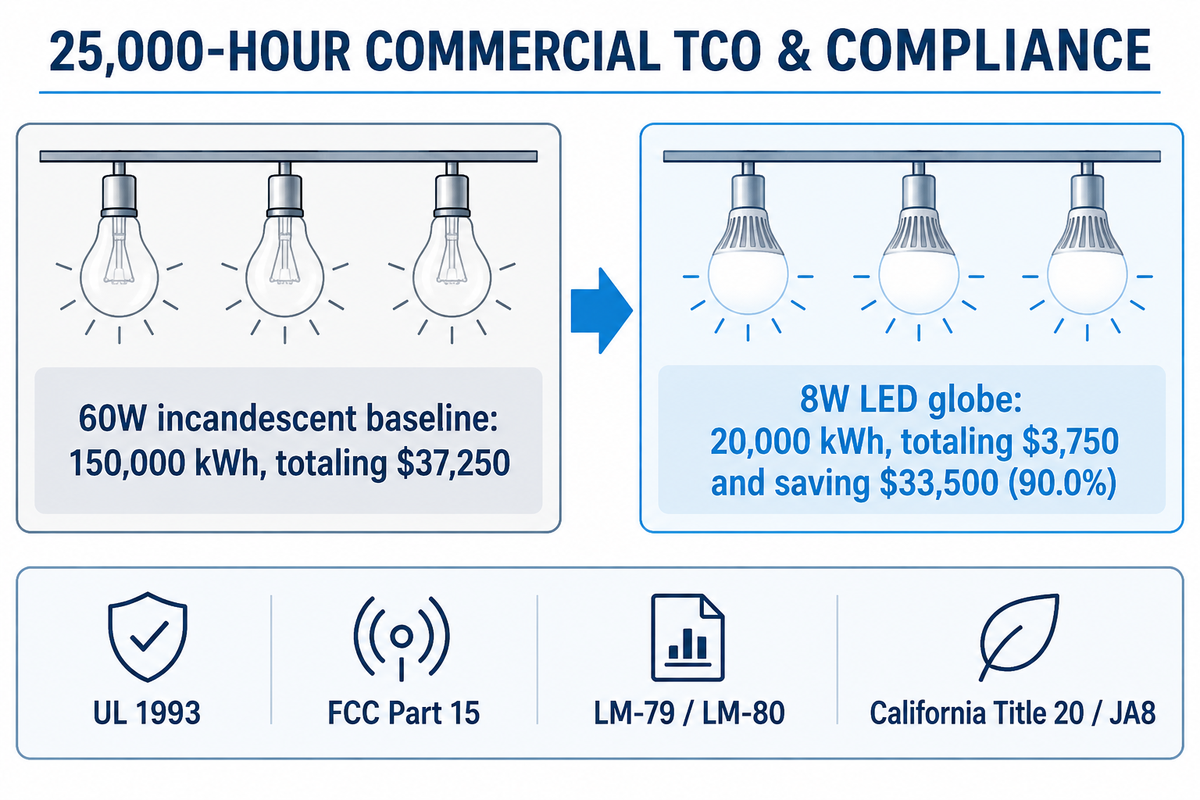
Evaluating light globe types by Total Cost of Ownership (TCO) rather than unit bulb price cuts 25,000-hour commercial lighting costs by 80% to 90%. In hotels, retail stores, and apartment buildings, electricity bills and maintenance ladder labor far exceed the upfront cost of energy-efficient lighting.
Compute the cost of running a 100-socket hotel vanity and corridor system at 4,000 hours per year for 25,000 total hours (6.25 years) at $0.14/kWh:
- A 60W traditional incandescent baseline (800 lm, 1,000 h B50 life) uses 150,000 kWh ($21,000 power) and needs 2,500 replacement bulbs ($3,750 in lamps + $12,500 labor), totaling $37,250.
- An 8W energy-efficient LED globe (800 lm, 25,000 h L70 life) uses 20,000 kWh ($2,800 power) and needs only 100 initial lamps ($450 in bulbs + $500 labor), totaling $3,750 and saving $33,500 (90.0%).
For warehouses and industrial plants replacing 250W to 400W mercury vapor or metal halide lamps, paybacks can be determined with our Industrial LED vs HID Replacement Savings Calculator.
What Certifications and Photometric Reports Should Commercial Buyers Verify When Sourcing Light Globes in Bulk?
Commercial buyers sourcing light globes in bulk should verify UL 1993 safety listing, FCC Part 15 EMI compliance, LM-79 / LM-80 photometric files, and California Title 20 / JA8 certification. Checking these test dossiers before shipment prevents customs delays, utility rebate denials, and early field failures.
Under California Energy Commission Title 20 and Title 24 JA8 rules, state-regulated LED lamps sold in California must appear in the MAEDbS database (with Title 20 setting a CRI ≥ 82 baseline under 20 CCR § 1605.3). For high-efficacy residential compliance, Title 24 JA8 requires CRI ≥ 90, R9 ≥ 50, audible noise ≤ 24 dBA at 1 meter, start time ≤ 0.5 seconds, and flicker below 30% at 200 Hz. Specifying JA8-grade drivers on hospitality lighting projects ensures quiet, flicker-free operation anywhere.
At Guangqi Lighting’s photometric and thermal aging lab in Zhongshan, our team tests sapphire-substrate COB filament globes (utilizing omnidirectional thermal paths similar to US Patent US8013501B2) and SMD globes, inside 45°C chambers. Analysis of IESNA LM-79 integrating sphere reports and TM-21 L70 sheets shows that all production batches meet your Kelvin bin and lumen output requirements.
Frequently Asked Questions
What are old-style filament light globes called today?
Old style exposed filament bulbs, i.e. “vintage Edison” bulbs, or Marconi “squirrel cage” lamps, or antique filament globes are listed in catalogs as ANSI shape codes ST19 (metric ST64) or G25, or T10. Modern energy efficient LED versions use sapphire or ceramic filament columns coated in warm 2200K to 2700K phosphor. They replicate 1890s carbon or tungsten coils while cutting electricity use by 85%.
Can I put a higher-lumen LED globe into a fixture rated for 60 watts max?
Yes, you can safely install a higher-lumen LED globe into a socket labeled “MAX 60W” as long as the LED bulb’s actual electrical wattage stays below 60 watts. Fixture wattage stickers protect socket insulation and wiring from heat under UL 1598 limits. Installing a 14-watt LED globe that produces 1,600 lumens (100W equivalent brightness) draws less than one-fourth of that 60W thermal ceiling.
Should I choose clear glass or frosted glass G25 globes for a bathroom vanity?
For bare-bulb bathroom vanity bars mounted at eye level around a mirror, choose frosted or milky opal glass G25 LED globes with CRI 90+ and a 2700K to 3000K color temperature. Glass type spreads the intensity of the diode array across the 3.125″ sphere, and cuts glare and sharp nose/chin shadows. Clear filament G25 bulbs in textured shades serve best for this task.
How do you dispose of broken or burned-out CFL light globes safely?
Because spiral CFLs contain 1.5 to 4.5 mg of mercury, air out the room for 15 minutes if broken, scoop glass with stiff cardboard instead of vacuuming, and bring intact CFLs to hazardous-waste drop-offs.
Do G25 and G30 globe bulbs fit the same standard light socket?
Yes, most North American G25 and G30 globes share the same E26 medium screw base, so both thread into standard sockets, just check that your fixture shade leaves at least 3.75 inches of width clearance.
Why do some LED light globes glow faintly after the wall switch is turned off?
Off-state glowing, known as LED ghosting, is the result of a very small leakage current from two-wire smart dimmers, lighted toggle switches, or motion sensors charging the input capacitor of the LED driver. Low voltage on switched lines from parallel traveler wires in 3-way switch loops can also cause LED ghosting. To completely stop LED ghosting, wire a UL-listed RC bypass capacitor (such as a Lutron LUT-MLC) across the fixture load.
References & Sources
- U.S. Department of Energy (FEMP), Purchasing Energy-Efficient Light Bulbs & Lumen Equivalency Guide
- U.S. Department of Energy, Solid-State Lighting LED Basics & L70 Lifetime Definitions
- U.S. Department of Energy, Solid-State Lighting Photometric Flicker Research
- U.S. Federal Register, Energy Conservation Standards for General Service Lamps (45 lm/W Rule)
- U.S. EPA ENERGY STAR, Program Requirements for Lamps V2.1 Final Specification (Legacy Benchmark)
- Title 20 & Title 24 JA8 Standards regulate LED lamps manufactured by state-regulated utilities.
- California Energy Commission, 2025 Building Energy Efficiency Standards (Title 24 Residential Lighting)
- ScienceDirect (Energy Reports), Thermal Effects on LED Lamp Lumen Depreciation and Driver Reliability
- United States Patent US8013501B2 – Omnidirectional Heat-Dissipating LED Pentagonal Bulb Architecture
- GE Lighting, Engineering Guide to Light Bulb Sizes, Types, Shapes, and ANSI Codes
- Lutron Electronics Support, Troubleshooting LED Lights That Glow, Flicker, or Ghost on Two-Wire Dimmers
Trending now