Get in Touch with GUANGQI



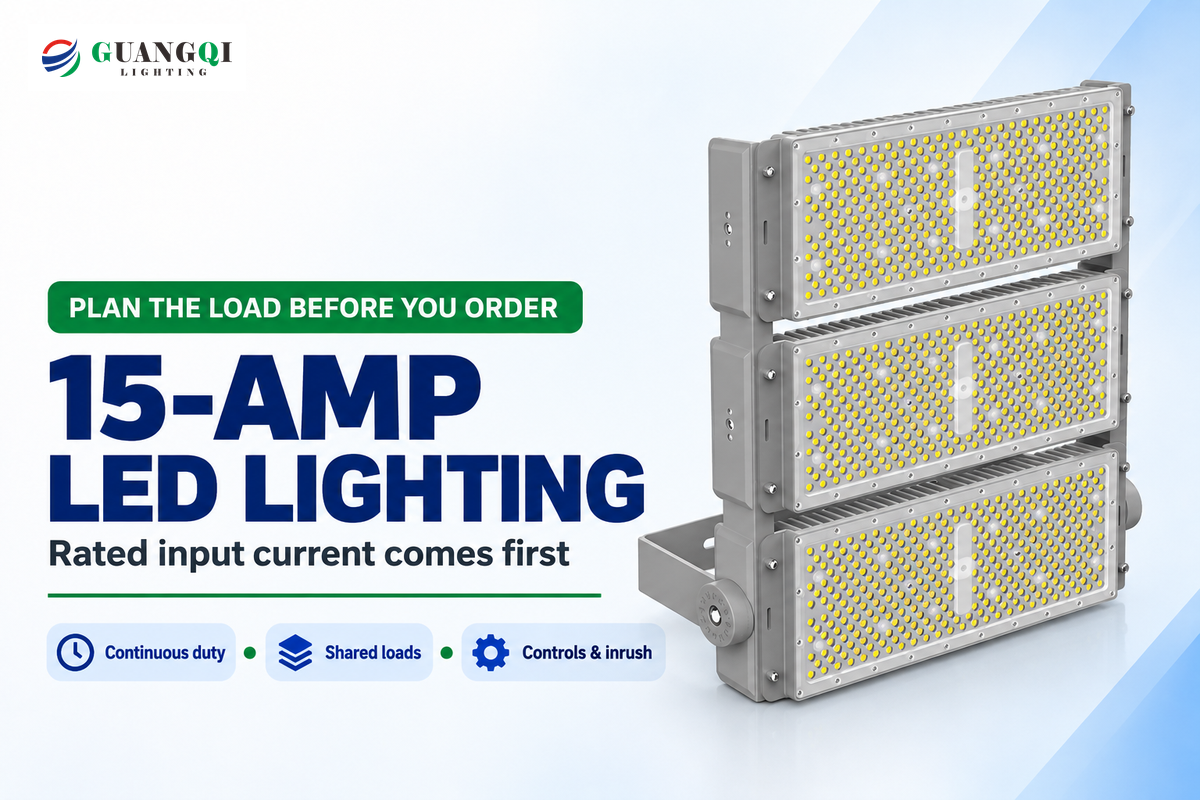
For a continuous-lighting-dedicated 15-amp circuit, work with a 12 A running-current budget. Divide that by each fixture’s rated AC input current and round down. The rated input current determines how many lights on a 15 amp circuit can run before separate control, start-up, and installation limits apply.
15 ACircuit amperage rating in these examples
12 AAll-continuous running allowance
120 VNominal supply for watt examples
A 15-amp lighting circuit has a 12 A current budget in the normal all-continuous sizing case. Fixture count equals 12 A divided by rated input amperes, rounded down; shared loads, controls and inrush can reduce it.
- LED-driver load is based on the complete unit’s ampere rating, rather than lamp watts or equivalent brightness.
- The familiar 1440 W calculation assumes 120 V and power factor 1.00.
- A dimmer or driver-startup limit can be lower than the branch-circuit current ceiling.
- Required circuit use and local code adoption still govern the installation.
Updated November 2026. Electrical examples use a US model-code framework; the locally adopted edition and amendments govern each project.
How Many LED Lights Fit on a 15-Amp Circuit?
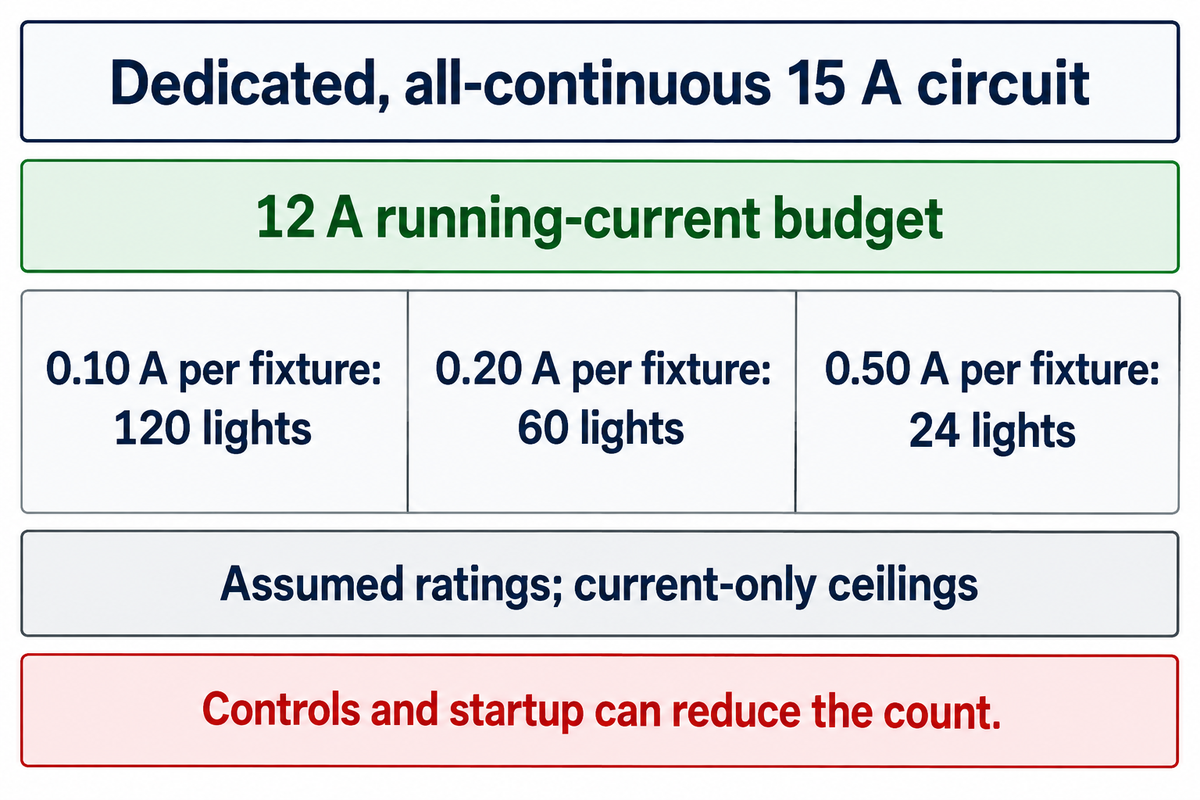
A 0.10 A LED fixture gives a current-based ceiling of 120 fixtures on an otherwise unloaded, all-continuous 15 A circuit. That follows from 12 A ÷ 0.10 A. Use the light fixtures’ rated AC input amperes at the supply voltage; the final permitted quantity must also satisfy the controls and startup constraints.
The 2024 International Residential Code, E3702.9, bases LED-driver luminaire loads on total unit ampere ratings. A lamp’s “60 W equivalent” marking indicates replacement brightness and not a 60 W load.
Assumed inputs: identical fixtures with the input-current ratings shown below, no shared loads, and the customary 125% continuous load sizing. These rows compare operating current ceilings, and aren’t tested installation quantities.
| Rated AC input per fixture | Current-based count, rounded down | Combined running current |
|---|---|---|
| 0.05 A | 240 | 12.00 A |
| 0.08 A | 150 | 12.00 A |
| 0.10 A | 120 | 12.00 A |
| 0.12 A | 100 | 12.00 A |
| 0.15 A | 80 | 12.00 A |
| 0.20 A | 60 | 12.00 A |
| 0.30 A | 40 | 12.00 A |
| 0.50 A | 24 | 12.00 A |
| 0.75 A | 16 | 12.00 A |
| 1.00 A | 12 | 12.00 A |
For mixed models, calculate the total by adding their input currents instead of dividing by an average bulb wattage. Ten fixtures at 0.20 A and ten at 0.10 A total 3 A. The number of lights on a single circuit changes, even if the breaker remains the same, with the fixture mix.
When Does the 80% Continuous-Load Rule Apply?
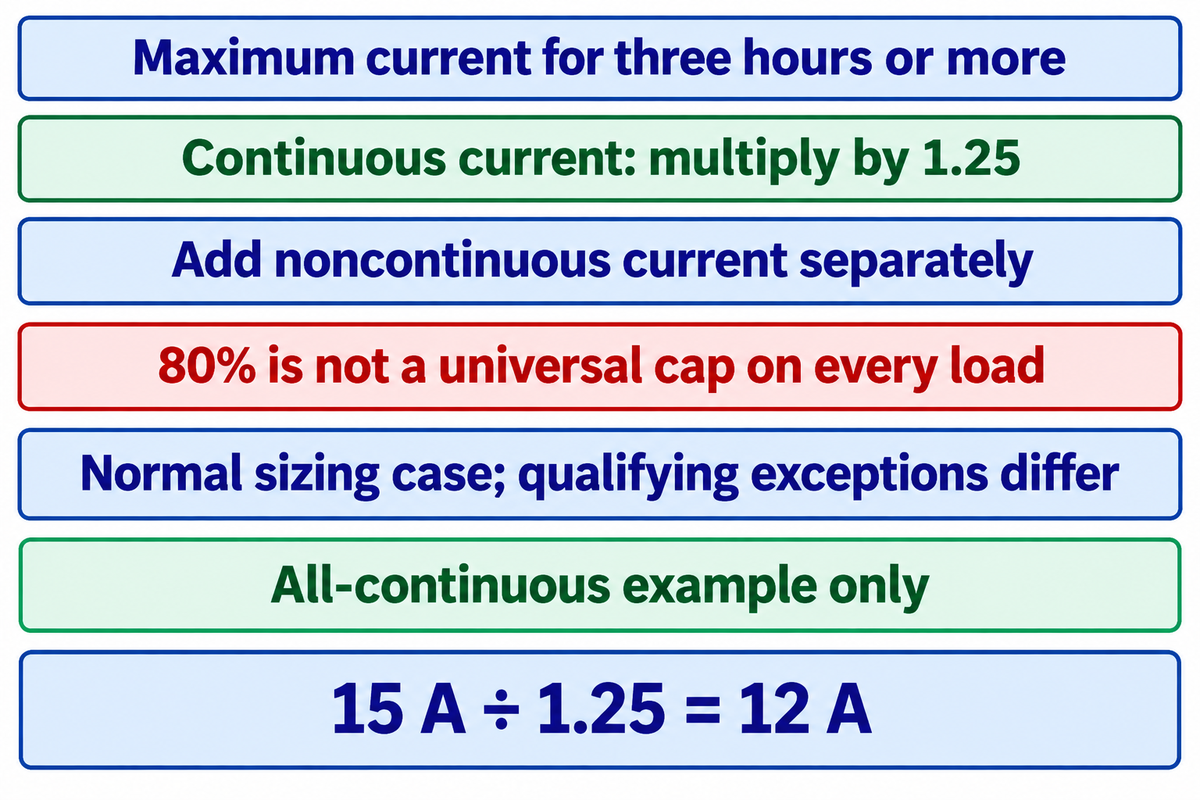
The 80% continuous-load allowance applies in the normal sizing case when maximum current is expected for three hours or more. Sizing that continuous load at 125% gives 15 A ÷ 1.25 = 12 A. Noncontinuous loads have a separate term; 80% isn’t a universal cap on every load.
The calculation for determining continuous loads at a circuit is like having a budget with different weights. A continuous lighting load consumes more calculated capacity than the same running current used noncontinuously. Under IRC E3701.2.1, the conductor-sizing expression is:
Calculated current = noncontinuous current + 1.25 × continuous current.
“the noncontinuous load plus 125 percent of the continuous load”
A bank of shop lighting in continuous use at full load for an entire shift is a continuous load. A different appliance that’s used for a short duration isn’t always a continuous load. The expected duration of maximum current matters, rather than whether the wall switch is on during a survey.
Noncontinuous loads are governed by equipment-specific limitations. A qualifying 100%-rated assembly may also receive different continuous-load sizing treatment. A qualifying 100%-rated assembly can also have different sizing treatment; a standard residential 15 amp breaker shouldn’t be assumed to have that exception. The 2026 code-calculation change is addressed separately in the Industry Outlook.
LED Wattage Examples at 120 Volts
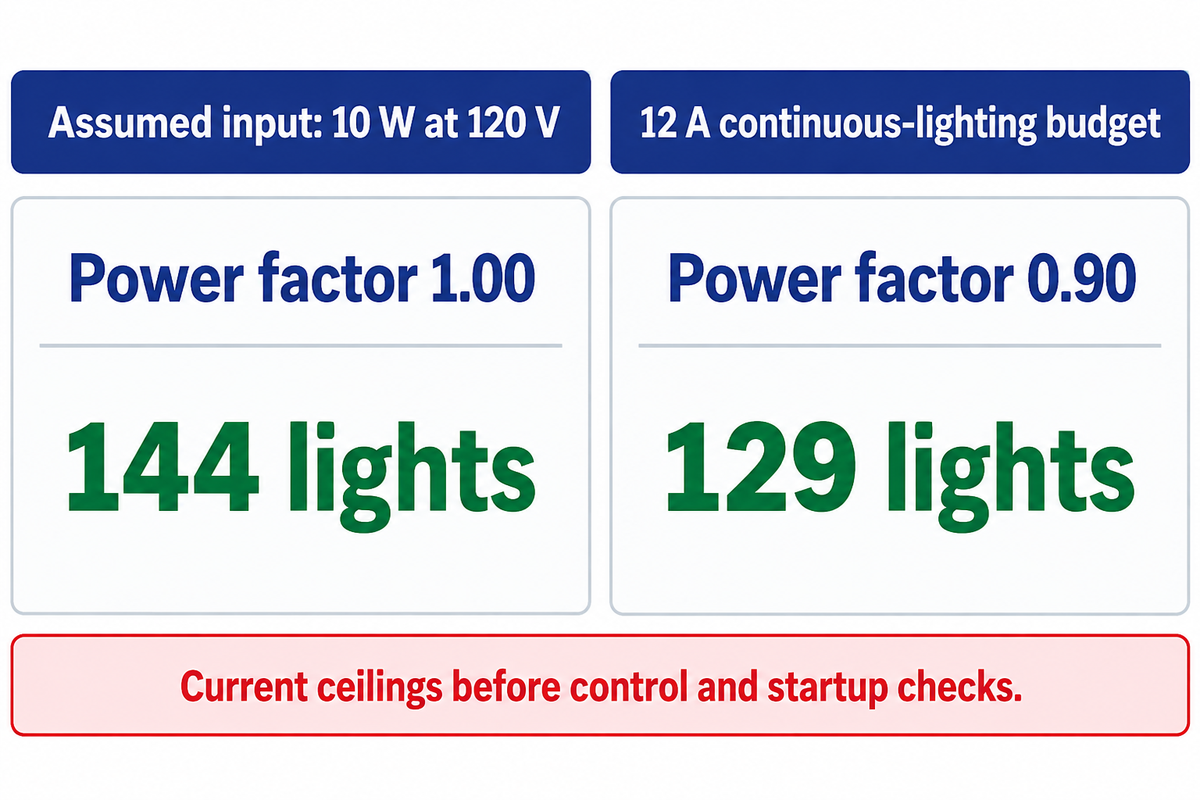
Ten watts of actual input power gives a calculated ceiling of 144 LEDs at 120 V and power factor 1.00 under a 12 A continuous-lighting budget. At power factor 0.90, the same 10 W input requires more current and the ceiling falls to 129. Both examples are before control and startup checks are performed.
Apparent power is voltage times RMS current, measured in volt-amperes. Real power is measured in watts. The U.S. Energy Information Administration’s power-factor definition states that true power factor equals real power divided by apparent power.
| Actual AC input watts per light | Calculated input current | Current-only count |
|---|---|---|
| 7 W | 0.0583 A | 205 |
| 9 W | 0.0750 A | 160 |
| 10 W | 0.0833 A | 144 |
| 12 W | 0.1000 A | 120 |
| 15 W | 0.1250 A | 96 |
| 20 W | 0.1667 A | 72 |
The 9W LED row and the 7 watts row use actual wattage at the AC input, not an incandescent-equivalent label. For 15W input, the PF 1.00 example produces 96 lights. A 15 W driver output rating is a different measurement boundary and can’t simply be substituted.
The University of Louisville’s electrical engineering lesson gives a detailed explanation of apparent and real power. Examples in the lesson use sinusoidal waveforms. For apparent and real power with respect to an LED driver, it’s preferable to consider the effects of waveforms and true power factor rather than presume that a phase-angle value describes the driver.
How Do Shared Outlets Change the Light Count?
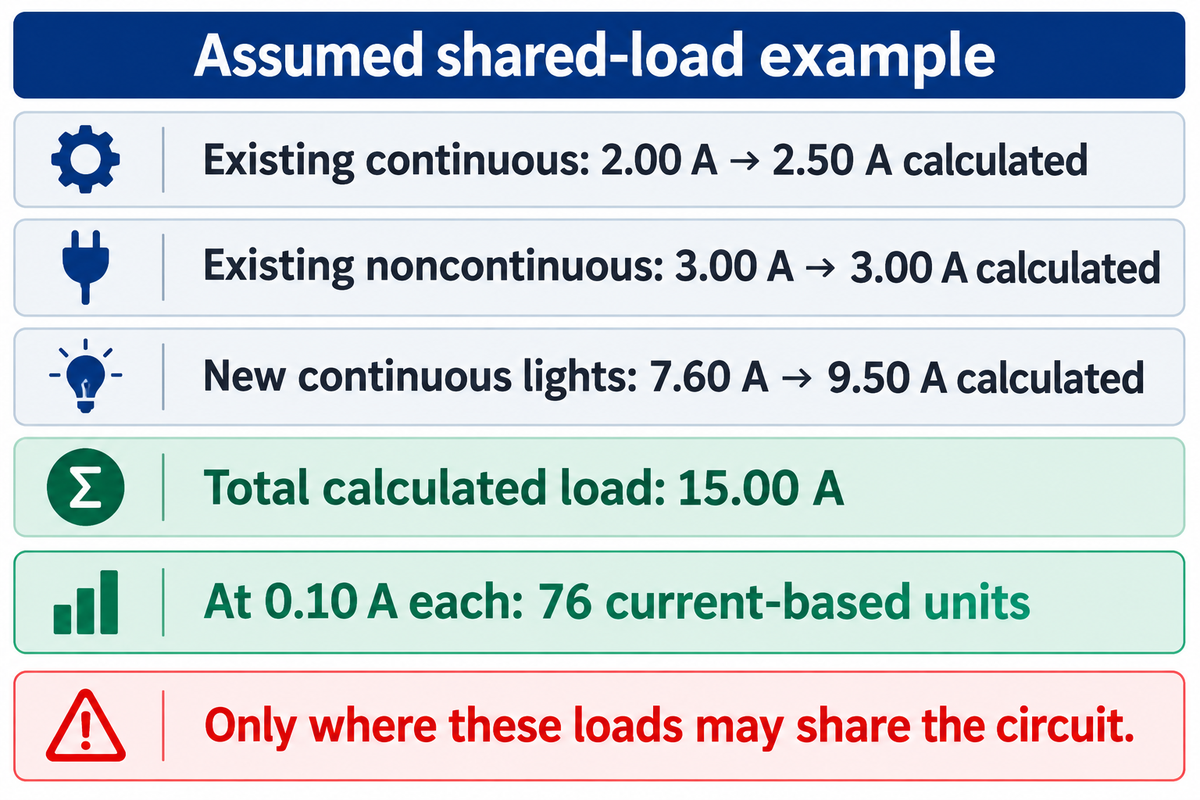
With an assumed 2 A of existing continuous load and 3 A of noncontinuous load, the remaining allowance is 7.6 A for new continuous lights on a normal 15 A circuit. At 0.10 A per fixture, that gives 76 current-based units. This calculation applies only where the proposed loads are permitted to share the circuit.
Example: A facilities manager adds ceiling lights on a general-purpose circuit. Current equipment uses 2 A continuously and another simultaneous load uses 3 A noncontinuously. The proposed fixtures each list an input current of 0.10 A and will be on for the entire shift. The manager first assigns 2.5 A of calculated capacity to the existing continuous equipment and 3 A to the other equipment. The remaining 9.5 A of calculated capacity provides for 7.6 A of new continuous lighting. Purchasing 76 fixtures would use the entire arithmetic allowance; however, procurement still needs the control and startup limits before agreeing on the installed grouping.
| Load | Running current | Sizing multiplier | Calculated contribution |
|---|---|---|---|
| Existing continuous equipment | 2.00 A | 1.25 | 2.50 A |
| Existing noncontinuous equipment | 3.00 A | 1.00 | 3.00 A |
| Available contribution for new continuous lights | 7.60 A | 1.25 | 9.50 A |
| Total calculated load | 12.60 A | Mixed | 15.00 A |
New continuous lighting current = (15 – 1.25 × 2 – 3) ÷ 1.25 = 7.6 A. Subtracting every load from a blanket 12 amps would mishandle the noncontinuous term.
Counting outlets on a single circuit does not replace a load assessment. The current per outlet can change with connected equipment, so a fixed allowance of 12 devices won’t account for the load. IRC E3702.4 also limits the load drawn by individual portable cord-and-plug equipment, as well as some fixed equipment on a shared circuit. Circuits dedicated to kitchen small-appliance receptacles, laundry receptacles, bathrooms or garages have specific use restrictions. A spare receptacle does not automatically make its circuit available for extra lights.
Replacing an outlet changes neither the wire gauge nor the circuit’s capacity. For home improvement work, planning outlets on a 15A general-purpose circuit requires both the actual loads and the circuit’s permitted use.
Check LED Driver Current, Power Factor and Inrush
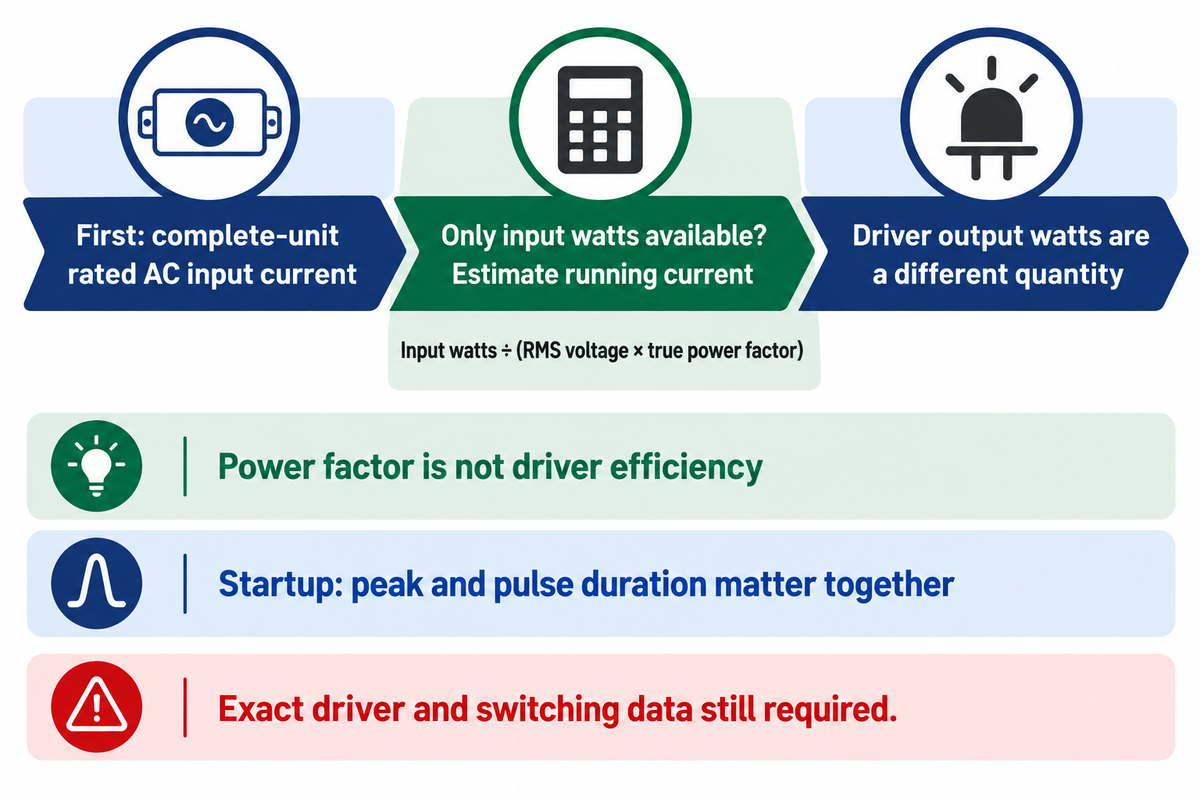
A whole-fixture AC input rating is the first value to use for LED light count. Where only real input watts are available, estimate single-phase running current as input watts divided by RMS voltage and true power factor. Driver output watts, equivalent bulb wattage and startup peaks describe different quantities.
For an assumed 10 W input at 120 V and PF 0.90, the estimate is 10 ÷ (120 × 0.90) = 0.0926 A. Keeping the unrounded value gives the 129-unit current ceiling. A manufacturer’s higher rated maximum input current takes precedence over this estimate when planning that actual fixture.
Use the watts to amps calculator provided with actual input watts, AC voltage and PF to get an estimate of running amps. Address other aspects of the electrical design, including protection, control, startup and component compatibility, separately.
Power factor isn’t the same as driver efficiency. Driver efficiency relates output power to input power. Power factor relates real power to apparent power. Using them interchangeably can lead to underestimating how much current LEDs draw.
Inrush current happens as driver input components charge at switch-on. Its peak and pulse duration matter together. Continuous amperage load conditions can differ greatly from load conditions from many drivers starting in unison and interacting with circuit impedance. A complete assessment of a startup condition can’t be determined by calculating peak times quantity.
A purchase sheet that just says “10 W LED” doesn’t specify the input conditions or identify the driver. The supplier handoff below keeps those fields together with breaker and lighting-control applicability.
What Else Limits a 15-Amp Lighting Circuit?
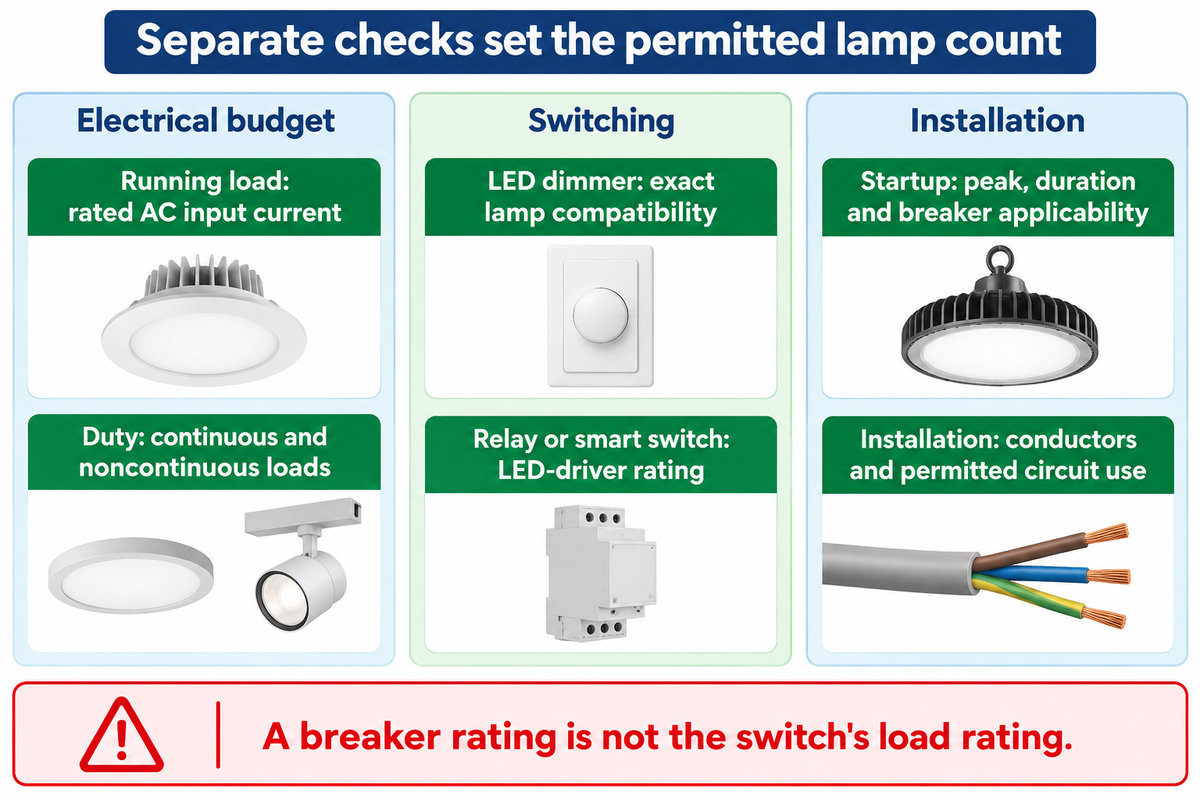
The allowed lamp count has to satisfy the branch circuit, control and start-up conditions together. Check a dimmer’s LED load rating rather than its incandescent rating, and a relay’s published LED-driver switching rating rather than its current rating alone. The Lamp Count Cross-Check separates these conditions before a quantity becomes a purchase or installation decision.
| Constraint | Value or document to use | What changes the decision |
|---|---|---|
| Luminaire running load | Rated AC input amperes at the supply voltage | Higher input current reduces the count. |
| Continuous duty | Maximum current expected for 3 hours or more | Normal sizing uses 125% of that continuous current. |
| Other simultaneous loads | Separate continuous and noncontinuous current | Shared equipment consumes the available circuit budget. |
| Portable cord-and-plug equipment | Applicable 80% single-equipment limit in IRC E3702.4 | A circuit-total calculation does not erase the device limit. |
| Fixed equipment other than luminaires | Applicable 50% limit where the circuit also supplies lights or portable loads | Some equipment cannot share the proposed circuit. |
| Input voltage | Exact fixture or driver voltage range | A 120 V product is not automatically suitable for 220 V. |
| Transformer primary | Whole-system AC input rating | Secondary lamp watts omit primary-side behavior. |
| LED dimmer | LED load rating and tested lamp combination | Incandescent watt ratings do not establish LED compatibility. |
| Relay or smart switch | Published LED-driver switching/load rating | A breaker rating is not the switch’s load rating. |
| 0–10 V control | Control output capacity and driver control-current demand | The signal channel can reach its limit before the power circuit. |
| Simultaneous startup | Driver inrush peak, pulse duration and breaker applicability | A low running load can still cause nuisance trips. |
| Conductors and installation | Material, ampacity, terminations and applicable adjustment | Wire size alone is not a complete circuit assessment. |
| Required circuit use | Adopted rules for the particular room or equipment | An otherwise spare circuit may be unavailable for extra lights. |
Per OSHA 1910.303(b)(2), for workplace installations, listed or labeled equipment must be installed and used in accordance with the instructions included with the listing or label.
What size circuit breaker should I use for lights?
The 2024 IRC copper-conductor summary couples 14 AWG with 15 A circuits and 12 AWG with 20 A circuits. Electricians use the circuit’s verified conductor and equipment requirements to select the breaker. Matching protection to the entire circuit is part of electrical safety. Assessment is based on the material, installation conditions, adjustment and terminations. A qualified electrician should determine any circuit alteration.
A 14 AWG wire marking doesn’t grant approval for all installations. Nor does a 12 AWG section establish the condition of the entire circuit. A 20-amp breaker must never be treated as a quick cure for a tripping 15-amp breaker.
Before adding fixtures
- Use rated input current for the complete unit.
- Keep control and startup limits on the project sheet.
- Have circuit changes assessed by a qualified electrician.
When a breaker trips
- Do not increase breaker amperage as a lamp-count shortcut.
- Do not repeatedly reset a circuit that continues to trip.
- Stop using damaged or overheating equipment and obtain qualified help.
Worked Examples for Recessed Lights and Commercial Fixtures
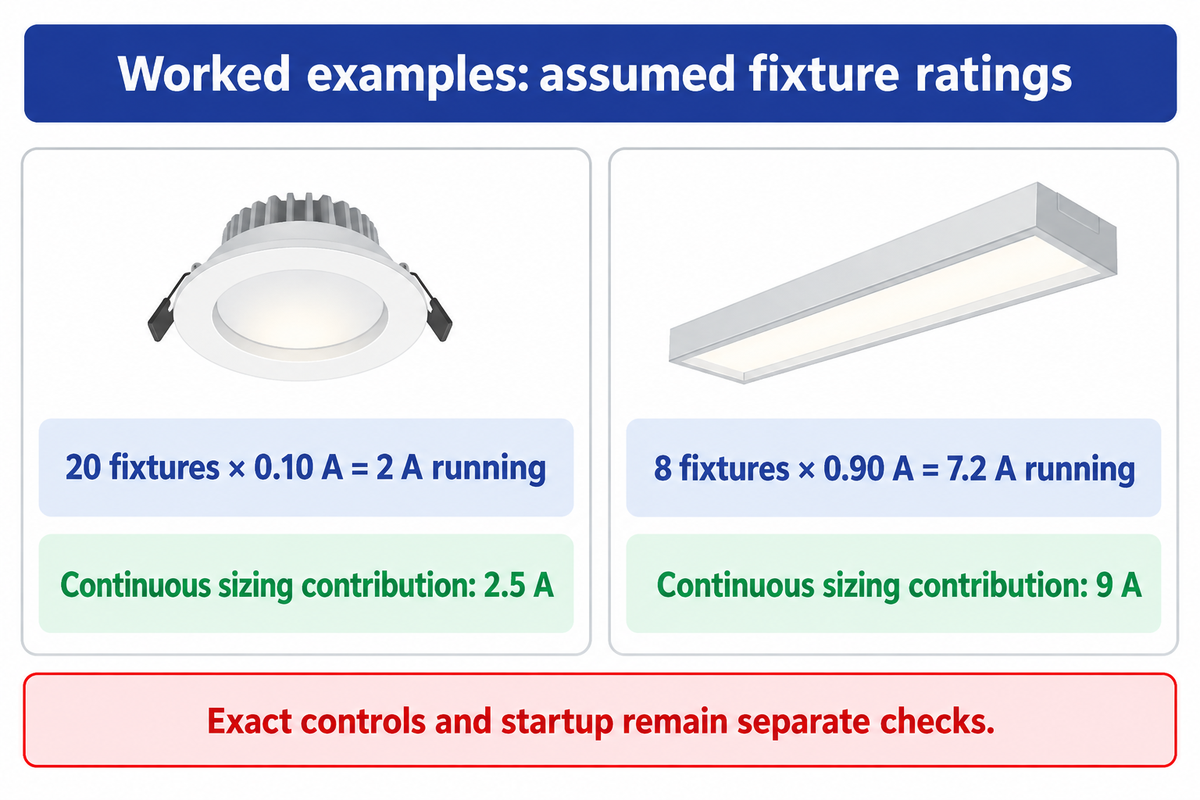
Twenty assumed recessed fixtures rated at 0.10 A each draw 2 A in total, or 2.5 A after the normal continuous-load multiplier. Eight assumed commercial fixtures at 0.90 A each draw 7.2 A, or 9 A calculated. Fixture input current, rather than the room name or housing size, changes the result.
Example: a basement renovation calls for 20 recessed lights, each with a rated 0.10 A input at 120 V. Their combined running current is 20 × 0.10 = 2 A. If maximum current is expected for three hours or more, the normal sizing contribution becomes 1.25 × 2 = 2.5 A. A proposed smart dimmer adds a separate compatibility question: its LED rating and allowed fixture combination must cover that bank. The remaining branch capacity can’t be allocated by counting how many switches or receptacles happen to be visible. Existing simultaneous loads and the permitted use of the circuit remain part of the project.
How many LED pot lights per circuit?
In the dedicated all-continuous 15 A example, 0.10 A pot lights have a current ceiling of 120. Determine the quantity from the pot light’s rated input current. The same housing style with a different driver can give a different count; the dimmer or startup limit can reduce the usable grouping.
Example: a workshop buyer considers eight luminaires, each rated 0.90 A at the actual supply voltage. Their running load is 8 × 0.90 = 7.2 A. Under the same all-continuous sizing assumption, their calculated contribution is 9 A. The current budget therefore leaves room arithmetically, but the buyer still needs the exact driver and switching data before ordering all eight fixtures for one circuit protected by one breaker. A model with lower input watts doesn’t automatically have a lower startup peak. A facilities team may choose separate lighting groups for operational continuity; that decision is different from claiming a universal maximum number of commercial fixtures per circuit.
For low-voltage lights, use transformer or power-supply primary input data as well as secondary load limits. Christmas lights and mini lights also have manufacturer limits for connected strings and plugs and connectors. These limits also apply even if total wattage shows the lights use little power.
See the industrial LED bulb retrofit checklist for answers to other selection questions regarding lamp bases, voltage and host-fixture conditions.
Industry Outlook: 2026 Code Changes and the Supplier Handoff
The 2026 National Electrical Code reorganizes load calculations, so a quotation or circuit schedule should identify the calculation stage and adopted edition. A change to service or feeder load calculation must not be used to assume a full 15 A continuous lighting allowance. Branch conductor and overcurrent sizing remain separate design checks.
In its January 2026 explanation, NFPA describes the move from Article 220 to Article 120. The summary says Section 120.5(E) changes how continuous loads are treated in load calculations. This is why a statement about “removing 125%” needs its calculation context.
NFPA also distinguishes calculations for dwelling service from the minimum number of required branch circuits. Its explanation for Section 120.13 retains 3 VA/ft² for the branch-circuit calculation. Adding the currents of low-power lamps by themselves doesn’t determine the number of dwelling circuits required.
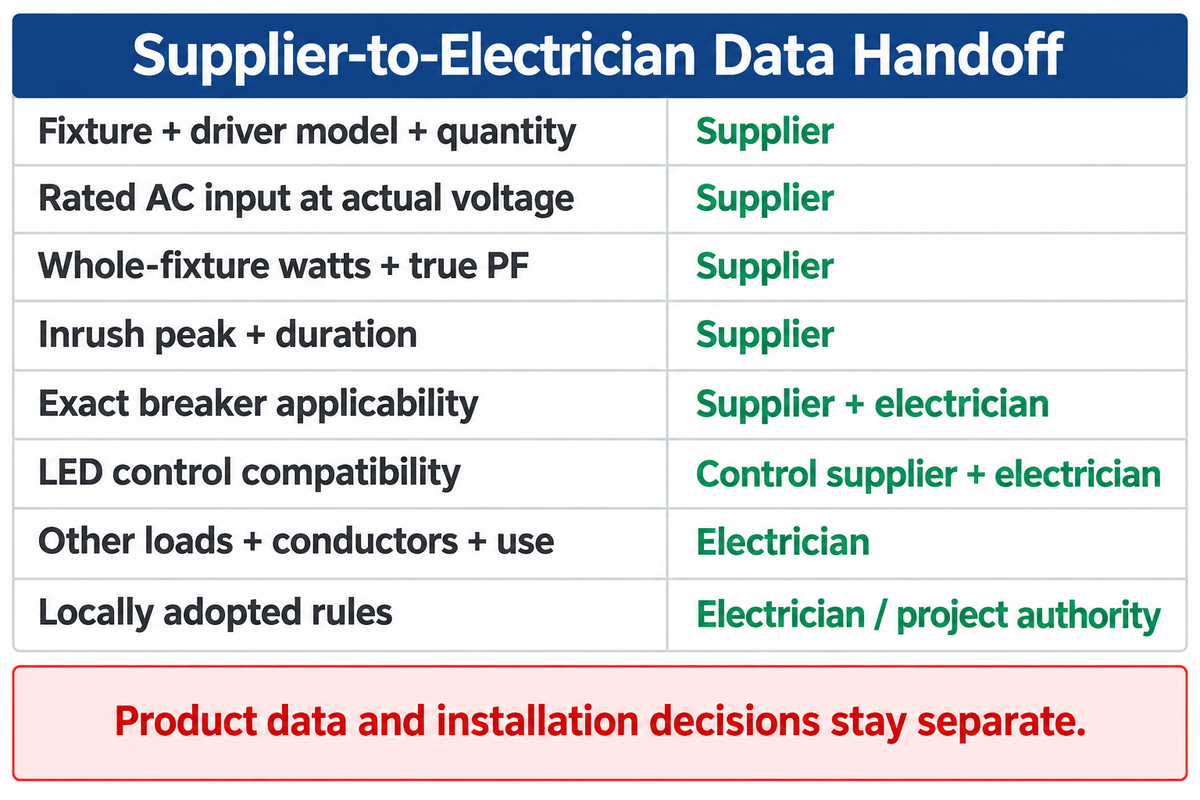
For a 2026 project, the procurement action is to keep product data separate from installation decisions. The supplier is able to identify the fixture and driver ratings. The electrician determines how those products fit the existing circuit and the locally adopted rules. A published edition of the code doesn’t automatically become law at every project location.
Enter the following details in a quote request. Lack of driver input or control data can delay grouping and commissioning even if the initial wattage calculation looks comfortable.
| Item | What to put on the project sheet | Responsible party |
|---|---|---|
| Fixture identity | Luminaire model, driver model and quantity | Supplier |
| AC input | Rated maximum input A or VA at the actual voltage/frequency | Supplier |
| Power data | Whole-fixture input watts and true PF at the stated condition | Supplier |
| Startup | Inrush peak A, pulse duration and simultaneous-start conditions | Supplier |
| Breaker applicability | Maximum units guidance for the exact breaker family/type and voltage | Supplier, checked by electrician |
| Lighting control | Exact dimmer, relay or smart-switch compatibility and LED rating | Control supplier and electrician |
| Existing circuit | Other loads, expected duration, conductor details and circuit use | Electrician |
| Code and installation | Locally adopted edition, amendments and required circuit provisions | Electrician / project authority |
Guangqi Lighting project enquiries can include the site’s electrical needs, proposed fixture quantity, supply voltage and control method. Keep the electrical data of the model selected with the electrician’s circuit assessment while comparing quotations. For an outdoor installation, compare outdoor LED flood light options with those supply and control requirements.
Frequently Asked Questions
How many 100 watt bulbs can be on a 15 amp circuit?
Fourteen actual 100 W incandescent bulbs fit the current calculation for a dedicated 120 V, all-continuous 15 A example at power factor 1.00.
The arithmetic is 1,440 W divided by 100 W, rounded down. A “100 W equivalent” LED consumes its own labelled input power instead. Other loads, controls and the installation requirements can reduce the usable quantity; equivalent brightness isn’t input wattage.
How many lights on a 15 amp circuit with 14 gauge wire?
For assumed 0.10 A fixtures, the dedicated all-continuous 15 A example has a current ceiling of 120; wire gauge alone doesn’t give a lamp count.
For the scoped copper-conductor summary in the 2024 IRC, 14 AWG corresponds to a 15 A circuit. Count lights from their rated input current and expected duration. Conductor material, installation conditions, terminations and other loads still matter. A 14AWG marking doesn’t establish the condition or suitability of the whole circuit.
Can I Change a 15-Amp Circuit to a 20-Amp Circuit?
Only with a verified redesign: the 2024 IRC copper-conductor summary pairs 20 A circuits with 12 AWG wire, while 15 A circuits use 14 AWG.
Don’t replace a 15 A breaker merely to add lights or stop nuisance trips. The entire conductor path, panel compatibility, connected equipment and applicable installation rules need assessment. Where extra lighting exceeds an existing circuit’s limits, a qualified electrician can evaluate another circuit or a different grouping.
How many LED Christmas lights can be connected?
The exact set’s connected-string limit and the circuit’s load calculation together determine the maximum connected quantity.
LED Christmas lights may use very little running power, but their plugs, connectors and string wiring have separate ratings. A small total input current doesn’t override those limits.
How many lights can run on a 15 amp circuit at 220 V?
Where local rules permit 220 V lighting circuits, divide the available current budget by each light’s rated input amperes at 220 V and round down.
A product must be rated for that voltage. If the same normal all-continuous 12 A assumption applies, the apparent-power budget is 2,640 VA, but real watts still depend on true PF. A wider input-voltage range can change running current without establishing an identical driver count under startup or control constraints.
Why Does My Circuit Breaker Keep Tripping?
Possible causes include overload, a fault, startup current or incompatible equipment.
A short circuit and ordinary overload require different investigation. Stop using the affected circuit when tripping continues, and obtain qualified electrical help. Repeated resets or a larger breaker don’t resolve the underlying cause.
What amp is a lighting circuit?
Fifteen and 20 amps are examples in the US residential model-code text; use the actual circuit identification and verified design.
Those examples don’t mean that all lighting must use one rating. The number of lighting outlets on a 15A circuit isn’t its ampere rating. Loads connected to outlets on one circuit must be considered together under the applicable local rules. Conductor ampacity, equipment and circuit use also determine the design. For an existing installation, the electrician’s assessment takes priority over a generic wattage chart.
Planning an LED lighting order?
Send Guangqi Lighting your fixture requirements, supply voltage and proposed controls so the product information can be matched to your project.
This guide explains load-planning calculations using public technical sources and clearly assumed examples. Live electrical work is outside its scope. Changes to the circuit must be assessed by a qualified electrician per the locally adopted rules.
References & Sources
- 2024 International Residential Code, Chapter 37 International Code Council; model-code provisions and copper-conductor summary.
- Glossary of Terms: Continuous Load U.S. Occupational Safety and Health Administration.
- Circuit Breaker Guide, item 38 UL Solutions; continuous-rating markings and conditions.
- Glossary: Power factor U.S. Energy Information Administration.
- ECE 252 Lesson 12: Power in AC Circuits University of Louisville; foundational AC definitions.
- 1910.303: General U.S. Occupational Safety and Health Administration; workplace equipment requirements.
- Key Changes in the 2026 NEC National Fire Protection Association, January 29, 2026.