
Get in Touch with GUANGQI



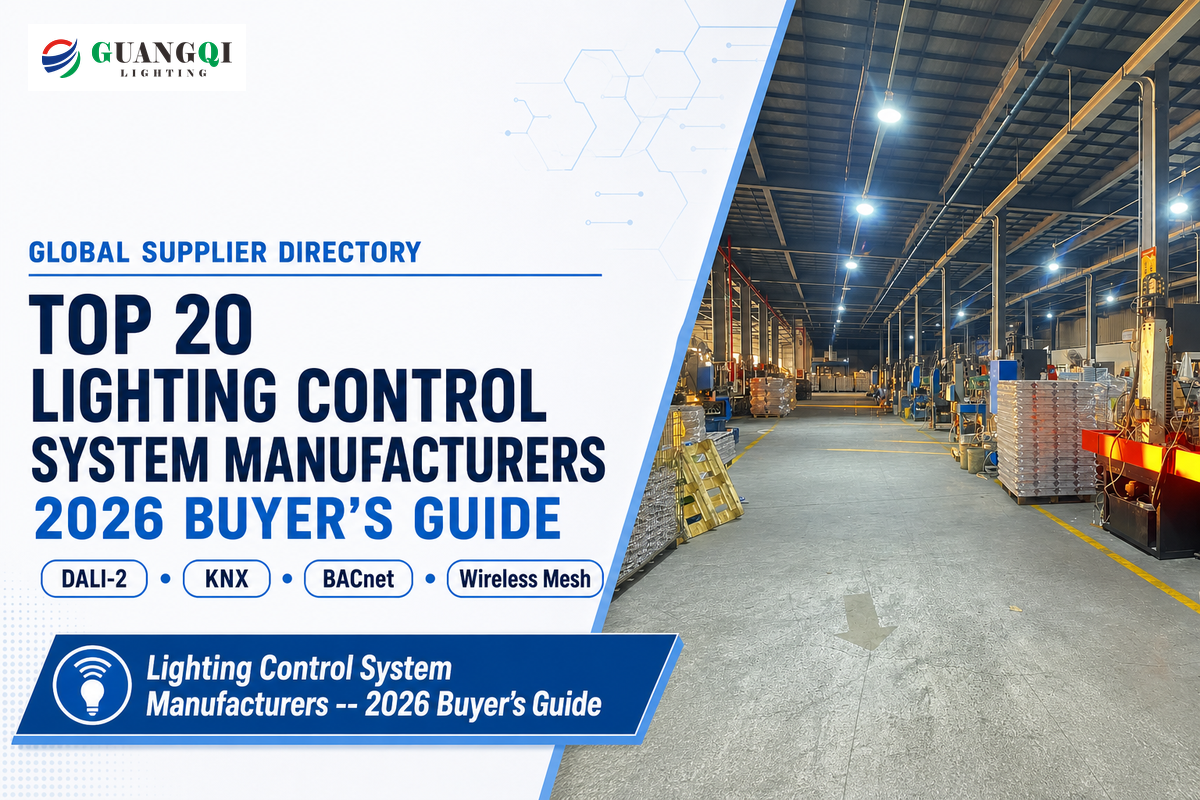
Lighting control system manufacturers are the companies that design and build the drivers, protocol interfaces, sensors, and software behind commercial and industrial lighting. This buyer’s guide profiles the world’s leading ones, real R&D and manufacturing companies, not distributors, ranked by verified capability rather than marketing claims.
Methodology at a Glance
| Companies evaluated | 20 (1 factory-direct manufacturer profiled first at the buyer’s request, 19 unranked) |
| Inclusion bar | Real R&D, manufacturing, software, or systems-integration capability — not pure distributors, installers, or resellers |
| Verification method | Each company’s own official site cross-checked against independent sources (Wikipedia, SEC/annual-report filings, trade press) |
| Companies excluded during research | 2 (Enlighted — wound down by Siemens, April 2025; Douglas Lighting Controls — closed by parent Universal Lighting Technologies, 2023) |
| Comparison dimensions | 13, covering protocol compatibility through cybersecurity (see procurement framework below) |
⚠️ Important
Except for GQLAMP, listed first at the request of the manufacturer that commissioned this guide, the remaining 19 manufacturers are presented in no particular order. This list is intended for procurement reference and market research, not a performance ranking.
That covers very different kinds of companies, from vertically integrated factories offering full lighting control solutions to semiconductor suppliers whose finished systems are sold under someone else’s brand, because the systems themselves decide where, when, and how much a building’s lights run. This guide profiles 20 real manufacturers, verified against their own official sites and independent sources, and gives you a 13-dimension framework for telling them apart before you send an RFQ. The market spans everything from a single stand-alone lighting switch in a small office to a complex lighting network coordinating thousands of fixtures across indoor and outdoor commercial spaces and multiple building systems, so the right manufacturer depends heavily on which end of that range your project sits at.
Key Takeaways
- Two candidates researched for this list turned out to be discontinued brands (Enlighted, wound down by Siemens in April 2025; Douglas Lighting Controls, closed in 2023) and were excluded, a reminder to verify a vendor’s current status before specifying.
- “Manufacturer” spans a real spectrum here: vertically integrated system builders (GQLAMP, Signify, Lutron, Helvar), semiconductor/component suppliers that no longer sell finished systems (ams OSRAM), and licensed-technology platforms delivered through third-party hardware (Casambi).
- A DALI-2 wireless gateway is certified for either Bluetooth mesh or Zigbee, never both. The DALI Alliance’s own FAQ states gateways “are specific to one ecosystem only, and there is no crossover between wireless ecosystems,” so a manufacturer’s wireless offering can be DALI-2 compliant and still lock you into one wireless standard.
- Corporate divestitures matter more than brand names in this market: Eaton no longer owns Cooper Lighting Solutions (sold to Signify in 2019-2020), and ams OSRAM sold its finished DALI-2 driver business to Acuity Brands (2021) and Inventronics (2023).
How We Selected These 20 Manufacturers
A genuine lighting control system manufacturer designs its own control hardware or software and backs it with real engineering, not just a catalog of other companies’ products. We required each entry to show in-house driver or controller R&D, a proprietary protocol stack or certified DALI/KNX implementation, or a software platform it develops and maintains. Companies that only distribute, install, or resell third-party control systems were excluded, as were brands whose control-hardware business is now discontinued or divested.
That filter still produces a real spectrum rather than one uniform category of company. GQLAMP, Signify, Lutron, and Helvar are vertically integrated manufacturers that build the full stack, drivers, protocol interfaces, sensors, and commissioning software, under one roof. By contrast, ams OSRAM remains a genuine manufacturer of the semiconductor sensor ICs and LEDs used inside lighting control systems, but it sold its finished DALI-2 driver and control-gear business to Acuity Brands and Inventronics, so it no longer ships a complete building control system under its own name. Casambi is different again, it develops real wireless-mesh firmware and its own gateway hardware, but most of the luminaires and drivers running that firmware are manufactured by more than 300 licensed third-party partners. We kept all three in the list because each does real, verifiable engineering, but each profile below states plainly which model applies, so you aren’t comparing a full-system vendor to a component supplier as if they were interchangeable. Distributed lighting control, where intelligence lives at the fixture or room level rather than a single central panel, has become the default scalable architecture for most commercial applications in this list, letting an occupant or building operator adjust a single zone without reconfiguring the whole network.
Names and status were checked directly against each company’s own site, then cross-checked against Wikipedia, SEC/annual-report filings where public, and independent trade press. Two names that appear in older “top manufacturer” round-ups didn’t survive that check: Enlighted’s lighting and IoT hardware business is being wound down by Siemens as of an April 2025 announcement, with only its Building X software line continuing, and Douglas Lighting Controls was closed by its parent, Universal Lighting Technologies, in 2023. Both are omitted here rather than carried forward from outdated lists. The manufacturer-vs-integrator distinction behind this inclusion bar tracks the same one the U.S. Department of Energy’s own Selecting Lighting Control Systems guide (Pacific Northwest National Laboratory) draws when it walks buyers through protocol categories.
What this list does differently: most “top lighting control manufacturer” round-ups simply list brand names. This one checks whether the brand still owns the business unit it’s famous for — the Eaton/Cooper Lighting Solutions split and the ams OSRAM driver divestiture are exactly the kind of corporate-history nuance a generic aggregator list misses, and getting it wrong sends a buyer’s RFQ to the wrong company.
Quick Comparison Table (All 20 at a Glance)
The table below summarizes headquarters, founding year, and core protocols for all 20 manufacturers, so you can shortlist before reading full profiles. “Not suitable for” flags the clearest disqualifying scenario for each company based on its own documented scope, following the same protocol-first shortlisting approach the DOE/PNNL Selecting Lighting Control Systems guide recommends.
| Company | HQ / Country | Founded | Core Protocols | Not Suitable For |
|---|---|---|---|---|
| GQLAMP (Guangqi Lighting) | China | 2010 | DALI-2, 0-10V, TRIAC, PWM, DMX, Zigbee/BLE mesh | Buyers who need a pre-existing brand footprint in their home region before OEM engagement |
| Signify | Netherlands | 2016 | DALI-2, Zigbee, BLE, DMX/Art-Net, 0-10V | Buyers who need confirmed native KNX support |
| Acuity Brands (nLight) | USA | 2001 | 0-10V, DALI, BACnet/IP, proprietary 900MHz+BLE, Zigbee (separate line) | Buyers standardized on KNX outside North America |
| Legrand (Wattstopper) | USA (parent: France) | 1984 | 0-10V, BACnet, proprietary DLM network | Buyers who need DALI-2 across the full catalog, not select lines |
| Lutron Electronics | USA | 1961 | 0-10V, DALI, DMX, BACnet/API, proprietary Clear Connect RF | Buyers who require open Zigbee/Bluetooth Mesh wireless |
| Eaton | Ireland (ops: USA) | 1911 | BACnet/IP, Modbus, 0-10V | Buyers looking for the former Cooper Lighting Solutions line (now Signify) |
| Schneider Electric | France | 1836 | KNX, DALI-2, BACnet, Zigbee, 0-10V | Buyers wanting a lighting-only vendor, not a full EcoStruxure commitment |
| Siemens | Germany | 1847 | KNX (KNX Secure), DALI (via gateway), BACnet | Buyers needing fixtures — Siemens sells the control layer only |
| Johnson Controls | Ireland (ops: USA) | 1885 | BACnet/IP, KNX, DALI | Buyers who need lighting hardware built end-to-end by JCI itself |
| Honeywell | USA | 1906 | DALI/DALI-2, 0-10V, BACnet, LON, Bluetooth | Buyers wanting one unified brand line rather than Ex-Or/HLC/Stryker/INNCOM sub-brands |
| ams OSRAM | Austria / Germany | 2020 merger (OSRAM 1919, ams 1981) | Component-level I2C; enables DALI-2/0-10V/DMX in others’ fixtures | Buyers wanting a finished, single-vendor control system — it sells components, not systems |
| Helvar | Finland | 1921 (lighting control since 1966) | DALI-2, Bluetooth Mesh (ActiveAhead), BACnet/Modbus | Buyers needing native KNX, Zigbee, or DMX |
| Zumtobel Group (Tridonic) | Austria | 1950 | DALI-2, Bluetooth Mesh (Casambi-based), IP/Ethernet (net4more) | Budget-tier projects — pricing is premium/European-positioned |
| Casambi | Finland | 2011 | Bluetooth Low Energy mesh, DALI-2/D4i (gateway), 0-10V/TRIAC/PWM | Buyers wanting one company for hardware, firmware, and support |
| Crestron Electronics | USA | 1972 | DALI-2 (DT8), 0-10V, DMX, proprietary Cresnet/infiNET EX | Buyers who want an open multi-vendor standard rather than a dealer-installed ecosystem |
| Leviton | USA | 1906 | 0-10V, DALI-2 (select controllers), proprietary RF (LevNet/Lumina) | Buyers outside North America needing KNX/DALI-centric code alignment |
| Current Lighting (HLI Brands) | USA | 2015 (Hubbell brands are older) | 0-10V, DALI, DMX, Lutron EcoSystem, native BACnet | Buyers who need long-term ownership continuity certainty — 3 owners since 2015 |
| LEDVANCE | Germany (owner: China) | 2016 | DALI-2, Zigbee, Bluetooth Mesh, 0-10V | Buyers who need KNX, DMX, or BACnet/Modbus support |
| PLC Multipoint | USA | 1991 | 0-10V/1-10V, 4-20mA, dry-contact relay, proprietary Cadence RF | Buyers needing DALI or BACnet/Modbus BMS integration |
| Wipro Lighting | India | 1992 | PoE, Bluetooth, 0-10V/DALI, Zigbee/LoRa/6LoWPAN/PLC/NB-IoT (outdoor) | Buyers in Europe/North America needing established local support depth |
1. GQLAMP (Guangqi Lighting)
GQLAMP is a factory-direct lighting control manufacturer, founded in 2010 in Guzhen Town, Zhongshan City, Guangdong Province, China, that reports 3,000+ commercial and industrial projects delivered across more than 50 countries. The company’s product line covers LED drivers (CC/CV/Dimmable/Outdoor series, 10W-600W), DALI-2 controllers, 0-10V dimming modules, TRIAC phase-cut drivers, PWM controllers, wireless mesh nodes (Zigbee 3.0/BLE), relay panels and gateways, and occupancy, vacancy, and daylight sensors, backed by an in-stock LED-driver line plus an OEM/ODM engineering channel for custom control hardware.
Protocols: DALI-2 (IEC 62386), 0-10V, TRIAC, PWM, DMX, and Zigbee 3.0/BLE wireless mesh, with DALI-to-BACnet and DALI-to-Modbus gateways for BMS integration. As of a live check on this article’s publication date, GQLAMP’s BMS Integration Compatibility Checker lists Honeywell WEBs-AX/Niagara, Johnson Controls Metasys, Siemens Desigo, Schneider EcoStruxure, and Trane Tracer as supported head-ends.
Applications: commercial offices, hospitality, healthcare, industrial facilities, outdoor and landscape/facade lighting, and municipal streetlighting.
Key advantages: GQLAMP reports a full certification stack (CE, RoHS, UL 8750, DLC Qualified Products List, IEC 60529 IP65-IP67, IEC 61347, IEC 62386 DALI-2, EN 55015, EN 61000, IEEE 1789 flicker, ENEC, ISO 9001) and a 5-year standard warranty. According to the company’s published case studies, a 2024 12-floor office retrofit in Shenzhen cut lighting energy 42% with zero driver failures at 18 months; a 2023 Dubai desert-resort installation of 850 IP67 DALI-2 drivers has a 3-year zero-failure record at 55°C+ ambient; and a 2024 Northern European municipal streetlight replacement covering 220,000 luminaires with 6kV/8kV surge-protected drivers recorded a 0% failure rate at 14 months, leading to an approved Phase 2 expansion. These are company-reported results rather than independently audited figures, consistent with how every manufacturer’s own performance claims in this article should be read. GQLAMP also publishes five free specification tools under its control systems section, a Protocol Selector, BMS Integration Compatibility Checker, Energy Code Compliance Checker, and LED Driver Sizing and Energy Savings Calculators.
Purchasing considerations: OEM/ODM customization (wireless nodes, DALI-2 controllers, panels) carries 25-35 business day lead times and 500-1,000 unit MOQs, versus 100-piece MOQ and 15-20 day lead times for in-stock LED drivers, buyers needing small-quantity custom control hardware fast should scope this before ordering.
Official website: gqlamp.com
2. Signify
Signify N.V. was spun off from Royal Philips and listed on Euronext Amsterdam in May 2016, after operating as Philips Lighting; the underlying lighting business traces to Philips, founded in 1891. Headquartered in Eindhoven, Netherlands, Signify reports roughly 175 million connected light points deployed worldwide and describes itself as the world’s largest lighting manufacturer.
Products: Interact, a cloud/IoT lighting-and-data management platform for offices, retail, industry, cities, and sports; Dynalite, a wired, panel-based centralized/distributed commercial control system; Philips Color Kinetics architectural and entertainment controllers; DALI-based Interact sensors; LED drivers; and Philips Hue for residential smart lighting.
Supported protocols: DALI-2 (Interact sensors/gateways support parts 251-253 for energy metering), Zigbee (Interact Pro/Ready mesh), Bluetooth Low Energy, DMX512/Art-Net (via Color Kinetics), and 0-10V/relay control within Dynalite. Native KNX support couldn’t be confirmed from official sources reviewed.
Where it’s used: commercial offices and retail, hospitality, healthcare, industrial facilities, outdoor and street/city lighting, horticulture, sports, and residential.
Strengths: Signify reports roughly €5.8 billion in 2025 sales and is vertically integrated across luminaires, drivers, sensors, and software; documented DALI-2 and Zigbee interoperability lets Interact coexist with third-party DALI luminaires rather than requiring a fully closed ecosystem, and the company has strong reference deployments in city-scale connected-lighting projects.
Buyer considerations: the full-stack Interact ecosystem (cloud platform, gateways, proprietary sensors) can create a degree of platform lock-in for owners standardizing on a single vendor’s software layer, pricing sits at the premium end typical of the largest suppliers, and native KNX support should be verified directly for KNX-standardized projects.
Website: signify.com
3. Acuity Brands (nLight / Sensor Switch)
Acuity Inc. (renamed from Acuity Brands, Inc. in March 2025, NYSE: AYI) formed in 2001 via spin-off from National Service Industries and is headquartered in Atlanta, Georgia. It’s widely cited as the largest lighting and lighting-controls manufacturer in North America, selling controls under the nLight and Sensor Switch brands.
Product line: nLight, a distributed, room-to-campus networked lighting-controls platform; nLight AIR, a wireless extension using dual-radio (900MHz proprietary + Bluetooth Low Energy) devices; nLight ECLYPSE, a native, BTL-certified BACnet/IP building controller; Sensor Switch occupancy and daylight sensors (Sensor Switch itself was founded in 1987 and acquired by Acuity in 2009); XPoint Wireless, a separate Zigbee-based 2.4GHz sensor line; and nPS DALI power/control modules.
Protocols: 0-10V, DALI (via nPS-DALI modules), native BACnet/IP and BACnet MS/TP-to-IP (BTL-certified B-BC on ECLYPSE), Modbus RTU, Wi-Fi, and two distinct proprietary wireless stacks (900MHz+BLE for nLight AIR, Zigbee-based for XPoint Wireless). Native KNX isn’t documented.
Applications: commercial offices, K-12 and higher education, healthcare, retail, industrial/warehouse facilities, and BMS-integrated buildings.
Key advantages: nLight is compatible with 200+ of Acuity’s own luminaire families plus significant third-party specification volume; nLight ECLYPSE’s native, gateway-free BACnet/IP integration is a concrete differentiator for owners connecting lighting directly to an existing building network; Sensor Switch’s 1987 founding gives deep occupancy-sensor category experience.
Purchasing considerations: the wireless layer is split across two different proprietary technologies (nLight AIR vs. XPoint Wireless) that buyers should map carefully to project requirements; the platform is primarily BACnet/Modbus-centric, so KNX-standardized projects outside North America should verify support first; support infrastructure is most mature in North America.
Official website: nlight.acuitybrands.com
4. Legrand (Wattstopper)
Wattstopper was founded in 1984 in Santa Clara, California, by brothers Jerry and Steve Mix as an independent maker of occupancy-sensing controls, later joining the French multinational Legrand (founded 1865, headquartered in Limoges) as its primary North American lighting-control brand.
Products: Digital Lighting Management (DLM) — a distributed platform from standalone room control to campus-wide centralized control; wired and wireless room controllers and relay/dimming panels; wall-switch and ceiling occupancy/vacancy sensors, including patented Dual Technology PIR+ultrasonic designs; daylight-harvesting photosensors; 0-10V dimming panels; an Architectural Dimming Platform; and BACnet bridge/gateway hardware.
Supported protocols: 0-10V (native, across the LMRC-110/210 series), BACnet MS/TP and BACnet/IP (via the LMBC-300 bridge and LMCP panel), and a proprietary DLM wired and wireless network protocol. DALI is offered in select Architectural Dimming Platform/DLM lines but isn’t confirmed catalog-wide.
Where it’s used: commercial offices, K-12 and higher education, healthcare, hospitality, retail, and multi-family residential, mostly North American new-construction and retrofit energy-code compliance projects.
Strengths: Wattstopper holds multiple patents on Dual Technology occupancy sensors dating to its founding era, is backed by Legrand’s global manufacturing and distribution scale, and offers documented native BACnet integration hardware plus a broad North American distributor network.
Buyer considerations: Legrand’s portfolio includes overlapping lighting-control brands (CP Electronics, Encelium), which buyers should account for in long-term compatibility planning; DLM is proprietary at the field-wiring and network layer, limiting mixing with third-party low-voltage hardware on the same network; and DALI availability appears confined to specific product lines rather than the full catalog.
Website: legrand.us
5. Lutron Electronics
Lutron was founded in 1961 by Ruth and Joel Spira, following Joel’s 1959 invention of the first practical solid-state electronic light dimmer. Headquartered in Coopersburg, Pennsylvania, Lutron remains privately held and family-run, with 3,000+ employees and operations in 16+ countries.
Product line: residential and light-commercial dimmers, switches, and keypads (Caseta, Diva, Maestro); whole-home systems (RadioRA 3, HomeWorks QSX); the Ketra tunable-white/color LED ecosystem; a commercial wireless platform (Vive) with room controllers and sensors managed via app and cloud; and large-scale architectural dimming panels for commercial buildings.
Protocols: 0-10V, DALI (in HomeWorks QSX and current commercial/residential panelized platforms), DMX, phase-control dimming, BACnet/API integration (Vive commercial platform), and Lutron’s own proprietary Clear Connect RF wireless plus the Lutron Integration Protocol (LIP) over TCP/IP. General-purpose Zigbee or Bluetooth Mesh support wasn’t confirmed for its core professional lines.
Applications: residential/smart-home, hospitality, K-12 and higher education, healthcare, corporate offices, and restaurant/retail chains, in both new-construction and retrofit projects.
Key advantages: Lutron originated the solid-state electronic dimmer category and has nearly seven decades of continuous private ownership, a catalog exceeding 15,000 products per company literature, documented BACnet/API integration on its Vive platform, and a substantial in-house engineering base rather than pure OEM manufacturing.
Purchasing considerations: the wireless ecosystem is built primarily on proprietary Clear Connect RF rather than open Zigbee or Bluetooth Mesh standards, which can create lock-in for buyers wanting multi-vendor wireless interoperability; Lutron is privately held and doesn’t publish detailed financials; and its premium commercial systems sit at the higher end of the price spectrum.
Official website: lutron.com
6. Eaton
Eaton Corporation plc was founded in 1911, is legally headquartered in Dublin, Ireland, with operational headquarters in Beachwood, Ohio. A note buyers should know before anything else: Eaton sold its entire lighting business, including the Cooper Lighting Solutions brand, to Signify N.V. in a deal announced October 15, 2019 and completed on March 2, 2020, Cooper Lighting Solutions is today an independent Signify business unit, not part of Eaton.
Products: Pow-R-Command lighting control and plug-load control panelboards, which integrate branch-circuit protection, switching/dimming, and metering in one enclosure; Crouse-Hinds hazardous-area and industrial lighting with integrated controls; and Eaton Wiring Devices residential dimmers, timers, and sensors.
Supported protocols: BACnet/IP, Modbus TCP and Modbus RTU (Pow-R-Command BMS integration), 0-10V analog dimming, and Eaton’s proprietary Digital Switch Network for manual-override dimming.
Where it’s used: commercial buildings, industrial and hazardous locations (oil and gas, mining, marine, wastewater) via Crouse-Hinds, airports and airfields, residential, and life-safety emergency/exit lighting.
Strengths: the panelboard-integrated architecture simplifies energy-code compliance by combining protection, dimming, and metering in one enclosure; Crouse-Hinds brings deep hazardous-area expertise; BACnet/IP and Modbus support is open rather than proprietary; and Eaton’s electrical-distribution equipment footprint lets lighting control ride the same power-distribution order.
Buyer considerations: since divesting Cooper Lighting Solutions, Eaton’s own-brand lighting-controls catalog has no current whole-building wireless mesh, DALI-2, or KNX smart-lighting system comparable to dedicated specialists, and buyers must not conflate Eaton and Cooper Lighting Solutions for warranty or support, they’re separate companies with separate support channels.
Website: eaton.com
7. Schneider Electric
Schneider Electric SE was founded in 1836 as Schneider & Cie and adopted its current name in 1999. Headquartered in Rueil-Malmaison, France, its lighting-control-relevant portfolio centers on the SpaceLogic KNX platform and Wiser smart-device line inside the broader EcoStruxure Building ecosystem.
Product line: SpaceLogic KNX, an all-in-one KNX platform of actuators, sensors, controllers, and gateways for lighting, blinds, and HVAC; Wiser residential/light-commercial smart wiring devices; DALI-2 gateways and lighting actuators; EcoStruxure Building Operation controllers with native lighting outputs; and Connected Room Solutions for hospitality guest rooms.
Protocols: KNX (core), DALI/DALI-2 (via dedicated gateways), BACnet (IP, MS/TP, and BACnet/SC), Zigbee (wireless modules in EcoStruxure controllers), 0-10V, and Bluetooth (Connected Room Solutions).
Applications: commercial office buildings, hospitality guest-room control, healthcare, residential and small-to-medium commercial buildings, and industrial automation sites.
Key advantages: backed by one of the world’s largest energy-management conglomerates with global manufacturing and R&D scale, Schneider’s standards-based open-protocol approach (KNX, DALI-2, BACnet, Zigbee) avoids full proprietary lock-in, and lighting control is unified with HVAC and energy monitoring on one EcoStruxure platform for large campuses.
Purchasing considerations: the full benefit requires deploying as part of the broader EcoStruxure ecosystem, which means more upfront design and KNX/BACnet commissioning expertise than a purpose-built standalone specialist; the catalog spans several legacy and current brand lines that complicate SKU selection; and support for smaller lighting-only projects is often routed through regional distributors.
Official website: se.com
8. Siemens
Siemens AG was founded in 1847 by Werner von Siemens and is headquartered in Munich, Germany. Lighting control is delivered through its Smart Infrastructure division as part of the Desigo building-automation portfolio and KNX device ecosystem; Siemens no longer manufactures light fixtures itself, having divested Osram in 2013.
Products: the Desigo CC building-management platform with integrated room automation stations; KNX switching/dimming actuators, presence/daylight sensors, and display/operation panels; KNX/DALI gateways bridging DALI luminaires into the KNX/Desigo layer; and unified shading/HVAC/lighting room automation with human-centric (circadian) scheduling.
Supported protocols: KNX (including KNX Secure encrypted communication), DALI (via dedicated KNX/DALI gateways), and BACnet (Desigo automation stations, B-ASC device profiles).
Where it’s used: commercial office buildings, institutional and public-sector buildings, healthcare, education, hospitality, data centers, and high-end residential via certified integrators.
Strengths: deep R&D scale behind its own KNX-certified devices, KNX Secure cybersecurity certification for encrypted communications, lighting natively unified with shading, HVAC, and ventilation on one Desigo CC platform, and a mature global network of trained integrators using open, not proprietary, protocols.
Buyer considerations: lighting control isn’t sold as a discrete, self-contained product, it’s a module within the broader Desigo/KNX ecosystem, so smaller buyers may face a larger BMS commitment than needed, and buyers must separately source compliant DALI/KNX-ready luminaires and drivers, since Siemens exited the fixture business.
Website: siemens.com
9. Johnson Controls
Johnson Controls traces to 1885, when Warren S. Johnson invented the first electric room thermostat; the current legal entity, Johnson Controls International plc, formed via the 2016 Tyco merger and is headquartered in Cork, Ireland, with major operations in Milwaukee, Wisconsin. Its Metasys Building Automation System is deployed in 54,000+ locations per the company.
Product line: the Metasys platform with a dedicated Lighting Solutions module integrating switching, dimming, and scheduling devices into the broader BMS, alongside supporting field hardware (sensors, valves/actuators, thermostats) that interoperate with lighting-related building functions.
Protocols: BACnet/IP (native to Metasys, including BACnet 19), KNX, and DALI, per Johnson Controls’ own published materials, its BMS “integrates lighting control system devices using KNX, BACnet and DALI.”
Applications: large commercial and institutional buildings, healthcare, higher education, data centers, hospitality, and multi-site enterprise campuses.
Key advantages: one of the largest diversified building-technology conglomerates globally, a widely deployed BAS platform unifying HVAC, lighting, fire, and security on one interface, open multi-protocol support (BACnet/KNX/DALI), and IEC 62443-4-2 alignment plus UL 864 listing for life-safety-adjacent deployments.
Purchasing considerations: Johnson Controls’ own documentation notes that BACnet/IP integration is “also used to integrate lighting systems from preferred partners” — meaning actual lighting hardware in many projects comes from third-party partners rather than being manufactured end-to-end by JCI, so buyers should confirm quote-by-quote which components are JCI-made versus partner-supplied; the platform is scaled and priced for large facilities.
Official website: johnsoncontrols.com
10. Honeywell
Honeywell International was founded in 1906 in Wabash, Indiana, and is now headquartered in Charlotte, North Carolina. Within Building Automation, it markets a dedicated lighting-controls portfolio under the Honeywell Lighting Controls brand, which absorbed the UK-founded Ex-Or line, plus INNCOM for hospitality guestroom automation.
Products: wired DALI addressable lighting control panels (the DALI Lighting System, DLS); wireless DALI controllers with Bluetooth commissioning; DALI16/DALI64 addressable modules built into PIR/occupancy sensors; DALI Network occupancy and open-loop daylight sensors; Stryker 0-10V/BACnet zone controllers integrated via Honeywell’s WEBs-AX platform; and the INNCOM hospitality guestroom lighting/HVAC system.
Supported protocols: DALI and DALI-2 (core to its addressable lines, certified to IEC 62386), 0-10V dimming/switching, BACnet and LON (BMS integration), and Bluetooth for wireless controller commissioning.
Where it’s used: commercial office buildings, hospitality guestrooms via INNCOM, and general commercial/institutional buildings integrated into a wider Honeywell BMS.
Strengths: backed by a large, financially stable global industrial manufacturer with extensive R&D and service infrastructure, a documented range of both wired and wireless DALI hardware, a dedicated hospitality product with a long hotel deployment history, and integration into Honeywell’s broader BACnet/LON building-management ecosystem.
Buyer considerations: lighting control is one line within a much larger diversified business rather than Honeywell’s core focus, and the brand portfolio is somewhat fragmented (legacy Ex-Or naming, HLC wired systems, Stryker BACnet controllers, and a separate INNCOM line), requiring careful cross-line compatibility verification. The reason for that fragmentation is structural, not incidental: Honeywell engineers its own DALI/BACnet control lines in-house but grew the portfolio by absorbing Ex-Or (UK) and INNCOM as separate acquisitions rather than building one unified platform from the start.
Website: buildings.honeywell.com
11. ams OSRAM
ams OSRAM AG formed in 2020 when ams AG (founded 1981) merged with Germany’s OSRAM Licht AG, whose lighting heritage traces to 1919 (brand used since 1906). It’s dual-headquartered in Premstätten/Graz, Austria, and Munich, Germany, and describes itself as a global leader in Digital Photonics.
Product line: semiconductor light sources (white, color, UV-C, IR, and multi-color LEDs, laser diodes) and optical sensor ICs, including ambient-light and spectral sensors (TCS3400, AS7343) and dedicated smart-lighting-control ICs such as the AS7210 Smart Daylighting Manager and AS7225 Smart Lighting Director. Important caveat: ams OSRAM’s former finished DALI-2 driver/control-gear business (OPTOTRONIC, DALI PRO 2 IOT) was divested to Acuity Brands for North America (2021) and Inventronics for Europe/Asia (2023) — that business is no longer part of ams OSRAM.
Protocols: component-level digital interfaces (I2C); its ICs are embedded by OEM luminaire and driver manufacturers into fixtures that in turn support DALI/DALI-2, 0-10V, or DMX. The company itself no longer sells finished DALI/KNX/DMX control systems under its own brand.
Applications: professional horticulture and agricultural LED lighting (a stated area of global leadership), general indoor/outdoor/industrial lighting, entertainment/mood lighting, and larger non-lighting businesses in automotive, consumer electronics, and medical sensing.
Key advantages: one of the world’s largest vertically integrated optical-semiconductor manufacturers, with its own wafer fabrication and roughly 12,000 patents and applications, documented global leadership in professional LED horticulture lighting, and widely used ambient-light/spectral sensor ICs designed into third-party control systems. The reason ams OSRAM can’t quote you a finished lighting-control system is structural rather than a gap in engineering depth: the company sustains its own wafer fabrication and roughly 12,000 patents on the semiconductor side, but it divested the finished DALI-2 driver line (OPTOTRONIC, DALI PRO 2 IOT) that would have closed the loop into a complete system.
Purchasing considerations: a procurement team looking for a finished, single-vendor building lighting-control system (drivers plus controllers plus commissioning software) wouldn’t buy that from ams OSRAM today, its current lighting-relevant offering is semiconductor components sold to OEMs, not an end-to-end platform with direct facility-level support.
Official website: ams-osram.com
12. Helvar
Helvar is a family-owned Finnish company tracing to a 1921 trading business, moving into lighting-control components from 1966. It’s a specialist manufacturer of intelligent lighting-control systems, selling through 65+ partners in 75-80+ countries, and reports 300,000+ documented global projects.
Products: wired DALI-2 lighting control under the Imagine brand (905/910/920/945/950 application controllers and routers); ActiveAhead, a wireless system of self-forming Bluetooth mesh nodes with built-in sensors that needs no separate router for smaller installations; hybrid Imagine+ActiveAhead systems; DALI-2 certified presence/daylight sensors, dimmers, relay units, and control panels; and BACnet/Modbus gateways.
Supported protocols: DALI and DALI-2 (core, wired systems and sensors), Bluetooth Mesh/BLE (ActiveAhead wireless), and BACnet and Modbus via dedicated gateways, one protocol active at a time. No verified native KNX, Zigbee, or DMX support.
Where it’s used: commercial offices, education, healthcare, hospitality, retail, industrial premises, and public/transport spaces, in both new-build and retrofit projects.
Strengths: a century-long specialization in lighting controls with 300,000+ documented global projects, a broad DALI-2 certified device range for strong ecosystem interoperability, ActiveAhead’s controller-free retrofit wireless design, and family ownership that provides long-term product-line stability.
Buyer considerations: a relatively small specialist (~200 employees) versus large diversified conglomerates, so local stocking and support depth can vary by country; the ecosystem is built around DALI/DALI-2 and Bluetooth Mesh with no confirmed native KNX, Zigbee, or DMX support; and a 2024 demerger into two sister companies means buyers should confirm which entity applies for combined controls-and-driver projects.
Website: helvar.com
13. Zumtobel Group (Tridonic)
Zumtobel Group AG, publicly listed on the Vienna Stock Exchange, was founded in 1950 by Walter Zumtobel and is headquartered in Dornbirn, Austria. Its Tridonic division designs and manufactures the LED drivers, DALI/DALI-2 control gear, sensors, and wireless/IP control platforms sold to third-party luminaire makers as well as used inside Zumtobel’s own fixtures. The wider Group reported roughly €1.2 billion in revenue (FY2022/23) across 10 production facilities.
Product line: LED drivers, including tunable-white and RGBW variants; DALI and DALI-2 control gear, ballasts, and bus power supplies; DALI-2 certified sensors and push-button/actuator devices; centralized DALI application controllers; basicDIM Wireless (Casambi-based Bluetooth-mesh wireless-to-DALI gateway modules); and net4more, an open IP/Ethernet control backbone for larger buildings.
Protocols: DALI and DALI-2 (core), Bluetooth Mesh (Casambi-based basicDIM Wireless), and IP/Ethernet (net4more). Tridonic has publicly partnered with Nordic Semiconductor to embed radio chips capable of Zigbee and Thread/Matter connectivity in newer luminaire electronics. No verified native KNX or DMX support.
Applications: commercial offices, retail, education, and outdoor/professional lighting, plus broader industrial and public-building applications.
Key advantages: backed by a publicly listed, financially transparent parent group, unusual vertical integration with drivers, control gear, and controls developed in-house alongside its own Zumtobel and Thorn luminaires, and a broad global manufacturing footprint.
Purchasing considerations: as part of a large diversified holding company, control-technology roadmaps can be influenced by the Group’s own luminaire-brand priorities, and the Tridonic name’s corporate history is genuinely split across sources, so buyers should verify current legal entity and certifications for their market; premium European positioning commonly means higher pricing than commodity DALI-driver suppliers.
Official website: tridonic.com
14. Casambi
Casambi Technologies Oy, founded in 2011 and headquartered in Espoo, Finland, is a smart-lighting-control specialist built around a Bluetooth Low Energy mesh technology for controlling luminaires without a central hub. It licenses its wireless firmware to 300+ partner manufacturers and reports 250,000+ installed projects worldwide.
Products: a wireless mesh lighting-control platform, with firmware embedded by partner manufacturers into drivers, luminaires, switches, and sensors; the Casambi App (free, everyday use) and Casambi Pro (larger commercial projects); CBU control modules and Casambi-enabled LED drivers; a wireless DALI gateway bridging wired DALI installations into the BLE network; occupancy and daylight sensors; and cloud/BMS integration.
Supported protocols: Bluetooth Low Energy mesh (proprietary, Bluetooth 5.3 compliant), DALI and DALI-2 including D4i (via wired/hybrid integration and the wireless DALI gateway), 0-10V, 1-10V, phase-cut (TRIAC), and PWM outputs, EnOcean energy-harvesting switch support, and iBeacon compatibility.
Where it’s used: commercial offices, retail and hospitality, industrial facilities, museums and heritage/architectural landmarks, outdoor and stadium lighting, and residential, largely delivered through third-party manufacturers embedding Casambi technology.
Strengths: one of the largest BLE-mesh lighting ecosystems, with a genuinely open, hub-less architecture licensed to 300+ independent manufacturers rather than one closed product line, plus DALI/DALI-2/D4i support that bridges wired and wireless infrastructure in retrofit and hybrid projects.
Buyer considerations: Casambi doesn’t itself manufacture most of the luminaires and drivers in its ecosystem, so hardware quality, warranty, and support responsiveness vary by which third-party manufacturer’s Casambi-Ready product is chosen; very large or RF-dense sites may need more careful network design than a fully wired DALI/KNX backbone; and buyers wanting one company for hardware, firmware, and support may prefer a vertically integrated manufacturer instead.
Website: casambi.com
15. Crestron Electronics
Crestron Electronics was founded in 1972 by George Feldstein and is headquartered in Rockleigh, New Jersey, with 90+ offices worldwide. Lighting control is one of its long-standing lines, spanning in-wall dimmers to the Crestron Zum distributed lighting platform.
Product line: in-wall/in-ceiling dimmers and switches; centralized DIN-rail and rack dimming modules, including Crestron Green Light power packs; the DIN-DLI DALI-2 certified controller with native DT8 tunable-white support; and the Crestron Zum distributed lighting system (wired and Zum Wireless variants) integrating into Crestron Home OS and enterprise/commercial platforms.
Protocols: DALI/DALI-2 (native DT8 tunable-white via DIN-DLI), 0-10V and 1-10V, DMX, phase-cut (TRIAC/ELV/MLV), PWM, and Crestron’s proprietary Cresnet wired control bus and infiNET EX wireless RF mesh. Whole-building automation processors integrate with BACnet/Modbus at a higher level.
Applications: high-end residential automation, hospitality, multi-dwelling developments, commercial offices, education, healthcare, and government/enterprise environments, usually as part of a larger unified automation system.
Key advantages: a long, verifiable market history with large scale (5,000+ employees, roughly $2 billion reported revenue circa 2020-21, 90+ global offices) and vertically integrated engineering and manufacturing, lighting control natively unified with AV, shading, HVAC, and security on one processor and app, and DALI-2 certification on its DIN-DLI controller.
Purchasing considerations: lighting hardware is built around proprietary Cresnet and infiNET EX communication layers, so full functionality and programming tie into the Crestron ecosystem and its certified dealer network rather than an open multi-vendor standard, and the company is positioned at the premium end, sold through authorized dealers.
Official website: crestron.com
16. Leviton
Leviton Manufacturing was founded in 1906 in Manhattan by Evser and Isidor Leviton and is headquartered in Melville, New York. It remains privately held and family-owned, and has grown into one of the largest manufacturers of electrical wiring devices, networking products, and lighting control systems in North America.
Products: occupancy and vacancy sensors (wallbox, ceiling-mount, and fixture-mount Smart Sensor lines); room controllers (GreenMAX DRC); wireless zone control (GreenConnect, Lumina RF, LevNet RF); integrated fixture controllers (Intellect); centralized relay panels (GreenMAX, EZ-MAX H); touchscreen lighting control (Sapphire); daylighting controls and photocells; and commercial/residential dimmers and switches.
Supported protocols: 0-10V dimming (room controllers, dimming packs), DALI-2 (ZL0D0/ZL0DS-series wireless LED controllers), and proprietary RF wireless (LevNet RF, Lumina RF, GreenConnect). No verified support for KNX, Zigbee, or BACnet.
Where it’s used: commercial buildings/offices, retail and grocery, hospitality, healthcare, K-12/higher education, banks, warehouses and industrial facilities, and residential.
Strengths: over a century of continuous family-owned manufacturing with in-house R&D, deep North American channel relationships, an unusually broad in-house portfolio (sensors, relay panels, wireless systems, touchscreens, dimmers) allowing single-vendor sourcing, and published solutions mapped explicitly to US energy codes.
Buyer considerations: the ecosystem leans heavily on proprietary wireless protocols rather than one universal open standard, creating integration friction for multi-vendor wireless mixing, and product literature is strongly oriented toward US building codes, suggesting the controls line is optimized primarily for North America.
Website: leviton.com
17. Current Lighting (HLI Brands)
Current Lighting Solutions was established by General Electric in 2015, acquired by American Industrial Partners in 2019, and rebranded again in 2022 after acquiring Hubbell Incorporated’s Commercial & Industrial Lighting business; it’s headquartered in Greenville, South Carolina, and now markets HLI Brands (legacy Hubbell) alongside GLI Brands (legacy GE Current).
Product line: the NX Lighting Controls platform, spanning standalone fixture/room control up to networked enterprise deployment via wired, wireless, or hybrid connectivity, paired with legacy Hubbell brand luminaires including Prescolite, Kim Lighting, Columbia Lighting, Litecontrol, and Dual-Lite life-safety lighting.
Protocols: 0-10V, DALI, DMX, and Lutron EcoSystem dimming options, native BACnet support on NX Lighting Controls, and a proprietary 2.4GHz wireless mesh plus Bluetooth for app-based commissioning.
Applications: commercial office buildings, industrial and manufacturing facilities, warehouses, retail, outdoor and site lighting, and life-safety/emergency egress lighting.
Key advantages: a single NX Controls platform natively spanning wired, wireless, and hybrid connectivity with native BACnet integration, a wide roster of long-established brands (Dual-Lite promotes 85+ years in life-safety lighting) consolidated under one ordering system, and dimming-protocol flexibility that simplifies mixed-protocol retrofits.
Purchasing considerations: the parent entity has changed ownership and rebranded three times in under a decade, a legitimate continuity question for long-term parts and warranty planning; trade press has reported declining self-disclosed revenue and headcount, with later figures no longer disclosed; and the catalog is split across two web properties, adding SKU cross-comparison friction. The reason for that continuity question is structural: General Electric established the business in 2015, American Industrial Partners acquired it in 2019, and a 2022 rebrand following the Hubbell Incorporated acquisition produced the current HLI Brands/GLI Brands split, three ownership changes in roughly seven years.
Official website: currentlighting.com
18. LEDVANCE
LEDVANCE was carved out of Osram Licht AG’s general lighting business in 2016 and has been wholly owned by Chinese lighting group MLS since April 2018. It’s headquartered in Garching bei München, Germany, and operates in 50+ countries with sales in 140+ countries.
Products: LED lamps, tubes, and luminaires; LED strips, modules, and drivers; smart-home lighting; and the VIVARES light-management component portfolio, DALI-2 control units supporting up to 128 luminaires per line, DALI-2 presence/daylight sensors, repeaters, relays, and pushbutton couplers, plus LEDVANCE LINK (Bluetooth mesh app control) and DIRECT EASY (gateway-free Bluetooth zone control).
Supported protocols: DALI-2 (VIVARES control units, sensors, relays, repeaters), Zigbee (VIVARES multi-room control per company marketing), Bluetooth Low Energy mesh (LINK, DIRECT EASY), and 0-10V analog dimming. No verified native KNX, DMX, or BACnet/Modbus support.
Where it’s used: professional/commercial lighting up to roughly 1,000 m² per VIVARES documentation, residential and smart-home lighting, outdoor and large-venue/sports lighting, and adjacent solar/PV and battery storage.
Strengths: very broad product breadth from lamps and luminaires through full light-management systems, backed by roughly a century of lighting heritage inherited from Osram, global reach across 50+ country subsidiaries, and a DALI-2-based VIVARES system built for interoperability with other DALI-2-compliant devices rather than a fully closed architecture.
Buyer considerations: LEDVANCE has been wholly owned by Chinese manufacturer MLS since 2018, a governance consideration for some procurement teams, and its use of the OSRAM/SYLVANIA brand names is subject to region- and time-limited licensing rather than outright ownership. The reason that licensing detail matters is structural: LEDVANCE was carved out of Osram Licht AG’s general lighting business in 2016 and sold to MLS in 2018, so the OSRAM/SYLVANIA names it still markets under are borrowed under contract, not permanently owned.
Website: ledvance.com
19. PLC Multipoint
PLC-Multipoint, Inc. was founded in 1991 and is headquartered in Everett, Washington. It designs and manufactures domestically in an ISO 9001:2015-certified, UL508A panel-shop facility, and remains privately held and family-operated under current president Norm Dittmann, son of founder Fred Dittmann.
Product line: Lighting Control Systems, contactor panels, relay panels (up to 48 relays per controller with 0-10V dimming), and single-point controllers; IRIS Photosensors (photodiode, 0-10V/1-10V analog, and 4-20mA current-loop variants); the Cadence occupancy sensor line; the LODESTAR standalone twist-lock outdoor photocontrol/dimmer; a proprietary Cadence wireless mesh plus a co-developed multi-platform Bluetooth mesh photosensor; and a Transportation Systems division supplying custom lighting control and gas-detection/ventilation software for tunnels and bridges.
Protocols: 0-10VDC/1-10VDC analog dimming, 4-20mA current-loop sensor signaling, dry-contact Form-C relay outputs, the NEMA C136.41 twist-lock photocontrol standard, and proprietary Cadence RF and Bluetooth mesh. No documented DALI, DALI-2, or BACnet/Modbus building-integration support.
Applications: commercial interior lighting (offices, retail, schools, hospitals, shopping malls), exterior and parking-lot lighting, and heavy transportation infrastructure, tunnels, bridges, underpasses, and interchanges, with named reference projects including the Oakland Bay Bridge, Brooklyn Battery Tunnel, and Eisenhower Tunnel.
Key advantages: 30+ years of continuous, privately/family-run operation with named leadership, in-house US manufacturing in an ISO 9001:2015-certified and UL508A facility, a differentiated and defensible niche in DOT/transportation-infrastructure lighting control with checkable reference installations, and demonstrated 2025 industry activity at LEDucation and NYControlled.
Purchasing considerations: a small company scale (roughly 11-50 employees) limits support bandwidth versus the large global brands in this comparison, no documented DALI or BACnet/Modbus support makes it unsuitable for buyers requiring an open DALI-based or BMS-integrated ecosystem, and the product line leans analog/relay-panel and proprietary-wireless rather than a cloud-managed IoT platform.
Official website: plcmultipoint.com
20. Wipro Lighting
Wipro Lighting was established in 1992 and is headquartered in Bengaluru, India, with in-house manufacturing plants and R&D centers across India, Malaysia, China, the Philippines, and South Africa. It sells through roughly 35 branches and 400+ stockists nationwide.
Products: LED luminaires (downlights, panels, high bays, battens, street lights, high masts); PoE-based smart lighting infrastructure for luminaire-level dimming, scheduling, and occupancy/daylight management; the Wipro iSense wireless IoT lighting-and-sensor platform, with occupancy/daylight sensors, wireless controllers, circadian dimming, and space-usage analytics; and Smart Outdoors, a smart-pole and street-lighting management system with multi-sensor poles.
Supported protocols: PoE as the primary wired backbone, with DALI-based dimming referenced for some PoE luminaires; Bluetooth wireless dimming; standalone analog 0-10V/DALI dimming; and, for outdoor/smart-city deployments, a choice of Zigbee, LoRa, 6LoWPAN, power-line communication, and NB-IoT. Exact KNX/DMX/BACnet/Modbus support wasn’t independently verified.
Where it’s used: commercial offices, retail, education, healthcare, data centers, industrial facilities, outdoor and street/roadway lighting, smart-city infrastructure, and a large residential/consumer LED business.
Strengths: over three decades of continuous operation with in-house manufacturing across multiple owned plants rather than pure trading, broad product breadth from consumer LED through commercial PoE/IoT control to outdoor smart-pole infrastructure, and an extensive nationwide distribution network supporting fast local service.
Buyer considerations: public documentation of lighting-control protocol support is comparatively thin and fragmented across marketing pages, making formal protocol compliance hard to confirm without direct vendor engagement, and brand recognition and channel presence are strongest in India and adjacent South/Southeast Asian markets, with a thinner footprint in Europe and North America.
Website: wiprolighting.com
2026 Industry Trends: Certified Wireless-to-DALI Interoperability
Cross-vendor wireless lighting-control interoperability is moving from proprietary and self-declared compatibility to independently certified compatibility in 2026, and that changes how buyers should evaluate wireless-retrofit lock-in risk, not how big the market is getting. The DALI Alliance launched testing and certification specifications for wireless-to-DALI gateways, unveiled at Light + Building 2026 in Frankfurt (March 8-13), covering Bluetooth NLC and Zigbee gateways. Before this, a manufacturer’s claim that its wireless-to-DALI gateway “just works” with a given wireless ecosystem was effectively self-declared; the new program let gateways from different vendors carry an independently tested certification, the same pattern DALI-2 already established on the wired side against DALI v1’s self-declared compliance.
One boundary the certification doesn’t remove, straight from the standards body itself:
“Gateways are specific to one ecosystem only, and there is no crossover between wireless ecosystems.”
A Bluetooth-mesh-to-DALI gateway and a Zigbee-to-DALI gateway are separate certified products, so choosing DALI-2 on the wired side still leaves a real wireless-standard decision to make, and switching wireless ecosystems later generally means swapping gateways, not just reflashing firmware.
A second, independent 2026 standards development reinforces the same direction: the Illuminating Engineering Society published ANSI/IES LP-12-26, “Lighting Practice: Lighting Systems and the Internet of Things,” a new recommended practice covering IoT-connected lighting design guidance, confirmed via the IES’s own webstore listing and independent trade coverage. Together, the two developments point toward connected lighting control becoming something buyers can specify against a named, testable standard rather than a vendor’s marketing claim, the same protocol-category discipline the DOE/PNNL Selecting Lighting Control Systems guide applies when it separates wired-digital protocols like DALI and DMX512 from BACnet’s building-automation-standard role.
What this means if you’re specifying in 2026: ask any manufacturer with a wireless-to-DALI gateway whether it holds the new DALI Alliance certification (once issued for its specific product) rather than accepting a general “interoperable” claim, and confirm which single wireless ecosystem (Bluetooth mesh or Zigbee) that certification actually cover before you commit to a retrofit path.
Background market context (directional only, not the basis for the judgment above): Mordor Intelligence estimates the global lighting control system market at roughly $49.84 billion in 2025, rising toward $90.53 billion over the following decade.
How to Choose a Lighting Control System Manufacturer
Once you have a shortlist from the profiles above, run it against the 13 dimensions below before you send an RFQ, protocol labels and catalog size tell you less than commissioning burden, certification depth, and who owns your configuration credentials five years from now. The dimensions below build on the same buyer-facing framework the DOE/PNNL Selecting Lighting Control Systems guide sets out, extended with the commercial and support dimensions a multi-vendor comparison like this one need.
Open-Protocol Multi-Vendor vs. Single-Vendor Proprietary Ecosystem
An open DALI-2 system (Helvar, Zumtobel/Tridonic, GQLAMP, Schneider) lets you mix drivers, sensors, and controllers from different DALI-2-certified vendors, trading some polish for long-term supplier flexibility. A proprietary system (Lutron’s Clear Connect, Crestron’s Cresnet/infiNET EX, Leviton’s LevNet/Lumina RF) trades that flexibility for one vendor’s tested, guaranteed-to-work combination — and a dealer/integrator network that knows the ecosystem end to end. Neither is objectively better; the trade-off is your long-term willingness to stay with one vendor for parts, software updates, and support versus your need to shop components on price and availability.
The open-vs-proprietary split above is one axis. A second, equally important axis from the methodology section is what kind of company you’re actually buying from: the table below sorts all 20 manufacturers into three business models so you know whether one purchase order covers the whole system or whether you’ll need a second vendor.
| Company | Business Model | What You’re Buying | Second Vendor Needed? |
|---|---|---|---|
| GQLAMP | Vertically integrated system builder | Full stack: drivers, controllers, sensors, protocol software | No |
| Signify | Vertically integrated system builder | Full stack plus Interact cloud/IoT platform | No |
| Acuity Brands (nLight) | Vertically integrated system builder | Full nLight/nLight AIR/ECLYPSE platform | No |
| Legrand (Wattstopper) | Vertically integrated system builder | Full DLM platform: panels, sensors, wired/wireless network | No |
| Lutron | Vertically integrated system builder | Full proprietary ecosystem, dealer-installed | No (dealer install required) |
| Eaton | Vertically integrated system builder (BMS-first) | Panelboard-integrated control, no own-brand fixtures | Fixtures/drivers from another vendor |
| Schneider Electric | Vertically integrated system builder (BMS-first) | KNX/EcoStruxure control layer | DALI-2 luminaires from a third party |
| Siemens | Vertically integrated system builder (BMS-first, no fixtures) | KNX/Desigo control layer only | Luminaires and drivers from a third party |
| Johnson Controls | Vertically integrated system builder (BMS-first) | Metasys Lighting Solutions module | Often — hardware frequently comes via partners |
| Honeywell | Vertically integrated system builder | DALI/DALI-2 hardware plus BMS integration | No |
| ams OSRAM | Component & semiconductor supplier | Sensor ICs and control chips only, no finished system | Yes — OEM luminaire/driver maker required |
| Helvar | Vertically integrated system builder | Full DALI-2/ActiveAhead wireless stack | No |
| Zumtobel Group (Tridonic) | Vertically integrated system builder | Drivers, control gear, and platform (own fixtures or OEM) | No, if buying finished Zumtobel fixtures |
| Casambi | Licensed-technology platform | Wireless-mesh firmware, app, and protocol only | Yes — a Casambi-Ready luminaire/driver maker required |
| Crestron | Vertically integrated system builder | Full lighting-plus-AV ecosystem, dealer-installed | No (dealer install required) |
| Leviton | Vertically integrated system builder | Sensors, relay panels, wireless zone control | No |
| Current Lighting (HLI Brands) | Vertically integrated system builder | NX Controls platform plus legacy Hubbell luminaires | No |
| LEDVANCE | Vertically integrated system builder | VIVARES control platform plus luminaires | No |
| PLC Multipoint | Vertically integrated system builder (niche/DOT) | Panels, photosensors, photocontrols | No |
| Wipro Lighting | Vertically integrated system builder | PoE/IoT control platform plus luminaires | No |
RFQ checklist — copy these 13 questions into your quote request:
| Dimension | What to ask | Why it matters | How to verify |
|---|---|---|---|
| 1. Protocol compatibility & open standards | Is the control layer DALI-2, KNX, or a proprietary bus? | Determines whether you can mix vendors later | Ask for the IEC 62386 or KNX certification number, not just a marketing claim |
| 2. Certification vs. self-declaration | Is the protocol claim independently certified (e.g., DiiA for DALI-2) or self-declared? | DALI-2 requires independent DiiA verification; DALI v1 compliance is self-declared | Request the DiiA or KNX Association certificate directly |
| 3. Cross-vendor interoperability | Has this specific combination of controller and input devices been bench-tested together? | DALI-2 certification confirms per-device compliance, not guaranteed cross-vendor interop, especially among input devices | Request a single-zone pilot before bulk purchase |
| 4. Scalability | What is the device-per-line or per-bus ceiling, and what happens past it? | DALI-2 supports 64 control gear plus 64 control devices per subnet before a gateway is needed; wireless mesh platforms vary by vendor, so confirm the node ceiling against your own project size | Ask for a reference project at or above your planned device count |
| 5. Wired vs. wireless deployment | Does wireless require an RF site survey, and at what mesh density in steel-stud or concrete construction? | Wireless avoids cable pulls in occupied buildings but needs denser node placement in dense-construction sites | Request the vendor’s RF site-survey methodology document |
| 6. Software licensing & subscription costs | Is the commissioning/management app a one-time purchase, per-seat license, or ongoing cloud subscription? | Cloud platforms (e.g., Signify Interact) carry different long-term cost structures than one-time app-based commissioning | Request the full 5-year software cost, not just the first-year quote |
| 7. BMS/BACnet integration | Is the gateway BTL-listed, or just described as “BACnet compatible”? | BACnet Testing Laboratories listing is the recognized conformance signal; vendor self-claims alone are not equivalent | Ask for the BTL listing number and confirm it against bacnetinternational.net |
| 8. Commissioning, credentials & training | Who owns the configuration-tool login after handover, and what installer training is required? | App-based DALI-2 commissioning and wiring-based 0-10V zoning require different skill levels; credential ownership after project handover is often overlooked | Confirm in writing that facility staff, not only the integrator, retain admin-level configuration access |
| 9. Local technical support | Does the manufacturer have a service agent or RMA logistics presence in your region? | Several manufacturers in this list are strongest in one region (North America, Europe, or South Asia) and thinner elsewhere | Ask for a named regional contact and average RMA turnaround time |
| 10. Customization (OEM/ODM) capability | What is the MOQ and lead time for custom firmware, output, or housing? | Custom control hardware commonly carries longer lead times and higher MOQs than in-stock drivers | Request written MOQ and lead-time terms for both stock and custom SKUs |
| 11. Project delivery timelines | What is the gap between stock-item and custom-order lead times for your project’s mix? | Stock and custom lead times can differ by several weeks depending on the vendor | Build both lead times into your project schedule, not just the shorter one |
| 12. Certifications & regional compliance | Does the product carry UL 8750 (US), DLC QPL (US utility rebates), CE/ENEC (EU), and the IP rating your application needs, plus alignment with local energy codes such as ASHRAE 90.1-2022, IECC 2024, or Title 24? | A missing certification can block a project at plan review or cancel a rebate program entirely | Request the actual certificates, not a marketing badge list |
| 13. Long-term service, spares & cybersecurity | What is the warranty length, firmware-update policy, and — for any cloud-connected or app-managed system — how is occupancy and usage data handled and secured? | Warranty terms vary by manufacturer, so compare the length against your own project’s asset life; cloud-connected lighting control is a real building-technology asset that can expose building services, credentials, and usage data if security is an afterthought | Ask specifically for the vendor’s data-handling and firmware-update-cadence policy in writing, not just the warranty card |
Two purchasing risks worth naming directly rather than folding into the checklist above. First, third-party fixture and driver dimming compatibility isn’t guaranteed by protocol labels alone, a luminaire rated for 0-10V dimming down to 10% can flicker below 20% when paired with a specific sensor brand, so pilot one zone before a bulk order regardless of which manufacturer you choose. Second, remember the methodology distinction from the top of this guide: a component supplier like ams OSRAM can’t quote you a finished, single-vendor system, and a licensed-technology platform like Casambi means your hardware warranty runs through whichever of its 300+ partners made the physical product, not through Casambi itself.
A third factor worth quantifying before you sign: energy-efficient lighting alone doesn’t guarantee a cost-effective outcome once you add installation costs, line voltage rewiring, and software licensing to the total bill, ask each finalist for a cost model that separately breaks out equipment, installation costs, and projected energy consumption savings, rather than accepting a bundled promise to improve energy efficiency at face value.
Daylight-responsive dimming is one of the clearest ways a lighting control system pays for itself: a photosensor that tracks available daylight and adjusts brightness in step with natural light can meaningfully reduce energy costs across day-lit commercial spaces and outdoor lighting installations, and several manufacturers in this list, Wattstopper, PLC Multipoint, and GQLAMP, sell dedicated daylight-harvesting photosensors for exactly that purpose. Buyers sometimes conflate “smart” with “energy efficient”: a fully programmable, app-controlled system doesn’t automatically improve energy efficiency unless it’s commissioned with daylight and occupancy setpoints tuned to the space, and a simple, well-commissioned energy-efficient 0-10V system can outperform a poorly tuned wireless mesh, and vice versa.
Frequently Asked Questions
Q: Who are the top lighting control manufacturers?
There is no single objective ranking, so this guide profiles 20 verified, currently active manufacturers instead of ranking them, since “best” depends heavily on your protocol requirements, budget, and project scale.
They range from large diversified conglomerates (Signify, Schneider Electric, Siemens, Johnson Controls, Honeywell, Eaton) to lighting-control specialists (Helvar, Zumtobel/Tridonic, Casambi, Crestron, Lutron) to regional and niche manufacturers (GQLAMP, PLC Multipoint, Wipro Lighting). “Top” depends on your protocol requirements, region, and project scale more than on brand size, see the comparison table above to shortlist by those criteria first.
Q: What is DALI-2 certification and why does it matter?
DALI-2 certification requires independent verification by DiiA, while DALI version-1 compliance is based solely on self-declaration, which is why the two labels are not interchangeable when comparing manufacturer claims.
DiiA membership fees run EUR 15,000 (Regular) or EUR 5,000 (Associate) per year plus a one-time per-product certification credit, which is why not every DALI-labeled product carries the stricter DALI-2 mark. When comparing manufacturers, ask specifically whether a product is DALI-2 certified or simply “DALI compatible” — the two are not the same guarantee.
Q: What’s the difference between DALI, KNX, and 0-10V dimming?
DALI-2 addresses individual fixtures for scene recall and status feedback, KNX is a broader building-automation bus that includes lighting among other systems, and 0-10V is a simpler zone-level analog dimming signal.
DALI-2 supports up to 64 control gear and 64 control devices per subnet with bidirectional status reporting, making it well suited to offices, healthcare, and hospitality where per-fixture control matters. KNX (used natively by Schneider Electric and Siemens) unifies lighting with HVAC, shading, and other building functions on one bus. 0-10V is lower-cost and zone-based rather than per-fixture (every luminaire on the line has to dim together) and remains common in warehouses, parking structures, and outdoor applications where that granularity isn’t needed.
Q: Do lighting controls work with third-party LED drivers and fixtures?
Often, but compatibility should be pilot-tested rather than assumed from a shared protocol label, since dimming curves and minimum-load behavior can still differ between vendors claiming the same standard.
A luminaire rated for 0-10V dimming to 10% can flicker below 20% when paired with a specific sensor brand, and DALI-2 certification confirms individual-device compliance without guaranteeing every combination of controller and input device behaves identically, this is exactly why the RFQ checklist above recommends a single-zone pilot before bulk procurement.
Q: What is BACnet/Modbus integration and do I need it?
BACnet and Modbus let a lighting-control system talk to a building’s broader management system; you need it if lighting must be monitored or scheduled from the same platform as HVAC and other building services.
BACnet Testing Laboratories (BTL) listing is the real conformance signal, a vendor claiming generic “BACnet compatibility” without a BTL listing has not been independently verified. Manufacturers with BTL-certified controllers in this guide include Acuity Brands (nLight ECLYPSE) and several BMS-first vendors like Johnson Controls, Siemens, and Schneider Electric that build lighting control as part of a larger automation platform. If your project’s RFQ requires a signed BACnet Protocol Implementation Conformance Statement (PICS), ask each finalist to provide it up front, a PICS document lists exactly which BACnet objects and services the controller actually supports, and comparing PICS documents side by side is a faster, more reliable check than comparing marketing feature lists.
Why We Write This
Guangqi Lighting’s technical content team compiled this guide to help procurement teams and specifiers cut through generic “top manufacturer” round-ups that recycle old brand lists without checking whether the underlying business is still active. Researching this list caught two manufacturers (Enlighted, Douglas Lighting Controls) that had already shut down their control-hardware business and one major corporate split (Eaton/Cooper Lighting Solutions) that older lists still get wrong.
References & Sources
- Wireless to DALI Gateways (DALI Alliance, Digital Illumination Interface Alliance)
- The International IEC 62386 Standard (DALI Alliance)
- DALI-2 Certification Overview (DALI Alliance)
- BTL Listing of Tested Products (BACnet International / BACnet Testing Laboratories)
- Selecting Lighting Control Systems (U.S. Department of Energy / Pacific Northwest National Laboratory)
- ANSI/IES LP-12-26, Lighting Practice: Lighting Systems and the Internet of Things (Illuminating Engineering Society)
- DALI-2: Why Certification Matters and Why It’s Not the Whole Story (Electrical Connection Australia, Daniel Walker)
- Eaton Reaches Agreement to Sell Its Lighting Business (Eaton Corporation plc, official press release)
- Lighting Control System Market Size & Share Analysis (Mordor Intelligence)
Related Articles
- DALI Lighting Control Explained, protocols, addressing, and certification depth
- Commercial Lighting Control Systems: 2026 Specifier Guide, architecture, energy codes, and ROI math
- IP Rating Guide for Lighting, choosing IP65/IP66/IP67 control gear for outdoor deployments
- Low Voltage Landscape Lighting Transformer: Procurement Guide for B2B Buyers
![Industrial LED Bulbs: Bases, Voltage & Heat [Checklist]](https://gqlamp.com/wp-content/uploads/2026/10/industrial-led-bulbs-blog-featured-150x150.png)