Get in Touch with GUANGQI



T8 is a sizing designation for a lamp of a tubular shape with a nominal diameter of 1 inch. This designation doesn’t describe the length, brightness, or voltage of the lamp. A properly fitted replacement in the socket may still not be the correct lamp for the fixture.
Quick specifications
- T: tubular shape.
- 8: eight eighths of an inch, or a nominal 25.4 mm diameter.
- Technology: fluorescent and LED versions exist.
- Still to identify: length, base, full part number and approved operating system.
For facility managers replacing lamps, the right question to ask is what comes after that size code. Read the full lamp marking and compare the dimensions and operating requirements. This discussion separates the checks for traditional fluorescent and LED lighting, and shows how to assess running costs, without mixing up lamp watts with whole fixture watts.
T8 means a nominal 1-inch tubular lamp. T8 lighting can use fluorescent or LED technology. Match the exact length, base and approved ballast or driver combination before choosing a replacement.
Key points
- Matching pins don’t prove electrical compatibility.
- The size code identifies diameter; the model identifies the replacement.
- Compare useful light and whole-fixture power together.
- Check local fluorescent-lamp availability and recycling requirements.
What does T8 mean on a tube light?
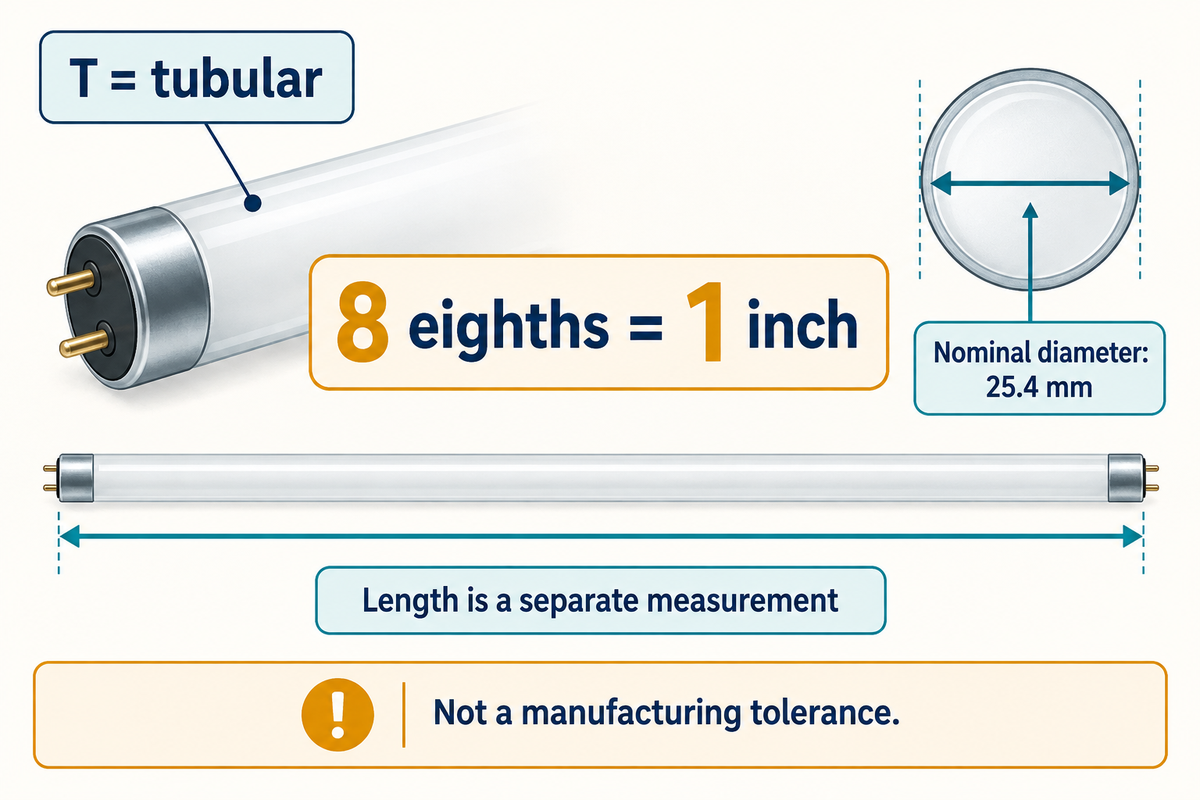
T8 means tubular, with a nominal diameter of eight eighths of an inch. A T8 lamp may be fluorescent or LED, so the marking must be read alongside the full model number and electrical specifications to select the right replacement bulb.
What do T5, T8 and T12 actually mean?
Lamp tubes T5, T8 and T12 have the same eighth-inch convention for nominal diameters. T5 is five eighths of an inch, T8 is one inch and T12 is one and a half inches. A family of lamp tubes can be identified with these labels. These labels don’t indicate the service life or energy efficiency of the tubes.
The calculation is straightforward: 8 divided by 8 equals 1 inch, and 1 inch equals 25.4 mm. This is the naming convention described in GE Lighting’s bulb-code guide. It isn’t a manufacturer’s tolerance.
In particular, “8 foot” describes length, while T8 describes diameter. A 32-watt marking describes rated power for the specified lamp. Neither of these replaces the model code. When writing out a code on a faded label to place an order, make sure to keep these details separate.
T8 tube lengths and bases: match the actual lamp
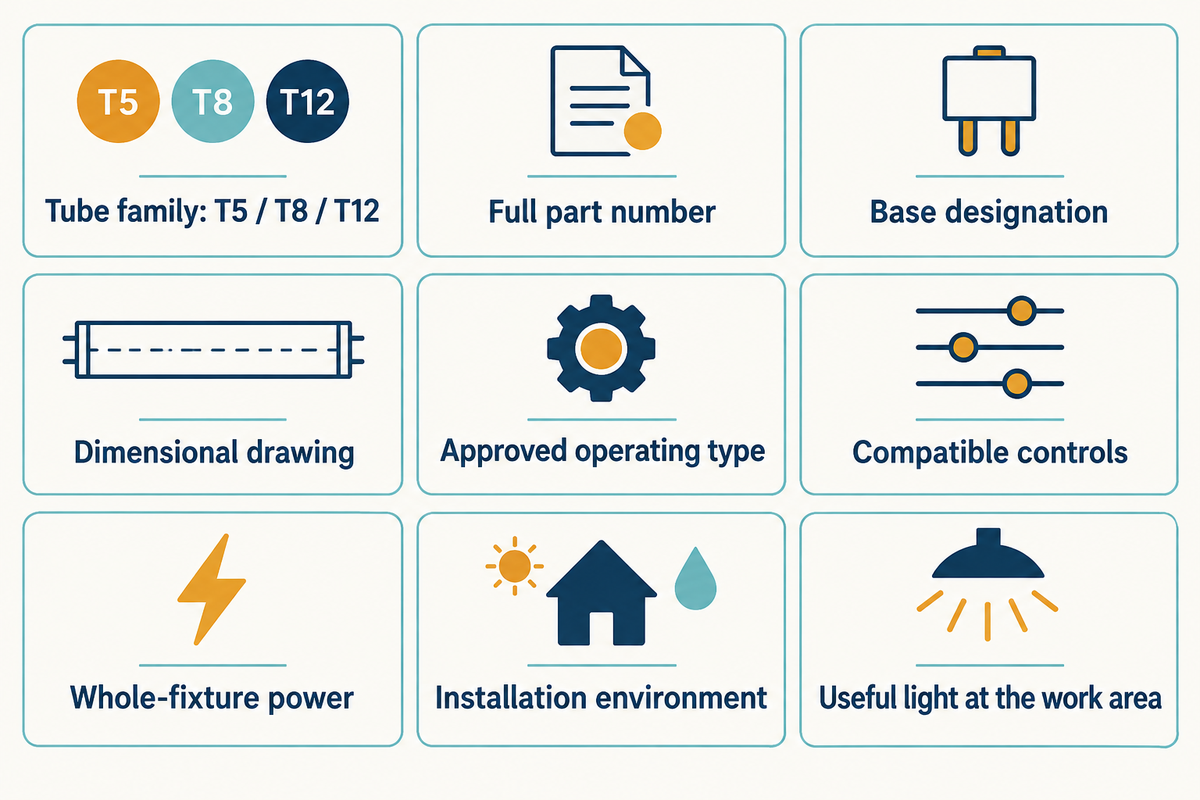
T8 tubes need to be matched to their full part number, dimensional drawing, and base designation. A label stating 2ft or 4ft is a good category for listing in a catalogue, but the drawing defines the endpoints for measurement. A body measurement can’t be checked against an overall measurement which includes the pins.
Tube identification record
A tube identification record separates the physical fit from the electrical approval needed for a replacement order.
| Specification category | What it establishes | What remains to check |
|---|---|---|
| T5: nominal 5/8 inch | Smaller diameter tube family | Exact length, cap and supported operating gear |
| T8: nominal 1 inch | Tube family, for fluorescent and LED versions | Full model, base, dimensions and electrical mode |
| T12: nominal 1.5 inches | Larger diameter tube family | Approved replacement system, even when pins fit |
| Base designation | Connection geometry, such as a G13 bi-pin base | Lamp holders, condition and electrical arrangement |
| Manufacturer’s drawing | Dimensions at specified reference points | Clearance within the actual fixture |
| Operating type | Whether the proposed lamp uses a ballast or a specified LED driver arrangement | Exact lamp and operating-gear compatibility |
| Controls | Whether the proposed product supports dimming | Approved control models and operating range |
| Whole-fixture power | Electrical input for the complete operating system | Useful light maintained at the working area |
| Installation environment | The conditions the luminaire must withstand | Suitability for dampness, dust or emergency service |
In straight replacements, the G13 base is common, but the T8 designation doesn’t encode that base. An example of this is the Philips FlexFit family of products, which includes straight G13 and U shaped products with a 2G13 base. Not every straight-tube example can establish a general rule.
The Philips CorePro 12T8/COR/48-5CCT/FF18/G/DIM data sheet shows a number of length reference points. The catalog length shouldn’t be labeled as “overall including pins.” For a cap that isn’t familiar, damaged holder, or for a measurement that isn’t certain, drawings and photographs should be sent to the supplier prior to purchasing a case of lamps.
T8 vs T12 and T5: identify first, compare second
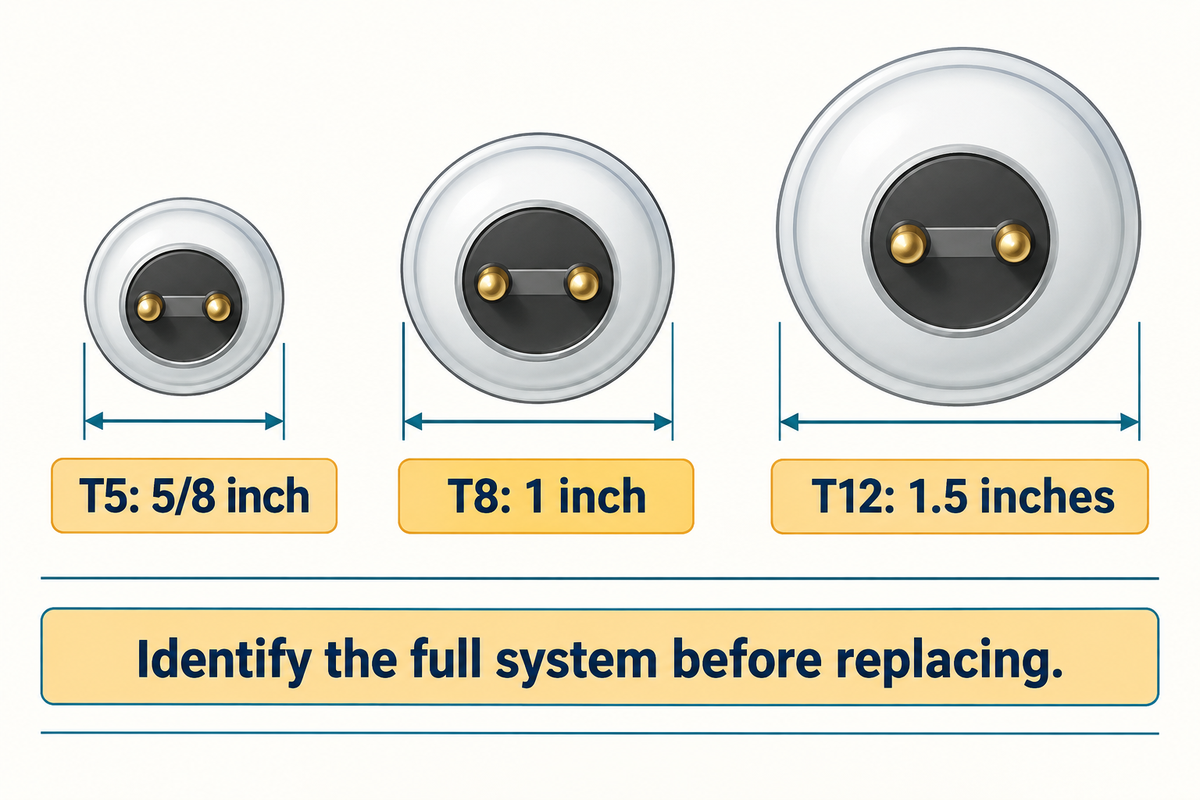
T5 and T8 differ in nominal diameter, but the smaller form factor isn’t an efficiency rating. T8 and T12 fluorescent lamps may require different types of operating gear. Replacing T12 bulbs therefore starts with the identification of the complete system, not a trial fit.
How do I know if my fluorescent bulbs are T8 or T12?
Codes printed on lamps should be read first to differentiate families, if necessary. If the marking is unclear, then the nominal diameter can be used to make a distinction. A T8 fluorescent tube is nominally 1 inch in diameter; T12 is nominally 1.5 inches. When in doubt, the full model should be compared with the documentation, as wattage and age alone won’t always verify the correct replacement.
A maintenance team may find older fluorescent lighting that has already been converted. The lamps that were installed at the time of conversion may differ from the original housing label. Look for conversion labels and records rather than assuming the fixture still has its factory wiring.
For a broader comparison of industrial lamp options, consider maintenance access, environmental conditions and mounting height. The T5 vs T8 decision is just one part of the assessment. T5 tubes and T5 bulbs should not be selected simply because their smaller diameter looks more modern.
Fluorescent T8 and LED T8 use different electrical systems
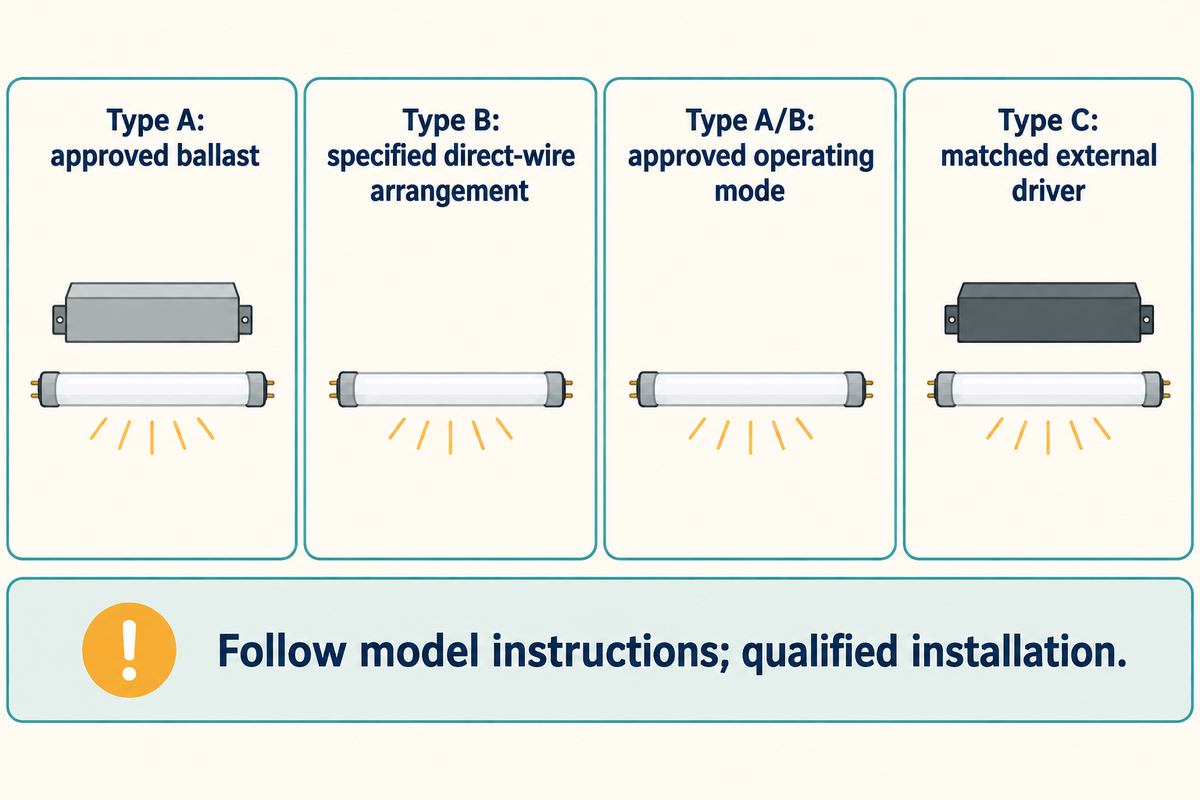
A fluorescent T8 uses a ballast to control lamp operation. An LED T8 tube uses a driver, with the required power path depending on the product type. Some replacements retain a compatible existing ballast; others require an approved conversion. The physical form factor doesn’t indicate which configuration is in use.
Can you just replace fluorescent tubes with LED?
You can replace a fluorescent tube with a suitable LED tube when the manufacturer approves the lamp and operating combination. A Type A LED replacement requires a compatible ballast. Other types require different installation arrangements. Check the precise instructions before purchasing; “fits the same socket” isn’t an adequate indication of compatibility.
| Type | Operating arrangement | Check before selecting |
|---|---|---|
| Type A, ballast compatible | Retains an approved fluorescent ballast | Exact lamp and ballast models on the applicable compatibility list |
| Type B ballast bypass | Uses the specified direct-wire arrangement | Certified retrofit application, holder requirements and installation instructions |
| Type A/B hybrid | Supports the manufacturer’s stated alternatives | Approval for the mode actually being used |
| Type C | Uses a specified external LED driver | Matched lamp, driver and controls |
Ballast bypass LED products may specify single ended or double ended wiring. Those terms represent different connection arrangements and aren’t interchangeable installation choices. Alterations should be done by a qualified electrician. A documented configuration is still required for flexible retrofit products.
UL’s retrofit guidance differentiates a standard lamp listing from a certified conversion kit. A lamp marked for one use does not automatically approve a modified luminaire.
“Always use UL Certified Retrofit Kits in accordance with their markings and installation instructions” UL Solutions.
For other functions and replacement options, see our lighting ballasts guide. Retain the approval list with the records of maintenance so that subsequent changes in lamp don’t negate the recorded conversion.
Compare LED tube light output, colour and lifespan
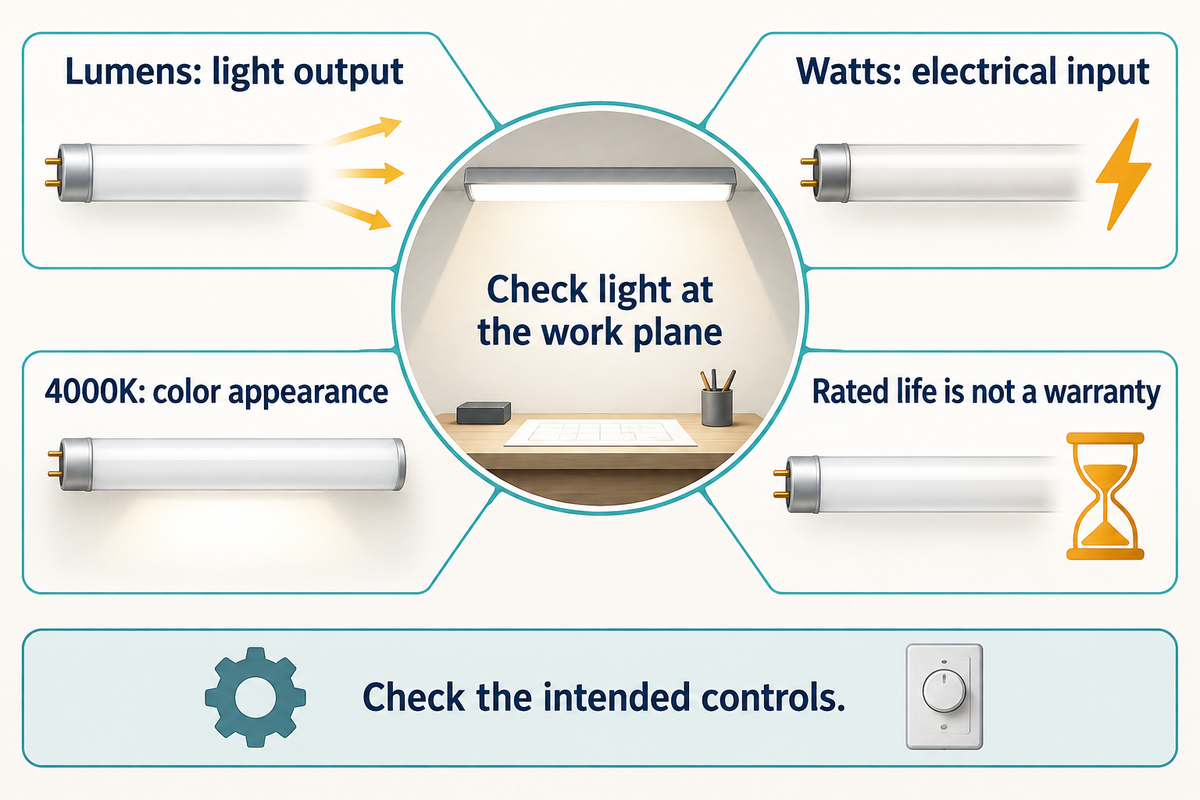
Compare light delivered to the work plane, not just the watts. A lumen measures light output; watts measure electrical input. Optics and condition of the fixture affect the usefulness of light. An LED bulb with lower power consumption may be acceptable only if the required lighting is maintained.
In a 2014 PNNL study of different troffers, the tested LED lamps improved luminaire efficiency in some housings but reduced it in recessed indirect fixtures. That historical data explains the pairing, and isn’t a comparative analysis of current products.
Use our lumens and watts comparison to evaluate how consumption and light output are distinguished. In the case of retail spaces, also consider how colors of merchandise are rendered. Color temperatures such as 4000K describe color appearance and not output. A label reading “4000K neutral white” doesn’t mean more useful light is available than a warmer alternative.
The Department of Energy’s explanation of LED life distinguishes light-output maintenance from electronics failure and colour shift. A longer lifespan claim isn’t the same as a warranty. Philips’ CorePro example lists a nominal 50,000 hours and allows for dimming only with certain dimmers; neither of those applies to all of the T8 LED bulbs.
Ask about flicker with the intended controls. The public scope of ANSI C82.77-6-2023 does not cover high-speed machine-shop stroboscopic effects or camera and barcode-scanner interference. Lighting applications in industrial settings require separate assessments. For color selection, our warm white color guide illustrates visual differences.
T8 LED replacement cost: use total fixture power
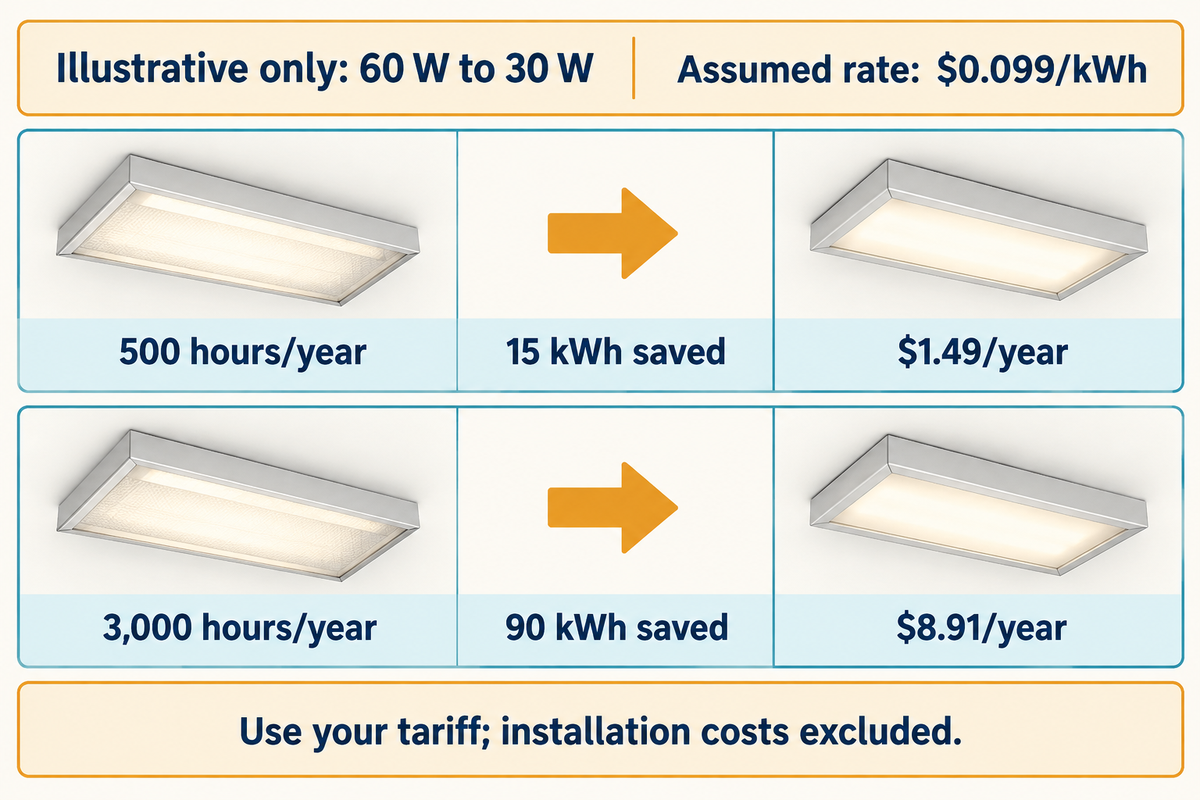
Calculate energy savings by total input power, operating hours and cost of energy of the old and new fixtures. Include any retained ballast or external driver. Then compare the energy savings with the installed cost of the fixture to determine the payback period. A lower cost tube may not be the most cost-effective choice when considering access, labour and future maintenance.
Whole-fixture energy comparison
Use total system power, operating hours and electricity cost to compare the energy component of a replacement decision.
Suppose an existing fluorescent fixture draws 60 W and a proposed replacement draws 30 W while providing the required lighting. At 3,000 hours per year and the $0.099/kWh assumption used in FEMP’s published procurement example, the calculation is: (60 − 30) ÷ 1,000 × 3,000 = 90 kWh saved; 90 × $0.099 = $8.91 per fixture per year.
| Annual operation | Old system | New system | Energy saved | Annual energy-cost saving |
|---|---|---|---|---|
| 500 hours | 60 W | 30 W | 15 kWh | $1.49 |
| 3,000 hours | 60 W | 30 W | 90 kWh | $8.91 |
Rates for electricity are from a procurement example published by FEMP . Use your own rates for purchasing decisions. Power and operating hours are fictitious.
The figures for energy are illustrative and don’t include costs of installation, disposal, financing, maintenance, and/or changes in the demand for lighting. Using less energy in a store room that’s rarely, if ever, used may generate small annual savings, even if the percentage looks significant.
According to a study by the University of Michigan on T8 lamp replacements, the best option from an up-front cost perspective may not be the best from a normalized life cycle cost perspective. It does not provide a quote for your project. To make an assessment on payback or long-term efficiency, you need to know the installed price, the conditions for downtime, and the terms for maintenance and replacement.
For retrofit projects, the lamps may not be the limiting factor; rather, it may be access to the fittings. Separate a planned lighting upgrade from an urgent failure replacement, and use the actual schedule when assessing whether the upgrade will reduce energy usage enough to justify the change.
Which brands supply T8 lamps for commercial lighting?
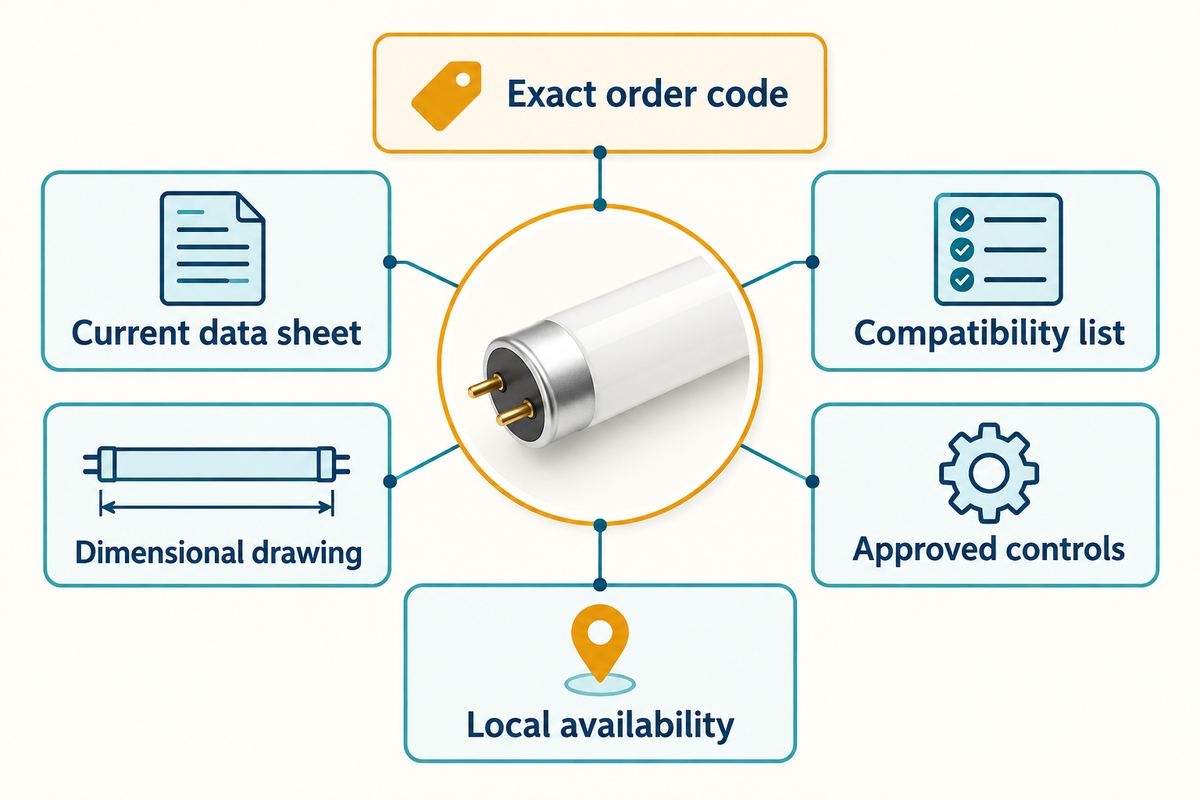
Philips and Feit Electric provided documented LED tube options. From a commercial lighting perspective, brand name products are only a starting point. Evaluate physical product features and compare warranty conditions. The right product may be an LED tube, but it may not be the case that the best known brand name product is the one specified for the installation.
Philips’ FlexFit line includes hybrid products. Feit publishes a Type A, B and AB compatibility guide. These are examples of buying documentation, and not a ranked shortlist. A “direct drive” description or a 120-277V label needs to be evaluated based on the context of that model’s instructions.
Ask each supplier to return the same information: exact order code, current data sheet, compatibility list, dimensional drawing, approved control options and local availability. For T8 LED tube lights, this allows you to compare quotes. If the project requires a completely new luminaire, compare complete LED solutions instead of replacing a tube in a broken luminaire.
Before ordering replacements for an existing fixture
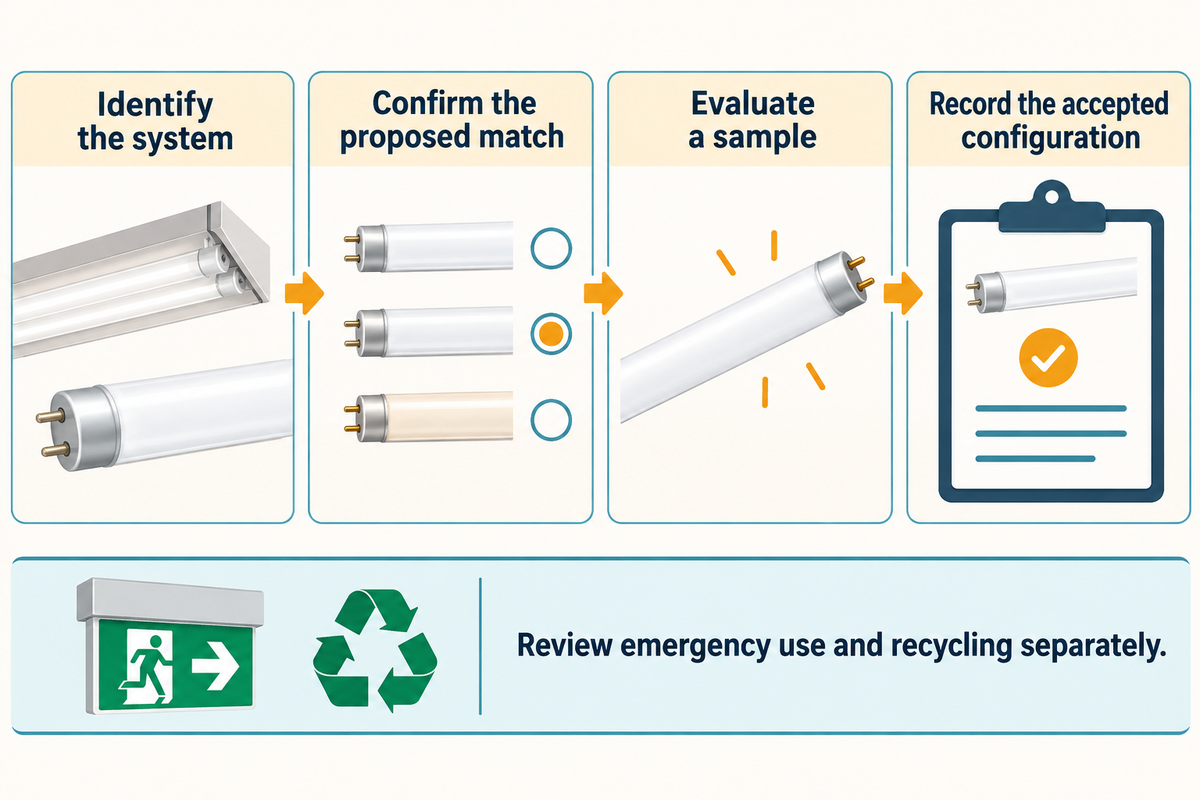
Record the current fluorescent lamp and fixture details, check records for any previous conversion, and place a bulk order only after reviewing the proposed operating arrangement and trying out a sample installation. Check the results for operation from actual working positions, i.e. for dark patches, glare, control behavior and tube behavior instead of confirming if the new tube switches on.
- Identify the system. Gather lamp codes, fixture labels, dimensions and conversion records.
- Confirm the proposed match. Obtain the manufacturer’s compatibility and installation documents.
- Evaluate a sample. Check useful light, controls and maintenance access in the intended location.
- Record the accepted configuration. Keep the order code and instructions available for future replacements.
Perform a separate review of emergency fittings. UL’s information on battery-backed tubes explains the reasoning for why an ordinary replacement-lamp doesn’t justify emergency lighting approval. Obtain documentation for that use and the installed system.
Fluorescent tubes contain mercury. Follow EPA recycling guidance and the applicable local requirements; business quantities may need a different collection route from household lamps. Verify the fixture is appropriate for a damp/dusty location with the lighting enclosure rating guide.
Key takeaway
T8 identifies a tube family. A successful replacement also needs the right dimensions, approved electrical combination and suitable light in the actual fixture.
Frequently asked questions about T8 lamps
Do T8 bulbs need a ballast?
Fluorescent versions do; LED versions depend on their operating type.
A fluorescent T8 needs a suitable ballast. A Type A LED tube also uses an approved fluorescent ballast, while Type B operates through its specified bypass arrangement. Type C uses a matched external driver. Read the exact model’s instructions before replacing anything, because the size designation alone does not identify the electrical system.
Are T8 and T12 bulbs interchangeable?
Matching dimensions or pins alone does not make them interchangeable.
Some straight tubes share a familiar base, but the lamp and operating gear must be approved together. Check the full lamp code, ballast information and any conversion labels. An older housing may already have been modified for LED operation. If the records are unclear, have the system identified before ordering replacements or trying another tube.
Are T8 LED tubes dimmable?
Only where the particular lamp, driver and controls support dimming.
Dimming depends on the product and the complete operating combination. A dimmable marking does not establish compatibility with every wall dimmer or control system. Ask for the manufacturer’s approved combinations and test the intended operating range. Check low-level behaviour as well as full output, including visible flicker, unstable starting and whether the light switches off reliably.
Is T5 or T8 better?
Neither diameter is automatically better for every application.
Choose according to the fixture and required light, not diameter alone. Compare approved operating gear, delivered illumination and system input. A different tube family may require a different fitting rather than a simple lamp swap.
Are T8 fluorescent tubes being discontinued?
Availability depends on the product and location; there is no single answer for every market.
Some jurisdictions restrict sales of certain mercury-containing fluorescent lamps. For example, Maine’s official guidance describes restrictions beginning January 1, 2026, with specialized-use exemptions. A sales restriction is different from an instruction to remove every installed lamp. The state’s listed exceptions include lamps designed and marketed exclusively for certain medical, research and other specialized uses; an exception should not be assumed for ordinary office lighting. Check the current rules and supplier availability for your location before planning replacements. If an approved fluorescent replacement is unavailable, assess an appropriate LED conversion or complete fixture replacement rather than substituting a similar-looking tube. Also arrange recycling for removed lamps. Business collection services can have different quantity and acceptance conditions from household drop-off programs.
Can I replace T8 with LED?
Yes, with a compatible product and the appropriate installation.
Match physical dimensions and the approved electrical arrangement, then check lighting performance. A compatible LED replacement can reuse a suitable fixture; damaged housings or unsuitable optics may make a complete luminaire replacement the better project to assess.
Plan a wider lighting upgrade

Review the space, mounting height and existing fittings before choosing products. Explore Guangqi Lighting’s industrial lighting options when the project needs new luminaires. For warehouse projects, use the high bay lighting selection guide to prepare requirements for light distribution, mounting and maintenance access.
The examples in this document are a combination of public, technical information and clearly labeled calculations. They’re examples of how the guidance may be implemented and aren’t Guangqi product tests, stock commitments or installation approvals. The final selection of a product depends on the product documentation and local requirements.
References and sources
- UL Solutions: LED retrofit luminaire conversion kit guidance.
- PNNL: CALiPER Report 21.2, 2014.
- US Department of Energy: LED Basics.
- University of Michigan: life-cycle cost analysis of T8 replacement options.
- ANSI C82.77-6-2023: public scope.
- UL Solutions in IAEI Magazine: emergency-lighting scope, 2020.
- EPA: recycling mercury-containing lamps.
- Maine DEP: fluorescent-lamp restrictions and recycling.